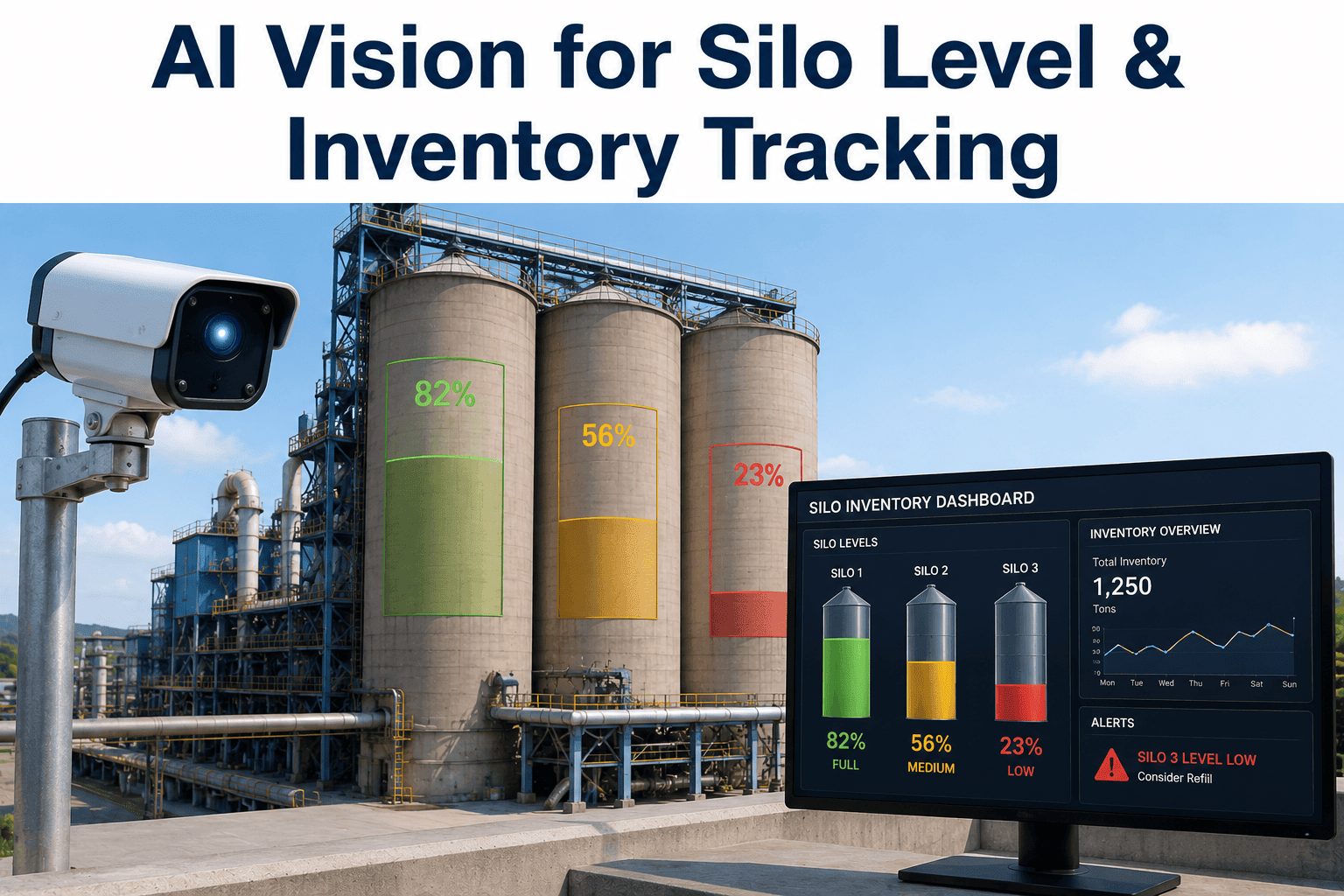
Cement silos sit at the operational center of every ready-mix, precast, and bulk cement operation — and for most plants, they are also the single largest source of inventory inaccuracy, unplanned downtime, and procurement waste. A silo that is read as 40% full by a failing pressure transducer is not 40% full. It may be 22% full with a hard pour scheduled in six hours and no purchase order raised. That is how plants run out of material in the middle of a shift. AI-powered 3D volumetric vision changes that equation entirely — not by adding another sensor to a broken measurement chain but by replacing the chain itself with a continuous, non-contact, geometry-based volume calculation that feeds directly into ERP and procurement workflows. This article covers exactly how that system works, why legacy technologies consistently fail in cement environments, what the architecture looks like from sensor to enterprise, and what the ROI case looks like for a mid-sized cement plant making the switch in 2026. Book a Demo to see how Silo Level Monitoring is done from AI Vision
Cement Silo Monitoring · AI Vision · Smart Inventory
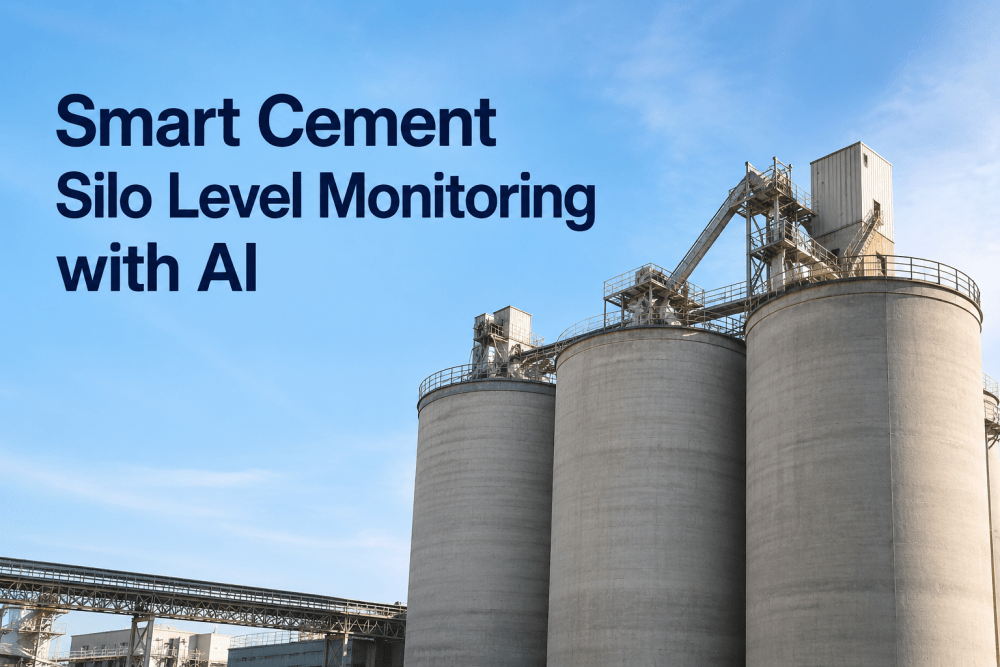
Smart Cement Silo Level Monitoring with AI Vision
Replace unreliable mechanical sensors with 3D volumetric AI vision for highly accurate, real-time cement silo level monitoring and automated ERP inventory syncing — so your plant never runs blind on bulk material.
Why Cement Silos Break Every Level Sensor You Install
Cement is not a cooperative material for measurement. It is cohesive, abrasive, variable in bulk density, prone to bridging and rat-holing, generates fine airborne dust during pneumatic filling, and produces wall vibration and temperature swings that destabilize both mechanical and electronic instruments. The result is a systematic failure cascade that every plant engineer recognizes: sensors that read correctly on commissioning day and drift into unreliability within 18–36 months, or fail outright on the next hard fill cycle.
Pressure / Load Cell
Drift Problem
Bulk density of cement varies 10–30% with moisture, aeration, and time-in-silo. Load cells measure mass — not volume. Mass-to-volume conversion errors compound with every density shift.
Typical error · ±8–15% of full scale
Ultrasonic / Radar
Surface Problem
Cement surfaces are rarely flat. Bridging, coning, and sloping surfaces return multiple reflections. High dust concentration during filling scatters ultrasonic signals. Single-point readings miss 30–50% of actual surface geometry.
Typical error · ±10–20% in active fill conditions
Mechanical Level Switch
Contact Problem
Rotating paddle and vibrating fork switches have direct contact with cement. Cement bridging around the probe gives false full readings. Fine cement dust penetrates seals and seizes moving parts within 1–3 years of service.
MTBF in cement duty · 18–36 months
Manual Dip / Visual Check
Frequency Problem
Still the primary verification method at 40–60% of cement plants globally. Requires hatch opening, confined-space risk, and produces a point-in-time reading with no continuous monitoring between checks — typically 1–2 readings per shift.
Reading frequency · 2–3 times per 12-hour shift
How 3D Volumetric AI Vision Works Inside a Cement Silo
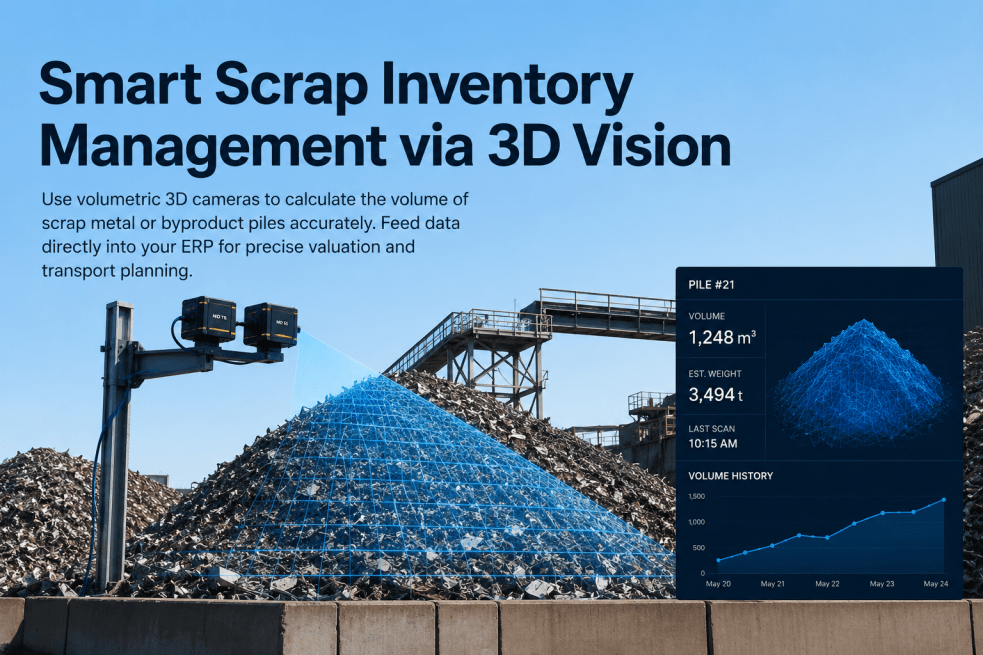
3D structured-light or time-of-flight cameras mounted at the silo apex generate a complete point cloud of the material surface on every scan cycle — typically every 30 to 60 seconds during active operations. AI processing converts the irregular surface geometry into a precise volume calculation, corrects for silo geometry deviations, and applies learned density models to produce both volume and mass estimates with accuracy that no single-point sensor can match. The entire measurement chain is non-contact, has no moving parts exposed to cement, and operates through controlled-porosity optical windows that are purged with clean air to prevent dust accumulation. Schedule a Demo to How 3D Volumetric AI Vision Works
3D AI Vision Measurement Pipeline · From Surface Scan to ERP Update
iFactory AI Architecture · Real-time processing at edge + cloud sync
01
3D Surface Scan
Time-of-flight camera generates 250,000+ point cloud per scan cycle. Full surface geometry captured — cones, voids, bridging all resolved. Scan cycle: 30–60 seconds.
Level 0 · Field Device
02
Edge AI Processing
On-device GPU applies point cloud segmentation, surface reconstruction, and silo geometry model. Volume calculated in <500ms. Dust and vibration noise filtered by AI model.
Level 1 · Edge Compute
03
SCADA / Historian
Volume, mass estimate, fill rate, draw rate, and anomaly flags published via OPC-UA to SCADA historian. Trend data enables predictive reorder modeling and bridging detection.
Level 2–3 · Control & Operations
04
ERP Auto-Sync
Inventory records updated in ERP (SAP, Oracle, others) on every fill and draw event. Purchase orders triggered automatically at configurable reorder levels. Zero manual entry.
Level 4 · Enterprise
Technology Comparison — Legacy Sensors vs 3D AI Vision
The decision to upgrade from legacy measurement is not just about accuracy. It is about the total cost of ownership across a 10-year operating life: sensor replacement cycles, maintenance labor, emergency procurement events caused by inaccurate inventory, and the hidden cost of over-ordering to buffer against measurement uncertainty. The table below compares the five dominant measurement technologies on the criteria that actually determine operating cost.
Assessment criteria: accuracy, cement-duty reliability, maintenance, and integration
Technology
Accuracy
Cement Dust Tolerance
Moving Parts
Replacement Cycle
ERP Integration
3D Surface Map
Pressure / Load Cell
±8–15%
Low — density drift
None
3–5 years
Manual export
No
Single-Point Radar
±5–10%
Medium — lens fouling
None
4–7 years
4–20mA / Modbus
No
Ultrasonic
±10–20%
Poor — dust scattering
None
2–4 years
4–20mA only
No
Mechanical Switch
Binary only
Very poor — seize risk
Yes — fails in cement
18–36 months
Alarm only
No
3D AI Vision (iFactory)
±0.5%
Excellent — air purge
None
7–12 years
OPC-UA / ERP API
Yes — full point cloud
The 6 Smart Silo Capabilities AI Vision Unlocks
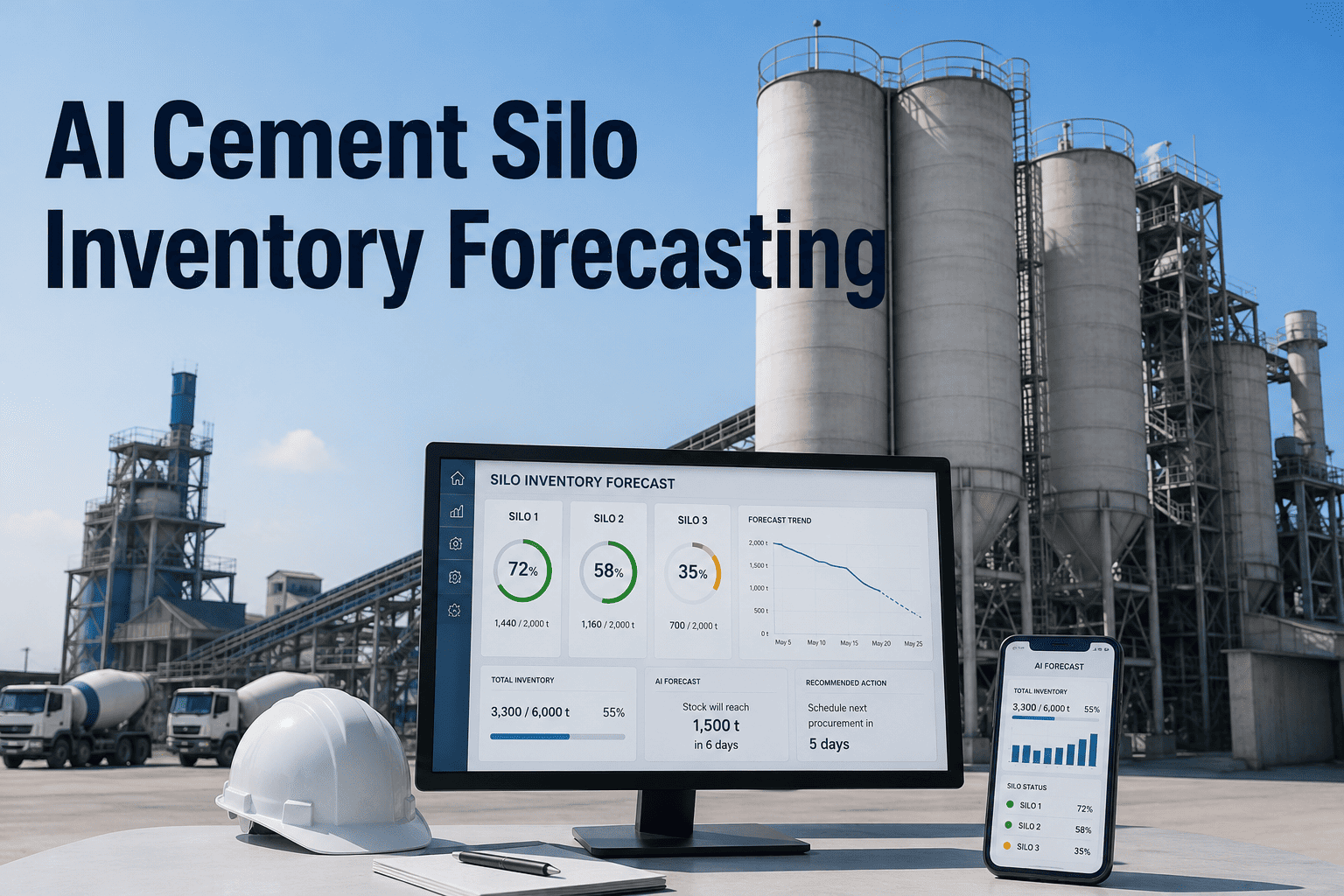
Replacing a sensor is the entry-level outcome. The more significant value comes from what AI vision enables that no legacy sensor can provide: continuous volumetric trending, anomaly detection, predictive reorder, bridging identification, fill rate verification, and digital twin integration. These six capabilities together transform a passive storage vessel into an active node in the plant's operational intelligence network.
01
Continuous Volume Trending
Every scan produces a timestamped volume record. Draw-rate curves reveal consumption patterns by shift, batch, and season. Fill-rate verification catches short deliveries automatically — no manual dip required to dispute a delivery.
Spec · 1-minute resolution volume log, 13-month rolling history
02
Predictive Reorder Engine
AI models trained on 90+ days of consumption history generate per-shift and per-day depletion forecasts. Purchase order recommendations issued when projected runout crosses a configurable horizon — typically 36–72 hours ahead of potential stockout.
Spec · Reorder alert lead time: configurable 24–96 hours ahead
03
Bridging & Rathole Detection
3D surface maps identify bridging voids and ratholing formations that do not change shape across successive scans despite reported draw. Automated alert triggers silo aeration or physical intervention before a bridge collapse event causes equipment damage.
Pre-delivery and post-delivery volume snapshots produce an audit-quality delivery record. Volume received is compared against tanker docket automatically. Short delivery detection accuracy: ±0.5 tonnes at typical bulk cement delivery volumes.
Spec · Delivery reconciliation report generated within 5 minutes of fill complete
05
Digital Twin Integration
Real-time silo inventory feeds the plant digital twin as a live data source. Production planners see accurate available cement alongside production schedule, batch demand, and delivery window — all in one operational view without switching systems.
Spec · Digital twin sync latency: <60 seconds from scan to twin update
06
ERP Inventory Auto-Update
SAP MM, Oracle, and open-API ERP platforms receive inventory updates on every significant fill or draw event — eliminating manual stock entry, GR discrepancies, and the buffer stock inflation that plants carry to compensate for measurement uncertainty.
Stop Running Blind on Bulk Inventory · See Every Tonne in Real Time
Book a Silo Vision Demo. See What AI-Grade Measurement Looks Like on Your Plant.
We will walk through your current silo configuration, measurement pain points, and ERP integration requirements — and show you exactly what the AI vision system looks like installed and running on a cement plant at your scale.
ROI Model — What the Numbers Look Like for a Mid-Size Cement Plant
The business case for AI vision silo monitoring is built on four cost reduction vectors, each of which can be quantified independently and validated against your plant's operating data. The table below models a representative mid-sized ready-mix or cement grinding plant operating 4 silos with a combined storage capacity of 1,200 tonnes and annual cement throughput of approximately 65,000 tonnes.
Annual ROI Model · 4-Silo Cement Plant · 65,000 Tonnes/Year Throughput
Model basis: iFactory deployment data 2025–2026 · Figures in USD · Plant-specific values will vary
Buffer Stock Reduction
Plants carry 8–15% extra inventory to buffer measurement uncertainty. At $95/tonne average cement cost, eliminating 60% of buffer stock on 1,200-tonne capacity frees $6,840–$17,100 in working capital annually plus reduced storage demurrage.
$8,500 – $17,000 / year
Emergency Procurement Avoidance
Average cement plant experiences 4–8 emergency procurement events annually due to stockout driven by inaccurate inventory. Emergency spot procurement premium: $12–22/tonne over contract price. At 40 tonne average emergency order size, that is $480–$880 per event.
$2,000 – $7,000 / year
Delivery Dispute Recovery
Delivery verification at ±0.5% accuracy identifies short deliveries that manual dip methods miss. Industry data suggests 1.5–3.5% short-delivery frequency at bulk cement volumes. On 65,000 tonnes annually, recovery of 0.5% shortfall at $95/tonne represents quantifiable recovery.
$3,000 – $9,000 / year
Sensor Maintenance Elimination
4-silo legacy sensor replacement + calibration labor at typical 3-year cycle: $1,200–$2,800 per sensor including technician time, confined-space entry cost, and production disruption. AI vision hardware replacement cycle: 7–12 years, optical window cleaning only.
$2,400 – $6,000 / year
Total Annual Benefit (4-silo plant)
$15,900 – $39,000 / year
Typical payback period: 18–30 months depending on plant scale and current inventory accuracy
Implementation Timeline — From Survey to Full Operation
Installing 3D AI vision on an existing cement silo fleet is a structured 5-phase process that can be executed without production interruption on most configurations. The installation access point is at the silo apex — typically a 200mm penetration — which can be scheduled during a planned maintenance window. Full commissioning including ERP integration and AI model training typically completes in 8–14 weeks depending on the number of silos and ERP complexity.
Phase 1
Weeks 1–2
Site Survey & Silo Geometry Modeling
3D laser survey of each silo to build geometry model used by volume calculation engine. Access point specification, electrical supply survey, network connectivity assessment. No production impact.
Camera unit, air purge system, edge compute module installed at silo apex during planned maintenance window — typically 4–8 hours per silo. Network connection to plant OT network established. Scan functionality validated.
Output · Hardware live, raw point cloud data flowing
Phase 3
Weeks 5–7
AI Model Training & Calibration
Volume calculation model calibrated against known fill and draw events. Density model trained using weigh-bridge cross-checks. Bridging detection model tuned to silo geometry. Parallel running against legacy sensors for validation.
Output · Volume accuracy validated at ±0.5% against reference measurements
Phase 4
Weeks 8–11
SCADA & ERP Integration
OPC-UA data published to SCADA historian. ERP inventory integration configured for automated stock updates on fill and draw events. Reorder logic and alert thresholds configured. Delivery reconciliation workflow tested.
Output · ERP inventory live, automated reorder alerts active
Phase 5
Weeks 12–14
Operator Training & Handover
Procurement, operations, and maintenance teams trained on dashboards, alert workflows, and delivery reconciliation procedures. Legacy sensors decommissioned or placed in backup standby. Full operational handover with 30-day hypercare support.
Output · Full operation, legacy sensors retired, team self-sufficient
Expert Review — What Plant Engineers Say After Deployment
We had three pressure transducer failures in 14 months on silo 2. Each time we caught the failure because the reading froze, not because of any alert. After moving to the 3D vision system, we caught a bridging event in week 3 of operation — something the old sensor would have missed entirely because the mass reading would have suggested material was still flowing. That one catch alone justified the installation cost.
Senior Plant Engineer · Cement Grinding Facility · Southeast USA
3-silo installation · iFactory AI Vision · Commissioned Q4 2025
The ERP auto-sync was what closed the business case for finance. Our procurement team was reconciling inventory manually every week — taking 3–4 hours per cycle to cross-check delivery dockets against silo readings. That process is now automated. The first short delivery we caught via the system more than covered two months of subscription cost.
6-silo installation · iFactory AI Vision + SAP MM integration · Commissioned Q1 2026
Frequently Asked Questions
Yes. The time-of-flight camera operates on near-infrared wavelengths that are less affected by fine particulate than ultrasonic or visible-light methods. Additionally, the optical window is continuously purged with clean compressed air at low volume to prevent surface fouling. The AI processing layer also applies dust-noise filtering trained specifically on cement fill conditions. Accuracy during active filling is maintained within ±1–2% versus ±0.5% in static conditions — which is still significantly better than any legacy sensor in the same conditions.
The site survey phase produces a 3D geometry model of each individual silo — including cone angles, internal supports, ladders, and any fixed equipment below the scan plane. The volume calculation engine uses this model to calculate material volume accurately regardless of geometry. Cone-bottom and hopper silos require a slight adjustment to the lower-bound volume correction but are fully supported. Silos with internal augers or central discharge cones require a geometry mask that excludes the fixed structure from the surface reconstruction — a standard configuration step at commissioning.
Native integrations are available for SAP MM (Materials Management), Oracle SCM Cloud, Microsoft Dynamics 365 Supply Chain, and Infor CloudSuite Industrial. For other ERP platforms, the system exposes a REST API and OPC-UA data stream that any ERP with a standard API or middleware can consume. iFactory has pre-built connectors for the four platforms above and supports custom integration projects for plants using regional or industry-specific ERP systems. Integration configuration is typically completed in Phase 4 of the installation timeline — weeks 8–11.
Installed cost for a 4-silo configuration typically ranges from $38,000 to $72,000 depending on silo diameter, access complexity, network infrastructure requirements, and ERP integration scope. This includes hardware, installation, commissioning, AI model training, and first-year support. The annual SaaS license for platform access, AI model updates, and cloud analytics runs separately — contact iFactory for current pricing based on your silo count and configuration. Most 4-silo installations achieve full payback within 18–30 months based on the ROI vectors modeled in this article.
Directly — no. The AI vision system measures geometry and volume, not chemical composition or hydration state. However, it does provide two indirect indicators that support age-monitoring workflows. First, the per-batch age tracking in ERP — because every fill event is timestamped and volume-recorded, the system can flag material that has been resident in the silo beyond a configurable age threshold. Second, anomalous density drift (detected via draw-rate vs. mass reconciliation) can be an early indicator of partial hydration affecting bulk flow characteristics. These flags are designed to trigger a physical sample check, not to replace ASTM C150 compliance testing.
Conclusion — The Case for Replacing Point Sensors with Volume Intelligence
Cement silo level monitoring is not a solved problem with legacy sensors. It is a permanently compromised one — where plants have accepted chronic inaccuracy, high maintenance frequency, and blind inventory as operational facts of life. 3D AI vision removes those constraints entirely. A plant that replaces pressure transducers or single-point radar with volumetric AI vision does not just get better numbers. It gets a continuous digital record of every tonne stored, drawn, and delivered — a data foundation that feeds ERP accuracy, reduces procurement risk, and catches physical anomalies like bridging before they cause unplanned downtime. The ROI case is clear, the implementation timeline is predictable, and the accuracy gap versus legacy technology is not marginal — it is an order-of-magnitude improvement on the measurement criteria that actually drive procurement and operational decisions. If your plant is still running on pressure transducers or manual dips, the question is not whether to upgrade. It is when.
Every Tonne Matters · Measure It Precisely
Ready to Replace Your Legacy Silo Sensors? Start with a 30-Minute Consultation.
Bring your silo count, current sensor setup, and ERP platform. We will show you the accuracy gap, the integration path, and the ROI model specific to your plant configuration — no obligation, no generic pitch.