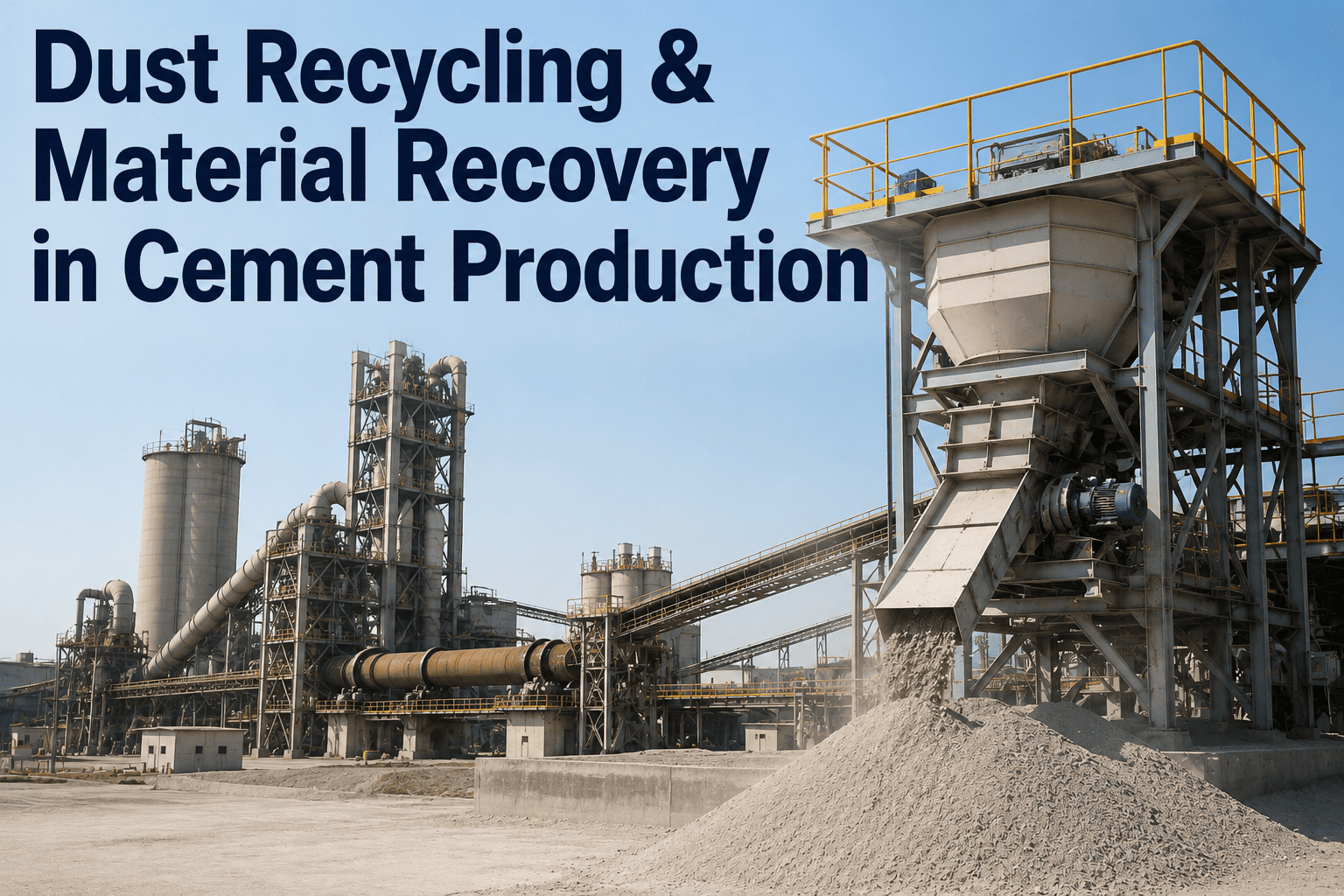
Every rotary kiln pulls a fraction of its raw feed straight back out the exhaust stack as fine particulate, and most plants treat that stream as a disposal problem instead of what it actually is — partially processed raw material sitting in a silo, still carrying calcium, silica, and reactive lime that the kiln already spent fuel to prepare. Cement kiln dust runs anywhere from 15% to 20% of total clinker output depending on kiln type and bypass configuration, and a meaningful share of it gets trucked to landfill instead of returned to the process, quietly inflating both raw material cost and landfill fees at the same time. This piece breaks down where that dust comes from, what actually limits how much of it can go back into the kiln, and how booking a demo of continuous dust stream monitoring turns a waste-management line item into a recovered-material stream.
CEMENT · DUST CONTROL · CKD RECOVERY · CIRCULAR ECONOMY
The dust your baghouse pulls out of the stack is raw material you already paid to process once.
Cement kiln dust is not one uniform waste stream — it is at least three chemically distinct streams, and only some of them can safely go back into the kiln. Knowing which is which is the difference between a recovered feed source and a landfill bill that keeps growing.
15–20%
Typical CKD generation rate as a share of total clinker production.
16%
Approximate maximum share of raw feed weight that treated CKD can safely replace.
0.6%
Common target ceiling for equivalent alkali content in finished clinker.
90%
Volatilization rate a bypass system needs to hold alkali and sulfur within spec.
Three streams, three different chemistries
Not all dust captured off a kiln system is the same material, and treating it as one homogeneous stream is the single biggest reason plants under-recover. The extraction point determines the chemistry, and the chemistry determines what the dust can safely become next — which is why a single plant-wide recirculation percentage almost always leaves either recoverable material on the table or a quality risk building quietly in the raw mix.
S-01
Preheater and Precalciner Dust
Captured before the burning zone, this stream is closest in composition to raw meal and generally carries the lowest alkali and chloride load, making it the easiest to return directly to the raw mill.
S-02
Alkali Bypass Dust
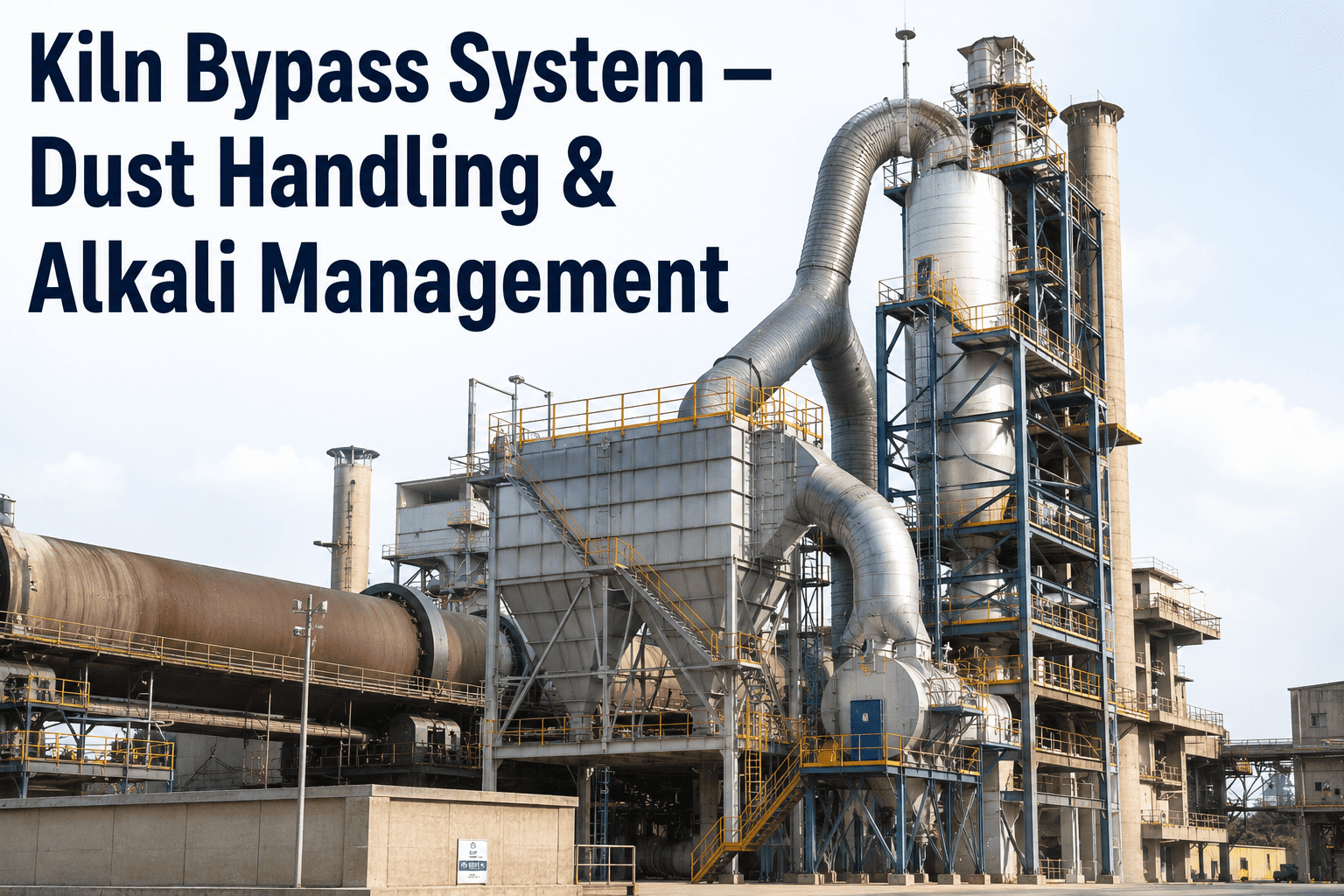
Extracted specifically to pull volatile alkalis, chlorides, and sulfates out of the kiln gas loop, this stream concentrates exactly the compounds a plant is trying to remove, and cannot go straight back to the kiln without treatment.
S-03
Clinker Cooler and Finish Mill Dust
Finer, more processed material with a composition closer to finished cement, better suited to blending applications than to reintroduction as raw kiln feed.
S-04
Mixed Baghouse Collection
Where multiple extraction points feed a single collection system, dust arrives as a blend, and its recovery path has to be decided by testing the blend rather than assuming any single source's chemistry.
The alkali ceiling that decides how much dust can go back to the kiln
The reason plants cannot simply return 100% of collected dust to the raw mill comes down to one constraint: alkali and chloride buildup. Every recirculation cycle concentrates these compounds further, and past a certain point they start attacking product quality and kiln refractory rather than just adding cost.
| Dust Stream | Typical Alkali/Chloride Load | Direct Recirculation Limit | Recommended Path |
| Preheater Dust |
Low to moderate |
Up to roughly 16% of raw feed weight |
Direct return to raw mill |
| Alkali Bypass Dust |
High, 6–15% total alkali as Na2O |
Effectively none without treatment |
Leaching or external reuse |
| Clinker Cooler Dust |
Low |
Blendable into clinker at low percentages |
Clinker blending or cement addition |
| Mixed Baghouse Dust |
Variable, depends on blend ratio |
Case by case, requires lab testing |
Test before assigning a path |
Know which dust stream is safe to recirculate before it becomes a quality problem
iFactory tracks extraction-point volumes and flags when recirculated dust is pushing alkali or chloride levels toward the ceiling your raw mix can tolerate.
Treatment methods that unlock the alkali-bypass stream
Bypass dust does not have to end up in a landfill just because it cannot be returned untreated. Several established treatment routes strip out the problem compounds and open up a return path, though each comes with its own equipment and cost profile.
01
Water Leaching
Washing the dust with water dissolves soluble alkali, chloride, and sulfate salts, which are then separated from the solids, leaving a calcium-rich residue suitable for return to the kiln feed.
02
Air Classification
Since chloride concentration correlates with particle size, separating dust by particle fraction isolates a smaller, more contaminated fine fraction from a larger fraction clean enough to recirculate directly.
03
Ion-Exchange Recovery
Leaching solutions can be passed through ion-exchange systems to recover reusable process water and concentrate the removed salts into a smaller waste volume, cutting overall disposal cost.
04
Pelletizing or Granulation
Compacting fine dust into pellets or nodules makes it suitable for fluid-bed calcining or direct kiln feed, since loose fine dust otherwise carries and re-elutriates rather than processing cleanly.
Where treated dust goes when it does not go back to the kiln
Not every tonne of CKD needs to end up as kiln feed to count as recovered material. A growing set of external applications gives plants a productive destination for dust that would otherwise sit in a landfill, turning a disposal cost into a byproduct sale.
Soil Stabilization
The high lime content in CKD makes it effective for stabilizing soft soils in road construction and earthworks, a well-established secondary market for plants near infrastructure projects.
Supplementary Cementitious Blending
Lower-alkali dust fractions can be blended into finished cement at controlled percentages, extending clinker supply without a corresponding increase in raw material extraction.
Building Material Substitution
Bypass dust has been used to partially substitute clay in fired products such as roof tiles, giving a disposal-cost stream a second life as feedstock for another industry entirely.
Flue Gas Desulfurization Sorbent
The reactive lime phase in CKD performs as an SO2 sorbent in wet scrubbing systems, sometimes outperforming standard limestone sorbents due to its finer particle distribution.
The economics of recovery versus disposal
Every tonne of dust sent to landfill is a tonne of raw material re-purchased and a landfill or hauling fee paid on top of it. Framed as a single line item, dust disposal looks like an unavoidable cost of operating a kiln; framed as a material balance, it is usually the largest unclaimed savings opportunity on the raw materials side of the plant, and one that rarely gets revisited once the original disposal contract is signed.
01
Avoided Raw Material Cost
Every tonne of preheater dust returned directly to the raw mill is a tonne of limestone, clay, or other raw feed that does not need to be quarried, crushed, and transported.
02
Avoided Landfill and Hauling Fees
Landfill tipping fees and transport costs for bypass dust scale with volume, and both are rising as disposal capacity tightens and carbon-related costs get layered onto waste disposal.
03
Byproduct Revenue
Soil stabilization, cement blending, and building-material applications can turn what was a disposal cost into a byproduct sale, even at modest per-tonne pricing.
04
Treatment Cost as an Investment, Not an Expense
Leaching or air classification equipment carries upfront cost, but where bypass volume is high enough, the combination of avoided disposal fees and recovered feed value typically pays that back within a few years.
Why plants recover less dust than they could
Most plants are not recovering zero dust — they are recovering some, usually whatever fraction fits an old rule of thumb set years ago and never revisited. The gap between that legacy rate and the true safe recirculation ceiling is where most of the unclaimed savings sits, and it usually comes down to one of a handful of recurring gaps rather than any single big mistake.
Recirculation Rate Set Once and Never Revisited
A rate chosen years ago under a different fuel mix or raw material source often no longer matches current alkali and chloride levels, leaving safe recovery headroom unused or, in some cases, quietly exceeding a rate that is no longer appropriate.
No Segregation at the Collection Point
Where preheater and bypass dust are captured through a shared collection system, the cleaner fraction inherits the contamination limits of the dirtier one, closing off a direct-return path that segregated collection would have kept open.
Treatment Written Off Without a Current Cost Model
Leaching or air classification is sometimes ruled out based on an outdated cost comparison, before landfill fees and raw material prices rose to the point where the economics of treatment shifted in its favor.
No Ongoing Composition Testing
Fuel mix changes, raw material source changes, and production rate shifts all change dust composition, and a recovery plan built on a single historical lab test drifts out of date faster than most plants revisit it.
Building a recovery program that holds up over time
A durable dust recovery program is less about a one-time engineering study and more about an ongoing operating discipline, since composition, volume, and disposal costs all shift over the life of a plant. The sequence below is how plants that sustain a high recovery rate actually run it.
01
Segregate Streams at Every Collection Point
Keep preheater, bypass, and clinker cooler dust in separate collection paths wherever the baghouse configuration allows it, preserving the option to route each stream to its highest-value use.
02
Test Composition on a Standing Schedule
Recheck alkali, chloride, and sulfate content on a recurring basis rather than a one-time baseline, so a fuel or raw material change is caught before it silently exceeds the safe recirculation rate.
03
Revisit the Cost Case Annually
Landfill fees, raw material prices, and byproduct market demand all move independently, so a treatment investment that did not pencil out three years ago may clear the bar today.
04
Track Extraction Volumes Continuously
Knowing how much dust each extraction point generates day to day, not just as an annual total, is what makes it possible to size treatment equipment correctly and negotiate byproduct offtake agreements with confidence.
Frequently asked questions
How do we know how much of our collected dust can safely go back into the kiln?
The safe recirculation rate depends on the alkali and chloride load of the specific extraction point, not a single plant-wide number. Preheater dust with a low alkali load can often be recirculated at a much higher rate than bypass dust drawn specifically to remove those compounds. Lab testing of each stream, combined with tracking the equivalent alkali level in finished clinker against the plant's quality target, is the only reliable way to set a recirculation rate that does not quietly degrade product quality.
Contact our support team to review your extraction points against a recirculation plan.
Is it worth investing in leaching or air classification equipment for a smaller plant?
The payback depends heavily on bypass dust volume, local landfill and hauling costs, and how much raw material cost is currently being lost. For a plant with a small bypass stream and low local disposal fees, treatment equipment may not clear the investment bar. For a plant with a large bypass ratio and rising landfill costs in its region, even a simple air classification step can pay for itself by unlocking direct recirculation of the cleaner fraction alone.
Book a demo to model the recovery economics against your own dust volumes.
Can dust from different extraction points be combined before deciding on a recovery path?
Combining streams before testing is one of the most common reasons recovery programs underperform, since a small volume of high-alkali bypass dust can push an otherwise clean preheater stream over its recirculation limit once blended. Keeping streams segregated at collection, even if they are recombined later for a specific application, preserves the option to send each stream down its highest-value path rather than defaulting everything to the lowest common denominator.
Contact our support team to review your current collection and segregation setup.
Does recirculating dust affect clinker quality?
It can, if alkali and chloride levels are not actively managed against the recirculation rate. Alkalis concentrated by repeated recirculation can react with aggregates in finished concrete over the long term, and excess chloride contributes to kiln ring formation and refractory wear. This is why most quality specifications set a ceiling on equivalent alkali content in clinker, and why recirculation rates need to be tracked continuously rather than set once and left alone.
Book a demo to see continuous alkali tracking against your clinker quality targets.
What is the difference between CKD and alkali bypass dust?
CKD is the general term for particulate carried out of the kiln system by exhaust gases, captured across any collection point in the process. Alkali bypass dust is a specific subset, extracted deliberately at a dedicated bypass duct designed to pull volatile alkali, chloride, and sulfate compounds out of the kiln gas loop before they concentrate further inside the system. All bypass dust is CKD, but not all CKD is bypass dust, and the distinction matters because the two streams need very different treatment before reuse.
Contact our support team to clarify which streams your current collection system is generating.
Turn a landfill line item into a tracked, recovered material stream
iFactory monitors dust extraction volumes and composition trends across every collection point, so recovery decisions are made on data instead of defaulting every stream to the safest, lowest-value path.