Cement laboratories operate under a unique set of pressures that most generic laboratory information management systems were never designed to handle. From tracking raw material variations across multiple quarries to maintaining compliance with IS, EN, and ASTM standards simultaneously, the requirements of a cement lab extend far beyond what a standard LIMS delivers out of the box. Selecting the wrong vendor means months of customization, frustrated lab technicians, and a system that still requires manual workarounds for tasks it should automate. Understanding exactly what to evaluate before signing a contract is what separates a smooth implementation from a costly one, and you can explore how iFactory approaches cement-specific LIMS by choosing to book a demo with our team.
DIGITAL LIMS · CEMENT INDUSTRY · VENDOR EVALUATION
Best LIMS for Cement Plants: How to Evaluate Vendors Without Getting Locked Into the Wrong System
Most cement plants that regret their LIMS purchase realize within the first three months that the system cannot handle the one thing they needed it to most. iFactory builds its LIMS module around cement-specific workflows so nothing gets missed during vendor evaluation.
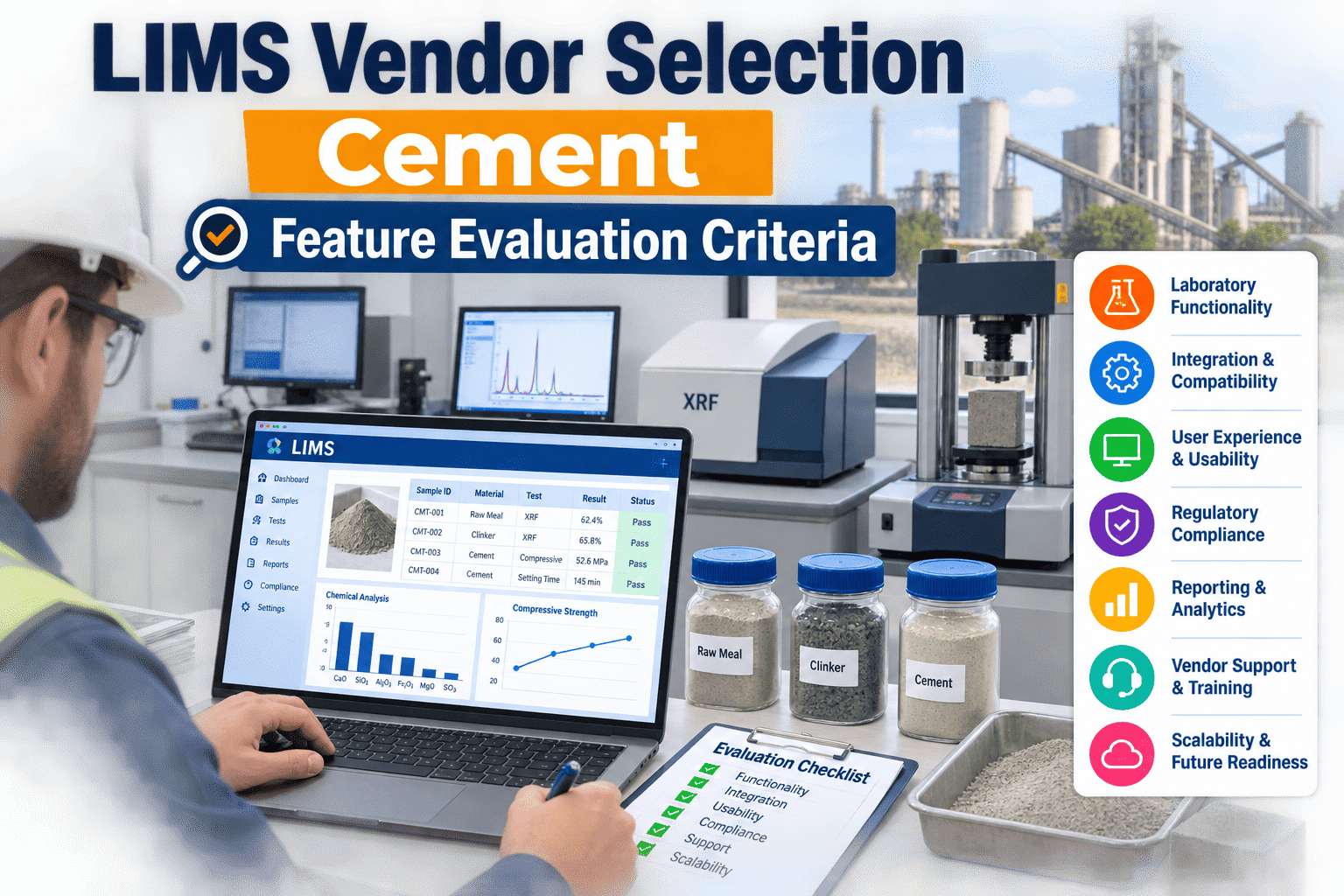
CEMENT LABS EVALUATE VENDORS ON THESE 6 DIMENSIONS
Cement-specific test methods
Instrument integration depth
Multi-standard compliance
Sample lifecycle tracking
CoA generation speed
Deployment flexibility
CEMENT-SPECIFIC REQUIREMENTS
Six Areas Where Cement Labs Demand More Than a Standard LIMS Can Deliver
Generic LIMS platforms are built to serve pharmaceutical, food, or environmental laboratories where a sample enters, gets tested, and leaves. Cement laboratories do not work that way. A single limestone sample might trigger chemical analysis, then feed into a raw mix calculation, then reappear as part of a clinker evaluation days later, and finally show up in a finished cement grade compliance report. That continuity across production stages is the core reason off-the-shelf LIMS products struggle in cement plants without heavy and expensive customization.
Every additional area below that a vendor cannot demonstrate natively during the evaluation stage translates directly into either a custom development cost, a manual workaround that defeats the purpose of automation, or both. The evaluation process should treat these six areas as non-negotiable verification points rather than nice-to-have features that can be added later, because later almost always means never within the original budget.
01
Raw Material Sampling and Quarry Variation Tracking
Cement plants draw limestone, clay, bauxite, and iron ore from multiple benches within the same quarry, and each bench carries a different chemical signature. The LIMS must be able to register samples against specific quarry locations, track compositional shifts over time, and feed that data into raw mix proportioning calculations without manual spreadsheet transfers between systems.
02
Clinker Phase Analysis and Kiln Feed Optimization
XRF and XRD data from clinker samples must flow directly into the LIMS and connect to kiln feed adjustments. A system that cannot ingest instrument output in real time or cannot store historical clinker phase data alongside corresponding kiln operating conditions forces the lab to maintain parallel records outside the LIMS, which is exactly the workflow problem the system was supposed to eliminate.
03
Fineness, Setting Time, and Strength Testing Integration
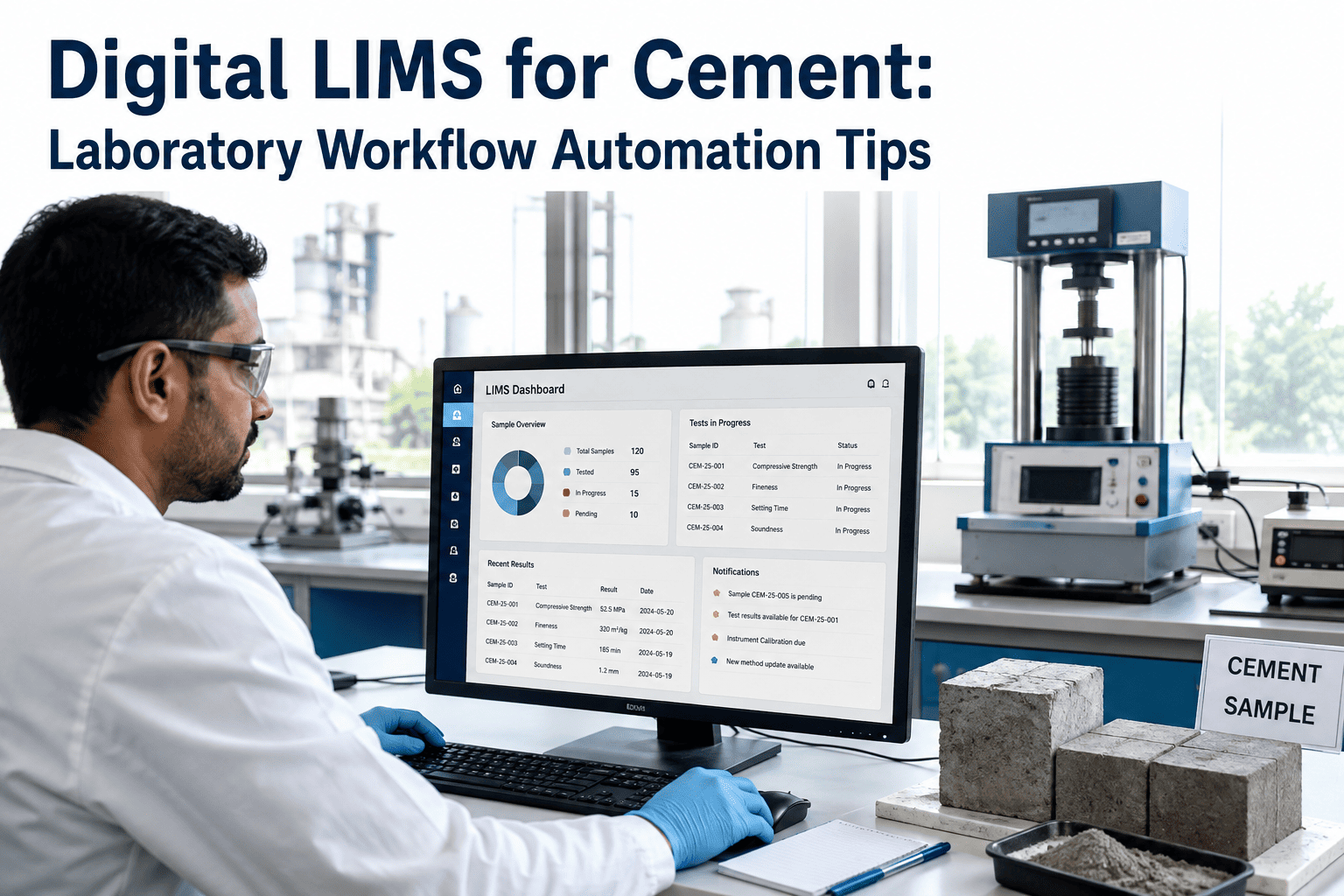
Physical testing in cement labs follows a time-dependent sequence where 1-day, 3-day, 7-day, and 28-day strength results accumulate over a month for a single batch. The LIMS must hold partial results, flag missing test dates, and auto-calculate grade compliance only when all required ages are complete, rather than treating each strength test as an isolated data point unrelated to the others.
04
Multi-Standard Compliance Engine
A cement plant in India might produce under IS 269 for OPC 33, IS 8112 for OPC 43, IS 12269 for OPC 53, and also export under EN 197 or ASTM C150 depending on the customer. The LIMS must hold multiple standard specifications simultaneously, apply the correct limits based on the target grade and market, and flag out-of-spec results against the right standard without the lab technician manually selecting which rule set to apply each time.
05
Batch and Blend Tracking Across Production Stages
Cement production is a continuous process, but quality control treats it as a series of discrete batches and blends. The LIMS must link raw material batch results to the corresponding kiln feed batch, then to the clinker batch, then to the finished cement batch, maintaining full traceability without requiring the operator to manually stitch together records from different production stages every time a customer or auditor asks for batch history.
06
Certificate of Analysis and Customer-Specific Reporting
Different customers often require different test parameters on their certificates, different formats, different languages, and different levels of detail from the same batch of cement. A LIMS that generates only one fixed CoA template per grade forces the commercial team to manually edit certificates for each customer, introducing errors and delays that a proper template engine should prevent entirely.
VENDOR SELECTION METHODOLOGY
The 8-Point Framework That Separates a Thorough LIMS Evaluation From a Guess
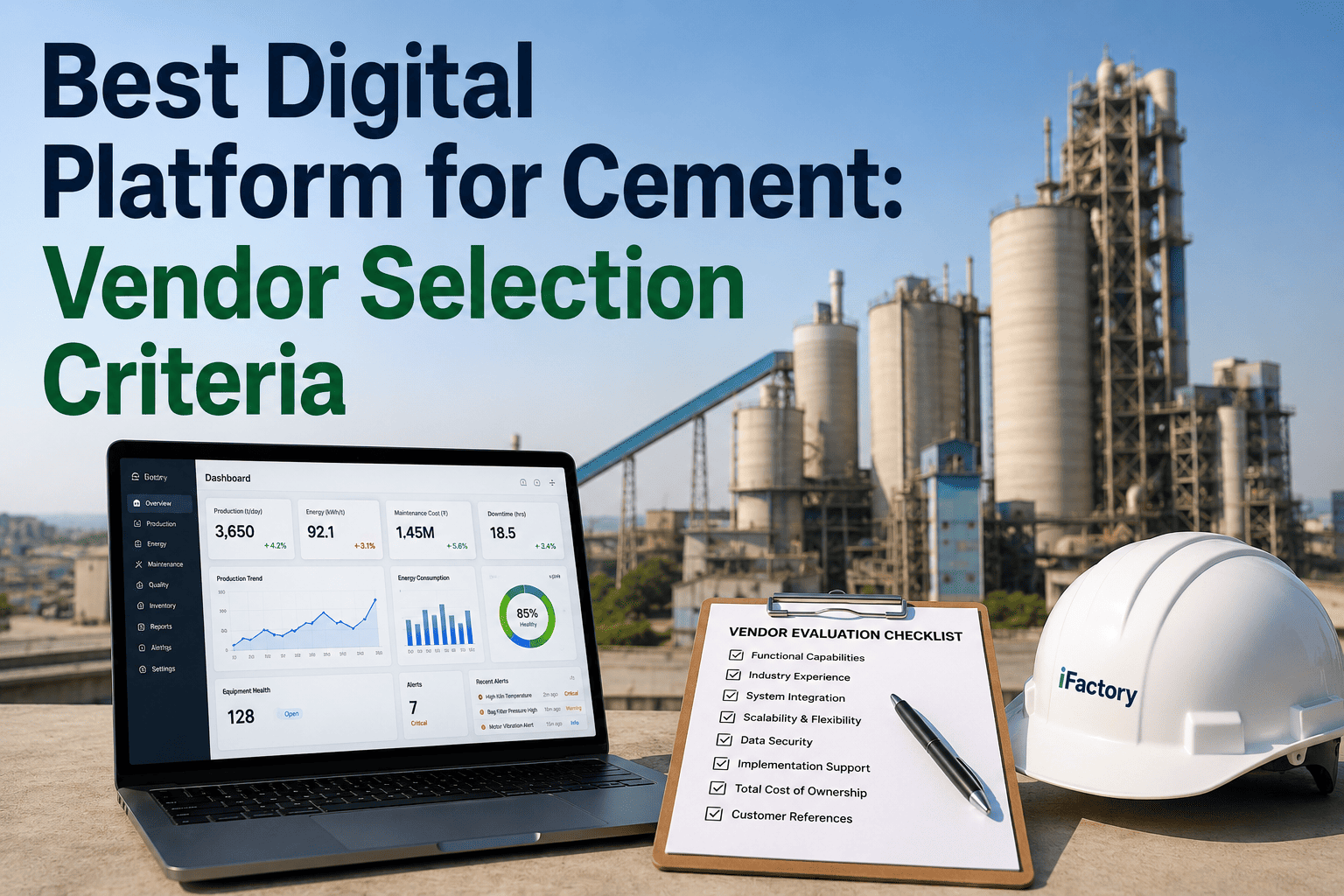
Most cement plants evaluate LIMS vendors by watching a demo, asking about price, and checking a few reference accounts. That process might work for commodity software, but a LIMS that will manage every quality decision in the plant for the next seven to ten years deserves a structured evaluation that tests the vendor against concrete criteria rather than subjective impressions from a polished presentation. The framework below is designed to be used as a scored evaluation sheet where each criterion gets a weight based on your plant's specific priorities and each vendor gets a score that can be compared objectively.
The reason this structure matters is that vendors are very good at demonstrating the features they know you will ask about while quietly avoiding the areas where their product is weak. A scripted demo will always look capable. What reveals the real gaps is asking the vendor to walk through a specific scenario from your own lab, such as how their system handles a 28-day strength result that arrives late and needs to retroactively update a batch compliance status that was already tentatively cleared at the 7-day mark. That single scenario tests sample lifecycle management, auto-recalculation, compliance engine behavior, and notification workflows all at once, and it is exactly the kind of test most plants never think to run during evaluation.
1
Cement-Specific Test Method Library
Verify that the system ships with pre-built test methods for common cement analyses including XRF chemical composition, Blaine fineness, Vicat setting time, Le Chatelier soundness, and compressive strength at multiple ages. If the vendor says these can be created manually, ask how many cement plants have already done that work and whether those configurations are shared across customers or rebuilt from scratch each time.
2
Instrument Integration Depth
Request a list of cement lab instruments the system has direct connectors for, not just generic CSV import capability. XRF spectrometers, XRD units, particle size analyzers, and automatic Blaine apparatus each produce data in different formats, and a LIMS that requires manual export-import steps for any of them will immediately create the parallel workflow problem you are trying to solve. Ask specifically about the integration method, whether it is real-time push, scheduled pull, or file-based, because that distinction determines how current the data in the LIMS actually is.
3
Sample Lifecycle Management
Test whether the system can track a single sample as it moves through multiple test stages over days or weeks, holding partial results, triggering pending test reminders, and auto-calculating final compliance only when all required tests are complete. Many LIMS platforms treat each test as an independent event, which works in pharma but breaks completely in cement where a batch result depends on tests performed across an entire month.
4
Regulatory Compliance Engine
Confirm that the system can hold multiple cement standards simultaneously and automatically apply the correct specification limits based on the grade being produced and the destination market. Ask what happens when a result falls between two standard specifications, how the system handles standard revisions when a new version of IS or EN is published, and whether compliance rules are configured by the vendor or by your lab team.
5
Reporting and Certificate of Analysis Generation
Ask to see the CoA template editor in action, not just a pre-built certificate. The real test is whether a non-technical lab supervisor can create a new customer-specific template without calling the vendor or writing code. Also verify whether the system can auto-generate CoAs the moment all required results are approved, or whether someone has to manually trigger certificate creation for each batch.
6
Deployment Flexibility
Determine whether the vendor offers cloud, on-premise, and hybrid deployment options, and what the actual trade-offs are for each in a cement plant environment where internet connectivity at the quarry or at remote grinding units may be unreliable. A cloud-only system that becomes unusable when the plant internet drops during a monsoon is not deployment flexibility, it is a deployment risk that was not disclosed during the demo.
7
Vendor Support and Implementation Track Record
Ask for the names of at least three cement plants where the vendor has completed a full implementation, not just a pilot. Then ask what went wrong during those implementations and how long it took to resolve. Vendors who can only describe smooth rollouts either have not done enough of them or are not being honest about the challenges, and both are red flags when you are about to commit your lab operations to their platform for the better part of a decade.
8
Total Cost of Ownership and Scalability
Request a five-year cost projection that includes license fees, implementation services, custom development, annual maintenance, support tiers, upgrade costs, and any per-user or per-instrument charges that scale with your operation. The vendor with the lowest year-one price almost never has the lowest five-year cost, and discovering that difference after year two when additional users, instruments, or plant sites need to be added is the most common budget surprise in LIMS procurement.
Evaluate iFactory Against Your Cement Lab Requirements Before You Shortlist Vendors
iFactory's LIMS module is built from the ground up for cement workflows. Book a focused evaluation session where we walk through your actual lab scenarios, not a generic slide deck.
FEATURE EVALUATION MATRIX
What to Verify in Every Cement LIMS Demo, Organized by Priority
The table below is designed to be printed and used as a live scoring sheet during vendor demonstrations. Each row represents a capability that should be demonstrated with your own lab data, not the vendor's sample dataset. Mark each cell with a score during the demo and compare vendors afterward. The three priority columns reflect how the feature should be weighted: Must Verify means the system is unusable without it, Should Verify means its absence creates significant manual work, and Good to Have means it provides convenience but not a critical gap.
Most vendors will score well on the Must Verify column because those are the features every LIMS demo is designed to showcase. The real differentiation appears in the Should Verify column, where gaps reveal whether the vendor truly understands cement workflows or is selling a horizontal platform that happens to have a few cement customers. Pay close attention to any feature where the vendor says it is on the roadmap rather than available today, because roadmap features in LIMS procurement have a track record of arriving two to three years late or not at all.
DEPLOYMENT CONSIDERATIONS
Cloud, On-Premise, or Hybrid: Which Deployment Model Fits Your Cement Plant
Deployment model is one of the earliest decisions in a LIMS procurement, and it is also one of the most frequently reversed after go-live when plants discover that the model they chose does not match their actual operating environment. The decision should be driven by three concrete factors: the reliability of internet connectivity at every location where the LIMS will be used, the plant's data residency and security policies, and the internal IT team's capacity to manage infrastructure. Any vendor who recommends a deployment model without first assessing these three factors is solving their own convenience problem, not yours.
The most common mistake is choosing cloud because it is cheaper in year one without accounting for what happens when the internet drops during a critical clinker analysis window, or choosing on-premise because of a vague security concern without accounting for the server maintenance, backup management, and upgrade effort that the internal IT team will absorb for the entire life of the system. The hybrid model exists precisely because most cement plants have a headquarters or main lab with good connectivity and satellite locations like quarries or grinding units that do not, and pretending that one-size-fits-all works for deployment is as inaccurate as pretending it works for test methods.
CLOUD
Best For Multi-Plant Operations With Reliable Connectivity
Lowest upfront investment, predictable subscription cost
Automatic updates and patch management handled by vendor
Centralized data access across all plant locations
Risk: becomes unusable during internet outages
Risk: data resides on vendor servers, may conflict with internal policies
ON-PREMISE
Best For Plants With Strict Data Residency Requirements
Full control over data location and backup strategy
No dependency on internet availability for daily operations
Can integrate deeply with on-site plant control systems
Risk: higher upfront cost for servers and infrastructure
Risk: internal IT team bears ongoing maintenance and upgrade burden
HYBRID
Best For Plants Transitioning or With Mixed Connectivity
Core LIMS runs locally at main lab, remote sites sync when connected
Keeps critical lab operations running during connectivity drops
Allows gradual migration from legacy systems or manual processes
Risk: data sync conflicts if same record is edited in multiple locations
Risk: more complex to configure and validate during implementation
AVOID COMMON TRAPS
Five Mistakes That Turn a LIMS Purchase Into a Multi-Year Problem for Cement Plants
Every failed LIMS implementation in the cement industry traces back to one or more of the mistakes below. They are not technical failures in most cases. They are procurement and planning failures that set the project up to struggle before a single line of configuration is written. Recognizing these patterns before you start the vendor selection process is the most effective way to avoid becoming someone else's cautionary case study at the next industry conference.
1
Evaluating LIMS as If It Were ERP Software
ERP systems manage transactions, inventory, and finance. LIMS manages scientific data, test methods, sample lifecycles, and regulatory compliance. The evaluation criteria for these two categories of software are fundamentally different, and a procurement team that applies ERP selection methods to a LIMS purchase will end up scoring vendors on the wrong dimensions. They will compare pricing models and integration breadth while missing whether the system can actually handle a 28-day strength test sequence or hold multiple cement standards simultaneously, which are the capabilities that determine whether the LIMS works in a cement lab at all.
2
Skipping a Formal Requirements Document Before Vendor Talks
Walking into vendor discussions without a written requirements document means the vendor controls the conversation. They will show you what their system does well and steer away from what it does poorly, and without a structured list of your own requirements to reference, you will have no way to redirect the conversation back to the gaps that matter. The requirements document does not need to be a hundred-page specification, but it needs to list every test method your lab performs, every instrument that needs to connect, every standard you report against, and every certificate format your customers require, because those are the exact things a demo should be forced to address.
3
Not Verifying Cement-Specific Test Methods During the Demo
Many LIMS vendors will demonstrate a general-purpose test workflow and then claim that cement-specific methods can be configured. The critical question to ask is whether those configurations already exist for other cement customers and can be activated for your plant, or whether your implementation team will be building them from scratch. Building a Blaine fineness test method or a 28-day strength tracking workflow from a generic template looks simple in a demo but takes weeks of configuration, testing, and validation in practice, and that effort is almost never included in the initial implementation quote.
4
Underestimating the Integration Effort With Existing Instruments
Every LIMS vendor claims instrument integration, but the depth of that integration varies enormously. A system that can import a CSV file exported from your XRF is technically integrated, but it requires a lab technician to manually export and upload that file every time, which is not automation, it is a digital version of the same manual step. True integration means the instrument pushes data directly into the LIMS sample record without human intervention, and verifying that this works with your specific instrument models, firmware versions, and data output formats during the demo phase is the only way to avoid discovering the gap during implementation when the vendor's hourly rate is already on the clock.
5
Choosing Based on Price Per Seat Instead of Total Cost of Ownership
The lowest bid in a LIMS procurement rarely accounts for the full cost of making the system operational in a cement plant. Custom development for missing cement workflows, additional integration work for instruments not on the vendor's standard connector list, extended implementation timelines caused by gaps discovered during configuration, and ongoing support costs for a system that requires more manual workarounds than expected all add up to a total cost that can be two to three times the initial license price. Evaluating vendors on a five-year total cost basis instead of a year-one license comparison is the single most effective way to avoid this trap.
BEFORE YOU REQUEST PROPOSALS
Signals Your Plant Is Ready to Start the LIMS Vendor Evaluation Process
Starting a LIMS evaluation before your plant is internally prepared wastes both your time and the vendors' time, and it almost always results in a rushed decision based on incomplete information. The readiness indicators below are not aspirational goals, they are concrete prerequisites that should be in place before the first vendor meeting is scheduled. If more than two of the "Not Ready" signals apply to your current situation, the most productive thing you can do is address those gaps first and begin the vendor search after, because no amount of evaluation rigor can compensate for a plant that does not yet understand its own requirements well enough to evaluate against them.
Ready Signals
Current manual lab processes are fully documented end to end, including every test, every handoff, and every report generated
Lab team has identified and prioritized the top five pain points that a LIMS must solve, not just a general desire to go digital
Complete instrument list with model numbers, firmware versions, and current data output formats is compiled and verified
IT infrastructure assessment covering network reliability, server capacity, and security policies at every plant location is complete
Not Ready Signals
No one has mapped the current sample workflow from quarry collection to final certificate dispatch in a single document
The LIMS decision is being driven entirely by the IT department without sustained input from lab managers and technicians
Budget has been allocated only for software licenses, with no line item for implementation, customization, or training
The evaluation timeline has been set by a corporate deadline rather than by the actual readiness of the plant's requirements and infrastructure
FREQUENTLY ASKED QUESTIONS
Questions Cement Plant Leaders Ask Before Selecting a LIMS Vendor
How long does a typical LIMS implementation take for a cement plant?
Implementation timelines for cement LIMS projects typically range from three to nine months depending on the number of plant locations, the complexity of instrument integrations, and how thoroughly the plant prepared its requirements before starting. Plants that enter the process with a complete requirements document, a verified instrument list, and documented workflows consistently finish on the shorter end of that range. Plants that skip the preparation phase and expect the vendor to figure out their processes during implementation almost always face delays of three to six months beyond the original estimate, along with corresponding cost overruns.
Book a demo to see how iFactory's implementation approach is structured to avoid those delays.
Can a LIMS handle both chemical and physical testing in the same cement lab?
A properly configured LIMS for cement should handle both categories within the same platform, tracking a single sample as it moves from chemical analysis on the XRF to physical testing for fineness, setting time, and compressive strength over the following days and weeks. The challenge is not whether the system can store both types of data, because any database can do that, but whether the system treats them as connected stages in a single sample lifecycle rather than unrelated tests. Systems that treat each test independently cannot auto-calculate final grade compliance when the last 28-day strength result arrives, which is one of the most valuable automations a cement LIMS can provide.
Contact our support team to discuss how iFactory manages this lifecycle approach.
What is the realistic total cost of a LIMS for a single cement plant over five years?
Five-year total cost for a cement plant LIMS typically falls in the range of two to four times the initial year-one license price, depending on how much custom development is required, how many instruments need integration work beyond the vendor's standard connectors, and what support tier is needed for ongoing operations. The biggest hidden cost is almost always custom development for cement-specific workflows that the vendor's standard product does not cover, which is why verifying those capabilities during the demo phase is so important. Plants that negotiate based on five-year total cost rather than year-one license price consistently make better procurement decisions and avoid the budget surprise of discovering in year two or three that critical features require additional paid development.
Book a demo to get a transparent cost breakdown from our team.
Should we involve our lab technicians in the vendor selection process or leave it to management?
Lab technicians should be directly involved in the demo evaluation phase, specifically in the portion where vendors are asked to demonstrate how their system handles the actual test workflows your lab performs every day. Management can evaluate pricing, deployment models, and vendor financial stability, but only the people who run the tests can accurately assess whether a workflow in the demo matches how work actually happens on the lab bench. Plants that exclude technicians from the selection process almost always discover after go-live that the system was configured around management's understanding of the lab process rather than the lab's actual process, and those gaps are expensive to fix once the system is already in production.
Contact our support team for guidance on structuring an evaluation process that includes your lab team.
Can we start with LIMS at one plant and expand to other plants later?
Yes, and this is actually the most common deployment pattern for cement groups with multiple plants, but it requires the vendor to offer a licensing and architecture model that supports incremental expansion without forcing you to reprocure or rearchitect the system each time. The key question to ask during evaluation is whether adding a second or third plant requires a new instance of the software or whether it extends the existing instance with additional site configurations, because the latter approach preserves centralized data access and consistent workflows across the group while the former often creates data silos and configuration drift between plants.
Book a demo to see how iFactory's multi-plant architecture handles incremental rollout.
Your Cement Lab Deserves a LIMS Built for the Way You Actually Work
iFactory combines cement-specific test methods, direct instrument integration, and multi-standard compliance in a single platform designed for the realities of cement production, not generic lab workflows.