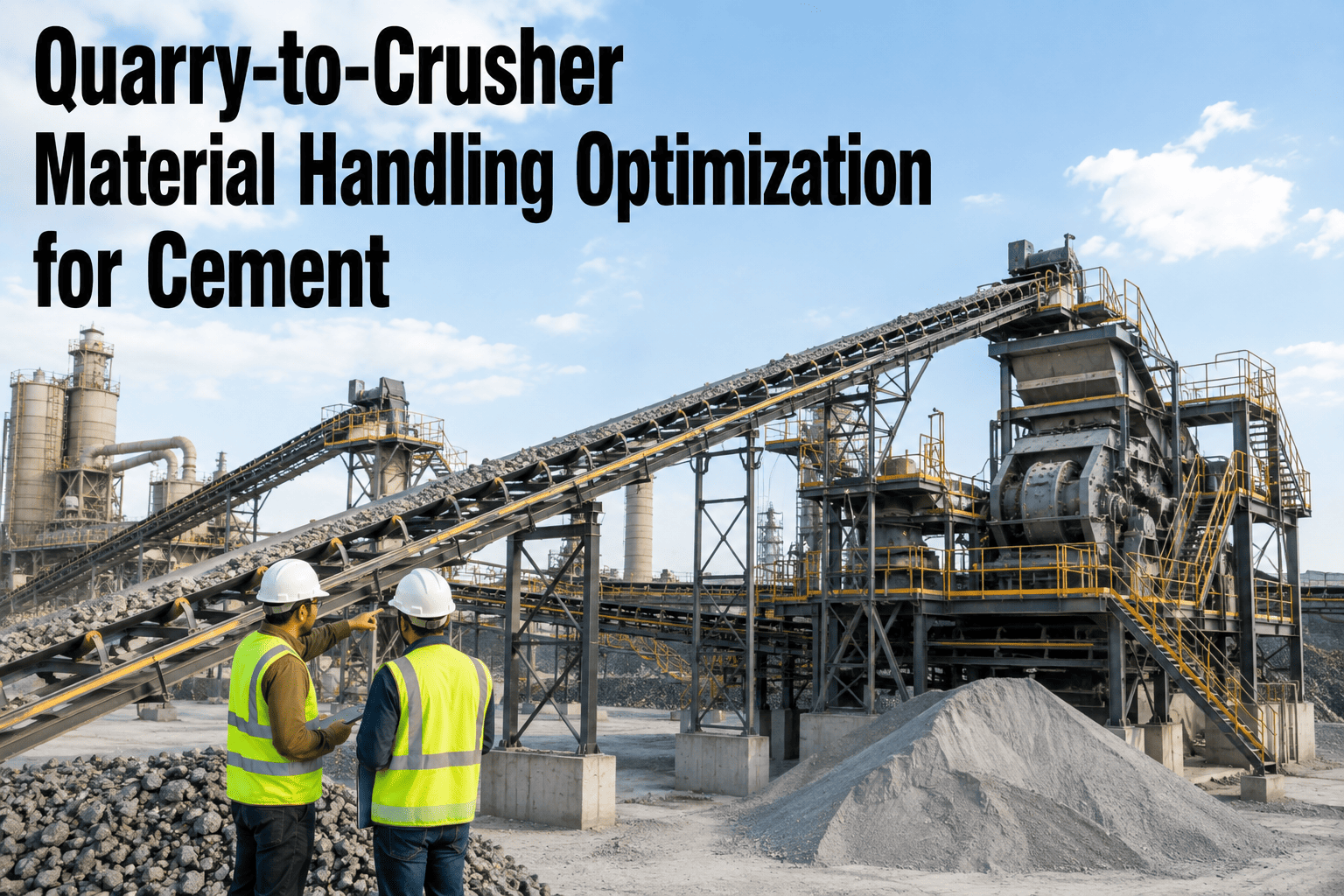
Every tonne of clinker a cement plant produces starts its journey long before it reaches the raw mill, moving from the quarry face down a haul road, through a hopper, and into a primary crusher that can only perform as well as the feed arriving in front of it. Plants that chase crusher efficiency by only looking at the crusher itself are optimizing one link in a four-link chain and leaving the other three to chance. Haul road condition, truck-to-loader balance, hopper sizing, and feed consistency each shape how much rock actually reaches the crusher ready to be processed, and the plants that treat this stretch of the operation as a connected system rather than four separate jobs are the ones that stop losing tonnes before the crusher ever gets a chance to touch them — book a demo to see how iFactory tracks that whole chain in one place.
The Crusher Gets Blamed for Losses That Started Three Stops Earlier
A crusher running below its rated tonnage is frequently reported as a crusher problem, but the actual cause is often sitting further upstream — an eroded haul road slowing cycle times, an imbalanced truck fleet queuing at the hopper, or a feed stream surging instead of flowing steadily into the crushing chamber.
Where Rock Actually Loses Time Between the Quarry Face and the Crusher Chamber
Material handling from quarry to crusher is not one process, it is four connected ones, and a delay or inefficiency at any single stop reduces what the crusher can deliver no matter how well-tuned the crusher itself is. Mapping the journey stop by stop is the first step to finding where tonnes are actually being lost.
Quarry Face
Blast pattern and shot fragmentation set the maximum feed size and gradation the crusher will receive.
Haul Road
Road condition and route design determine truck cycle time, fuel burn, and tire wear on every loaded run.
Dump & Hopper
Hopper sizing and dump area layout decide whether trucks queue or discharge without a wait.
Crusher Feed
Feeder speed and feed consistency determine whether the crusher runs at steady throughput or surges.
The Road Between the Face and the Hopper Is Rarely Treated Like Production Equipment, but It Behaves Like One
A haul road in poor condition does not just slow a single truck down, it compounds across every cycle every truck makes for the rest of the shift. Rolling resistance from a rutted or poorly maintained surface increases fuel consumption and cycle time on every loaded run, and the effect is large enough that route and surface decisions are treated as seriously as equipment specifications on well-run sites.
Route and Grade Planning
The shortest route is not always the fastest once grade, congestion, and turning geometry are factored in. Some operations have relocated a primary crusher specifically to shorten the loaded haul and turn a return trip mostly downhill, cutting fuel and cycle time on every load.
Dump Area Geometry
A dump zone with a smooth approach and a straight entry into the hopper lets trucks maintain speed until the last moment and brake in a controlled line, rather than slowing early or maneuvering awkwardly, both of which add seconds to every single cycle.
Surface and Bench Maintenance
Bench widths and road surface at the loading face matter just as much as the main haul road itself, since a haul road is only as productive as its weakest section, whether that section is near the pit or near the hopper.
Truck-to-Loader Balance Is a Math Problem Most Sites Solve by Instinct Instead of Data
The objective at this stage of the chain is simple to state and hard to hold steady day to day: keep the crusher and hopper fed continuously without trucks queuing on one end or the loader sitting idle on the other. Both failure modes cost money in different ways, and both are common enough that they deserve their own read on the signals that reveal them.
| Signal | What It Usually Means | Typical Fix |
|---|---|---|
| Trucks queuing at hopper | Fleet oversized for current haul distance or loader rate | Reassign a truck to a shorter route or second duty |
| Loader idle between loads | Fleet undersized for current cycle time | Add a truck or shorten the route |
| Rising average cycle time | Haul road degradation or congestion building | Inspect and grade the affected road section |
| Uneven truck body fill | Truck body mismatched to loader bucket geometry | Match body rail height and width to loading tool |
Every one of these signals is available from the fleet already operating on site, but they only become useful when tracked as trends across shifts rather than noticed anecdotally when a supervisor happens to be watching the dump point at the wrong moment.
A Hopper Sized for Yesterday's Truck Fleet Becomes Tomorrow's Bottleneck
Hopper sizing is not a one-time design decision that stays correct forever, it is a specification that needs to track whatever truck fleet is actually dumping into it. The commonly used sizing rule is that minimum hopper live load capacity should run around one and a half times the size of the largest unit dumping into it, which gives enough buffer that a single truck discharge doesn't overwhelm the feeder's ability to draw material out at a steady rate.
Rock Box Hoppers
The standard choice for dump truck operations, built to absorb the impact of a full truck load discharging directly into the chamber without damaging the structure underneath.
Sloped-Side Hoppers
Better suited to sticky or fine material that would otherwise bridge or hang up on flat surfaces inside a standard rock box design, keeping material flowing toward the feeder instead of building dead zones.
Apron Feeders
Built rugged enough to handle the impact and lump size of raw quarry feed, typically speed-controlled so the feeder draw rate can be matched directly to whatever the primary crusher can actually process at that moment.
Truck body design factors into this stage too. A flat-floor body is generally better suited to dumping into a hopper because it allows material to be metered out gradually rather than dropping as a single mass, which is exactly the kind of controlled discharge a properly sized hopper and feeder are designed to receive.
A Crusher Running Below Rated Tonnage Is Often Being Fed Inconsistently, Not Overloaded
A crusher performs at its best on a steady, continuous feed. When that feed surges instead — spiking then dropping as trucks dump in bursts rather than a metered stream — the crusher spends part of every cycle underfed and part of it choke-fed, and neither condition delivers the throughput the machine is rated for. Bridging inside the hopper and uneven loading onto the feed conveyor are the two most common causes of this surging pattern, and both trace back to decisions made earlier in the chain: hopper geometry, feeder speed matching, and how evenly trucks are spaced arriving at the dump point.
These figures represent typical distribution of upstream-driven crusher throughput constraints and shift with quarry geology, blast quality, and equipment condition, which is why continuous feed monitoring matters more than a one-time audit.
Stop Guessing Whether It's the Feed, the Gap, or the Face
iFactory tracks feed rate stability, hopper level, and crusher gap setting against quarry blast schedule so you can see exactly which stage introduced today's throughput loss.
The Quarry Face Decision That Shapes Every Stage Downstream
Everything downstream of the blast is, to some degree, compensating for the blast. A tighter shot pattern that produces well-fragmented rock with less oversize material reduces the load on every stage that follows: fewer oversize rocks mean fewer feeder jams, a steadier crusher feed, and less wasted capacity spent breaking material that a better blast design would have already sized correctly. A quarry that treats blast design and material handling as two separate departments is missing the fact that a fragmentation problem created at the face shows up as a crusher throughput problem hours later, disguised as an equipment issue rather than a quarry planning one.
Feed grading also changes gradually as quarry faces advance and geology shifts across a bench, which means a crusher gap setting and feeder speed that were correct six months ago may no longer match the material actually arriving today. Reviewing feed gradation against crusher performance on a recurring basis, not just after a visible throughput drop, is what catches this drift while it is still a minor adjustment rather than a full requalification of crusher settings.
Why Quarry-to-Crusher Losses Rarely Show Up as a Single Number on a Report
A finish mill running short on feed shows up immediately as a production shortfall everyone can see and trace. A haul road that has degraded by ten percent over eighteen months, or a truck fleet that has drifted one truck out of balance since the last route change, almost never shows up that cleanly. Instead, these losses distribute themselves across a dozen smaller line items — slightly higher fuel spend per tonne hauled, slightly more tire wear, a crusher operator quietly running below rated capacity because the feed has become unpredictable, a loader operator absorbing idle time that never gets logged as downtime because the machine is technically running. None of these individually triggers an investigation, but together they represent real tonnes and real cost that a plant is absorbing every single shift without a clear owner responsible for tracing it back to its source.
This is precisely why quarry-to-crusher material handling tends to be under-optimized relative to downstream stages like grinding or kilning. A grinding circuit has a small number of well-instrumented variables feeding a control room screen. A haul road, a truck fleet, and a hopper stage typically do not, which means the data needed to catch drift early either doesn't exist in a usable form or lives scattered across GPS telematics, weighbridge tickets, and a supervisor's memory of how the shift felt. Bringing that data together into one continuously monitored view is what turns quarry-to-crusher optimization from an occasional special project into an ongoing discipline with the same rigor already applied downstream.
The Chain Doesn't Stay Optimized on Its Own — Conditions Change Underneath It
A haul road, fleet plan, and hopper configuration that were correctly sized for one set of conditions rarely stay correct as those conditions shift, and several of the variables that move are easy to overlook until their combined effect shows up as a throughput drop. Weather is the most obvious one: rain softens haul road surfaces and increases rolling resistance on every cycle, while extreme heat or cold affects both equipment performance and material handling characteristics, particularly for sticky or moisture-sensitive feed. Seasonal production targets shift truck fleet requirements too, since a plant ramping up ahead of a high-demand period needs a different truck-to-loader ratio than the same plant running a maintenance-driven reduced schedule.
Quarry face progression is the least visible of these variables and often the most consequential. As mining advances deeper into a bench or shifts laterally across a deposit, both the haul distance and the rock characteristics change gradually, sometimes over months, which means a route, hopper setting, and crusher gap calibrated for last quarter's face position may already be several percent off from optimal without anyone having made a deliberate decision to change anything. Reviewing the full chain against current face position, weather patterns, and production targets on a recurring schedule — rather than only after a shortfall appears — is what keeps a quarry-to-crusher system tuned to the conditions it is actually operating under, instead of the conditions it was designed for a year or two ago.
Benchmarks Worth Tracking Across the Full Quarry-to-Crusher Chain
What a Quarry-to-Crusher Optimization Review Actually Involves
Plants that get real value out of this kind of review tend to follow a similar sequence rather than trying to fix every stage of the chain simultaneously. The first step is establishing a baseline across all four stages at once — haul cycle time by route, truck and loader utilization, hopper queue frequency, and crusher feed rate stability — over a representative window that includes normal shift variation rather than a single best-case day. That baseline is what makes it possible to say with confidence which stage is actually the binding constraint, instead of assuming based on where the complaints happen to be loudest.
From there, the fix generally follows the same lowest-cost-first logic that applies everywhere else in a plant: a route or scheduling adjustment costs nothing but planning time and can be tested within days, a hopper or feeder reconfiguration takes more coordination but still fits inside a normal maintenance window, and a haul road resurfacing or fleet resizing decision represents real capital and gets scoped only once the data confirms it's the genuine constraint rather than a symptom of something upstream. Skipping the baseline step and jumping straight to capital spending is the most common way plants end up solving the wrong problem — resurfacing a road segment that was never actually the bottleneck, or adding a truck to a fleet that was already correctly sized once the real issue turned out to be dump area geometry.
Questions Quarry and Plant Teams Ask About Material Handling Optimization
See the Whole Quarry-to-Crusher Chain, Not Just the Crusher
Haul road cycle time, fleet balance, hopper level, and crusher feed consistency all live on one platform with iFactory, so the real constraint gets found before it costs you a shift's worth of tonnes.