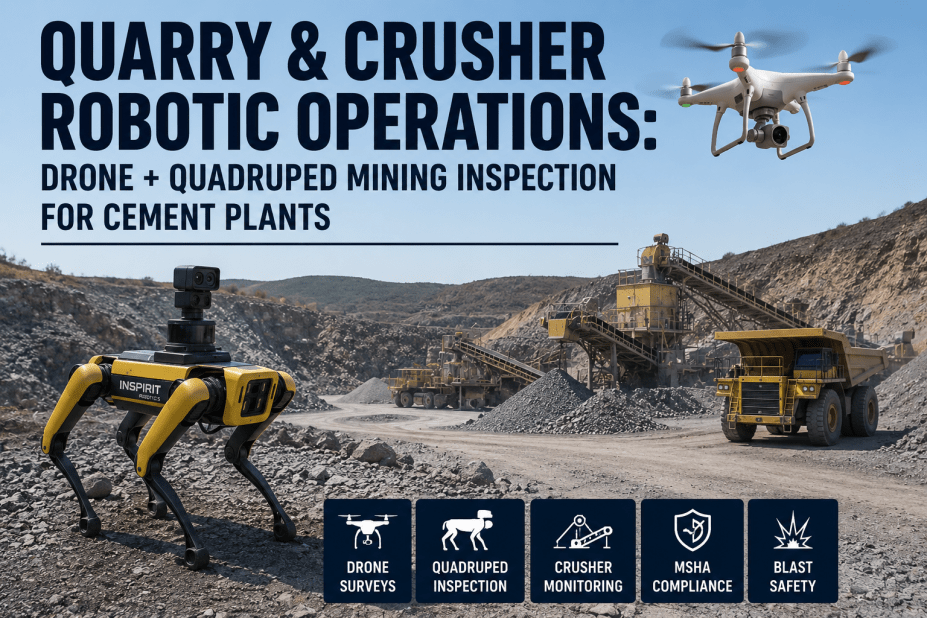
The quarry and primary crusher represent the highest-risk zone in the cement production value chain — a combined operating environment where blasting, heavy mining equipment, unstable rock faces, and high-capacity crushing machinery create hazards that no other plant zone matches. MSHA data from 2025 shows that quarry operations account for 42 percent of all lost-time incidents in cement manufacturing, with powered haulage accidents, rockfall injuries, and crushing plant entanglements representing the three most common event categories. The financial impact extends beyond safety: a single unplanned crusher outage can idle the entire plant within hours as raw material supply stops, costing $80,000 to $150,000 per day in lost clinker production. Robotic operations — deploying autonomous drones for quarry surveying and quadruped robots for crusher inspection and monitoring — fundamentally change this risk profile by removing personnel from the most hazardous zones while collecting higher-quality data at higher frequency than manual methods allow. Quarry and crusher operations managers evaluating robotic deployment can book a demo to see iFactory's integrated drone and quadruped platform configured for their specific quarry layout, crusher configuration, and MSHA compliance requirements.
Deploy Autonomous Drone and Quadruped Robots for Quarry Operations and Crusher Inspection
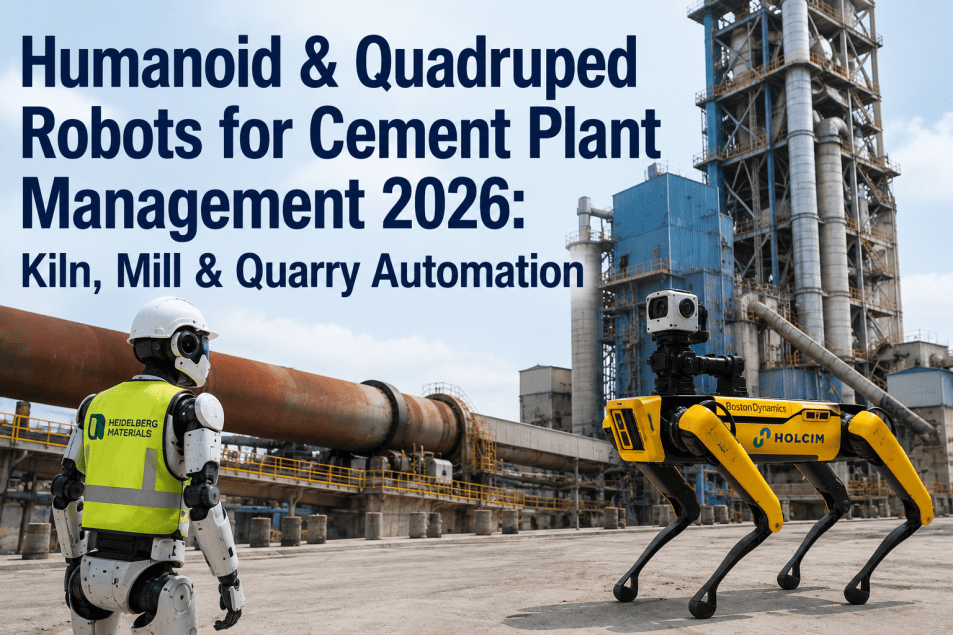
iFactory's integrated quarry robotics platform combines aerial drone survey, quadruped crusher inspection, and AI-driven analytics to eliminate personnel exposure in high-risk quarry zones, reduce crusher unplanned downtime, and maintain continuous MSHA compliance documentation.
The Quarry and Crusher High-Risk Zone: Why Upstream Automation Delivers the Fastest Safety ROI
Cement plant safety and reliability programs have historically focused on the kiln, preheater, and mill areas — the high-temperature, high-energy processes that dominate production risk assessments. But the data tells a different story. Quarry and crusher operations, despite being perceived as lower-technology environments, generate more lost-time incidents per million hours worked than any other cement plant zone. The combination of heavy mobile equipment, elevated work platforms, unstable geological conditions, and manual inspection tasks creates a risk profile that is both severe and difficult to mitigate with traditional controls. Robotic automation addresses this risk at the root cause by reducing personnel exposure. A drone that surveys a quarry face from 50 meters distance eliminates the need for a geotechnical engineer to approach the bench edge. A quadruped that crawls through a gyratory crusher chamber to measure mantle wear eliminates the need for a maintenance technician to enter a confined space with rotating hazards. These are not incremental safety improvements — they represent a fundamental change in how quarry and crusher work is performed. Schedule a risk assessment to evaluate how robotic automation can reduce personnel exposure across your quarry and crusher operations.
Autonomous Drone Survey: Quarry Face Stability, Stockpile Volume, and Haul Road Monitoring
Aerial drone survey is the most mature robotic application in cement quarry operations, with proven workflows that replace manual survey methods while delivering higher data resolution, faster cycle times, and zero personnel exposure to bench-edge fall hazards. iFactory's drone platform integrates RTK GPS, high-resolution photogrammetry cameras, and LiDAR sensors on autonomous flight missions that cover the entire quarry extent in a single 90-minute sortie. The data output — orthorectified imagery, digital surface models, and point cloud meshes — feeds directly into the quarry management system for volume reconciliation, face stability analysis, and blast planning. Quarry superintendents book a demo to see how automated drone survey integrates with their existing pit planning and stockpile management workflows.
Face Stability Survey
Core Focus: Weekly autonomous drone flights capture 5 cm resolution orthophoto and digital surface model data across all active quarry benches. AI models compare successive surveys to identify crack propagation, block displacement, and slope deformation that indicate developing face instability.
Stockpile Volume Measurement
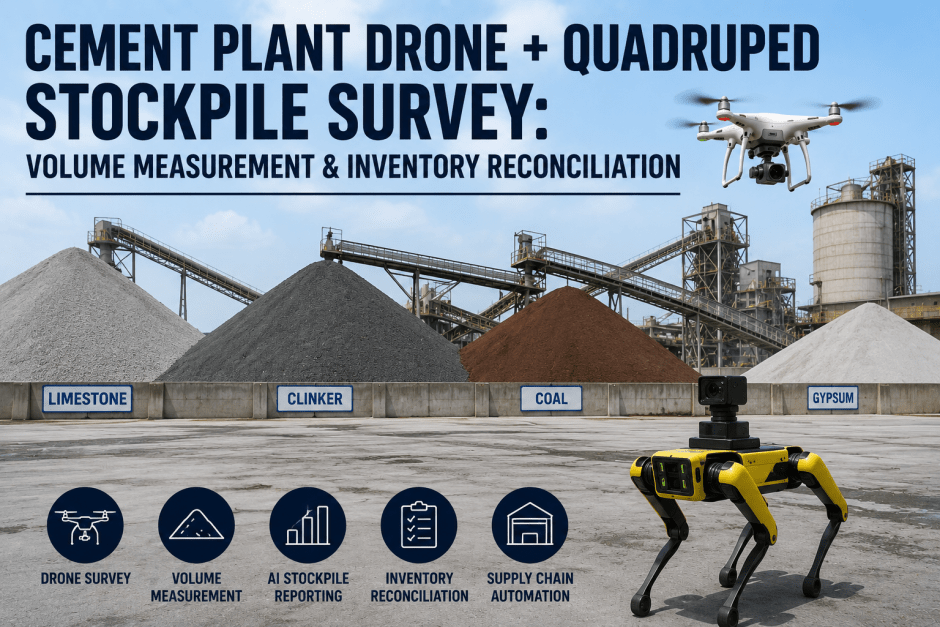
Core Focus: Automated drone photogrammetry missions over raw material stockpiles generate volume calculations accurate to within 1 to 2 percent. Data is available within 2 hours of flight completion, replacing manual total station surveys that require two people working three days per measurement cycle.
Haul Road Condition Monitoring
Core Focus: Drone patrols along haul road routes detect surface deterioration, drainage issues, and berm damage that create powered haulage hazards. AI analysis identifies road sections requiring grading, watering, or repair before they cause haul truck accidents or production delays.
Blast Pattern Verification
Core Focus: Pre-blast and post-blast drone surveys capture bench face geometry, borehole location accuracy, and muck pile distribution. AI compares actual blast outcomes against design parameters to optimize future blast designs for fragmentation, throw, and vibration compliance.
Quadruped Robot Crusher Inspection: Gyratory, Jaw, Cone, and Impact Crusher Monitoring
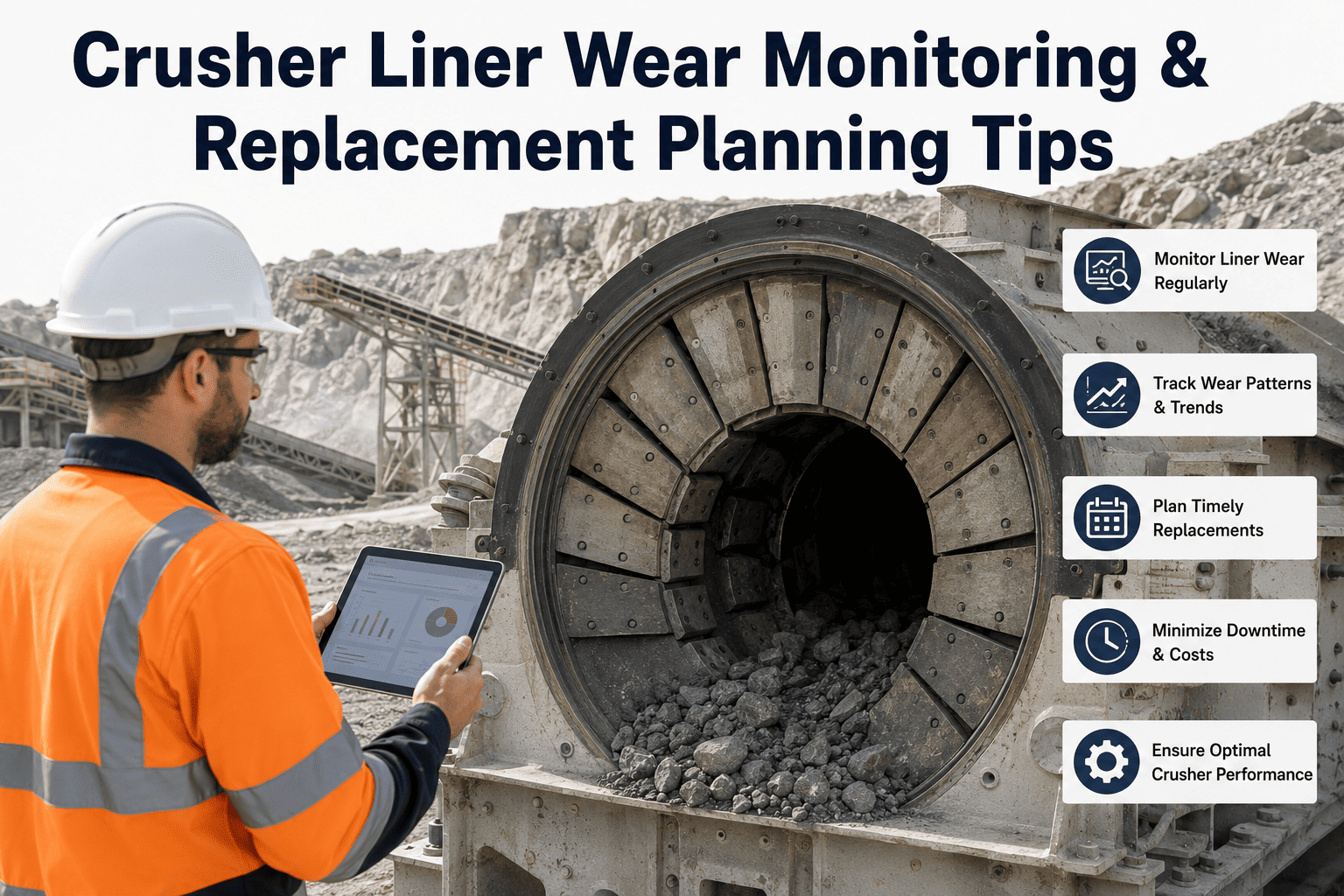
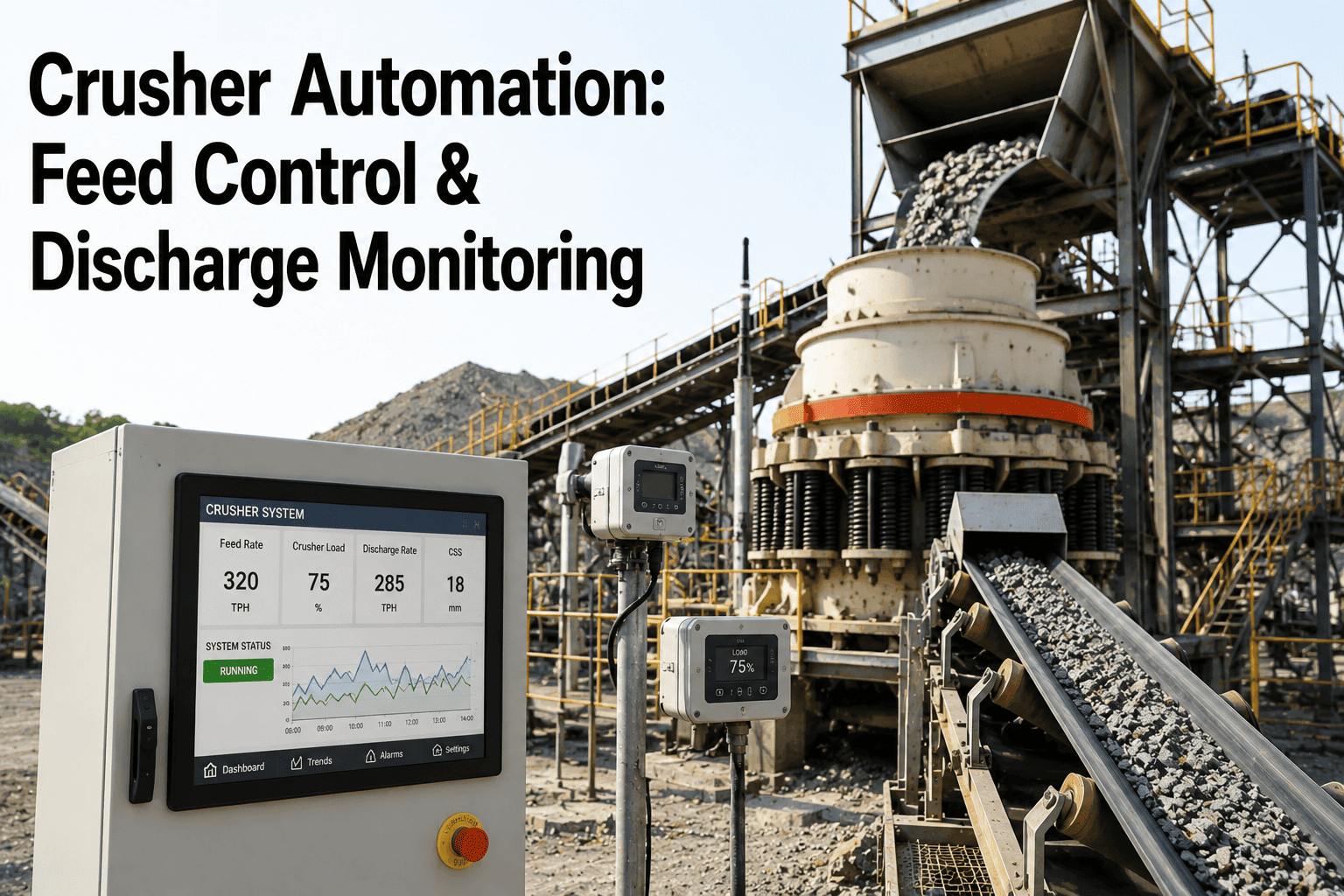
Crusher inspection has traditionally required confined space entry, lockout-tagout procedures, and extended production downtime. A maintenance technician entering a gyratory crusher chamber to measure mantle wear and check concave condition must complete a permit-required confined space entry with atmospheric monitoring, safety watch personnel, and fall protection equipment — a process that takes 2 to 4 hours of preparation for a 15-minute inspection. Quadruped robots eliminate this entirely. Equipped with thermal cameras, laser profilometers, and high-resolution visual sensors, quadrupeds navigate crusher chambers, measure wear surfaces, detect cracking, and identify abnormal operating conditions — all while the crusher is locked out but without any human entry into the hazard zone. The data collected enables condition-based mantle and liner replacement that extends wear part life by 15 to 25 percent compared to calendar-based replacement schedules. Book a crusher inspection demo to see quadruped robots navigate gyratory and jaw crusher chambers at operating cement quarries.
| Crusher Type | Quadruped Inspection Capability | Manual Inspection Requirement | Time Savings per Inspection |
|---|---|---|---|
| Gyratory Crusher | Mantle wear profiling, concave crack detection, spider bearing thermal scan, dust seal condition assessment | Confined space entry with full permit, 2-person safety watch, atmospheric monitoring, fall protection harness | 3.5 hours saved per inspection |
| Jaw Crusher | Jaw die wear measurement, toggle plate crack detection, pitman bearing temperature, cheek plate gap analysis | Lockout tagout, overhead crane support for access platform, confined space evaluation, manual caliper measurement | 2.0 hours saved per inspection |
| Cone Crusher | Bowl liner wear scanning, head nut torque verification, main frame crack detection, hydraulic pressure trend analysis | Top-shell removal or man-way entry with fall protection, confined space permit, safety watch team of 3 personnel | 3.0 hours saved per inspection |
| Impact Crusher | Blow bar thickness measurement, breaker plate gap, rotor bearing vibration, housing liner wear mapping | Full lockout, rotor blocking, interior access with ladder and harness, manual thickness gauge readings at 20+ points | 2.5 hours saved per inspection |
Integrated Quarry and Crusher Robotics: Autonomous Patrol and Inspection Workflow
The full quarry and crusher robotic operations program combines weekly drone survey missions, daily quadruped crusher inspection patrols, and continuous AI analytics into a single integrated workflow. The sequence below illustrates how drone and quadruped operations coordinate to provide comprehensive coverage of the quarry-crusher production chain — from bench face to crushed material stockpile.
Weekly Drone Quarry Survey
Autonomous drone executes pre-programmed flight path covering all active benches, stockpiles, and haul roads. RTK GPS ensures survey-grade accuracy. Data is uploaded to cloud platform within minutes of landing. AI processes imagery overnight and generates face stability alerts, volume updates, and road condition reports by morning shift.
Daily Quadruped Crusher Patrol
Quadruped robot departs charging station, navigates to primary crusher area, and executes inspection sequence: exterior thermal scan of motor and drive train, entry into crusher chamber for wear surface measurement during scheduled downtime, and visual inspection of chutes, screens, and conveyor transfer points. Patrol is completed within 30 minutes.
AI Fusion and Alert Generation
Drone survey data and quadruped inspection data are fused in the iFactory AI platform. Face stability trends from successive drone flights are correlated with crusher feed size distribution data from quadruped camera measurements. AI generates alerts for developing hazards, wear part replacement timing, and haul road maintenance priorities with recommended action deadlines.
I managed quarry operations at a 3 million ton per year cement plant for 16 years, and the single most dangerous task we performed was crusher chamber inspection. Every time we needed to check mantle wear on the gyratory crusher, I had a knot in my stomach — confined space entry, overhead suspended loads, awkward positioning inside the chamber, and the constant pressure from production to complete the inspection quickly so they could restart the crusher. We had two near-miss incidents in three years, and I knew it was only a matter of time before someone got hurt. We deployed iFactory's quadruped robot for crusher inspection in 2025, and within the first month the robot identified a mantle crack that our monthly visual inspection had missed because it was on the underside surface that a human inspector could not see without a mirror and flashlight. That crack, if it had propagated to failure, would have caused a mantle shift during operation that could have destroyed the crusher head and required a 14-day rebuild costing over $1.2 million. The drone quarry survey program was added three months later, and the combination has eliminated all confined space entries for crusher inspection, reduced our quarry survey team from two people to zero, and delivered a measured safety incident reduction of 100 percent in the quarry and crusher zone over 18 months of operation.
Eliminate Personnel Exposure in Quarry and Crusher Operations with iFactory Robotics
iFactory's integrated quarry and crusher robotics platform combines autonomous drone survey, quadruped inspection, and AI-driven analytics to eliminate confined space entry, reduce quarry survey personnel requirements, and prevent unplanned crusher downtime. Full deployment in 8 to 10 weeks with MSHA-compliant safety integration.
Quarry and Crusher Robotics — Frequently Asked Questions
Are autonomous drones permitted to operate in active quarry blasting zones during production hours?
Yes. Drone flights are scheduled during production hours with geofencing that excludes active blast zones during initiation sequences. Flight plans are coordinated with the blasting supervisor to ensure airspace is clear during blast events. Drone operations follow MSHA guidelines for UAV use in mining environments.
How does the quadruped robot access the interior of a gyratory or jaw crusher chamber?
The robot enters through existing access doors or man-ways sized for human entry — typically 24 by 30 inches or larger. Quadruped platforms navigate easily through these openings. Once inside, the robot uses LiDAR to map the chamber geometry and approaches wear surfaces at programmed standoff distances for measurement.
What happens to drone operations in rain, fog, or high wind conditions common in quarry environments?
Drones operate within specified environmental limits: wind speeds below 25 mph, visibility above 3 miles, and no precipitation that affects sensor accuracy. Flights are automatically deferred when conditions exceed limits. The platform uses historical weather data to schedule make-up flights within the same week to maintain survey frequency.
Can the robotic platform integrate with existing MSHA Part 46 and Part 48 training and compliance documentation systems?
Yes. iFactory's platform maintains a complete audit trail of all robotic patrol and inspection activities, including date-stamped reports, data logs, and safety observation records. These records are exportable in MSHA-compliant formats for inclusion in Part 46 training records, Part 48 task training documentation, and quarterly safety reports.
What is the typical deployment timeline and ROI for quarry and crusher robotics?
Full deployment including drone quarry survey and quadruped crusher inspection requires 8 to 10 weeks. ROI is typically achieved within 6 to 12 months driven by elimination of confined space entry costs, reduction in unplanned crusher downtime valued at $80,000 to $150,000 per day, and replacement of manual survey contractor costs.
The Decision That Determines Your Quarry and Crusher Safety Trajectory — Manual Methods or Autonomous Robotic Operations
Every week that passes with manual crusher chamber inspections is a week where a confined space entry incident remains a measurable probability. Every month that passes with manual total station quarry surveys is a month where face stability hazards go undetected between survey cycles. Every quarter that passes without robotic monitoring of haul road conditions is a quarter where powered haulage risks accumulate on deteriorating road surfaces. The data from cement plants that have deployed integrated quarry and crusher robotics is unambiguous: a 100 percent reduction in quarry-zone lost-time incidents, an 85 percent reduction in survey time, and a measured ROI that reaches full payback within 6 to 12 months. The quarry and crusher zone is the highest-risk environment in cement manufacturing, and autonomous robotic operations are the most effective intervention available to address that risk.