Most cement plants don't fail at Industry 4.0 because the technology doesn't work. They fail because the pilot that proved it worked on one kiln never made it to the other three. Research from the Manufacturing Leadership Council found that manufacturers run an average of eight digital transformation projects at once, and fewer than a third ever get implemented at scale — the rest stall out in what the industry has started calling pilot purgatory, successful in isolation and permanently stuck there. For a cement group with multiple lines running continuous production, that gap between "it worked on Line 2" and "it works across the group" is where most of the return on investment quietly evaporates. A roadmap that treats scaling as a design requirement from day one, not an afterthought once the pilot succeeds, is what separates the plants closing that gap from the ones still debating it. iFactory's cement digital transformation team can map this roadmap against your specific plant footprint and existing DCS infrastructure.
Digital Transformation · Cement
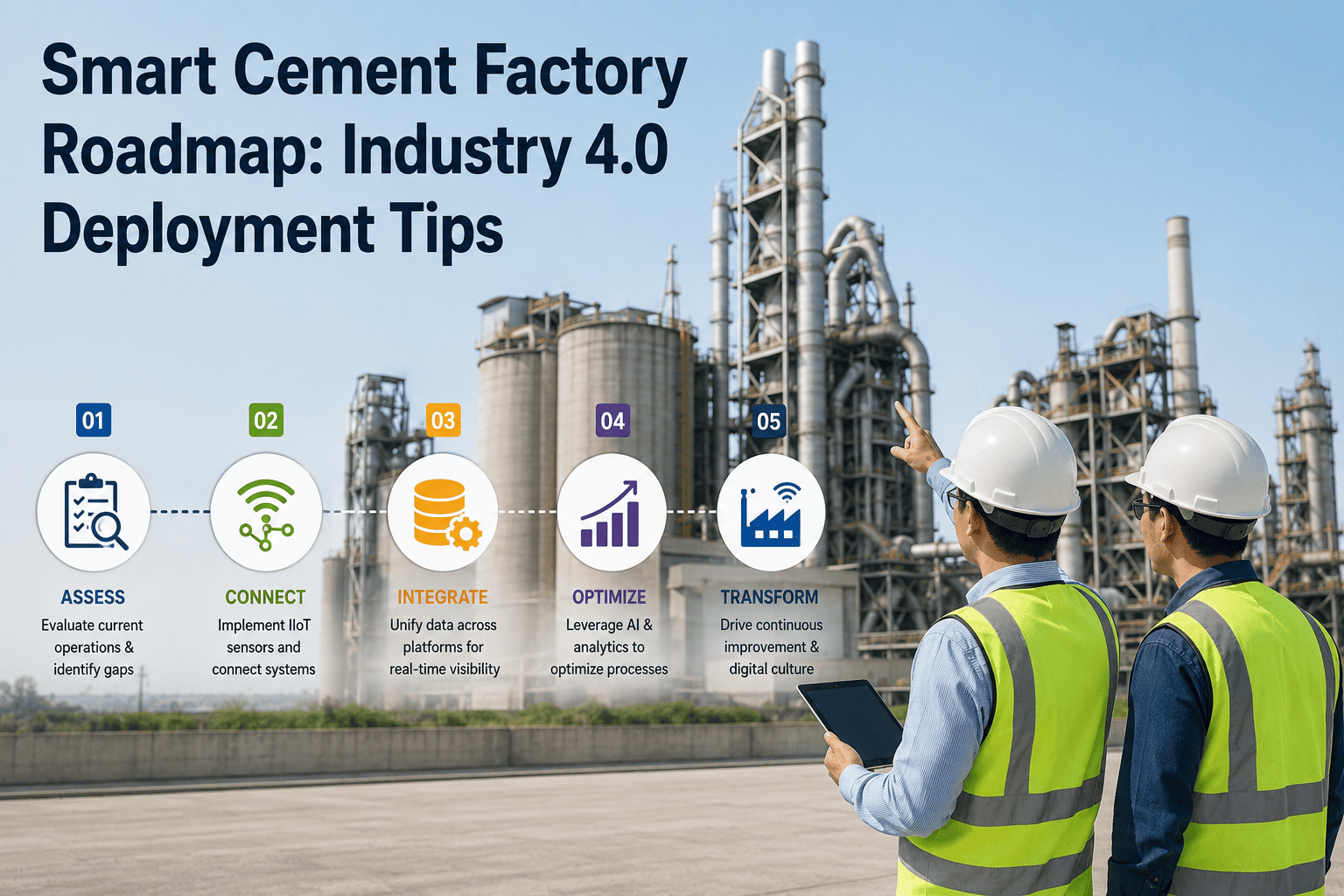
Smart Cement Factory Roadmap: Industry 4.0 Deployment Tips
A practical, phase-by-phase roadmap for cement plant modernization — technology deployment sequencing, integration milestones, and value realization tracking built to avoid the pilot purgatory that stalls most Industry 4.0 initiatives before they ever reach the second plant.
Why Roadmap Discipline Matters
75%
Of digital pilots never scale past the lab
8
Avg. parallel digital projects per manufacturer
<⅓
Of pilots reach full-scale deployment
18mo
Typical ROI horizon for phased rollout
The Real Failure Point
Cement Plants Don't Struggle to Start Digital Transformation — They Struggle to Scale It
Almost every cement plant that starts an Industry 4.0 initiative can point to a successful pilot: a kiln with predictive vibration monitoring, a mill with an energy optimization model, a preheater tower inspected by drone instead of scaffolding. The pilot works. The metrics look good. And then, according to research on digital transformation at scale, roughly three-quarters of those initiatives never make it past that single line or single plant — not because the technology failed, but because the organization never built the scaling path the pilot was supposed to prove out.
The pattern behind this failure is consistent enough to name: pilots get designed as isolated proof-of-concept projects rather than as the first phase of a production deployment. Nobody assigns a production owner. Nobody defines which business KPI has to move before the next plant gets funded. The rollout template that worked on one line gets assumed to transfer unchanged to a plant with different DCS vendors, different data quality, and a different operations culture — and it doesn't, because it was never actually designed to.
A roadmap built for cement's specific constraints — continuous production, legacy DCS and SCADA layers accumulated over decades, heterogeneous equipment vintages across a multi-plant group — treats scale as the design target from the first phase, not a hoped-for outcome after the first pilot succeeds. That's the difference between a roadmap and a pilot with good intentions attached.
The Four-Phase Roadmap
From Connectivity Audit to Group-Wide Autonomous Operation
A phased approach delivers measurable value at every stage rather than asking the organization to wait eighteen months for a single big-bang result. The four phases below reflect the structure that mature cement Industry 4.0 rollouts converge on, regardless of which specific technologies fill in the detail. What makes this sequence resilient to the pilot-purgatory pattern is that each phase carries its own defined milestone and its own go/no-go gate — the roadmap doesn't ask leadership to commit eighteen months of budget on faith, it asks for a decision at each checkpoint based on what the previous phase actually proved.
Phase 1
Connectivity Audit and Critical Asset Instrumentation
Audit existing Level 1/2 automation maturity across PLC, SCADA, and DCS layers. Deploy IIoT sensors and edge gateways on the top-tier critical assets — kiln, primary ball mill, ID fans — establishing a unified OPC-UA or MQTT data layer without disrupting continuous production. This phase defines the data foundation every later phase depends on.
Milestone: Real-time data flowing from critical assets into a unified historian, first 90 days
↓
Phase 2
Analytics, Prediction Models, and CMMS Integration
Layer AI prediction models onto the connected assets — kiln bearing failure prediction, refractory wear simulation, energy optimization against live thermal and chemistry data. Integrate with CMMS so predictions generate work orders instead of dashboards nobody acts on. This is where the pilot either proves a repeatable pattern or reveals the integration gaps that would sink a wider rollout.
Milestone: First validated failure prediction with 4–8 week lead time, months 3–6
↓
Phase 3
Scale to Full Asset Coverage and Second-Plant Replication
Expand sensor coverage from the top 20% of critical assets to the full asset base — secondary mills, conveyors, crushers, coolers. Replicate the validated Phase 1–2 architecture at a second plant, using the first deployment's integration lessons to compress what took months the first time into weeks the second time. This is the phase that most initiatives never reach.
Milestone: Second plant live on the same architecture within 8–12 weeks of kickoff, months 6–12
↓
Phase 4
Digital Twin, Closed-Loop Optimization, Group-Wide Standardization
Build the high-fidelity digital twin correlating shell temperature, refractory thickness, and raw meal chemistry across the full asset base. Move validated AI recommendations from advisory "shadow control" — where models suggest setpoints operators approve — into closed-loop automation for specific, well-proven use cases. Standardize the architecture across the full plant group.
Milestone: Group-wide KPI standardization and closed-loop control on validated use cases, 12–18 months
See a Cement-Specific Roadmap Built for Your Plant
Walk Through Phase 1 Against Your Actual DCS and Asset Inventory
iFactory's cement digital transformation team maps this roadmap against your specific plant footprint — existing SCADA vendors, critical asset list, and multi-plant sequencing — in a live working session, not a generic template. Bring your automation audit and we'll build the Phase 1 plan together.
Value Realization Tracking
The KPIs That Actually Prove the Roadmap Is Working
A pilot that "worked" but never got measured against a business KPI is exactly the pattern that produces pilot purgatory. Every phase of the roadmap needs a defined metric that either justifies moving to the next phase or signals the plan needs adjustment before more budget goes in. The reference below reflects the KPI categories that hold up under executive scrutiny.
| KPI Category |
What It Measures |
Typical Phase 3–4 Result |
| Unplanned Downtime |
Kiln and mill availability against baseline |
40–60% reduction |
| Energy Intensity |
kWh/tonne clinker against pre-digital baseline |
35–50% reduction |
| Bearing / Mechanical Failures |
Predicted vs. unplanned kiln and mill failures |
Up to 71% fewer unplanned stops |
| Shutdown Scope Overrun |
Planned vs. actual shutdown duration |
Up to 42% reduction vs. condition-based only |
| Inspection Cost per Event |
Manual scaffolding inspection vs. drone/robotic |
From ~$18,000 to ~$2,400 per event |
| Time to ROI |
Combined energy, maintenance, and quality gains |
Positive ROI within 12–18 months |
The pattern worth internalizing: every one of these metrics is measurable within the first plant, before a second plant gets funded. A roadmap that can't show this table filled in with real numbers by the end of Phase 2 doesn't have a scaling case — it has a pilot.
Integration Milestones
Where Rollouts Actually Stall — and What Unblocks Them
The technical integration points below are where most cement Industry 4.0 rollouts either establish momentum or get stuck. Each one is a specific, checkable milestone rather than a vague "integration phase" — the specificity is what makes a roadmap auditable by plant leadership instead of just aspirational. A milestone leadership can check off in a status meeting is worth more than a phase description that sounds thorough but can't actually be verified as done or not done.
DCS/SCADA Data Bridge
A secure edge gateway ingesting Historian and DCS data into a unified OPC-UA layer, without requiring a rip-and-replace of existing control systems. This is the single most common stall point when vendors assume a greenfield architecture instead of building on what's already running.
CMMS and Work Order Linkage
Predictions and anomaly flags need to generate actual maintenance work orders, not just populate a dashboard nobody checks. This integration is what converts a predictive model from an interesting demo into a tool the maintenance team actually uses every shift.
Cross-Plant Data Standardization
Different plants in a group often run different DCS vendors and different tag naming conventions. Normalizing KPI tracking across these differences is what makes group-wide comparison possible — and what one global cement producer used to identify a persistent 15% efficiency gap between plants that looked identical on paper.
Shadow Control Before Closed Loop
AI models recommend setpoints and operators approve them before any model gets authority to adjust process parameters directly. This trust-building phase is what makes closed-loop automation viable later — skipping it is a common reason operators quietly route around a system they were never brought along with.
Common Pitfalls
The Mistakes That Turn a Good Pilot Into a Permanent Pilot
These are the failure patterns that show up repeatedly across cement digital transformation initiatives that stall — and the fix that gets a roadmap back on track.
01
Technology-First Instead of Constraint-First
Buying sensors and platforms before defining which production constraint actually costs the most money. The fix: quantify the cost of the specific problem first — a single avoided kiln failure or a one-percent energy reduction often justifies the entire Phase 1 investment on its own.
02
Too Many Parallel Use Cases
Running eight pilots at once fragments attention and budget so thin that none of them reach the scale decision. The fix: sequence use cases by financial impact and prove one before starting the next, rather than pursuing breadth before depth.
03
Assuming the Rollout Template Transfers Unchanged
Plant 2 has a different DCS vendor, different data quality, and a different operations culture than Plant 1, and a template built for one rarely drops cleanly onto the other. The fix: budget explicit time in Phase 3 for adapting the architecture, not just replicating it.
04
Underinvesting in Change Management
Putting existing plant managers into digital product roles with minimal training, and expecting operators to trust AI recommendations without a shadow-control trust-building phase. The fix: budget twenty to thirty percent of the technology investment for training and change management, not as an afterthought.
Turnkey Deployment Support
iFactory's Role in Executing the Roadmap, Not Just Designing It
iFactory ships the technical foundation for each roadmap phase as a pre-configured turnkey bundle — pre-racked NVIDIA AI server, edge gateways pre-loaded with cement-specific models trained on kiln thermal profiles, raw mill particle size distributions, and clinker chemistry. Rack it, plug in power and network connectivity, and Phase 1 data flow begins. The same turnkey scope carries through Phase 3 replication at additional plants, so the second and third sites in a group inherit a proven architecture instead of starting the integration work from scratch.
1000+Clients on iFactory platform
99.9%Platform uptime SLA
24×7Remote AI monitoring
6–12wkPhase 1 live deployment
Common Questions
Frequently Asked Questions
Do we need to replace our existing SCADA and DCS systems to start this roadmap?
No — the standard approach connects and unifies existing SCADA and DCS infrastructure rather than replacing it. A secure edge gateway ingests data from your current Historian and control layer into a unified OPC-UA data model, which means Phase 1 builds on top of what's already running instead of requiring a disruptive rip-and-replace of systems that are working fine at the control layer. Replacement decisions, when they come up at all, are typically driven by hardware end-of-life rather than by the digital transformation roadmap itself.
Talk to the cement digital transformation team about your specific DCS vendor and integration path.
How do we avoid pilot purgatory specifically — what makes a pilot different from a scaling-ready Phase 1?
The difference comes down to what gets defined before the pilot starts, not what happens after it succeeds. A scaling-ready pilot has a named production owner, a specific business KPI that acts as the go/no-go gate for expansion, and an architecture built with standardized data models from day one rather than bespoke point solutions. A pilot that's designed as an isolated proof of concept — succeed or fail, then figure out what's next — is the pattern that produces purgatory even when the technology performs well. Treating Phase 1 as the first stage of a production rollout, not a separate experiment, is the single highest-leverage change most cement groups can make to their roadmap.
How long before a second plant in our group can go live on the same architecture?
Mature deployments typically compress the second plant's timeline to eight to twelve weeks, versus the months the first plant's Phase 1–2 work required — the compression comes specifically from applying integration lessons learned at the first site, not from skipping steps. Plants with meaningfully different DCS vendors or data quality baselines than the first site should expect some of that timeline to go toward architecture adaptation rather than pure replication, which is exactly the kind of variance a roadmap should budget for explicitly rather than discovering mid-rollout.
What's the right way to sequence which assets get instrumented first?
Start with the top-tier critical assets that carry the highest cost of unplanned failure — typically the kiln, primary ball mill, and ID fans — rather than trying to instrument the full plant at once. This isn't just a budget-conscious starting point; it's what generates the fastest, most defensible ROI case to justify expanding sensor coverage to the full asset base in Phase 3. Sequencing by financial impact rather than by what's easiest to connect first is one of the clearest signals of a roadmap built around business value instead of technology for its own sake.
When does AI move from making recommendations to actually controlling the process?
Closed-loop automation — where validated AI models adjust setpoints directly rather than recommending them for operator approval — is the final phase of the roadmap, not a starting requirement. Most deployments run an extended "shadow control" period first, where the model's recommendations are logged and compared against operator decisions to build a validated accuracy track record and, just as importantly, to build operator trust in the system. Moving to closed loop before that trust and validation period is complete is a common reason operators route around a system rather than rely on it.
Book a demo to see how the shadow-control transition is typically sequenced.
Build a Roadmap That Actually Reaches Plant Two
Turnkey Cement Digital Transformation, Phase 1 Live in 6–12 Weeks
iFactory's cement Industry 4.0 platform ships as a pre-configured turnkey bundle — hardware racked and ready, cement-specific AI models pre-loaded, DCS integration scope defined upfront, and 24×7 remote monitoring included. Get a turnkey AI quote with the twelve-week Phase 1 delivery timeline, or start with a focused pilot on your highest-cost constraint to build the scaling case before committing group-wide.