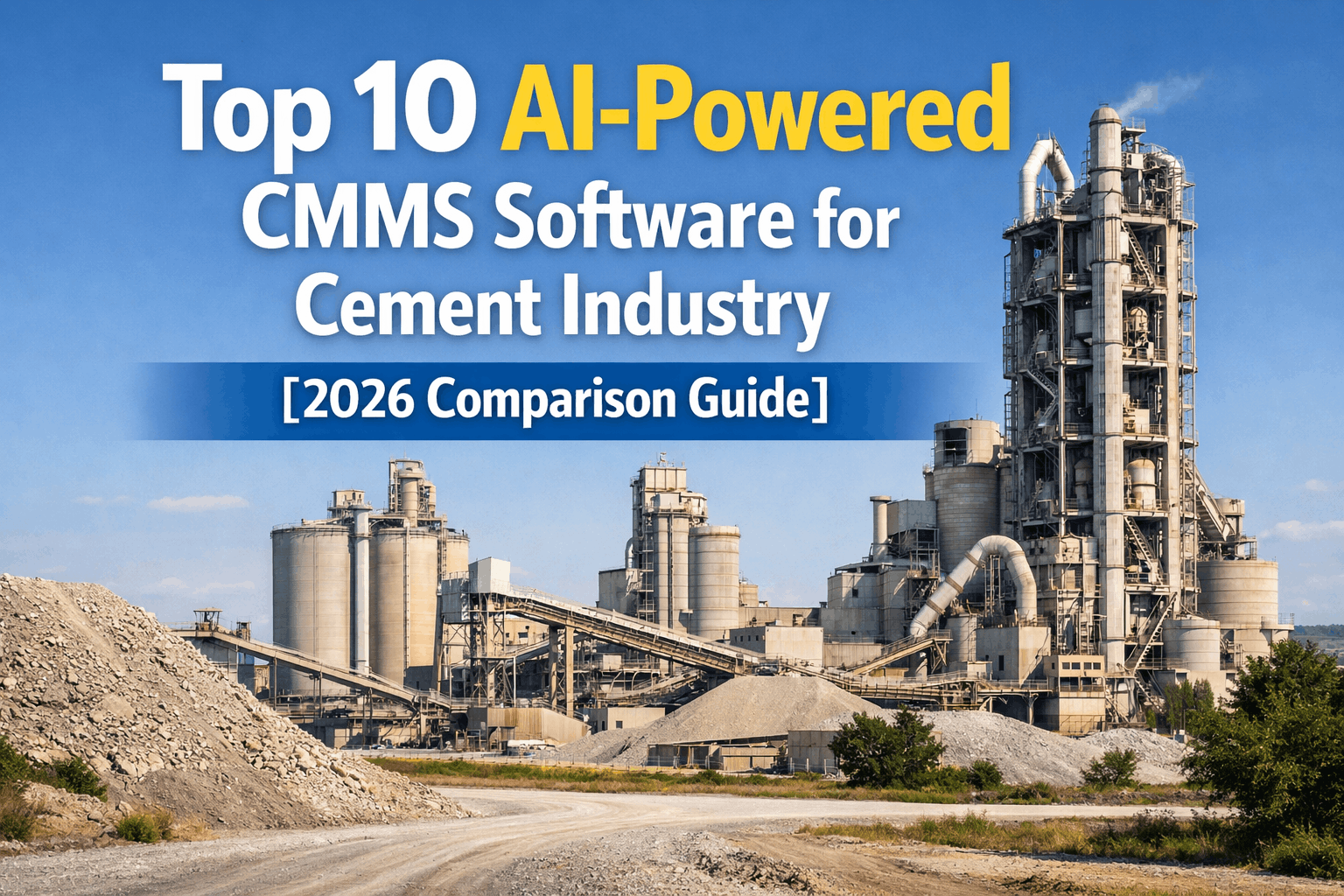
The cement industry operates some of the most punishing equipment on earth — rotary kilns exceeding 1400°C, ball mills grinding at massive torque, and conveyors running 24/7 through abrasive clinker dust. Yet most cement plants still manage maintenance reactively, waiting for catastrophic failures before dispatching crews. In 2026, AI-powered CMMS platforms are transforming cement plant reliability — shifting from costly breakdowns to intelligent, data-driven foresight. iFactory's AI platform brings this transformation to your cement plant. Book a free consultation and discover how AI-powered CMMS eliminates unplanned downtime before it happens.
Top 10 AI-Powered CMMS Software for Cement Industry
Compare. Choose. Transform.
Cement plants lose millions annually to unplanned kiln shutdowns, grinding mill failures, and reactive maintenance chaos. This comprehensive 2026 guide evaluates the top AI-powered CMMS platforms purpose-built for cement manufacturing — comparing predictive AI, IoT integration, ERP connectivity, and cement-specific capabilities to help you choose the right system.
Unplanned Kiln Downtime
With AI-Powered CMMS
Within First 2 Years
What Goes Wrong in Cement Plant Maintenance — And What It Costs
Cement manufacturing pushes equipment to its absolute limits. Here is where operations break down without AI-driven predictive intelligence.
Key Features to Evaluate in a Cement Plant CMMS
Not all CMMS platforms are built for the demands of cement manufacturing. Here are the six critical capabilities your software must deliver.
AI Predictive Maintenance
Machine learning that analyzes vibration, temperature, and performance patterns to forecast equipment failures weeks in advance. The system should continuously refine predictions based on actual wear data from your specific kiln, mill, and crusher assets.
IoT & SCADA Integration
Direct connection to your existing sensors, PLCs, and SCADA/DCS systems via OPC-UA, Modbus, or MQTT protocols. Real-time condition data should automatically trigger work orders without manual monitoring.
ERP Connectivity (SAP/Oracle)
Bidirectional data sync between maintenance operations and enterprise systems ensures finance, production, and procurement see the same numbers — eliminating manual re-entry and data silos.
Multi-Site & Multi-Plant Management
Centralized oversight with cross-facility benchmarking, role-based permissions, and standardized workflows that scale from a single grinding unit to a fifty-plant cement conglomerate.
Spare Parts & Inventory Tracking
Parts linked to specific jobs with low-stock alerts, automated reorders, and vendor management — critical for keeping kiln refractories, mill liners, and crusher wear plates always available.
OEE & Reliability Analytics
Live dashboards tracking MTTR, MTBF, OEE, and downtime causes — visible in real time to operators, maintenance managers, and plant directors for immediate decision-making.
2026 AI CMMS Comparison Table for Cement Plants
Ratings reflect suitability specifically for cement manufacturing operations. Scroll horizontally on mobile to view the full comparison.
| Rank | Software | AI Capabilities | Cement Fit | IoT/SCADA | ERP Integration | Mobile | Pricing |
|---|---|---|---|---|---|---|---|
| #1 | Oxmaint | ★★★★★ | ★★★★★ | ★★★★★ | ★★★★ | ★★★★★ | Free tier |
| #2 | IBM Maximo | ★★★★★ | ★★★★ | ★★★★★ | ★★★★★ | ★★★ | Custom enterprise |
| #3 | SAP Plant Maintenance | ★★★★ | ★★★★ | ★★★★ | ★★★★★ | ★★★ | Custom enterprise |
| #4 | MaintWiz | ★★★★★ | ★★★★★ | ★★★★ | ★★★★ | ★★★★ | Custom quote |
| #5 | Fiix (Rockwell) | ★★★★ | ★★★ | ★★★★ | ★★★★★ | ★★★★ | Free – $75/user/mo |
| #6 | iFactory CMMS | ★★★★ | ★★★★★ | ★★★★★ | ★★★★ | ★★★★ | Custom quote |
| #7 | Tractian | ★★★★ | ★★★ | ★★★★★ | ★★★ | ★★★★★ | Custom quote |
| #8 | UpKeep | ★★★ | ★★★ | ★★★ | ★★★ | ★★★★★ | Free – $75/user/mo |
| #9 | Limble CMMS | ★★★ | ★★★ | ★★★ | ★★★ | ★★★★ | Free – $69/user/mo |
| #10 | MaintainX | ★★★ | ★★★ | ★★★ | ★★★ | ★★★★★ | Free – $85/user/mo |
Our specialists will map these rankings to your specific asset count, ERP stack, and budget in a free 30-minute consultation.
Detailed Reviews — Top 10 AI CMMS for Cement Plants
Each platform evaluated for AI depth, cement-industry fit, IoT/SCADA connectivity, ERP integration, mobile experience, and total cost of ownership.
Oxmaint
Best Overall for Cement ManufacturingOxmaint has positioned itself as the purpose-built CMMS for heavy industry, with specific modules designed for cement plant operations. The platform connects directly to existing PLCs and SCADA systems, feeding real-time sensor data into AI models that predict failures across kilns, mills, crushers, and conveyors. A cement plant in India reduced unplanned downtime by 73% after implementing predictive maintenance powered by Oxmaint PLC sensor integration and CMMS analytics.
IBM Maximo
Best for Large Enterprise and Complex OperationsIBM Maximo is the long-standing leader in enterprise asset management, offering near-infinite customization, deep IoT integration through Watson IoT, and comprehensive lifecycle management for high-value assets. For large cement groups managing multiple plants globally, Maximo depth is unmatched — though it comes at significant cost in licensing and 3–6 month implementation timelines.
Need enterprise depth without enterprise complexity? Compare alternatives in a free demo.
SAP Plant Maintenance (S/4HANA)
Best for Existing SAP EcosystemsSAP Plant Maintenance is the natural choice for cement companies already running SAP ERP infrastructure. The module delivers seamless bidirectional sync between maintenance, finance, procurement, and production planning. AI/ML capabilities have been enhanced in S/4HANA Cloud, but the core strength remains integration depth — not shop-floor usability.
Need a mobile-first cement CMMS to complement SAP? Schedule a free demo.
MaintWiz AI CMMS
Best Cement-Specific AI PlatformMaintWiz has built its entire platform around heavy manufacturing, with cement as a primary focus. Their AI models are trained specifically on cement plant equipment patterns — from kiln refractory monitoring and preheater performance to ball mill wear prediction. OEE monitoring with 16-loss analysis provides deep production efficiency visibility.
Fiix (Rockwell Automation)
Best for Complex ERP EcosystemsBacked by Rockwell Automation, Fiix delivers deep ERP integration with SAP and Oracle, along with AI-powered failure pattern recognition through its Foresight module. Multi-site work order management with SLA escalation makes it strong for distributed cement operations. Allen-Bradley hardware integration is a significant advantage for plants using Rockwell PLCs.
Using Rockwell infrastructure? See how alternatives compare in a live demo.
iFactory CMMS
Best for Industry 4.0 and Digital Twin IntegrationiFactory positions itself as the intelligent hub connecting IoT sensors, AI analytics, digital twin technology, and enterprise systems into a unified platform purpose-built for cement manufacturing. Their digital twin capability lets operators simulate kiln process changes and predict equipment behavior on a virtual plant replica before touching physical equipment.
Explore digital twin capabilities. Book a free demo.
Tractian
Best for Fast Deployment and Technician AdoptionTractian takes a technician-first approach, combining proprietary hardware vibration sensors with AI-driven software that structures recurring issues into standard operating procedures automatically. Deploys in days to weeks — not months. SOPs are embedded in every task, and governance features come standard.
UpKeep
Best Mobile-First CMMS for Smaller PlantsUpKeep pioneered the mobile-native CMMS category. Push notifications, photo capture, signature collection, and a visual PM calendar make it incredibly intuitive. While lacking heavy industrial depth, it is an excellent entry point for smaller cement operations transitioning from paper to digital maintenance.
Need more than mobile basics? Schedule a cement-specific demo.
Limble CMMS
Best for Usability and Quick ImplementationLimble offers outstanding usability and rapid implementation — operational within days. It provides a solid foundation for organizing preventive maintenance schedules and controlling costs. However, it does not natively connect to machine controllers or ingest production routing data.
MaintainX
Best for Team Collaboration and CommunicationMaintainX blends CMMS functionality with real-time team collaboration. In-app chat, photo/video sharing, and collaborative work order resolution make it uniquely effective for plants where cross-shift communication speed is critical. Excels at coordinating rapid maintenance response across shifts.
Need collaboration AND cement-grade AI? See how we combine both — book demo.
The AI CMMS Revolution for Cement — In Numbers
The cement industry is investing heavily in AI-driven maintenance as plants realize the staggering cost of reactive operations.
| Metric | Without AI CMMS | With AI CMMS | Improvement |
|---|---|---|---|
| Unplanned Downtime | 120+ hrs/year | <48 hrs/year | 35% reduction |
| Maintenance Costs | Baseline | 25–40% lower | 40% savings |
| Energy Consumption | Baseline | 8–15% optimized | 15% savings |
| Mean Time to Repair | 4–8 hours | 1–2 hours | 75% faster |
| Spare Parts Waste | 25–35% excess | <10% excess | 70% reduction |
| ROI Timeline | N/A | 8–14 months | 200–400% ROI |
Talk to our cement industry AI specialists before the next kiln failure costs you hundreds of thousands.
Reactive Cement Plant Maintenance vs. AI-Powered CMMS
How to Choose the Right CMMS for Your Cement Plant
Single Plant, <200 Assets
Start with a cloud-based platform offering fast deployment and low upfront cost. Oxmaint, UpKeep, or Limble will get your team digital in days. Focus on mobile work orders and preventive maintenance first, then layer in AI as data matures.
Multi-Plant, 200–1000 Assets
You need cross-facility benchmarking, standardized workflows, and ERP integration. Evaluate Fiix for Rockwell environments, MaintWiz for cement-specific AI, or iFactory for digital twin capabilities. Budget for 3–6 months phased implementation.
Enterprise, 1000+ Assets
Complex asset hierarchies, regulatory compliance across jurisdictions, and deep financial integration. IBM Maximo or SAP PM are proven — consider pairing with a mobile-first layer like Tractian for floor-level technician adoption.
Not Sure Where You Fit?
Every cement plant is different — asset count, ERP stack, team size, and budget all matter. Our cement industry specialists will map these recommendations to your specific operation in a free 30-minute consultation.
Cement Plant Equipment Monitored by AI CMMS
Everything You Need to Know About AI CMMS for Cement Plants
What is the typical ROI timeline for AI CMMS in a cement plant?
Most cement plants see positive ROI within 8–14 months. Primary savings come from preventing unplanned failures (avoiding incidents costing $50K–$200K each), extending component life, and reducing spare parts inventory. A single prevented kiln failure often covers the entire implementation cost. Plants typically report 25–40% lower maintenance costs and 200–400% ROI within two years. Schedule a demo to calculate projected ROI for your plant.
How long does it take for AI predictive models to become accurate?
Basic anomaly detection works immediately upon deployment. Accurate failure predictions typically require 3–6 months of operational data to establish baselines and learn degradation patterns specific to your equipment. The AI continuously improves as more data accumulates, with most plants reporting reliable 2–3 week advance failure warnings within the first year.
Do we need to replace our existing SCADA/DCS systems?
No. Modern CMMS platforms layer on top of your existing infrastructure. IoT sensors and data gateways connect via standard protocols like OPC-UA, Modbus, and MQTT. The CMMS integrates through REST APIs, wrapping your current systems without rip-and-replace upgrades. See how integration works in a live demo.
Can AI CMMS handle the extreme dust and heat in a cement plant?
The CMMS software runs in the cloud. For sensor hardware, industrial-grade sensors with IP67+ ratings, sealed enclosures, and wireless transmission are designed specifically for cement plant conditions. Data gateways placed in protected locations aggregate sensor feeds before transmitting to the cloud platform.
What is the difference between CMMS and EAM software?
CMMS focuses on maintenance management — work orders, preventive scheduling, parts tracking, and technician workflows. Enterprise Asset Management (EAM) encompasses the full asset lifecycle from acquisition through disposal, including depreciation and capital planning. IBM Maximo and SAP are true EAM platforms, while UpKeep and Limble are primarily CMMS. For most cement plants, a modern AI-powered CMMS provides everything needed.
How much does AI CMMS cost for a cement plant?
Pricing spans from free basic tiers to over $100 per user per month for enterprise solutions. Oxmaint, Limble, MaintainX, and Fiix offer free tiers. Paid plans range from $16–$85 per user/month. Mid-size cement plants typically budget $50,000–$150,000 annually including licensing, setup, and training. Get a custom pricing estimate for your plant.
How do I get started with AI CMMS for my cement plant?
Start with a phased approach: Phase 1 — monitor critical assets (kilns, mills) with IoT sensors connected to your CMMS. Phase 2 — expand to AI analytics and predictive maintenance. Phase 3 — scale plant-wide with digital twin integration. Most platforms offer free tiers or demo periods. Book a free 30-minute demo to see the platform configured for cement operations.
Ready to Transform Your Cement Plant Maintenance?
Every unplanned kiln shutdown is preventable with the right predictive intelligence. Join hundreds of cement manufacturers who have reduced downtime by 35%, cut maintenance costs by 40%, and achieved full ROI within 18 months. Let our cement industry AI specialists show you how — in a free, no-obligation 30-minute demo.