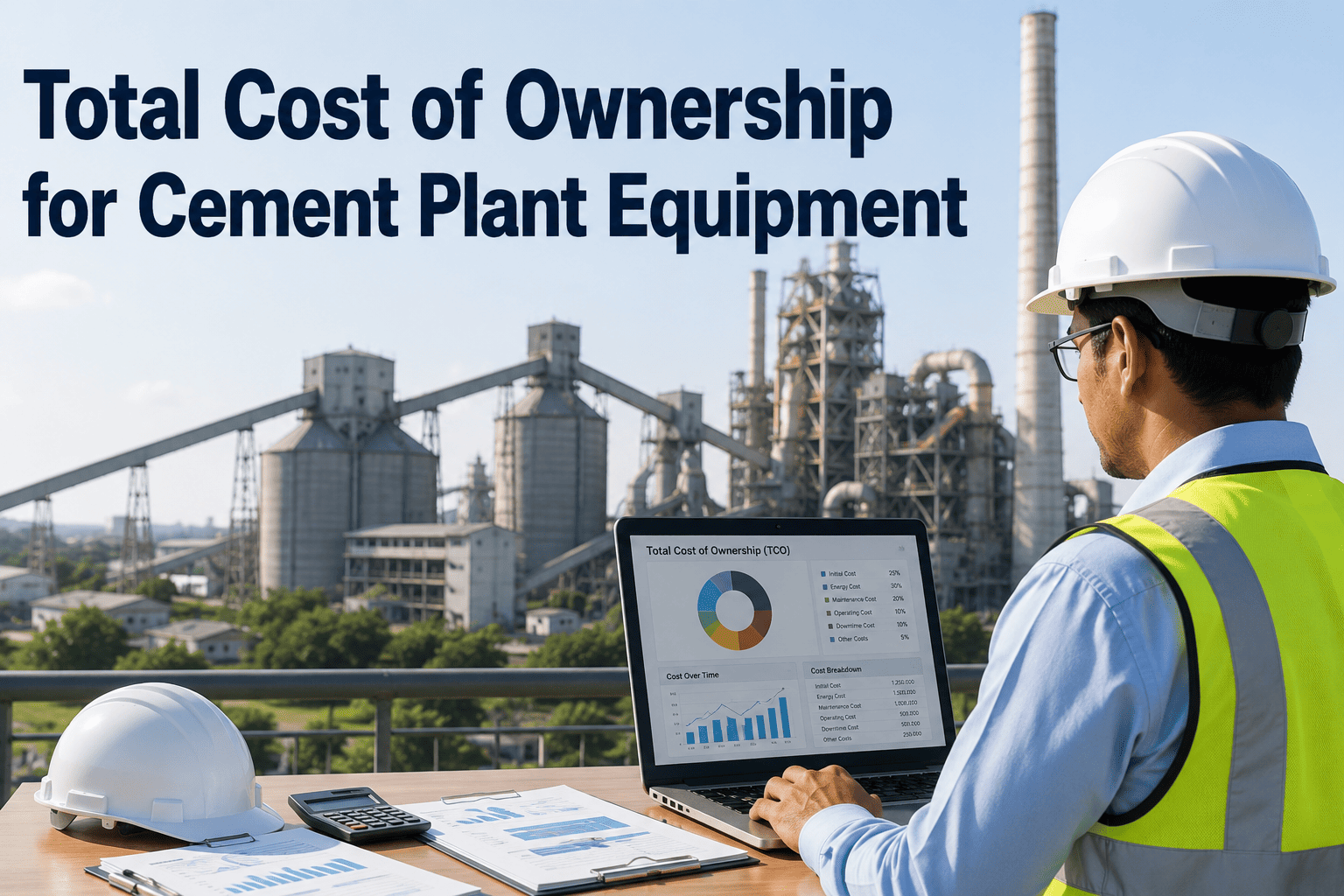
Purchase price typically represents only 25 to 40 percent of an industrial equipment's total lifecycle cost, yet it is usually the only figure procurement teams compare when selecting between vendors for a major cement plant purchase. The remaining 60 to 75 percent — energy, maintenance, downtime, and disposal — accumulates quietly across years of operation, which is why the cheaper machine at purchase is very often the more expensive one to own, a distinction covered further in iFactory's support documentation.
01 / The Five Cost Categories Behind Every Equipment TCO
A complete total cost of ownership model breaks equipment cost into five categories spanning the full asset lifecycle, from the purchase order to final disposal. Each category carries a different weight depending on the equipment type and how critical it is to continuous production, and treating them as a single blended number tends to hide exactly the tradeoffs a TCO model exists to reveal.
| Cost Category | Typical Share of TCO | What It Includes |
|---|---|---|
| Acquisition | 25-40% | Purchase price, delivery, installation, commissioning, training |
| Energy | Varies by asset | Power consumption over the equipment's operating life |
| Maintenance | 30-45% | Preventive labor, spare parts, consumables, corrective repairs |
| Downtime | Up to 40-60% for critical assets | Lost production revenue during unplanned outages |
| Disposal | $50K-200K | Decommissioning, removal, and environmental compliance at end of life |
02 / What Purchase-Price-Only Comparison Actually Costs
A worked comparison makes the gap concrete. Consider two machines being evaluated for the same duty over a ten-year lifecycle — one with a lower sticker price and one with a higher purchase cost but stronger reliability and lower energy draw. On paper, procurement scoring that weights purchase price heavily would favor the cheaper machine, yet the ten-year outcome tells a different story once maintenance and energy differences compound year over year.
03 / Building a TCO Model for a Major Purchase
A usable TCO model does not need to be complex, but it does need to be built before the purchase order is signed, since retroactively discovering a hidden cost category after installation defeats the purpose of the analysis.
04 / Why Downtime Cost Changes the Calculation Most
Of the five TCO categories, downtime cost swings the most between equipment types and is the category most often left out of a procurement comparison entirely, since it does not appear on any vendor quote. Getting this weighting wrong is the single most common reason a TCO model produces a recommendation that does not hold up once the equipment is actually in service.
05 / TCO Weighting Across Common Cement Plant Equipment
The five cost categories apply to every asset, but the weighting between them shifts significantly by equipment type. Knowing which category dominates for a specific piece of equipment is what should drive how much analysis effort goes into modeling it.
Conclusion — Compare What the Equipment Costs to Own, Not Just to Buy
A total cost of ownership model turns a procurement decision that would otherwise be won on quote price alone into one grounded in the full lifecycle cost the plant will actually carry. Building the model before the purchase order is signed, and weighting downtime cost by how critical the asset actually is, consistently prevents the kind of hidden cost overrun that only becomes visible years after installation. Book a demo to build a TCO comparison for your next major equipment decision.
Frequently Asked Questions — Total Cost of Ownership for Cement Plant Equipment
Purchase price typically represents only 25 to 40 percent of total lifecycle cost for heavy industrial equipment, meaning the majority of what a plant will actually spend on an asset over its lifetime falls outside the number on the initial quote. The remaining share is split across energy consumption, maintenance labor and spare parts, downtime from unplanned outages, and end-of-life disposal, with the exact weighting shifting significantly depending on how critical the equipment is to continuous production. Procurement processes that compare vendors on purchase price alone are, by definition, comparing on the smaller portion of the true cost, a distinction covered further in iFactory's support documentation.
Maintenance cost covers the direct spend on keeping equipment running — preventive labor, spare parts, consumables, and corrective repairs — while downtime cost covers the lost production revenue that occurs while the equipment is not running, which is a separate and often much larger figure for process-critical assets. A cheap repair that takes three days to complete can cost far more in lost production than the repair itself, which is why downtime cost needs its own line in the model rather than being folded into maintenance spend. For assets carrying redundancy or backup capacity, this downtime weighting drops substantially since a failure does not halt the production line.
Most TCO analyses use a lifecycle window of three to ten years, chosen to match the equipment's realistic useful life before major overhaul or replacement rather than an arbitrary round number. Shorter-lived or rapidly evolving equipment categories are often modeled over three to five years, while heavy, long-service industrial assets such as kilns, mills, or major rotating equipment are typically modeled over a full decade or longer. The key requirement is applying the same time window consistently across every vendor option being compared, since a mismatched period will distort the comparison regardless of how accurate the underlying cost estimates are.
Disposal and decommissioning costs are frequently left out of procurement analysis entirely, yet for large industrial equipment they can reach $50,000 to $200,000 depending on environmental regulations and site complexity, making them a meaningful line item rather than a rounding error. Equipment containing hazardous materials, complex electronics, or components subject to specific environmental disposal rules typically carries a higher end-of-life cost than simpler mechanical equipment, which is a factor worth weighing at the time of purchase rather than discovering only when the asset is finally retired. Some equipment retains meaningful resale or salvage value that partially offsets this cost, and that expected value should be netted against disposal cost in the model.
Organizations that evaluate equipment purchases using a full TCO model rather than purchase price alone have been shown to reduce total ownership costs by roughly 22 percent on average, largely by avoiding vendors whose lower quote price is offset by higher maintenance, energy, or downtime cost over the asset's life. In documented comparisons, choosing a higher-priced but more reliable and efficient machine over a cheaper alternative has delivered total lifecycle savings in the range of 15 to 20 percent, even after accounting for the larger upfront investment. Book a demo to see how this analysis applies to a specific piece of equipment you're evaluating.