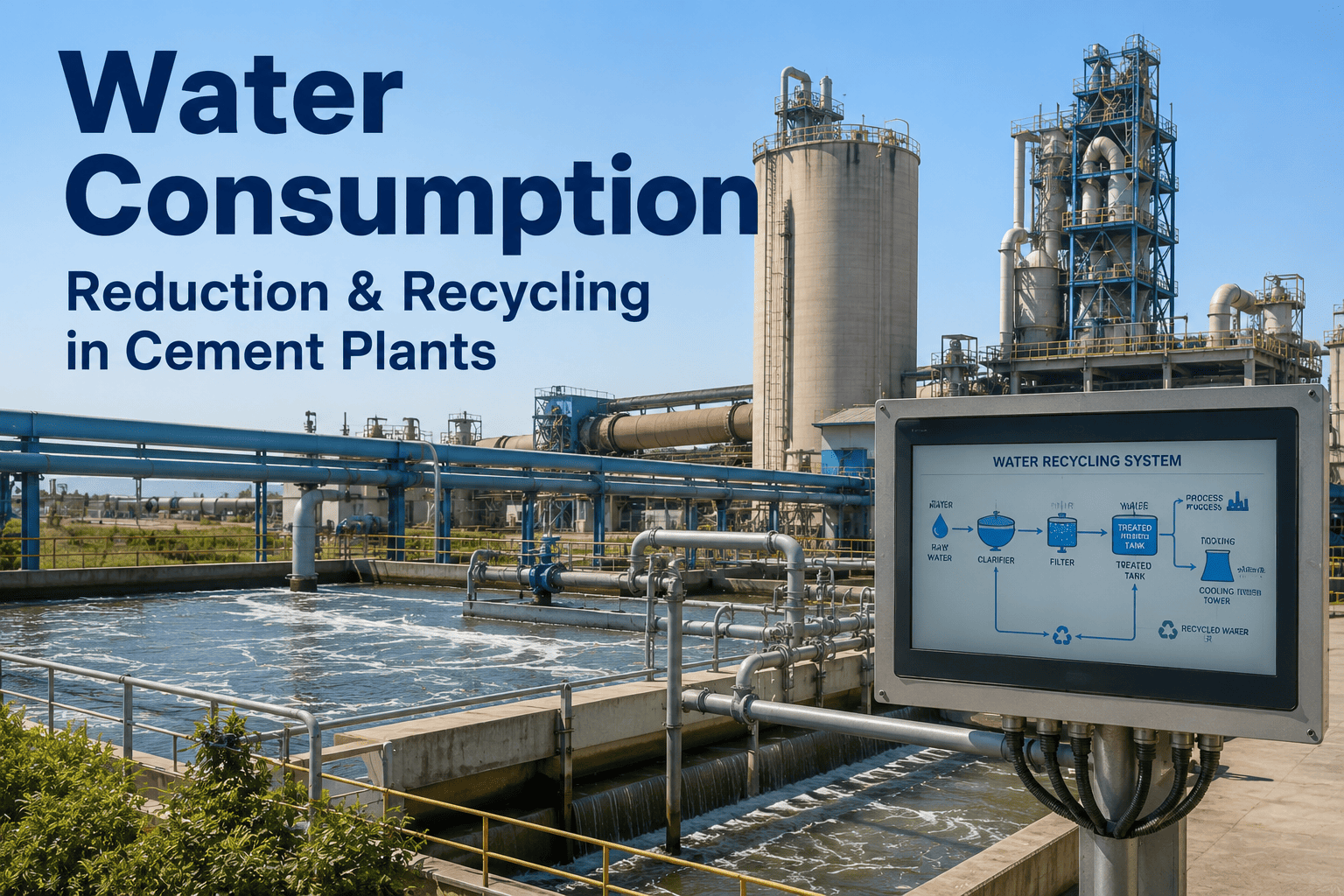
Water consumption in cement production is a material cost and environmental compliance issue that directly affects plant operating margins and regulatory standing. A typical portland cement plant consuming 3,000 to 5,000 gallons of water per 100 tons of clinker production faces annual water procurement costs of $180,000 to $420,000 depending on local industrial water rates of $3.50 to $8.00 per 1,000 gallons — and those costs are escalating at 6 to 12% per year across most U.S. manufacturing watersheds as groundwater extraction permitting tightens and municipal supply allocations are reduced for industrial users. Beyond procurement cost, the compliance exposure from unmanaged water discharge is substantial: Clean Water Act National Pollutant Discharge Elimination System (NPDES) permit violations carry civil penalties of up to $59,973 per day per violation under the 2025 EPA penalty adjustment, and cement plant cooling tower blowdown, process wastewater, and stormwater runoff are all discharge points that require continuous monitoring, treatment verification, and compliance documentation that most plant environmental managers are still tracking on spreadsheets. iFactory's Environmental Monitoring and Analytics & Reporting modules provide cement plant environmental managers with the digital infrastructure to track water consumption across every process area, monitor discharge quality against NPDES permit limits in real time, automate compliance reporting, and identify conservation opportunities that reduce purchased water volume by 28 to 42% within the first 18 months of deployment. Book a Demo to see iFactory's water management platform configured for your plant's water balance and discharge permit profile.
Water Consumption Profile in Cement Plants — Where the Water Goes and What It Costs
The first step in any water conservation program is understanding the plant's water balance — the volume of water consumed by each process area, the source of that water, and the cost per unit at each point of use. Cement plant water consumption is distributed across five primary process categories, each with distinct water quality requirements and conservation potential. The table below presents the typical water consumption profile for a 1.5 million ton per year cement plant operating at 85% capacity utilization.
| Process Area | Primary Water Use | GPM (Avg) | Annual Volume (Gallons) | Annual Cost at $5.50/1K gal | Conservation Potential |
|---|---|---|---|---|---|
| Cooling Tower — Kiln and Compressor Circuits | Evaporative cooling, blowdown replacement | 180-240 | 94.6M — 126.1M | $520,000 — $694,000 | High — 35-50% reduction via cycles of concentration optimization |
| Process — Raw Mill and Finish Mill | Material moisture, bearing cooling, seal water | 50-80 | 26.3M — 42.0M | $145,000 — $231,000 | Moderate — 20-30% via closed-loop conversion and leak repair |
| Quenching — Clinker Cooler | Clinker temperature control, dust suppression | 40-65 | 21.0M — 34.2M | $116,000 — $188,000 | High — 40-60% via dry clinker cooling upgrades and recirculation |
| Dust Suppression — Material Handling and Conveyor Transfer Points | Fugitive emission control, road wetting | 30-50 | 15.8M — 26.3M | $87,000 — $145,000 | Low — 10-15% via automated nozzle control and mist systems |
| Domestic and Sanitary — Admin, Lab, Locker Rooms | Drinking, sanitation, laboratory analysis | 10-20 | 5.3M — 10.5M | $29,000 — $58,000 | Moderate — 25-35% via low-flow fixtures and greywater recycling |
Water Conservation Strategies for Cement Plants — The Five Levers of Reduction
Reducing purchased water volume in a cement plant requires a systematic approach across five conservation levers. Each lever targets a specific category of water use within the plant's water balance and has a measurable reduction potential, implementation cost range, and payback period. The framework below presents each conservation lever with its cement plant application, typical water savings, and the iFactory monitoring and control capability that supports it.
Zero Liquid Discharge Implementation Pathway for Cement Plants
Zero liquid discharge (ZLD) is the most comprehensive water management strategy available to cement plants — eliminating all liquid wastewater discharge from the facility and recovering usable water for reuse in plant operations. While ZLD represents a significant capital investment ($3 to $8 million for a typical cement plant), it eliminates NPDES discharge permit compliance requirements entirely, recovers 90 to 95% of wastewater volume as reusable water, and produces a solid waste stream (primarily calcium sulfate and sodium chloride) that can be blended into cement or sent to landfill. The implementation pathway below presents the five-stage process for ZLD deployment at an existing cement plant.
Water Quality Monitoring and NPDES Compliance Tracking — Real-Time Discharge Management
Cement plant NPDES permits typically specify effluent limits for pH (6.0-9.0 standard range), total suspended solids (TSS — 30 to 100 mg/L depending on receiving waterbody), oil and grease (10 to 15 mg/L), and temperature (maximum 5 degrees F above receiving water ambient temperature). Exceedances of any of these limits during a compliance monitoring period trigger a permit violation that must be reported to the EPA or authorized state agency and carries the penalty exposure noted above. iFactory's environmental monitoring module connects directly to inline water quality sensors at discharge points and provides real-time compliance status with automated notification and documentation when limits are approached or exceeded.
pH Monitoring and Automated Neutralization Control
Continuous inline pH sensors at each discharge point feed real-time readings to iFactory's monitoring dashboard. When pH approaches the permit limit threshold (within 0.5 pH units), iFactory triggers an alert to the environmental manager and the plant control room operator. For discharge points with automated pH neutralization systems, iFactory can send a control signal to adjust acid or caustic feed rates to maintain compliance without operator intervention. All pH readings, control actions, and neutralization chemical consumption are logged for NPDES compliance reporting and audit trail documentation.
Total Suspended Solids Monitoring and Clarifier Performance
TSS is measured using inline turbidity sensors calibrated to site-specific TSS-turbidity correlation curves. iFactory tracks clarifier effluent turbidity continuously and provides early warning when TSS approaches 80% of the permit limit — giving operations staff time to adjust polymer feed rate or clarifier weir level before an exceedance occurs. TSS exceedances are automatically logged with the date, time, duration, magnitude, and the corrective action taken, generating the documentation required for EPA non-compliance reporting.
Oil and Grease Monitoring and Spill Prevention
iFactory integrates with inline oil-in-water fluorescence sensors at discharge points where oil and grease limits apply — typically cooling tower blowdown, compressor room drains, and stormwater outfalls. When oil and grease concentration exceeds 50% of the permit limit, iFactory triggers a Level 1 notification to the environmental manager. If the concentration reaches 80% of the permit limit, iFactory activates a Level 2 escalation that includes automatic shutoff of the discharge valve (if configured) and generation of a spill prevention report for EPA SPCC compliance documentation.
Discharge Flow and Temperature Monitoring
Flow measurement at each NPDES outfall is essential for calculating total pollutant loading (mass per day) in addition to concentration-based permit limits. iFactory tracks instantaneous flow rate and cumulative daily discharge volume, calculating pollutant loadings automatically from concentration data. Temperature sensors at the outfall and at the receiving waterbody upstream provide the data needed for thermal discharge compliance — automatically generating the temperature differential calculation and logging any exceedances with the required ambient water temperature measurement documentation.
Digital Water Management Performance Benchmarks — Manual vs. iFactory Platform Comparison
The performance gap between manual spreadsheet-based water management and iFactory's digital platform is measurable across water consumption, compliance, and operational efficiency metrics. The comparison below presents benchmark data from cement plant deployments across the United States, comparing pre-iFactory baseline performance to results achieved within the first 18 months of platform operation.
Water Management Implementation Checklist — What iFactory Configures and Tracks Continuously
The checklist below covers the configuration items and continuous monitoring actions in a fully operational iFactory water management deployment for a cement plant. Items are organized across five functional domains. All items are visible on the iFactory environmental monitoring dashboard in real time and exportable for NPDES compliance reporting, corporate ESG reporting, and internal water audit purposes.
- Zone-level flow meters installed at each major consumption point — cooling tower makeup, mill cooling, clinker quench, dust suppression, sanitary
- Water balance model configured in iFactory — inflow vs. consumption by zone, daily reconciliation, anomaly flagging for unaccounted losses
- Makeup water source tracking — municipal supply, well water, recycled water, rainwater — by volume and cost per source
- Automated water cost reporting — monthly procurement cost by source, cost per ton of clinker, year-over-year trend for budget planning
- Continuous pH, TSS, temperature, and flow monitoring at each NPDES outfall — sensor calibration tracking and data validation
- Automated exceedance alerting and documentation — trigger thresholds at 80% and 100% of permit limit with corrective action logging
- NPDES Discharge Monitoring Report (DMR) generation — auto-populated from sensor data, ready for electronic submission to EPA or state agency
- SPCC spill prevention documentation — oil-water separator monitoring, secondary containment inspection tracking, spill event logging
- Cooling tower cycles of concentration optimization — conductivity setpoint control, blowdown volume tracking, water savings calculation
- Recycled water volume tracking — treatment system throughput, quality parameters, reuse destination, displacement of purchased water
- Rainwater harvesting system performance — basin level, capture volume, water quality, pump-to-use schedule, cost displacement reporting
- Leak detection and repair program performance — zone-level anomaly identification, work order generation, leak closure rate tracking
- Water intensity metric tracking — gallons per ton of clinker, gallons per ton of cement, trend reporting for GRI 303 and CDP water disclosure
- Water conservation project tracking — project description, capital cost, water savings achieved, payback period, ROI calculation
- Wastewater discharge volume and quality trend — annual reduction reporting, pollutant loading reduction, receiving waterbody impact documentation
- Regulatory compliance archive — NPDES DMR copies, inspection reports, permit correspondence, enforcement action documentation
Expert Review: What Cement Plant Environmental Managers Say About Digital Water Management
I have managed environmental compliance at three cement plants over the past sixteen years — a wet-process plant in the Midwest, a dry-process plant in the Southeast, and a plant with both preheater and in-line raw mill systems in the Southwest — and water management at every one of them was the environmental compliance area with the widest gap between what the plant thought it knew and what it actually had visibility into. At the first plant, we tracked water consumption with monthly manual meter readings that were always two to three weeks stale by the time they reached a spreadsheet. We had no way to know whether a cooling tower blowdown valve was stuck open between readings — and at that plant, it was, for an estimated 47 days before a semi-annual meter calibration caught the loss. At the second plant, we had an NPDES pH exceedance that was not detected until the weekly grab sample was analyzed — four days after the event — and we had already accumulated four days of continuous exceedance at a cost of $59,973 per day under the penalty guidelines at that time. The plant settled with the state agency for $186,000. That exceedance would have been detected and corrected within 30 minutes with continuous inline pH monitoring and automated alerting. At the third plant, we deployed iFactory's environmental monitoring module with inline sensors at every major discharge point and zone-level flow meters at the five largest consumption points. Within six months, we identified and repaired three leaks that were collectively losing 14 gallons per minute — 7.4 million gallons per year that the plant was buying, treating, and discharging without any productive use. The leak repairs paid for the sensor deployment in under four months. The difference between reaction and visibility is the difference between finding a leak six months after it starts and finding it six minutes after it starts — and that difference is the difference between a $186,000 fine and a zero-violation compliance record. iFactory does not change what a good water management program requires. It changes whether you can actually see whether you have one.
— Plant Environmental Manager, U.S. Cement Manufacturing — 16 Years Environmental Compliance Management — Registered Environmental Manager (REM), NREP — Certified Hazardous Materials Manager (CHMM)Conclusion
Water management in cement plants sits at the intersection of operating cost, environmental compliance, and corporate sustainability — and the margin between adequate and excellent water management is determined almost entirely by visibility. The plant that can see its water consumption in real time, detect leaks and inefficiencies within hours instead of weeks, track discharge quality continuously instead of by weekly grab sample, and generate NPDES compliance reports in minutes instead of days is the plant that operates at lower cost, lower regulatory risk, and higher water stewardship performance than the plant managing the same water balance with the same equipment but without digital visibility.
iFactory's Environmental Monitoring and Analytics & Reporting modules provide that visibility — connecting zone-level flow meters, inline water quality sensors, cooling tower performance data, and compliance documentation into a single water management platform that serves the needs of the environmental manager, the plant engineer, the CFO, and the corporate sustainability officer simultaneously. The 28 to 42% reduction in purchased water volume, the 85 to 100% reduction in NPDES violation exposure, and the elimination of manual compliance reporting labor at iFactory-managed plants are not the result of different water management strategies — they are the result of having a system that makes those strategies visible and manageable in real time. Book a Demo to see how iFactory's platform manages water consumption, conservation, and compliance for your plant's water balance and discharge permit profile.
Frequently Asked Questions
Yes. iFactory's sensor integration layer supports Modbus RTU/TCP, 4-20 mA analog, HART, PROFIBUS, and OPC-UA protocols — covering the most common industrial water quality sensor and flow meter communication standards. Existing sensors are typically integrated without requiring replacement or parallel installations.
Yes. iFactory's compliance reporting module generates DMRs in the EPA NetDMR electronic format and in state-specific formats for authorized NPDES programs — pre-populated with monitoring data from the current reporting period. The system supports manual review and approval workflow before submission.
iFactory automatically detects data gaps and flags them for investigation. For NPDES compliance purposes, the system applies the EPA's data gap handling policy — carrying forward the last valid measurement for monitoring period calculations and flagging the gap period in compliance reports with the data quality qualifier required by the permit.
iFactory's water management module is typically deployed in 4 to 8 weeks — including sensor integration, zone-level meter configuration, NPDES outfall monitoring setup, water balance model calibration, and team training. Book a Demo for a site-specific deployment scope and pricing estimate.
Yes. iFactory's project tracking module captures capital cost, implementation date, baseline consumption, post-implementation consumption, and calculated water savings — generating project-level ROI reports and aggregate water conservation metrics that support GRI 303, CDP water security questionnaire, and corporate ESG disclosure requirements.