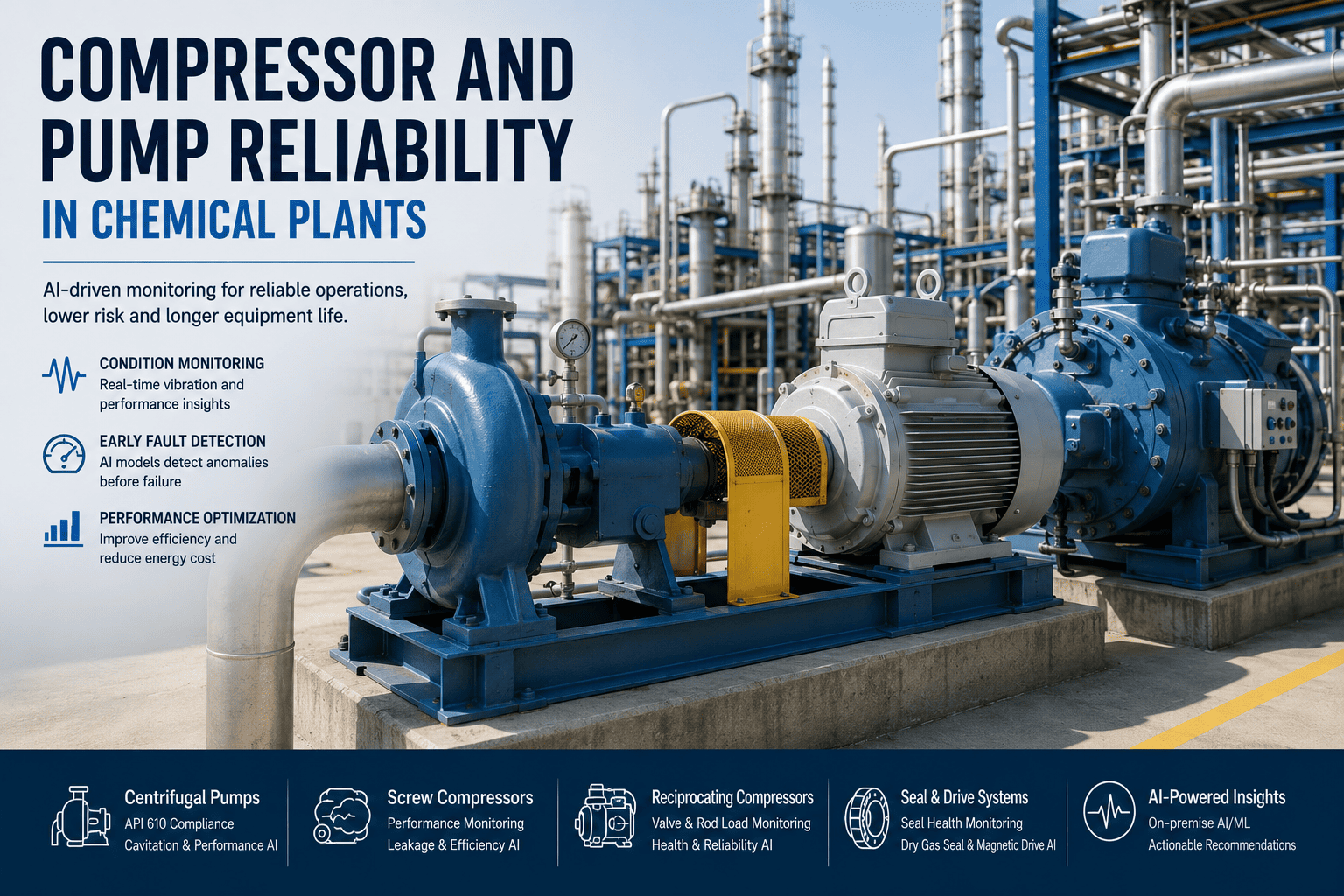
Compressor and Pump Reliability in Chemical Plants
By David Cook on August 24, 2026
Walk any chemical plant and you are surrounded by rotating equipment. Hundreds of pumps and compressors move every fluid and gas through the process, and they are also where most of the unplanned failures live. A reliability lead does not lose sleep over the big columns and vessels — they lose it over the centrifugal pump whose seal is weeping, the reciprocating compressor whose valves are on borrowed time, and the dry gas seal that could turn a running machine into a release. In chemical service the stakes are higher than downtime: a seal or containment failure is a leak of something hazardous. iFactory's Rotating Equipment AI reads vibration, performance, and seal health together — catching the degradation across your fleet before a machine takes itself, or the plant, down.
Rotating Equipment Reliability for Chemical Plants
Compressor and Pump Reliability in Chemical Plants
Vibration, performance, and seal AI for centrifugal pumps, screw compressors, and reciprocating compressors. Detect seal, bearing, valve, and cavitation problems early, prioritize the fleet, and keep hazardous service contained — on-premise.
Pumps and compressors are the most numerous machines in the plant and, not coincidentally, the most frequent source of unplanned work. They run hot, fast, and continuously, in aggressive service, and they fail through mechanisms a single sensor rarely catches on its own. The reliability lead's problem is not a lack of data — it is that vibration alone misses a fouling impeller, performance alone misses a developing bearing, and neither sees a seal degrading until it leaks. Reading them together, across the whole fleet, is what turns scattered signals into early warning.
Three Signals Tell the Whole Story
Rotating equipment speaks through three channels at once. Any one is partial; fused per asset, they give a complete picture of health and the lead time to act on it.
Vibration
Spectral analysis for bearing defects, unbalance, misalignment, looseness, and blade-pass — the mechanical health of the machine.
Performance
Head, flow, efficiency, and power against the curve — revealing wear, fouling, and operation away from the best efficiency point.
Seal
Seal chamber and flush conditions, leakage, and dry gas seal behaviour — the containment that keeps hazardous fluid inside.
Fused per asset into one health picture, with a remaining-life window you can plan maintenance around
Read the Pump by Its Curve
A centrifugal pump tells you how it is doing by where it sits on its performance curve. Near the best efficiency point it runs smooth and reliable; pushed far to either side it runs rough, stressing seals and bearings and inviting cavitation. Performance AI watches the operating point and the curve itself, so drift off the reliable window shows up as a reliability risk, not just an efficiency loss.
Pump operating point and the reliable window
Sustained operation off the best efficiency point does not just waste energy — it shortens seal and bearing life. Catching the drift early protects the machine, not only the power bill.
The Failures That Take Rotating Equipment Down
Most rotating-equipment failures come from a short list of mechanisms, and each leaves a signature before it fails. In chemical service, several of them are containment events, which is why early warning is a safety measure as much as a reliability one.
Mechanical seal failure
Signal: seal flush conditions, leakage, temperature, vibration
The leading cause of pump failure — and a leak of process fluid.
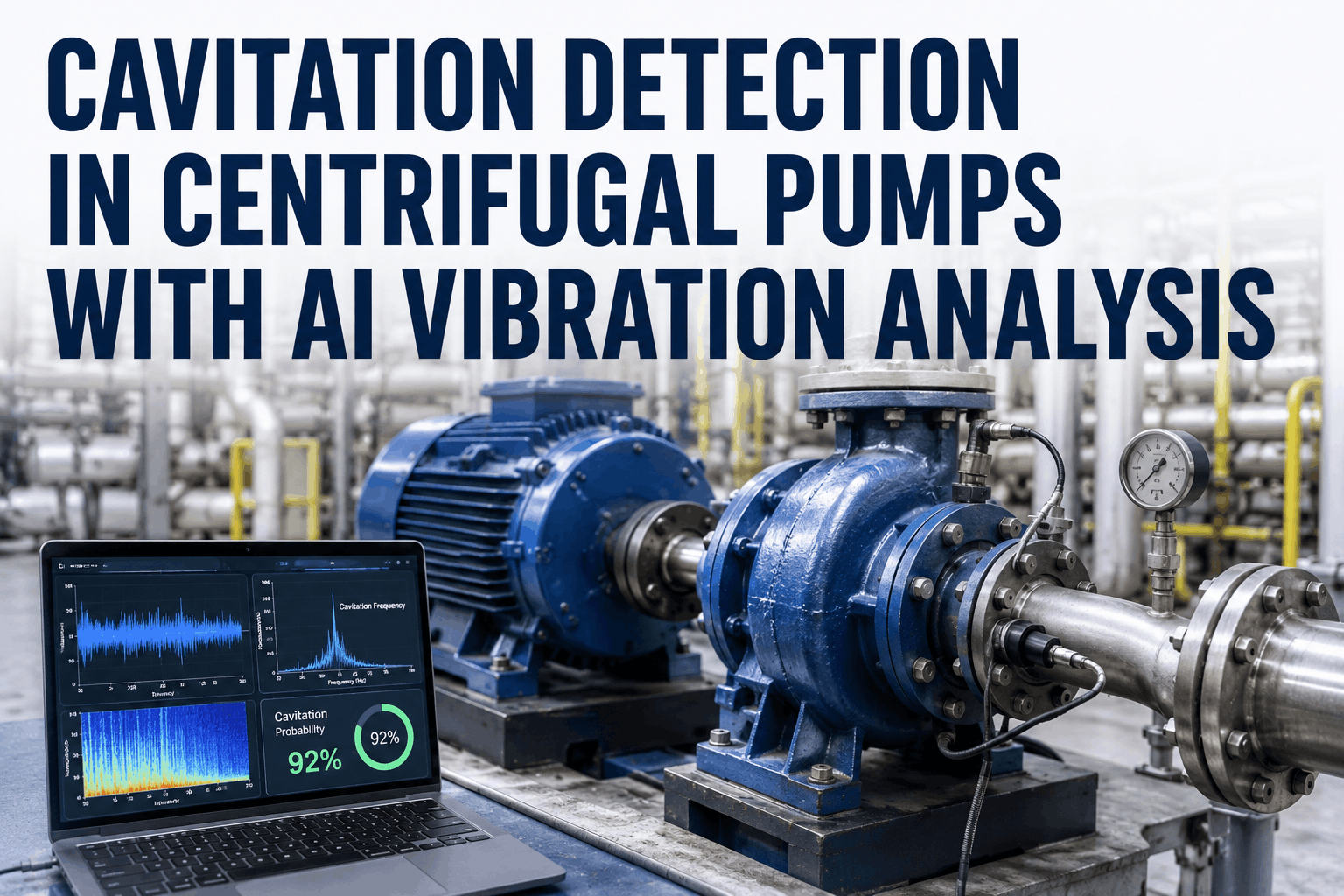
Cavitation
Signal: NPSH margin, suction pressure, acoustic and vibration signature
Erodes the impeller and shakes the machine; often an operating problem.
Gradual and detectable, with weeks of warning if it is being watched.
Reciprocating valve wear
Signal: valve temperature, pressure, cylinder performance, rod load
The top maintenance item on recip compressors, catchable before failure.
Dry gas seal issues
Signal: seal gas flow and pressure, leakage trend
On centrifugal compressors, a seal problem is a potential release.
Every Machine, Its Own Standard
Different rotating equipment fails in different ways and is built to different standards. The AI is configured to each machine class, so the diagnostics fit the asset rather than a generic template.
Centrifugal pumps
API 610
Seal, bearing, cavitation, and off-BEP operation across your largest pump population.
Reciprocating compressors
API 618
Valve health, rod load, packing, and cylinder performance on the plant's hardest-working machines.
Screw compressors
Rotor and bearing health
Rotor condition, bearings, and lubrication trended continuously.
Seals and sealless
Dry gas seals and mag-drive
Dry gas seal monitoring, seal-plan health, and magnetic-drive containment for leak-free service.
Hundreds of Assets, One Priority List
The reliability lead's daily question is not whether something is degrading — something always is — but which machine to attend to first. Ranking every asset by condition and by how critical it is turns a fleet of alarms into a short, honest priority list.
Fleet priority: criticality against condition
HighCriticalityLow
K-201 recip
P-104 seal
P-101
C-302
HealthyConditionCritical
The top-right corner — critical machines in poor condition — is where maintenance goes first. Everything else waits its turn, on evidence rather than on the loudest complaint.
Which of your rotating machines is closest to the top-right corner right now? Book a 30-minute demo and we'll rank a slice of your fleet by condition and criticality.
What Rotating Equipment AI Delivers
Watching vibration, performance, and seal health across the fleet changes both the reliability numbers and the safety ones.
Early
Failure warning
seals, bearings, and valves caught in time
Fewer
Leaks and trips
containment protected, not just uptime
Caught
Off-BEP and cavitation
operating problems fixed before damage
Focused
Maintenance
the fleet ranked, effort where it counts
Frequently Asked Questions
Why fuse vibration, performance, and seal data instead of just vibration?
Because each channel is blind to some failures. Vibration is excellent for bearings and mechanical faults but will not see a fouling impeller or a pump drifting off its curve, and neither vibration nor performance reliably catches a seal degrading before it leaks. Combining all three per asset detects more failure modes earlier and, importantly for chemical service, watches the seals that keep hazardous fluid contained.
Does it handle reciprocating compressors, not just pumps?
Yes. Reciprocating compressors have their own failure profile — valves, rod load, packing, and cylinder performance — and the AI is configured for it, in line with how API 618 machines are monitored. It also covers centrifugal pumps to API 610 practice, screw compressors, and the seals across them, so one platform spans the rotating fleet.
Can it monitor dry gas seals and sealless pumps?
Yes, and these are among the most valuable to watch. Dry gas seal behaviour on centrifugal compressors and the containment health of magnetic-drive pumps are directly tied to whether hazardous service stays contained. Trending seal gas flow, pressure, and leakage gives warning of a developing seal problem before it becomes a release.
We have hundreds of pumps. How does it help us prioritize?
By ranking every asset on both its condition and its criticality, so you get a short priority list rather than a wall of individual alarms. The machines that are both critical and degrading rise to the top, and the rest are ordered behind them on evidence. It turns fleet-wide monitoring into a manageable maintenance plan.
Does it run on-premise?
Yes. It runs on-premise inside the plant, working with your existing vibration, process, and seal instrumentation and historian, keeping data within your firewall. The best next step is a demo where we take a slice of your rotating fleet and show the fused health picture and the priority ranking on your own machines.
Catch the Seal Before It Becomes a Leak.
See Your Rotating Fleet Ranked by Health and Risk
Bring a slice of your pumps and compressors — vibration, performance, and seal data. We'll show the fused health picture per machine, the failure modes it catches early, and the fleet priority list against criticality.