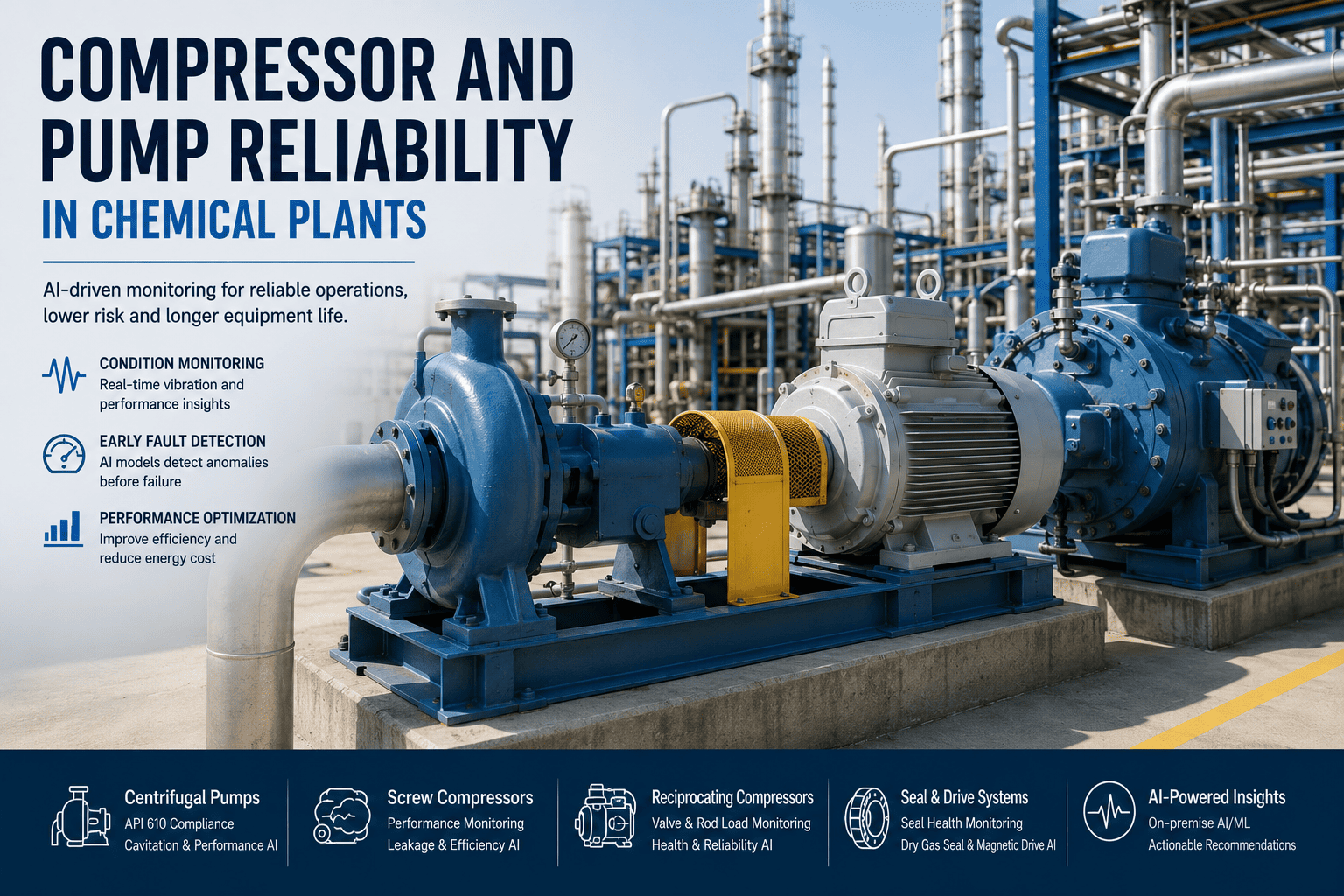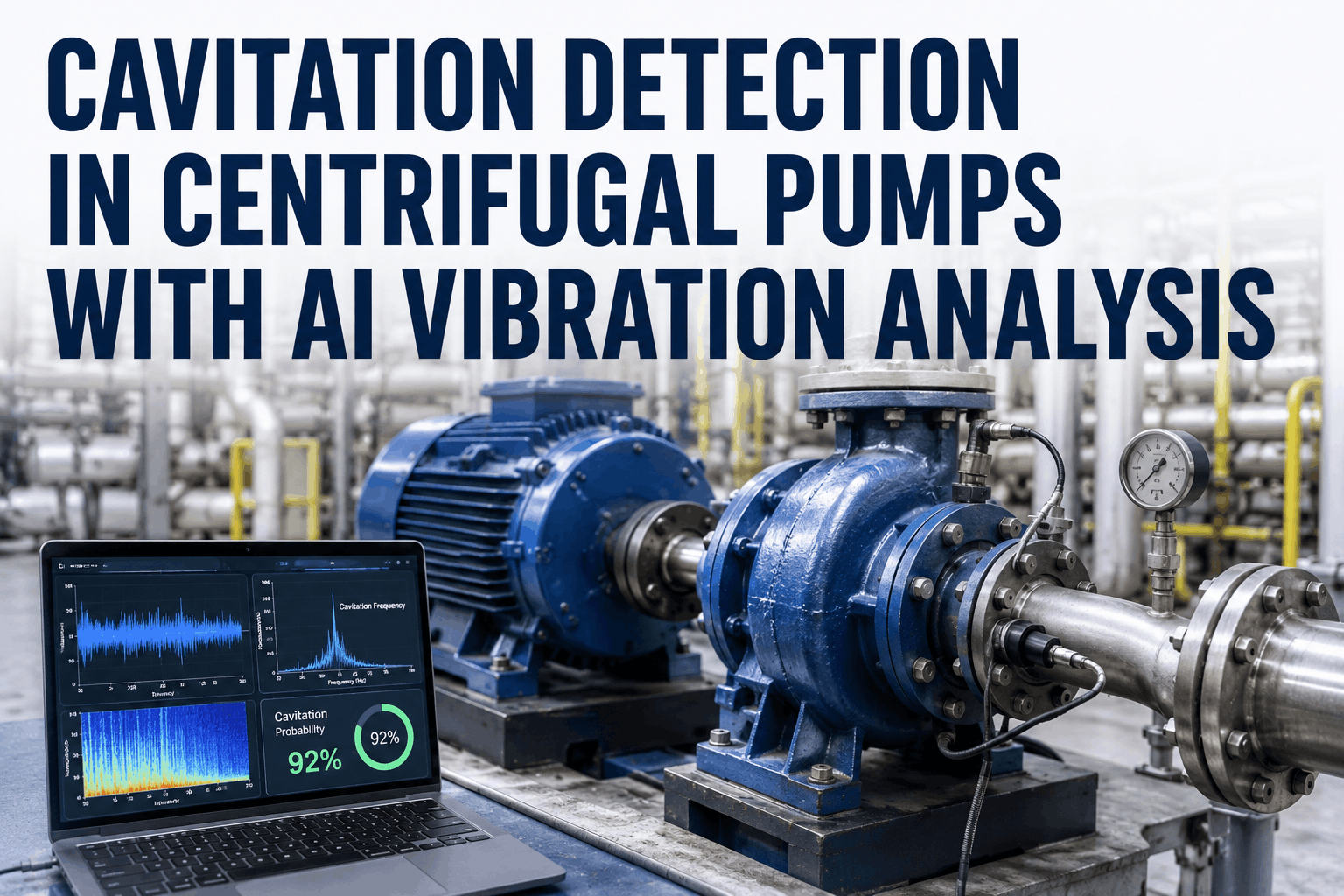
AI identifies cavitation signatures in pump vibration spectra before impeller damage occurs — distinguishing between suction cavitation, discharge recirculation, and air entrainment with a specificity that broadband vibration alarms cannot achieve. Start Trial Free to see how iFactory gives rotating equipment engineers the cavitation-specific vibration analysis needed to protect centrifugal pump impellers before structural damage occurs.
Detect Cavitation Before Impeller Damage — Not After
iFactory's AI analyzes pump vibration spectra for cavitation-specific frequency signatures — distinguishing cavitation type, severity, and progression rate to give engineers actionable lead time before pitting damage reduces impeller efficiency or causes mechanical failure.
Why Broadband Vibration Alarms Miss Early Cavitation
Broadband vibration RMS thresholds are effective for detecting structural failure progression — but cavitation in its early stages does not significantly elevate overall vibration amplitude. The signature appears in the high-frequency spectrum, in spectral noise floors between blade pass harmonics, and in acoustic emission energy bands that wideband accelerometer RMS measurements average out. By the time cavitation severity has progressed enough to raise broadband vibration above a conventional alarm threshold, impeller pitting is already underway. AI vibration analysis trained on cavitation-specific spectral features detects the signature pattern earlier — giving maintenance engineers intervention lead time while operating parameter correction is still a viable option. Engineering teams that Book a Demo with iFactory see how spectral feature extraction changes cavitation detection timing compared to threshold-based alarm systems.
-
Suction Cavitation Detection
iFactory identifies suction cavitation signatures — elevated sub-synchronous noise, increased broadband energy in the 1–10 kHz range, and instability in the 1X component — from vibration spectra on the pump suction side accelerometer.
-
Discharge Recirculation Identification
Discharge recirculation produces distinct spectral features at sub-BPF frequencies combined with increased low-frequency noise. iFactory differentiates discharge recirculation from suction cavitation using the spectral ratio pattern and flow condition context.
-
Air Entrainment Discrimination
Air entrainment produces a characteristically irregular broadband noise signature without the structured frequency content of vapor cavitation. iFactory's classification model distinguishes air entrainment from true cavitation to prevent misdiagnosis-driven interventions.
-
Blade Pass Frequency Harmonic Analysis
iFactory tracks BPF harmonics and their sidebands across operating conditions — identifying the harmonic distortion patterns associated with impeller cavitation damage progression in addition to early-stage spectral noise indicators.
-
Operating Point Correlation
Cavitation risk varies with flow rate relative to the pump's best efficiency point. iFactory correlates vibration spectral features with flow and head data — providing operating-point-normalized cavitation severity assessments that reduce false positives at off-BEP operation.
-
Severity Staging and Progression Rate
iFactory stages cavitation severity across four levels — incipient, developing, established, and advanced — and tracks progression rate between assessments to estimate the intervention window before impeller damage becomes irreversible.
Cavitation Type Classification: Vibration Signature Characteristics
-
Suction Cavitation: Sub-Synchronous Noise and High-Frequency Broadband Elevation
Most Common TypeSuction cavitation — caused by insufficient net positive suction head available relative to required — produces vapor bubble formation at the impeller eye, collapse on the leading face of the blades, and a characteristic vibration signature: elevated broadband noise energy in the 1–10 kHz range, increased sub-synchronous spectral content below 1X running speed, and a rising spectral noise floor between BPF harmonics that grows as cavitation intensity increases. iFactory's feature extraction identifies this signature pattern in the frequency domain and tracks its development over successive analysis windows — enabling engineers to quantify cavitation intensity before the broadband RMS level reaches a conventional alarm threshold. Teams that Start Trial can begin analyzing installed pump vibration spectra for suction cavitation signatures immediately.
-
Spectral Signature
Broadband elevation 1–10 kHz, sub-synchronous noise below 1X
-
Root Cause
Insufficient NPSHa relative to pump NPSHr
-
iFactory Record
Spectral feature trend tracked per pump unit with severity staging
-
-
Discharge Recirculation: Sub-BPF Instability and Low-Frequency Noise
Off-BEP CavitationDischarge recirculation occurs when a pump operates significantly below its best efficiency point flow — causing reverse flow at the impeller discharge that generates vapor bubble formation and collapse on the pressure face of blades. The vibration signature differs from suction cavitation: the dominant spectral feature is increased energy at sub-BPF frequencies, combined with irregular low-frequency noise and impulsive content that reflects the unsteady recirculation flow pattern. iFactory's classification model uses the sub-BPF to BPF energy ratio and low-frequency spectral character to differentiate discharge recirculation from suction cavitation — a distinction that determines whether the corrective action is NPSH improvement or flow rate increase. Teams that Book a Demo can review the classification logic for discharge recirculation versus suction cavitation in their pump configurations.
-
Spectral Signature
Sub-BPF energy elevation, low-frequency irregular noise
-
Root Cause
Operation below minimum continuous stable flow
-
iFactory Record
BEP deviation ratio recorded alongside spectral classification
-
-
Air Entrainment: Irregular Broadband Noise Without Harmonic Structure
Ingestion CavitationAir entrainment produces a vibration signature that superficially resembles cavitation — elevated broadband noise, increased vibration amplitude — but lacks the structured spectral features that characterize vapor cavitation. Air-entrained flow produces random, burst-like impulsive content rather than the quasi-periodic high-frequency signature of bubble collapse. iFactory's classification model distinguishes air entrainment from vapor cavitation by analyzing spectral regularity, kurtosis of the time-domain signal, and the absence of structured BPF-correlated harmonic content. Correct classification prevents misdiagnosis: the corrective action for air entrainment addresses system piping and suction design rather than head or flow rate adjustment.
-
Spectral Signature
Irregular broadband noise, high kurtosis, no structured harmonics
-
Root Cause
Air ingestion through seals, vortexing, or inadequate submergence
-
iFactory Record
Classification confidence score logged with spectral feature values
-
-
Impeller Damage Progression: BPF Harmonic Distortion and Asymmetric Sidebands
Structural Damage StageAs cavitation pitting progresses, impeller vane geometry changes — producing asymmetric blade pass responses, sideband families around BPF harmonics, and changes in the BPF amplitude relative to running speed harmonics that indicate non-uniform vane loading. iFactory tracks BPF harmonic amplitudes and sideband patterns over time — identifying the transition from cavitation-induced noise to the structured spectral changes that indicate mechanical impeller degradation. This transition marker is the boundary between operating parameter correction and physical intervention: once BPF harmonic distortion appears, the cavitation has already caused structural change that cannot be reversed by process adjustment alone. Teams that Start Trial can configure iFactory to alert on BPF sideband development as a damage progression indicator.
-
Spectral Signature
BPF sideband families, asymmetric harmonic amplitudes
-
Damage Indicator
Transition from noise signature to structured harmonic distortion
-
iFactory Record
BPF harmonic trend archived per pump for damage stage assessment
-
-
Operating Point Normalized Cavitation Severity Assessment
Context-Aware AnalysisCentrifugal pumps operating away from their best efficiency point exhibit elevated vibration and noise that is not cavitation — and cavitation severity assessment without operating point context produces false positives whenever pumps operate at reduced flow. iFactory integrates flow rate and head data with vibration spectra — normalizing spectral features against the expected vibration character at the current operating point before applying cavitation classification. A pump showing elevated high-frequency noise at 40% of design flow is assessed against the expected spectral profile at that operating point rather than against a fixed threshold — reducing false positive cavitation alerts during intentional reduced-flow operation while maintaining sensitivity to true cavitation onset. Teams that Book a Demo can review operating point normalization configuration for their pump curves.
-
Context Input
Flow rate, differential head, and speed relative to rated conditions
-
Normalization Output
Operating-point-adjusted cavitation severity score
-
iFactory Record
Operating condition recorded per cavitation assessment event
-
-
Acoustic Emission Supplemental Analysis
High-Frequency ModalityAcoustic emission sensors operating in the 100 kHz to 1 MHz range detect the stress wave energy released during cavitation bubble collapse with greater sensitivity than standard accelerometers — providing an earlier detection window for incipient cavitation that is not yet visible in the vibration spectrum. iFactory incorporates acoustic emission data where sensors are installed, fusing AE feature trends with vibration spectral analysis to extend detection lead time on high-value pumps in critical service. AE-enhanced cavitation detection is particularly effective for pumps on water-like, low-viscosity fluids where bubble collapse energy is highest and vibration spectral features develop more slowly. Teams that Start Trial can configure iFactory to incorporate AE sensor data alongside vibration analysis where installed.
-
AE Frequency Range
100 kHz to 1 MHz stress wave energy detection
-
Detection Advantage
Earlier incipient cavitation detection than vibration alone
-
iFactory Record
AE feature trend fused with vibration spectral history per pump
-
Cavitation Detection Performance Benchmarks
Detection Lead Time vs Alarm Method
AI spectral analysis provides 16 days of lead time before impeller damage onset versus 3 days for RMS threshold alarms — with AE fusion extending detection to 22 days.
Classification Accuracy by Cavitation Type
iFactory achieves 90% classification accuracy for suction cavitation and 87% for discharge recirculation — enabling type-specific corrective action without additional diagnostic testing.
False Positive Rate by Severity Stage
False positive rates decline at higher severity stages — from 24% at incipient detection to 4% at established cavitation — as spectral features become more pronounced.
Impeller Life Extension by Early Intervention
Early AI cavitation detection and operating parameter correction extends average impeller service life by 2.4x compared to operation until broadband alarm activation.
Cavitation Vibration Signature Reference: Analysis Specifications
Scroll for more
| Cavitation Type | Primary Spectral Feature | Frequency Range | iFactory Detection Method | Corrective Action |
|---|---|---|---|---|
| Suction Cavitation | Broadband noise elevation, sub-1X energy | 1–10 kHz, sub-synchronous | Spectral noise floor trend + BPF ratio | Increase NPSHa, reduce speed |
| Discharge Recirculation | Sub-BPF instability, low-frequency noise | Sub-BPF, 0–200 Hz | Sub-BPF energy ratio + flow context | Increase flow toward BEP |
| Air Entrainment | Irregular broadband, high kurtosis | Broadband, no harmonic structure | Kurtosis + harmonic absence classification | Fix suction piping, seal leaks |
| Impeller Damage | BPF sideband families, asymmetric harmonics | BPF and harmonics ± sidebands | Sideband family detection + asymmetry index | Impeller inspection and replacement |
| Incipient (AE) | Stress wave energy bursts | 100 kHz–1 MHz | AE energy trend + burst rate analysis | Operating parameter optimization |
How iFactory Supports Pump Cavitation Detection Programs
Protecting centrifugal pump impellers from cavitation damage requires detecting the vibration signatures specific to each cavitation mechanism before structural progression begins — and that requires spectral analysis capability that threshold-based alarm systems were not designed to provide. iFactory processes pump vibration spectra through feature extraction models trained on cavitation-specific signatures, correlates findings with operating point data to normalize severity assessments, and tracks spectral feature trends over time to identify progression rates that determine intervention urgency. When iFactory identifies developing suction cavitation on a critical process pump — staging the severity as developing, estimating 14 days to impeller damage threshold, and recommending specific NPSHa improvement actions — maintenance engineers have the diagnostic precision to intervene at the process level rather than waiting for pump performance degradation to confirm the diagnosis. Facilities can Start Trial and begin analyzing existing pump vibration data for cavitation signatures within the first iFactory session.
Cavitation-Specific Spectral Feature Extraction
iFactory extracts the frequency domain features specific to each cavitation mechanism — broadband noise floors, sub-synchronous energy, BPF harmonic ratios — rather than relying on overall vibration amplitude thresholds that cavitation bypasses in its early stages.
Multi-Type Cavitation Classification
iFactory classifies detected cavitation signatures by mechanism — suction, discharge recirculation, or air entrainment — providing the type-specific diagnosis that determines which corrective action will resolve the condition.
Operating Point Normalized Severity Scoring
iFactory integrates flow, head, and speed data with vibration spectra — producing cavitation severity scores that account for operating point so off-BEP operation does not trigger false positive cavitation alerts.
Damage Progression Rate Estimation
iFactory tracks cavitation spectral feature trends over successive analysis windows — estimating progression rate and the remaining time to impeller damage threshold to support prioritized maintenance scheduling decisions.
Implementing AI Cavitation Detection: Deployment Steps
01
Inventory Pump Instrumentation and Data Availability
Identify which centrifugal pumps have vibration sensors installed, at what locations, and at what sampling rates — establishing the data availability baseline before configuring iFactory's cavitation analysis for each pump unit.
02
Configure Pump Curve and Operating Point Data
Load pump curve data and connect flow and head measurement inputs to iFactory — enabling operating point normalization that distinguishes cavitation-related spectral changes from normal off-BEP vibration variation.
03
Establish Baseline Spectral Profiles per Pump
Run iFactory's baseline acquisition on each priority pump under known good operating conditions — building the reference spectral profile that cavitation feature extraction compares against during ongoing monitoring.
04
Configure Cavitation Alert Thresholds by Severity Stage
Define the spectral feature deviation thresholds that trigger iFactory alerts at each cavitation severity stage — setting stage 2 alerts for engineer notification and stage 3 alerts for immediate maintenance work order generation.
05
Validate Classification Against Known Cavitation Events
Compare iFactory's cavitation classification outputs against historical pump events where cavitation type was confirmed by inspection — validating classification accuracy and adjusting feature weighting for your specific pump types and fluid properties.
06
Integrate with Process Control for Corrective Action
Connect iFactory cavitation alerts to process control recommendations — enabling operators to adjust NPSHa, flow rate, or speed in response to detected cavitation before the condition progresses to impeller damage. Book a Demo to see the full cavitation detection workflow.
Frequently Asked Questions
Why do standard vibration alarms miss early pump cavitation?
Broadband vibration RMS thresholds average high-frequency cavitation energy across the full spectrum — diluting the early-stage spectral signatures that appear in specific frequency bands. AI spectral analysis extracts features from the cavitation-relevant frequency regions directly, providing detection at severity levels too low to raise broadband alarm thresholds.
How does iFactory distinguish between suction cavitation and discharge recirculation?
Suction cavitation produces elevated broadband noise above 1 kHz and sub-synchronous energy, while discharge recirculation produces elevated energy at sub-BPF frequencies with irregular low-frequency content. iFactory uses the spectral energy distribution across these regions, combined with the flow rate relative to BEP, to classify the mechanism with 87–90% accuracy.
What vibration sensor placement is required for cavitation detection?
Accelerometers mounted on the pump casing near the suction nozzle provide the best sensitivity for suction cavitation signatures. For discharge recirculation, a casing measurement near the volute is more sensitive. iFactory works with existing sensor placements and provides guidance on which cavitation types are detectable given the installed sensor configuration.
How early before impeller damage can iFactory detect cavitation?
iFactory's AI spectral analysis typically detects cavitation 14–22 days before impeller pitting damage reaches the threshold visible on performance curves — with the earlier end of that range achievable when acoustic emission sensor data supplements vibration analysis.
Does cavitation detection work on all centrifugal pump types?
iFactory's cavitation detection is effective for end-suction, double-suction, multi-stage, and vertical turbine pump configurations. Classification accuracy varies with impeller type and operating fluid — baseline calibration on known good operating conditions and validation against historical cavitation events improves performance for specific pump configurations in your facility.
Protect Centrifugal Pump Impellers with Cavitation-Specific AI Vibration Analysis
iFactory gives pump engineers the spectral feature extraction, multi-type cavitation classification, and operating-point-normalized severity staging needed to detect cavitation before pitting damage begins — turning a reactive impeller replacement program into a proactive operating parameter correction program.