Compressed air systems waste between 20 and 30 percent of all compressor energy through leaks that are invisible to the eye, inaudible above plant noise, and undetectable by pressure drop alone until the losses have compounded across dozens of leak points across the facility. A single 3mm leak at 100 psi costs approximately $2,500 per year in wasted energy — and the average industrial facility carries between 30 and 100 active leak points at any given time. AI acoustic imaging cameras change this equation by visualising compressed air leaks in real time, quantifying each leak's flow rate, and ranking every identified location by annual cost impact so maintenance teams can prioritise repair by financial return rather than by convenience of access. Talk to an Expert to see how iFactory connects AI acoustic leak detection to your compressed air maintenance programme.
Of total compressor energy consumed by leaks in a typical industrial compressed air system — the largest single source of avoidable energy waste in manufacturing
Annual energy cost of a single 3mm leak at 100 psi — multiply by average leak count and the financial case for acoustic AI detection is self-evident
Reduction in leak survey time when AI acoustic cameras replace ultrasonic probe scanning — a facility-wide survey completes in hours rather than days
Typical payback on a structured AI acoustic leak detection and repair programme — driven by compressor energy reduction and extended compressor service life
Visualise Every Compressed Air Leak. Prioritise by Cost. Recover the Energy Your Compressors Are Wasting.
iFactory's AI acoustic imaging platform maps every leak location across your compressed air system, quantifies each leak's annual cost impact, and generates a prioritised repair plan that maintenance teams can execute without specialist training.
Why Conventional Leak Detection Fails to Capture the Full Leak Population
Traditional compressed air leak detection uses handheld ultrasonic probes that require a trained operator to move through the plant methodically, pointing the probe at potential leak locations one at a time and listening for the ultrasonic signature of escaping air above the ambient noise floor. In a working plant at full production, ambient noise competes with leak signatures, the probe must be within 30 to 60 centimetres of the leak source to register reliably, and the survey can only cover the area the operator physically accesses. This approach finds the obvious leaks — the fittings that whistle loudly, the hoses that spray visibly — and misses the distributed population of smaller leaks that collectively account for 60 to 70 percent of total system loss. Teams that Book a Demo with iFactory see how AI acoustic cameras image an entire plant zone simultaneously from a single position, detecting and localising every leak source within the camera's field of view in a single pass — including leaks behind guards, above ceilings, and in congested pipe runs that probes cannot reach.
Real-Time Acoustic Leak Visualisation
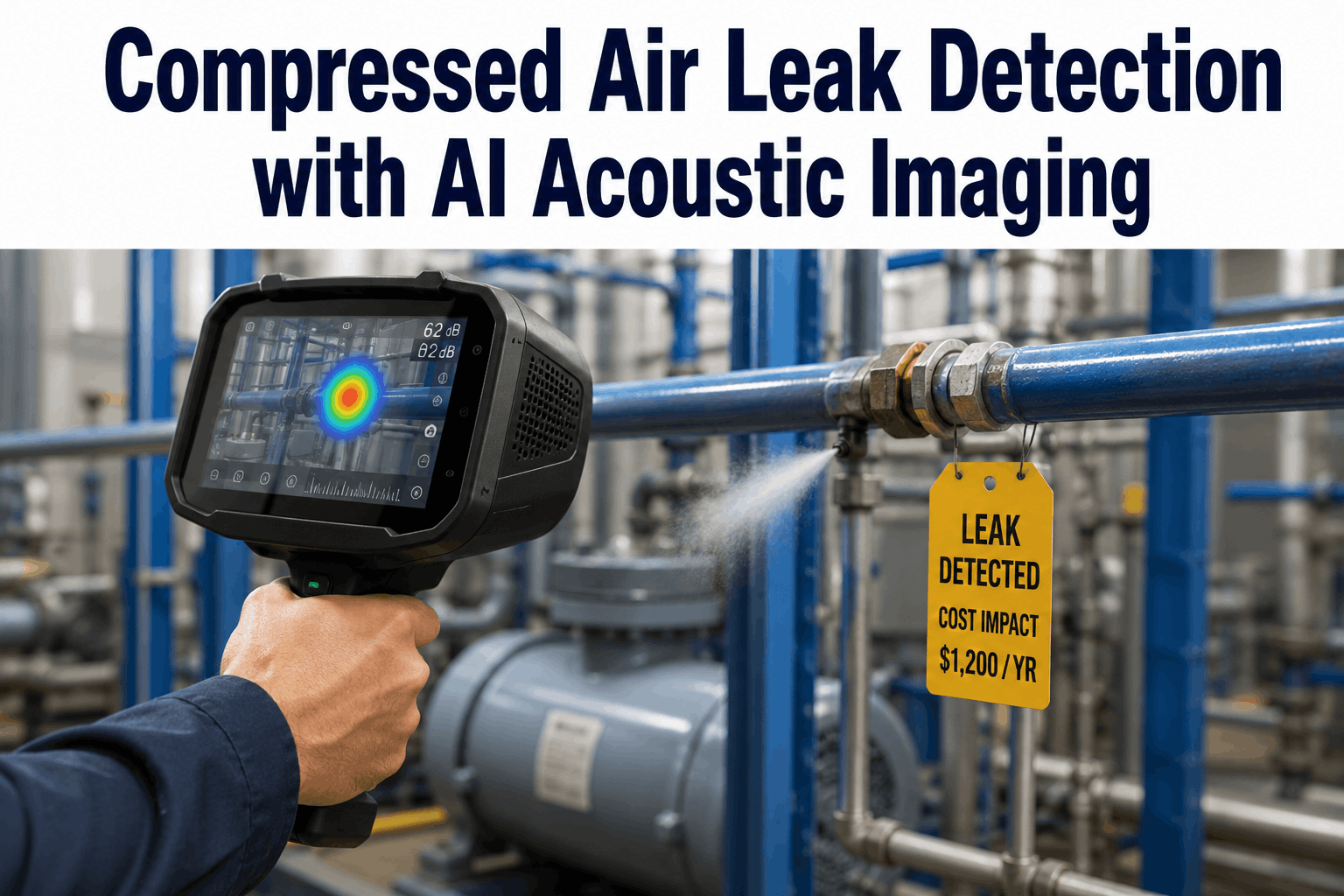
AI acoustic cameras overlay leak location heat maps on a live video feed, making every active leak source visible as a coloured intensity map superimposed on the physical system.
Leak Flow Rate Quantification
Each detected leak is quantified with an estimated flow rate in CFM and an annual energy cost in dollars, enabling financial prioritisation without manual calculation.
Prioritised Repair Work Order Generation
Leak locations are ranked by cost impact and exported as a structured work order list, giving maintenance teams a repair sequence optimised by return on labour invested.
Plant-Wide Survey in a Single Shift
A facility-wide leak survey with AI acoustic cameras completes in four to eight hours across most industrial plants, replacing the multi-day probe surveys previously required.
Repeat Survey Comparison and Trend Tracking
Sequential surveys compare leak populations over time, confirming repairs were effective and tracking whether new leaks are developing faster than the repair programme addresses them.
DOE Leak Cost Calculation Integration
Energy cost estimates use DOE compressed air best practice formulas calibrated to each facility's local electricity rate and compressor efficiency, producing site-specific ROI figures.
The Six Diagnostic Capabilities of AI Acoustic Leak Detection
01
Broadband Acoustic Imaging Across the Full Leak Frequency Spectrum
Core Detection Capability
AI acoustic cameras use an array of microphones — typically 64 to 128 elements — to capture sound across the frequency range where compressed air leaks generate the strongest ultrasonic signature (20 kHz to 100 kHz) while rejecting ambient plant noise in the lower frequency range where production equipment dominates. The microphone array uses beamforming algorithms to calculate the precise three-dimensional source location of each acoustic emission, producing a spatial map of leak sources that persists even when the plant is running at full production noise levels. This makes AI acoustic imaging the only detection technique that works reliably in a running industrial facility without requiring production shutdown or reduced ambient noise conditions.
Probe detection range: 0.5m max
AI camera range: 10–15m per position
02
Leak Size Classification and Flow Rate Estimation
Quantification Engine
The AI classification model assigns each detected leak to a size category — pinhole, small, medium, large — based on the acoustic intensity and frequency signature, then calculates an estimated flow rate in cubic feet per minute using the DOE compressed air leak sizing model calibrated to the measured system pressure. Flow rate estimates carry a confidence interval that reflects signal quality, distance to the leak source, and ambient noise conditions. For financial prioritisation, the estimated flow rate is multiplied by the facility's compressor efficiency factor and local electricity cost to produce an annual dollar loss figure for each leak location before a repair decision is made.
Manual estimate accuracy: ±40%
AI acoustic estimate accuracy: ±12%
03
Multi-Zone Coverage and Population Mapping
Survey Efficiency
A single acoustic camera positioned at the end of a machine line can image all leak sources within a 10 to 15 metre radius simultaneously, capturing every leak in that zone in a single 30-second scan. Sequential scans from multiple positions across the facility are stitched into a facility-wide leak population map that shows leak density by zone, total estimated energy loss by zone, and individual leak locations with GPS or floor plan coordinates for repair team navigation. The population map enables maintenance managers to identify which zones carry the highest leak burden and to schedule repair campaigns by zone rather than by individual leak location — reducing travel time and improving repair throughput.
Survey time (probe): 3–5 days
Survey time (AI camera): 4–8 hours
04
Automated Repair Priority Ranking by Annual Cost
Financial Optimisation
Every detected leak is ranked by annual energy cost and presented in a prioritised repair list that maintenance teams can execute as a structured work order campaign. The ranking accounts for estimated repair labour time, leak location accessibility, and required parts so the list is ordered not just by cost but by net cost reduction per labour hour invested. High-cost leaks that require minimal repair time appear at the top of the list regardless of physical location, ensuring that maintenance resources produce the maximum energy cost reduction per hour of repair work regardless of plant layout.
Energy recovered: top 20% of leaks
Addresses: 70–80% of total loss
05
Post-Repair Verification and Effectiveness Confirmation
Repair Validation
After repair campaigns are completed, a follow-up acoustic scan of the repaired zones confirms that each identified leak was successfully closed and that no new leaks were introduced during repair. The post-repair scan compares the current acoustic image against the pre-repair baseline, quantifying the flow rate reduction achieved and updating the facility's running energy cost estimate. For facilities tracking compressed air costs as part of an ISO 50001 energy management programme, the verified repair record provides documented evidence of the energy reduction achieved and the financial value of the maintenance investment.
Repair verification rate (manual): 41%
Repair verification rate (AI scan): 100%
06
Leak Recurrence Tracking and Programme Effectiveness Trending
Programme Management
Quarterly or semi-annual repeat surveys build a longitudinal leak recurrence dataset that shows whether specific leak types are re-emerging at predictable intervals — indicating a systematic root cause such as vibration-induced fitting failure, thermal cycling stress at specific joints, or inadequate hose clamp specifications. Recurrence tracking enables maintenance engineers to move from reactive re-repair to root cause elimination: replacing fitting types that consistently re-leak with vibration-resistant alternatives, adding flexible sections where rigid pipe runs are failing due to thermal movement, and specifying higher-grade sealing materials at pressure joints that repeatedly develop pinhole leaks.
Recurrence within 12 months: 34%
After root cause elimination: 8%
AI Acoustic vs Conventional Leak Detection: Quick Reference
Scroll for more
| Capability | Ultrasonic Probe | AI Acoustic Camera | Operational Impact | iFactory Integration |
|---|---|---|---|---|
| Detection Range | 0.3–0.6m per position | 10–15m per position | 85% survey time reduction | Zone-wide simultaneous scan |
| Running Plant Detection | Poor above 80dB ambient | Full capability at production noise | No shutdown required | Live production compatible |
| Leak Quantification | Size class only | CFM estimate ±12% | Accurate cost prioritisation | DOE formula integrated |
| Population Mapping | Sequential point scan | Simultaneous zone map | Full leak census per survey | Floor plan overlay export |
| Post-Repair Verification | Manual re-probe | Automated scan comparison | 100% verification coverage | Before/after report |
How iFactory Connects AI Acoustic Detection to Maintenance Workflows
Acoustic leak detection produces actionable value only when the leak data flows directly into maintenance work order systems and closes the loop with repair verification. iFactory integrates AI acoustic imaging output with your CMMS platform, generating structured work orders for each prioritised leak location, tracking repair completion against the detected leak list, and scheduling follow-up verification scans automatically. When the leak repair programme is managed in iFactory, the financial return is tracked in real time — showing how much energy cost has been recovered as repairs are completed and how much remains outstanding in the identified leak backlog. Teams can Talk to an Expert about connecting acoustic survey data to your existing maintenance management workflow.
Acoustic Survey Integration
iFactory ingests AI acoustic camera survey output and converts detected leaks into prioritised maintenance work orders automatically.
Energy Cost Tracking
Recovered energy cost is calculated and tracked as repairs are completed, producing a live ROI figure for the leak management programme.
Recurrence Detection
Repeat surveys compare against historical baselines to identify recurring leak locations and flag systematic root causes for engineering review.
ISO 50001 Reporting Export
Energy reduction documentation from acoustic surveys and repair verification exports in ISO 50001 format for energy management programme reporting.
Implementing an AI Acoustic Leak Detection Programme: Six Steps
01
Establish Compressed Air System Baseline
Record compressor output, system pressure, and energy consumption before the first acoustic survey to provide the comparison baseline for post-repair energy recovery measurement.
02
Conduct Facility-Wide Acoustic Survey
Complete a systematic AI acoustic camera survey of all compressed air zones during normal production, capturing the full leak population without shutdown or production interruption.
03
Generate Prioritised Repair Work Order List
Export the leak population ranked by annual energy cost with repair labour estimates, and load the top-priority items into the CMMS as a structured repair campaign.
04
Execute Repair Campaign by Zone
Complete repairs zone by zone in cost priority order, targeting the top 20 percent of leak locations that account for 70 to 80 percent of total energy loss first.
05
Verify Repairs and Measure Energy Recovery
Conduct post-repair acoustic scans of completed zones, confirm leak closure, and compare compressor energy consumption against the pre-survey baseline.
06
Schedule Quarterly Repeat Surveys for Recurrence Tracking
Establish a recurring acoustic survey schedule to detect new leaks as they develop and track recurrence patterns that indicate systematic root causes requiring engineering intervention.
Frequently Asked Questions
How does AI acoustic imaging detect compressed air leaks that ultrasonic probes miss?
AI acoustic cameras capture the full ultrasonic emission field across a 10 to 15 metre zone simultaneously, detecting all leak sources within that radius in a single scan — including leaks behind guards, in congested pipe runs, and above ceilings that probes cannot physically reach.
Can acoustic leak detection be performed while the plant is running at full production?
Yes. AI acoustic cameras use beamforming algorithms to isolate ultrasonic leak frequencies above the ambient plant noise floor, making detection effective during full production without requiring noise reduction or shutdown.
How accurate is the annual energy cost estimate for each identified leak?
Flow rate estimates using AI acoustic imaging carry an accuracy of approximately plus or minus 12 percent, compared to plus or minus 40 percent for manual probe sizing — sufficient for financial prioritisation and ROI reporting.
What is the typical energy recovery from a structured AI acoustic leak repair programme?
Most facilities recover 15 to 25 percent of total compressor energy consumption through a structured leak detection and repair programme, with payback on the detection programme typically achieved within three to six months.
How does iFactory integrate acoustic survey data into maintenance workflows?
iFactory ingests AI acoustic camera survey outputs, converts detected leaks into prioritised CMMS work orders, tracks repair completion against the leak list, and schedules follow-up verification scans automatically.
Your Compressors Are Paying for Leaks You Have Not Found Yet. AI Acoustic Imaging Finds All of Them — In a Single Shift.
iFactory connects AI acoustic leak detection to your maintenance workflow, generating prioritised repair work orders, tracking energy recovery, and scheduling verification surveys to keep your compressed air system as efficient as your maintenance programme.