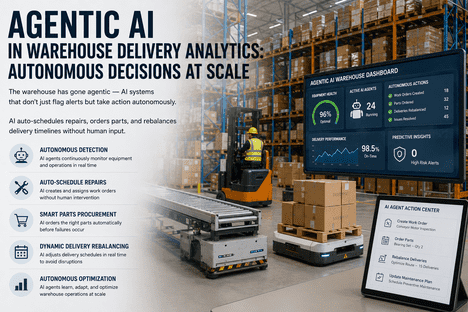
Agentic AI doesn't alert your warehouse team to a problem and wait for someone to act. It detects the condition, evaluates the options, selects a response, and executes autonomously, in milliseconds, at scale. This is the operating model that separates high-performing warehouse and delivery networks from those still running on manual escalation chains and end-of-day reports. This guide covers how agentic AI works in warehouse and delivery analytics, what autonomous decision loops look like in practice, and how iFactory AI's Shift Logbook and connected modules provide the operational data layer that makes agentic decisions reliable.
Agentic AI in Warehouse & Delivery Analytics: Autonomous Decisions at Scale
AI systems that don't just surface alerts — they auto-schedule repairs, trigger parts orders, and rebalance delivery timelines without waiting for human input. Here is how it works and what it requires from your operational data.
From Alert-Based to Action-Based: The Agentic Shift
Traditional warehouse analytics platforms are advisory systems. They generate dashboards, surface anomalies, and send notifications. The response — creating a work order, calling a technician, adjusting a delivery window still requires a human to read the alert, decide what to do, and take action. In a warehouse processing thousands of picks per hour, that gap between signal and action is where throughput is lost.
Agentic AI closes that gap. An agentic system is an AI that perceives its environment, reasons about goals and constraints, selects actions, and executes those actions through connected systems without requiring human intervention at each step. In warehouse and delivery contexts, this means equipment faults trigger automatic maintenance work orders, delivery delays trigger automatic timeline rebalancing, and inventory shortfalls trigger automatic replenishment requests all within seconds of the condition being detected.
The enabling infrastructure for this capability is a continuous, high-fidelity stream of operational data. Agentic decisions are only as reliable as the data they act on. iFactory AI's connected modules Shift Logbook, Production Monitoring, Work Order Management, and Parts & Inventory — provide that data layer across every shift, every line, and every asset in the facility.
What Agentic Decision Loops Look Like in Warehouse Operations
An agentic decision loop has four stages: Perceive, Reason, Act, and Verify. Each stage depends on data quality and system connectivity. The following examples illustrate how these loops operate across the three primary warehouse and delivery analytics domains.
iFactory AI's Shift Logbook is the operational memory that agentic AI systems depend on. Every autonomous action — work order, rebalancing decision, replenishment trigger — is written back to the Shift Logbook so that the next shift, the next AI decision loop, and the next audit all have complete context. Book a demo to see how it connects to your warehouse systems.
What Agentic AI Requires From Your Operational Data
Agentic systems fail when they act on stale, incomplete, or inconsistently structured data. The following requirements are the minimum data infrastructure that makes autonomous decisions reliable rather than risky in a warehouse or delivery environment.
| Data Requirement | Why It Matters for Agentic AI | iFactory Module | Risk if Missing |
|---|---|---|---|
| Real-Time Event Streams | Agentic loops require sub-second event detection to intervene before conditions cascade into throughput loss | Production Monitoring, PLC Integration | High — decisions lag events |
| Structured Downtime History | AI reasoning depends on matching current fault signatures to historical patterns with known outcomes | Shift Logbook, Work Order Management | High — wrong action selected |
| Shift Boundary Continuity | Agentic decisions that span shift changes must carry full context — an open fault cannot be re-evaluated without its history | Shift Logbook, Shift Handover | Medium — duplicate actions |
| Parts Availability State | Autonomous work order creation is only valid if the required parts are confirmed available — otherwise the technician arrives to nothing | Parts & Inventory | High — wasted dispatch |
| Reason Code Consistency | AI classification of fault type depends on consistent reason coding across all shifts and lines — generic codes produce generic (wrong) actions | Shift Logbook, Downtime Tracking | High — misclassified root cause |
| Human Override Audit Trail | Every autonomous action that a human overrides must be logged with the reason — this feedback loop is how agentic models improve | Shift Logbook, Analytics Reporting | Medium — model drift |
Why the Shift Logbook Is the Core of Agentic Warehouse Intelligence
Agentic AI systems are only as good as their memory. A system that cannot recall what happened in the previous shift, cannot distinguish between a recurring fault and a new failure mode, and cannot trace the chain of decisions from signal to action is not an agentic system — it is a reactive alert engine with an automation wrapper.
iFactory AI's Shift Logbook is purpose-built to serve as this operational memory layer. Every event logged during a shift — downtime stops, throughput deviations, quality events, autonomous interventions, human overrides — is structured, timestamped, reason-coded, and linked to the assets and orders involved. This creates a continuous, queryable record that agentic AI can use as the foundation for every decision loop.
Event Detection
PLC sensors, production counters, and quality scanners feed real-time events into iFactory's data layer. Every event is timestamped and linked to the specific asset, line, and shift.
Context Enrichment
The Shift Logbook enriches raw events with historical context — previous occurrences, last repair action, parts consumed, shift conditions — giving the AI the reasoning context it needs.
Autonomous Action
The agentic layer selects and executes the appropriate response — work order, replenishment trigger, delivery rebalancing — through iFactory's connected modules.
Outcome Recording
Every autonomous action and its outcome is written back to the Shift Logbook. This creates the feedback loop that improves future decisions and provides the audit trail for compliance and operations review.
Connect Your Warehouse Data to Autonomous Decision-Making
iFactory AI connects to your existing PLCs, WMS, and MES infrastructure. The Shift Logbook captures every event. The agentic layer acts on it — in real time, at scale, without waiting for a human to read an alert.
Rolling Out Agentic AI in Warehouse & Delivery Operations: A Four-Phase Approach
Agentic AI rollouts fail most often when autonomous action scope is set too wide too early. The four-phase approach below has been validated across high-throughput warehouse and distribution environments. Each phase builds the data quality and operator trust required to expand autonomous decision scope safely. Book a Demo to see how iFactory structures this rollout for your facility.
Data Baseline (Weeks 1–4)
Connect iFactory to your PLCs and WMS. Run the Shift Logbook across all shifts without autonomous action enabled. The goal is a clean, structured event history with consistent reason coding. This is the training data for every agentic model that follows.
Supervised Recommendations (Weeks 5–8)
Enable the agentic layer in recommendation mode. Every autonomous decision is surfaced to a supervisor for approval before execution. Log every approval and every override. Overrides reveal where the model needs adjustment before autonomous action is trusted.
Scoped Autonomy (Weeks 9–16)
Enable autonomous execution for the highest-confidence, lowest-risk action types first: parts reservation, minor maintenance work orders, pick queue resequencing. Keep human approval in the loop for anything involving carrier commitments or supplier orders.
Full Autonomous Operations (Month 5+)
Expand autonomous scope to include delivery timeline rebalancing, supplier purchase requests, and predictive maintenance scheduling. Review the Shift Logbook weekly for override patterns — these are the signals that guide ongoing model refinement.
What Warehouse Operations Leaders Get Wrong About Agentic AI
The most common mistake I see is treating agentic AI as a technology problem rather than a data discipline problem. Operations teams spend months evaluating AI platforms and weeks on integration — and then discover that the autonomous decisions are wrong because the underlying Shift Logbook data is inconsistent across crews. An AI system that acts on noisy data doesn't just fail quietly. It acts confidently on incorrect information, and the consequences scale with the automation.
The second mistake is confusing agentic AI with robotic process automation. RPA follows fixed rules and executes fixed actions. Agentic AI reasons about goals, evaluates options, and selects actions based on context. That distinction matters enormously in warehouse environments where conditions change by the hour. You need a system that can adapt its response to a conveyor fault differently at 2 AM with minimum staffing than at 10 AM with full crew — not a system that always creates the same work order template.
The facilities that extract real value from agentic AI — measurable throughput gains, documented MTTR reductions, traceable delivery improvement — all treat their Shift Logbook as a production asset, not an administrative record. They audit reason code consistency the same way they audit pick accuracy. That discipline is what makes agentic decisions trustworthy enough to execute without a human in the loop.
Agentic AI in Warehouse & Delivery Analytics — Common Questions
See Agentic AI in a Live Warehouse Environment
We connect to a live iFactory instance and walk you through how the Shift Logbook feeds autonomous decision loops — from fault detection to work order creation to delivery rebalancing — in real time. No slides. No mockups. Real operational data.