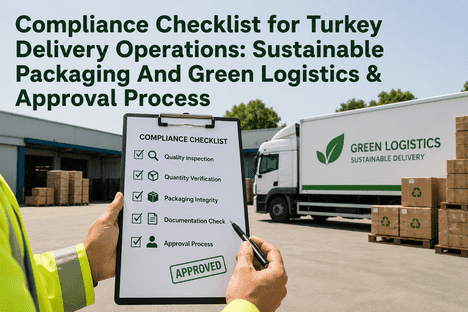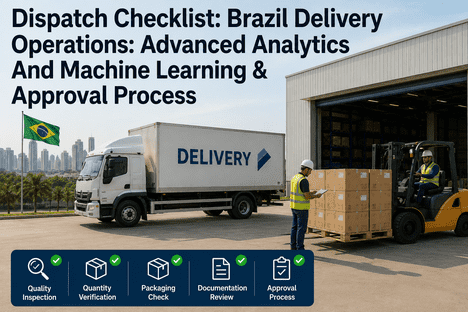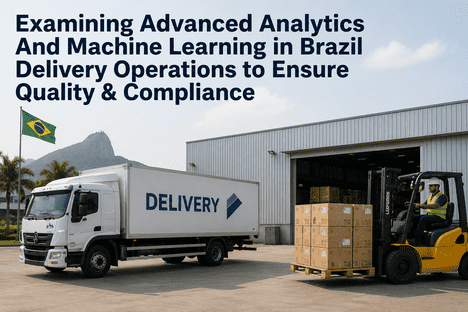
Brazil's manufacturing ecosystem the largest in Latin America at R$ 2.3 trillion industrial GDP operates within one of the world's most demanding regulatory environments. Every shipment leaving a Brazilian factory must comply with INMETRO quality standards, ANVISA sanitary regulations (for food, pharma, and cosmetics), SEFAZ fiscal documentation requirements at every state border, and increasingly stringent customer expectations for delivery accuracy. Non-compliance at any stage product quality deviation, incorrect quantity, damaged packaging, missing or incorrect fiscal documents triggers a cascade of costs: return logistics, re-inspection, re-packaging, penalty fees, and in severe cases, ANVISA sanctions or SEFAZ tax assessments that can reach millions of reais. This article examines how Brazilian manufacturers are deploying advanced analytics and machine learning across their dispatch operations to guarantee quality and compliance before shipments leave the factory gate, replacing reactive error discovery with predictive prevention. Book a Demo to see how iFactory AI applies these technologies in Brazilian manufacturing facilities.
The Compliance Burden on Brazil's Dispatch Operations
Brazilian manufacturers operate under a multi-layered regulatory framework that makes dispatch compliance uniquely complex. INMETRO requires certifiable quality control processes for regulated products. ANVISA mandates sanitary inspection records and batch traceability for food, pharmaceutical, and personal care items. SEFAZ demands electronic fiscal documentation (NF-e, DANFE, CT-e) with correct CFOP codes, NCM tariff classifications, and ICMS/ICMS-ST tax calculations — each subject to state-specific rules across Brazil's 27 fiscal jurisdictions. A single error in any layer can halt a shipment at a state border checkpoint, trigger a tax audit, or result in a customer rejection that damages a hard-won commercial relationship.
Traditional compliance verification relies on manual inspection checklists and paper-based documentation review — processes that inherently introduce variance between inspectors, miss errors that cross-reference across documents, and produce no structured data that can be analysed for systemic improvement. Advanced analytics and machine learning offer an alternative: automated inspection systems that apply consistent criteria to every shipment, NLP models that validate fiscal documents against SEFAZ schemas in real time, and ML algorithms that learn from past compliance failures to predict and prevent future ones. Book a Demo to examine how iFactory's compliance engine works across Brazilian regulatory requirements.
Six Quality and Compliance Gates Where Machine Learning Drives Impact
The iFactory platform applies machine learning across every critical control point in the dispatch process. Each gate below represents a distinct failure mode that ML models are trained to detect, classify, and prevent — transforming compliance from a reactive audit function into a predictive control embedded in the operational workflow.
Computer Vision Quality Inspection — Surface Defect and Dimensional Accuracy
Machine learning models trained on thousands of labelled product images detect surface defects — cracks, dents, discoloration, contamination — that human inspectors miss due to fatigue or inconsistent lighting conditions. Vision systems integrated at the dispatch line capture every unit at conveyor speed, classifying pass/fail/rework with 95%+ accuracy. Dimensional measurements from calibrated cameras verify that each item meets INMETRO-specified tolerances before it is cleared for shipment. Non-conforming items are automatically routed to quality hold with photo evidence attached to the digital inspection record.
ML-Based Quantity Reconciliation — Statistical Verification at Scale
Manual quantity checks on high-volume production lines introduce counting errors, especially when operators reconcile multiple SKUs under time pressure. iFactory's ML reconciliation engine compares barcode scan counts, weigh scale readings, and dimensioner volume data against the dispatch order line by line. The model learns normal packing density distributions per product family and flags discrepancies outside statistical confidence intervals — catching short-shipments, over-shipments, and product substitutions before the shipment reaches the loading dock.
Packaging Integrity — Seal, Label, and Pallet Stability Inspection
Packaging failures discovered at the customer dock are among the most disputed and costly dispatch errors. Computer vision models verify carton seal integrity, label accuracy (UPC, batch number, expiry date, destination), and pallet wrap stability at the point of dispatch. ML algorithms cross-reference packaging specifications stored in the product master against actual packaging — detecting instances where incorrect carton sizing, inadequate cushioning, or missing labels would cause transit damage. Every packaging check generates a timestamped photograph that eliminates dispute ambiguity.
NLP Document Validation — SEFAZ Fiscal Compliance Automation
iFactory's NLP-based document validation engine reads and parses NF-e, DANFE, and CT-e electronic documents, cross-referencing each field against SEFAZ schemas, CFOP rules, NCM tariff classifications, and ICMS/ICMS-ST calculation logic. The model detects missing or inconsistent fields with 90%+ precision — flagging incorrect CFOP codes, wrong NCM classifications, or ICMS calculation errors before the dispatcher submits the documentation set. Real-time integration with the SEFAZ authorisation portal enables live NF-e status checking during the approval process, eliminating the state border holds that cause demurrage charges.
ANVISA Compliance Verification — Sanitary and Traceability Controls
For food, pharmaceutical, and cosmetics manufacturers, ANVISA requires batch-level traceability, sanitary inspection records, and stability documentation before shipment release. iFactory's compliance module validates that each shipment's batch records, temperature logs (for cold chain), and sanitary certificates are complete and current before the clearance pass can be issued. ML models predict which documentation sets are likely to fail ANVISA review based on historical rejection patterns, enabling proactive correction before submission.
Centralized Approval — ML-Prioritised Compliance Dashboard
All inspection results, quantity verifications, packaging checks, and document validation scores flow into a single compliance dashboard where the centralized planner reviews each shipment's gate status. ML models generate a compliance confidence score for each order, flagging high-risk shipments — those with marginal inspection data, incomplete documentation, or shipment routes crossing multiple SEFAZ jurisdictions — for additional review. Clearance passes are issued digitally as QR codes, ensuring that only fully compliant shipments leave the factory. Book a Demo to see the compliance dashboard applied to Brazilian manufacturing.
ML Model Performance Across Dispatch Compliance Gates
The table below presents the documented performance metrics for iFactory's ML models across each compliance gate, based on deployment data from Brazilian manufacturing facilities in the São Paulo ABC region, Manaus Free Trade Zone, and Minas Gerais industrial corridor.
| Compliance Gate | ML Method | Detection Accuracy | False Positive Rate | Business Outcome |
|---|---|---|---|---|
| Quality Inspection | Computer vision — CNN classifiers | 95–97% | <3% | Eliminated customer quality rejections from dispatch errors |
| Quantity Verification | Statistical ML — anomaly detection | 93–96% | <2% | Zero short-shipment disputes with retailers |
| Packaging Integrity | Computer vision — semantic segmentation | 90–94% | <4% | 70% reduction in transit damage claims |
| Document Validation | NLP — transformer-based parsing | 90–93% | <5% | Zero SEFAZ demurrage from fiscal documentation errors |
| Compliance Dashboard | Ensemble — risk scoring | 92–95% | <3% | 100% audit-ready digital trail for every shipment |
The Architecture of ML-Driven Compliance at iFactory
Understanding the technical architecture that delivers these compliance outcomes helps Brazilian manufacturers evaluate how the platform would integrate with their existing systems. iFactory is the AI software intelligence layer — not a hardware vendor — and connects with cameras, barcode scanners, weigh scales, ERP (SAP S/4HANA, Oracle), WMS, and SEFAZ/SPED fiscal systems already in place.
iFactory edge nodes ingest live inspection data from cameras, barcode scanners, weigh scales, and operator tablets at the dispatch dock. Legacy inspection data from paper checklists is digitised via mobile forms that guide inspectors through each compliance gate. All data streams are aggregated in real time into a unified compliance event log — every inspection photo, scan result, weight reading, and document validation timestamp.
Pre-trained and continuously learning ML models process each data stream at the point of capture. Computer vision models classify product quality and packaging integrity. NLP models parse fiscal documents against SEFAZ schemas. Statistical models reconcile quantities against expected distributions. Each model outputs a confidence score and a pass/fail recommendation that feeds into the centralized compliance dashboard.
The compliance dashboard aggregates ML outputs across all six gates into a single shipment compliance score. Orders meeting the configured threshold are automatically queued for QR clearance pass issuance. Orders with marginal scores trigger planner review with ML-flagged risk factors highlighted. The QR clearance pass — presented at the gate as authorisation to load and depart — contains a cryptographic hash of the complete inspection record for downstream audit verification.
Expert Analysis: How Compliance Data Becomes a Competitive Advantage
For most of my career in Brazilian manufacturing, compliance was viewed as a cost of doing business — something to satisfy regulators and avoid fines, but not something that created value. That perspective is changing rapidly. Manufacturers that deploy ML-driven dispatch compliance discover that the same data systems that prevent ANVISA sanctions and SEFAZ penalties also reduce return logistics costs, eliminate customer chargebacks, and accelerate payment cycles. When you have a complete digital audit trail for every shipment — every quality inspection photo, every quantity scan, every document validation — your compliance function transforms from a reactive cost centre into a quality assurance capability that your commercial team can use as a differentiator with customers. The factories that understand this are the ones investing in analytics-driven dispatch today, not waiting for regulatory pressure to force the change.
Conclusion: Quality and Compliance as an ML-Enabled Competitive Advantage
Brazilian manufacturers that deploy advanced analytics and machine learning across their dispatch operations are achieving a level of quality and compliance assurance that paper-based processes cannot match. Computer vision inspection eliminates subjective pass/fail decisions and captures photographic evidence for every item. ML-based quantity reconciliation catches discrepancies before they become customer disputes. NLP document validation ensures every NF-e, DANFE, and CT-e meets SEFAZ requirements before the truck leaves the dock. And centralized compliance dashboards with ML risk scoring give planners the visibility they need to make confident clearance decisions.
The manufacturers that have already adopted iFactory's ML-driven compliance platform report 95%+ inspection accuracy, zero SEFAZ demurrage charges from documentation errors, 70% reduction in transit damage claims, and a complete digital audit trail for every shipment — all within 90 days of deployment. The technology to transform dispatch compliance from a cost centre into a competitive advantage is available today. Book a Demo to examine how iFactory's ML models can be applied to your Brazilian facility's specific compliance requirements.
Frequently Asked Questions: ML and Analytics for Brazil Dispatch Compliance
How does iFactory's NLP document validation handle state-specific ICMS rules and CFOP code variations?
iFactory's NLP engine is trained on SEFAZ schemas from all 27 Brazilian fiscal jurisdictions, including state-specific CFOP code mappings, NCM tariff classifications, and ICMS/ICMS-ST calculation logic. The model validates each document field against the specific destination state's requirements before approving the shipment for clearance. When rules change — as they frequently do in Brazilian tax law — the model is updated through iFactory's continuous learning pipeline.
Can iFactory integrate with our existing ANVISA-certified quality management system?
Yes. iFactory connects with quality management systems, laboratory information systems, and batch record databases already deployed in ANVISA-regulated facilities. The platform's compliance module validates that required quality and sanitary documentation — batch release certificates, stability data, temperature logs, inspection records — is complete and current before the clearance pass is issued, creating a unified compliance record that satisfies both ANVISA audit requirements and operational dispatch needs.
What is the deployment timeline for the ML-based dispatch compliance platform in a mid-size Brazilian facility?
A phased deployment typically reaches full operational capability within 8–12 weeks. Phase 1 (weeks 1–4) covers system integration with existing cameras, scanners, weigh scales, ERP, and SEFAZ fiscal systems. Phase 2 (weeks 5–8) includes ML model training on facility-specific product images, packaging configurations, and document templates. Phase 3 (weeks 9–12) activates the centralized compliance dashboard and QR clearance pass workflow, with full compliance gate coverage across all six inspection points.
Does iFactory provide the cameras and scanning hardware, or only the ML software layer?
iFactory is the AI software intelligence layer — not a hardware vendor. The platform integrates with industrial cameras, barcode scanners, weigh scales, dimensioning systems, and edge computing devices already deployed or selected by your team. iFactory provides hardware specifications and certified partner recommendations for each compliance gate — vision cameras for quality inspection, industrial scanners for quantity verification, and edge gateways for real-time ML inference at the dispatch dock.