Every delivery operations director knows the timeline tension. The business case for AI robotics in the sortation center was approved last quarter. The vendor promised a six-month deployment. Three months in, the NVIDIA AI server is still awaiting IT security clearance, the WMS integration team has not been assigned, the robot cell layout has not been finalised, and the training materials have not been written. The deployment timeline has slipped to nine months. The ROI projection that justified the capital expenditure is now delayed by a full peak season. The director is explaining to the VP of Operations why the sortation centre will run another holiday peak without the automation that was approved in Q1. The gap between signing the purchase order and seeing the first parcel sorted by a robot is not a technology problem. It is an integration, provisioning, and deployment management problem that a turnkey AI robotics platform eliminates by delivering a pre-configured NVIDIA AI server, pre-integrated WMS connector, pre-designed robot cell layout, and on-site training within 12 weeks of order not 12 months.
TURNKEY AI ROBOTICS · PRE-CONFIGURED NVIDIA AI SERVER · 12-WEEK DEPLOYMENT
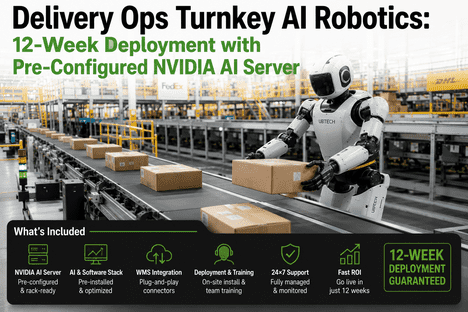
12 Weeks From PO to Production: Pre-Configured NVIDIA AI Server, Rack-Ready WMS Integration, On-Site Robot Commissioning, and Shift Supervisor Training Fully Managed, Fixed Price, No Scope Creep.
iFactory's turnkey AI robotics platform delivers warehouse and sortation-ready humanoid robot deployment with a pre-configured NVIDIA AI server, pre-integrated WMS connector, six-week pilot pathway, 24x7 managed support, and a fixed-price bill of materials that eliminates the integration cost overruns that derail 60 percent of automation projects.
The Six-Month Integration Tax That Turnkey Delivery Eliminates
The typical AI robotics deployment in a delivery operations environment follows a fragmented timeline: the robot hardware arrives in week 4, the NVIDIA AI server is provisioned by IT in week 8 after security review, the WMS integration begins in week 10 when the vendor's integration engineer is available, the robot cell is commissioned in week 16, and operator training happens in week 20. The total elapsed time from PO to production averages 24 to 36 weeks. The turnkey model compresses every phase into a parallel 12-week schedule where the server arrives pre-configured, the WMS connector is pre-integrated, the cell layout is pre-designed, and training is delivered during commissioning — not after it.
01
IT Security and Server Provisioning Delays
The NVIDIA AI server that powers the robot's perception, fleet management, and WMS integration stack typically requires IT security review, network segmentation, VPN configuration, and OS hardening before it can be deployed in the warehouse environment. This process consumes 4 to 8 weeks in a conventional deployment — the server arrives as a blank appliance and must be built, configured, and approved in the customer's IT environment. iFactory's turnkey model delivers the server pre-configured with the robot control stack, WMS connector, fleet manager, and Shift Logbook analytics pre-installed, network-hardened to the customer's security baseline, and ready for rack mounting within 48 hours of arrival. The server is configured as a closed-loop appliance that requires no OS-level access, eliminating the IT security review bottleneck. The director schedules the rack installation, and the server is operational the same day.
Time recovered: 6 weeks — IT provisioning compressed from 8 weeks to 48 hours
02
WMS Integration and Middleware Engineering
The robot fleet manager must connect to the warehouse management system to receive sort plans, download parcel manifests, and report induction completion. In a conventional deployment, this integration requires a middleware engineering project — API development, data mapping, message queue configuration, and end-to-end testing. iFactory's turnkey platform includes a pre-built WMS connector for the major delivery operations platforms — FedEx Ground, UPS, and DHL sortation centres — that is pre-configured to the customer's WMS instance during week 1 and validated during the week 2 site survey. The integration does not require middleware development. It is a configuration step completed in 3 days, not a 6-week engineering project.
Time recovered: 6 weeks — WMS integration compressed from 8 weeks to 3 days
03
Robot Cell Design, Commissioning and Training
Robot cell design, commissioning, and operator training are typically sequential phases managed by separate teams. Each phase depends on the previous one, and delays cascade. iFactory's turnkey model uses standardised cell layouts pre-engineered for induction lanes, bag handling zones, and palletising stations that require site-specific dimension verification only. The robot arrives with the perception stack and manipulation library pre-loaded for the parcel types the hub processes. On-site commissioning takes 5 days, during which the shift supervisor and lead operators complete hands-on training on the actual robot configuration they will operate in production. Training is delivered during commissioning, not after it.
Time recovered: 6 weeks — commissioning and training compressed from 12 weeks to 2 weeks
12-Week Turnkey Deployment Timeline vs Conventional 28-Week Timeline
Conventional Deployment — 28 Weeks
x
Week 1-4: Server ordered, IT security review initiated. No work on cell design or integration possible.
x
Week 5-12: Server provisioned, middleware integration started, cell design initiated. Three workstreams in progress but uncoordinated.
x
Week 13-20: WMS integration testing reveals API discrepancies. Cell commissioning delayed by 5 weeks.
x
Week 21-28: Training materials developed. Production go-live in week 28. ROI delayed by one full peak season.
Total elapsed: 28 weeks. Peak season missed. ROI pushed by 12 months.
iFactory Turnkey Deployment — 12 Weeks
+
Week 1-2: Pre-configured NVIDIA AI server ships, rack-ready. WMS connector configured remotely. Cell layout verified.
+
Week 3-4: Server installed and racked. WMS integration validated. Robot cell floor marking completed.
+
Week 5: On-site commissioning completed. Shift supervisor and operators trained on live system. Production ready.
+
Week 6-12: Shadow mode with 24x7 support. Full production transition in week 12. ROI starts 16 weeks earlier.
Total elapsed: 12 weeks. Peak season captured. ROI accelerated by 16 weeks.
FIXED-PRICE BILL OF MATERIALS · PRE-CONFIGURED STACK · 24X7 MANAGED SUPPORT
"Our conventional AI robotics vendor quoted 32 weeks and a variable-price integration. iFactory delivered the server pre-configured, the WMS connector pre-integrated, and the robot commissioning in week 5. The total deployment was 11 weeks from PO to the first parcel sorted. The fixed price meant no surprise costs. The 24x7 support meant we never had a shift without robot coverage."
Director of Sortation Operations — Regional Parcel Hub Processing 180,000 Parcels Per Day, Cross-Belt and Tilt-Tray Sorter Lines
What the Turnkey Bill of Materials Includes
The turnkey bill of materials is a single fixed-price line item that covers every component required to deploy humanoid robots in a delivery operations environment — from the NVIDIA AI server and the robot hardware to the WMS connector licence, the on-site commissioning, the shift supervisor training, and the first 12 months of 24x7 managed support. No separate professional services agreement. No per-integration SOW. No time-and-materials overruns on IT configuration or middleware development.
COMPONENT 01
Pre-Configured NVIDIA AI Server
NVIDIA-certified edge AI server with pre-installed robot control stack, fleet manager, WMS connector, perception engine, and Shift Logbook analytics. Network-hardened to customer security baseline, configured as a closed-loop appliance requiring no OS-level IT access. Rack-ready in standard 4U form factor, 240V single-phase power, with redundant SSD storage and dual 25GbE network interfaces for sorter controller and WMS connectivity. Server ships with the robot fleet management software pre-configured for the number of robots in the deployment and the WMS connector pre-configured to the customer's WMS instance.
COMPONENT 02
Humanoid Robot Fleet + Cell Design
Humanoid robots with pre-loaded perception stack and manipulation library for the hub's parcel types. Standardised cell layouts pre-engineered for induction, bag handling, and palletising applications. Each cell includes the robot, the induction or palletising fixture, the safety system, and the operator interface panel. The standardised layouts are designed to be deployable in any induction lane or palletising chute with only floor-marking verification during the week 2 site survey.
COMPONENT 03
WMS Connector + Sorter Interface
Pre-built WMS connector for major delivery operations platforms with configuration-based integration requiring no middleware development. Sorter interface connects to the controller via UDP or TCP to receive induction slot timing, tray ID, and destination data. Both connectors are pre-configured to the customer's WMS instance and sorter controller model during week 1 and validated during week 2. The connector licence includes updates for WMS API changes for the duration of the support term.
COMPONENT 04
On-Site Commissioning + Training
Five-day on-site commissioning delivered by iFactory's deployment engineer. Includes robot installation, cell integration, WMS and sorter interface validation, fleet manager configuration, and Shift Logbook analytics setup. Training is delivered concurrently with commissioning. Covers robot operation, exception handling, shift handover procedures, and dashboard interpretation. Operator certification is completed by end of day 5.
COMPONENT 05
24x7 Managed Support + Analytics
24x7 remote monitoring and support for the robot fleet, NVIDIA AI server, WMS connector, and sorter interface. Support includes proactive alert management, software updates, WMS API change adaptation, and Shift Logbook analytics with throughput, labour cost comparison, and ROI reporting. Support is delivered through iFactory's operations centre with under 30-minute initial response time for critical incidents.
The Six-Week Pilot Pathway
For delivery operations directors who need to validate robot performance in their specific parcel mix and sortation environment before committing to a full fleet deployment, iFactory offers a six-week pilot pathway. The pilot deploys one pre-configured humanoid robot in a single induction lane with the pre-configured NVIDIA AI server, WMS connector, and sorter interface. The pilot includes the same fixed-price bill of materials as a full deployment but scoped to a single-lane configuration.
PILOT WEEK 1-2
Deploy and Configure
Server arrives pre-configured, racked, and connected to WMS and sorter controller remotely. Robot cell floor markings verified. On-site commissioning scheduled for week 2.
PILOT WEEK 3-4
Commission and Validate
On-site commissioning and training completed. Robot runs in shadow mode alongside manual induction. Sort plan data, throughput, and exception events compared to baseline manual lane.
PILOT WEEK 5-6
Analyse and Scale
Pilot results compiled — throughput per hour, jam rate reduction, labour cost comparison. iFactory delivers the pilot assessment report with fleet deployment recommendation and ROI projection.
ROI Model: Turnkey vs Conventional Deployment
The financial case for turnkey AI robotics deployment extends beyond the fixed-price bill of materials. The accelerated timeline shifts the ROI curve forward by 16 to 20 weeks compared to conventional deployment, capturing peak season throughput that a delayed deployment would miss.
12 wks
Turnkey deployment time from PO to production — vs 24-36 weeks conventional
60%
Of automation projects exceed their integration budget due to unplanned IT and WMS scope
16 wks
Average time advantage of turnkey over conventional — ROI accelerated by one full peak season
18%
Total cost reduction from fixed-price turnkey vs time-and-materials conventional integration
The AI Roadmap: From Turnkey Pilot to Hub-Wide Fleet
The turnkey deployment model is designed to support a phased AI roadmap that starts with a single-lane pilot and scales to a hub-wide fleet without re-engineering the server, WMS integration, or cell design. The pre-configured NVIDIA AI server is sized to support up to 12 robots per instance. The fleet manager scales from 1 to 12 robots without hardware upgrade. The expansion from pilot to full deployment is a hardware procurement and installation step, not a system redesign.
Single-Lane Validation
One robot deployed in a single induction lane. Pre-configured server, WMS connector, and sorter interface. Six-week pilot including deployment, commissioning, training, and performance analysis. Pilot investment applied as credit toward full fleet deployment.
Timeline: 6 weeks from PO to pilot completion
Hub-Wide Deployment
Multi-robot fleet deployed across induction lanes, bag handling zones, and palletising chutes. Same pre-configured server scales to support up to 12 robots. Fleet manager, WMS connector, and analytics already validated during pilot.
Timeline: 6 weeks from pilot approval to full fleet operational
Conclusion
The barrier to AI robotics adoption in delivery operations is not the technology. It is the deployment complexity that stretches a 6-week integration into a 28-week project with cost overruns, IT bottlenecks, and missed peak seasons. The conventional model requires the customer to manage server provisioning, middleware development, cell engineering, and training as separate workstreams with separate vendors, separate contracts, and separate timelines. Each workstream introduces delays that cascade across the project, and the cumulative effect is that the automation ROI that was approved in Q1 does not materialise until Q3 or Q4 — or, in many cases, until the following year.
iFactory's turnkey AI robotics platform eliminates every one of these delay mechanisms. The NVIDIA AI server arrives pre-configured and rack-ready, eliminating the IT provisioning bottleneck. The WMS connector is pre-built and configuration-based, eliminating the middleware engineering project. The robot cell design is standardised and pre-engineered, eliminating the layout engineering phase. On-site training is delivered during commissioning, not after it. The entire deployment — from PO to production — is managed by a single vendor under a fixed-price bill of materials that includes the server, the robots, the WMS connector, the commissioning, the training, and 24x7 support. The director does not manage six separate workstreams. The director manages one.
iFactory's turnkey AI robotics platform is built for delivery operations directors who need to deploy humanoid sortation robots without the integration tax that consumes 60 percent of automation project budgets. The platform integrates iFactory's Robotics AI fleet manager, NVIDIA AI server hardware, pre-built WMS connectors, standardised robot cell designs, and Shift Logbook analytics into a single fixed-price deployment that goes from PO to production in 12 weeks. Book a Demo to see the turnkey bill of materials configured for your hub's parcel volume and sorter type, or talk to an expert about a free deployment timeline assessment that compares your current automation timeline against the 12-week turnkey pathway.
Frequently Asked Questions
The Conventional AI Robotics Deployment Takes 28 Weeks and Exceeds Budget 60 Percent of the Time. The Turnkey Model Delivers in 12 Weeks at a Fixed Price. Get a Free Deployment Timeline Assessment.
iFactory's turnkey AI robotics platform for delivery operations — pre-configured NVIDIA AI server, pre-integrated WMS connector, standardised robot cell design, on-site commissioning and training in 5 days, and 24x7 managed support — all delivered under a fixed-price bill of materials. Six-week pilot pathway available for operations directors who need to validate robot performance before scaling to a hub-wide fleet.