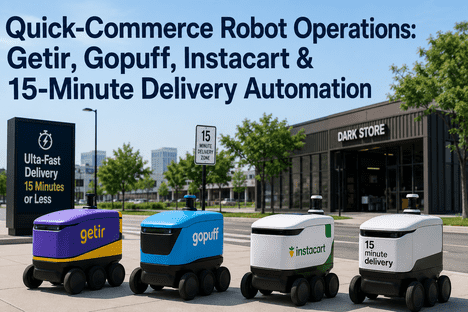
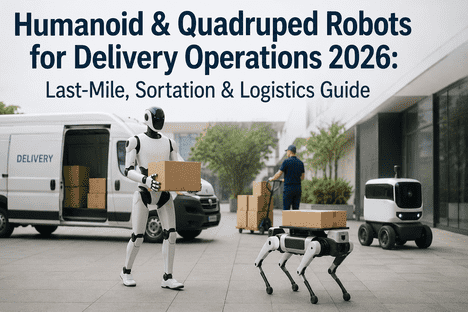
Quick-commerce robot operations have redefined the speed expectation in urban delivery logistics. In 2026, the 15-minute delivery window is no longer a marketing claim — it is an operational standard enforced by dark store robotics, autonomous mobile picking systems, and last-metre delivery robots that cover the critical gap between the micro-fulfillment centre and the customer's doorstep. Getir, the Turkish instant delivery pioneer that expanded across the UK, Europe, and select US markets, operates a network of neighbourhood dark stores where autonomous mobile robots transport picking totes between ambient, chilled, and frozen zones while AI-powered pick-path optimisation algorithms sequence every order for minimum travel time. Gopuff, operating under GoBrands in the US and UK, has integrated automated sortation systems in its dark store network to handle the 12-minute average pick-and-pack cycle that its delivery fleet depends on. Instacart, after building the largest US grocery delivery marketplace, has invested in micro-fulfillment robotics partnerships that enable 15-minute delivery windows from automated dark stores in high-density urban corridors. The operating model that powers this speed is built on a tightly integrated robotics layer — AMRs for in-store transport, automated picking cells for high-velocity SKUs, conveyor sortation for order consolidation, and curb-side delivery robots for the final 500 metres. For delivery operations managers who built their logistics infrastructure around 2-hour delivery windows, the transition to 15-minute operations requires a complete rethinking of dark store layout, picking workflows, shift scheduling, maintenance cycles, and Parts & Inventory management for the robotics fleet that now drives the operation. Book a Demo to see how iFactory AI's Shift Logbook and delivery operations management platform supports dark store robot maintenance tracking, shift handovers, and inspection workflows for quick-commerce fleets.
Q-Commerce Robotics · Dark Store Automation · 15-Minute Delivery
Quick-Commerce Robot Operations: Dark Store Automation, AMR Picking, and Last-Metre Delivery Robots Powering 15-Minute Delivery in 2026.
Getir, Gopuff, Instacart, Buyk, Gorillas, and Jokr — each operating at a different point on the robotics maturity curve. iFactory AI's delivery operations platform provides unified Shift Logbook, Work Order Management, and Parts & Inventory tracking across both autonomous and conventional dark store operations.
Minutes — the delivery window that defines quick-commerce. Dark store robotics compresses pick-pack-dispatch to under 4 minutes to enable this speed.
3-4x
Pick rate improvement when AMR-assisted picking replaces manual trolley-and-basket workflows in dark store operations
74%
Of quick-commerce operators report robot maintenance and spare parts availability as the top operational constraint limiting fleet scale
40%
Reduction in dark store labour costs achieved when pick-to-robot workflows replace walk-to-shelf picking in automated micro-fulfillment centres
The Quick-Commerce Robot Landscape: Key Platforms and Operating Models in 2026
The quick-commerce robotics ecosystem is segmented by delivery speed tier, dark store size, and automation depth. Getir operates the most vertically integrated model — its own dark stores, its own robotics stack, its own delivery fleet — and has invested heavily in AMR-based picking automation across its European dark store network. Gopuff, with over 500 dark store locations in the US and UK, has pursued a more modular automation strategy, deploying automated sortation and conveyor systems in high-volume locations while maintaining manual picking in lower-throughput neighbourhood sites. Instacart, operating as a marketplace rather than a vertically integrated operator, has partnered with third-party micro-fulfillment robotics providers to enable 15-minute delivery from automated dark stores operated by retail partners. Buyk, Gorillas (acquired by Getir), Jokr, and Fridge No More each experimented with different combinations of dark store density, delivery radius, and robotics investment — leaving behind a set of operational lessons that define the current best practices for quick-commerce robotics deployment.
MANUAL PICKING — THE DARK STORE BOTTLENECK
Every delivery window, the same constraints appear
Order arrives. Picker walks shelf-to-shelf across ambient, chilled, and frozen zones.
→
Average pick time: 6-9 minutes for a 12-item order. Travel time accounts for 70% of pick cycle.
Peak demand surge (6-9 PM). Picker congestion in aisles reduces throughput by up to 35%.
→
Delivery window slips. Customer defection accelerates. Dark store SLA performance drops below 80%.
Robotics fleet added but maintained reactively. When a single AMR goes down, picking throughput drops 18%.
→
Shift managers scramble for replacement. No structured Parts & Inventory or Work Order Management for robot components.
ROBOT-ASSISTED PICKING — CONTINUOUS THROUGHPUT
Every order flow is optimised by robotics
Order arrives. AI pick-path optimisation sequences the tote across zones. AMR transports to picker.
→
Average pick time: 2-4 minutes for a 12-item order. Travel time near-zero. Pick rate: 3-4x manual.
Peak demand surge. AMR fleet scales by deploying additional robots from charging stations. No congestion — robots follow optimised paths.
→
Delivery window maintained. Dark store SLA exceeds 95%. Customer retention improves.
Robot health monitored via Shift Logbook. Predictive maintenance scheduled. Spare parts tracked in unified inventory.
→
Uptime > 97%. Maintenance costs predictable. AMR fleet operates at design throughput consistently.
Getir, Gopuff, and Instacart: Three Robotics Strategies Compared
The three leading quick-commerce platforms represent distinct approaches to robotics investment — and each approach creates different operational requirements for fleet maintenance, shift scheduling, and Parts & Inventory management. Understanding the difference is critical for delivery operations managers evaluating which robotics strategy aligns with their dark store network profile.
Dimension
Getir
Gopuff (GoBrands)
Instacart
Automation Model
Vertically integrated — own dark stores, own robotics stack (AMR picking, automated sortation, delivery robot integration)
Modular — automated sortation and conveyor in high-volume sites; manual picking in local neighbourhood locations
Marketplace-led — partnerships with third-party micro-fulfillment robotics providers; no direct dark store ownership
Dark Store Scale
1,000+ dark stores across Turkey, UK, Germany, Netherlands, US (selected markets)
500+ dark store locations across US and UK; 45+ micro-fulfillment sites with automated sortation
1,500+ retail partner locations enabled for 15-minute delivery via robotics partnerships
Robot Fleet Type
Proprietary AMR platform for tote transport; third-party delivery robots for last-metre curb delivery
Conveyor and sortation systems (Dematic, Vanderlande); no in-store AMR fleet deployed across all locations
Partner-provided robotics; Fabrik, Takeoff, and Alert Innovation micro-fulfillment systems
Maintenance Model
In-house maintenance teams with dedicated robot servicing bays; Shift Logbook for inspection tracking
Vendor-managed maintenance contracts; Work Order Management via internal CMMS or outsourced provider
Partner-managed; operator responsible for facility-level maintenance coordination and Parts & Inventory tracking
Key Operational Constraint
AMR battery management and charging station capacity at peak hours; robot-to-picker ratio optimisation
Sortation system throughput at peak; conveyor jam frequency increases during high-volume periods
Coordination across third-party robotics providers; system-level integration complexity
Dark Store Robot Fleet Operations: Maintenance, Inspection, and Shift Workflows
The operational difference between a dark store that consistently delivers 15-minute windows and one that misses the mark every peak period is rarely the robotics technology itself — it is the maintenance and shift operations framework surrounding the robot fleet. AMR battery degradation, LiDAR sensor drift, conveyor belt wear, sortation divert misalignment, and delivery robot wheel wear are all predictable failure modes that become operational bottlenecks when inspection and maintenance are reactive. Quick-commerce operators who scale from 5 dark stores to 50 dark stores must transition from repair-on-failure to structured Shift Logbook-based inspection and Work Order Management, or the robotics fleet uptime becomes the constraint that caps the entire business model.
For delivery operations managers managing dark store robot fleets, iFactory AI's platform provides a unified operations management layer that spans Shift Logbook, Work Order Management, Parts & Inventory, and Inspection Management — purpose-built for quick-commerce dark stores where robot uptime directly determines delivery SLA performance. Book a Demo to see how iFactory's platform supports dark store robot fleet operations at scale.
97%
AMR Fleet Uptime (Structured Maintenance vs. Reactive)
Dark stores using Shift Logbook-based AMR inspection schedules achieve 97%+ uptime versus 82% for reactive maintenance. Predictive battery replacement scheduling alone recovers 8% fleet availability.
63%
Reduction in Robot-Related Delivery Delays
Structured pre-shift robot health checks and Work Order Management reduce delivery delays caused by robot failures during peak periods. Average resolution time drops from 45 minutes to 12 minutes.
3.2:1
Parts & Inventory Turn Ratio Improvement
Unified Parts & Inventory for both conventional dark store supplies and robot-specific components (AMR drive wheels, LiDAR units, conveyor rollers, battery modules) reduces overstock by 40% and stock-out by 55%.
Dark Store Robotics · AMR Fleet · Shift Operations
Your Dark Store Robot Fleet Uptime Determines Whether Your 15-Minute SLA Becomes a Revenue Driver or a Cost Centre. iFactory Unified Operations Management Keeps Every Robot Running at Design Throughput.
Shift Logbook, Work Order Management, Parts & Inventory, and Inspection Management for quick-commerce dark stores — configured for AMR maintenance, conveyor health, and delivery robot fleet operations.
Three Operational Shifts That Scale Quick-Commerce Robotics from 5 Dark Stores to 50
Delivery operations managers who have scaled quick-commerce robotics from a single flagship dark store to a multi-city network consistently describe three structural shifts that determine whether the robotics investment generates the anticipated throughput improvement or becomes a cost centre that erodes unit economics at scale.
Reactive Repair to Predictive Maintenance
At 5 dark stores, a single AMR breakdown can be worked around by redirecting picks to another robot. At 50 dark stores, the same failure pattern occurring simultaneously across 10 stores collapses SLA performance. The shift to Shift Logbook-based predictive maintenance — tracking battery cycle count, drive motor hours, LiDAR health, and conveyor roller wear — is the operational prerequisite for robot fleet scale.
Ad-Hoc Parts Stocking to Structured Inventory Management
Quick-commerce operators scaling from 5 to 50 dark stores discover that robot spare parts — AMR drive wheels, LiDAR sensors, conveyor rollers, battery modules — have different supplier lead times, storage requirements, and cost profiles than conventional dark store supplies. A unified Parts & Inventory system that tracks both consumables and robot-specific components prevents the stock-out events that idle robots during peak hours.
Manual Shift Handover to Digital Shift Logbook
In a single dark store, shift supervisors communicate robot health status verbally. Across 50 dark stores, each with 3 shifts, the information loss between shifts results in maintenance delays, calibration drift, and avoidable downtime. A digital Shift Logbook that records robot inspection results, maintenance actions, and shift-level throughput metrics provides the operational visibility required to manage robot fleet health at scale.
"
Our first dark store deployed Getir's AMR picking system and achieved 12-minute average order-to-dispatch time within the first month. We scaled to 12 dark stores within 6 months without changing the maintenance model — repair-on-failure with the same vendor support contract. The AMR fleet uptime dropped from 96% at the pilot store to 74% at our highest-throughput location because we had no structured Shift Logbook for pre-shift robot health checks, no Work Order Management for tracking recurring fault patterns, and no Parts & Inventory system for the AMR-specific components that had different lead times than our dark store consumables. We deployed iFactory's Shift Logbook and saw AMR uptime recover to 94% within two shifts. The Work Order Management module identified that 60% of our AMR breakdowns were caused by three specific failure modes — drive wheel wear, LiDAR sensor obstruction, and battery connector corrosion — that were all preventable with structured inspection schedules. We now have a standard operations playbook for every new dark store opening based on the iFactory platform configuration developed during that recovery.
— Quick-Commerce Dark Store Operations Director, European 15-Minute Delivery Operator, 50+ Dark Stores
Implementation Pathway — From First Dark Store to Multi-City Robot Fleet
Quick-commerce operators evaluating robotics for their dark store network consistently ask how quickly a structured robot fleet operations management framework can be deployed. The implementation follows a consistent three-phase structure that aligns with dark store opening cadence and does not require replacing existing robotics vendor platforms.
WEEKS 1-3
Dark Store Operations Assessment & Shift Logbook Configuration
Assess existing dark store robot maintenance workflows, shift handover processes, and Parts & Inventory practices. Configure iFactory Shift Logbook with robot-specific pre-shift inspection templates and Work Order Management workflows. Integrate with existing robotics vendor platforms via API or manual event logging.
Deliverable: Configured Shift Logbook and Work Order Management for AMR fleet operations.
WEEKS 4-6
Pilot Deployment & Baseline Data Collection
Deploy iFactory platform across 2-3 pilot dark stores. Collect baseline data on AMR uptime, pick throughput, maintenance response time, and Parts & Inventory availability. Train shift supervisors on digital Shift Logbook usage and Work Order Management workflows.
Deliverable: Pilot stores operating on iFactory with baseline metrics established.
WEEK 7+
Network-Wide Rollout & Continuous Optimisation
Roll out iFactory platform to remaining dark stores in phased waves aligned with store opening cadence. Establish shift-level AMR uptime KPIs, maintenance response time SLAs, and Parts & Inventory reorder thresholds based on pilot data. Continuous optimisation via Automated Analytics Reporting.
Deliverable: All dark stores operating on unified Shift Logbook and Work Order Management platform.
Conclusion
The quick-commerce robotics market has passed the technology validation phase. Getir's AMR picking system, Gopuff's automated sortation network, and Instacart's micro-fulfillment partnerships have each demonstrated that robotics can enable the 15-minute delivery window that consumer expectations now demand. The operational question that determines which quick-commerce operators scale profitably and which stall at 5 to 10 dark stores is no longer about robot hardware or pick-path algorithms — it is about the operations management infrastructure surrounding the robot fleet.
The dark stores that consistently deliver 15-minute SLAs at scale are those where every robot shift begins with a structured inspection logged in a Shift Logbook, every robot fault is tracked through a Work Order Management system with Parts & Inventory visibility, and every maintenance decision is supported by data on robot uptime, pick throughput, and component lifecycle costs. iFactory AI's platform provides this infrastructure as a single integrated system that spans Shift Logbook, Work Order Management, Parts & Inventory, Inspection Management, and Automated Analytics Reporting — purpose-built for quick-commerce dark stores where robot uptime determines delivery SLA performance.
For delivery operations managers planning to scale their quick-commerce robot fleet from pilot to multi-city network, the operations management framework should be deployed before the second dark store opens — not retrofitted after the tenth store reveals the maintenance gap. Talk to an expert to schedule a quick-commerce robotics operations assessment, or book a demo to see the iFactory platform configured for your dark store robot fleet.
Frequently Asked Questions
Getir operates the most vertically integrated robotics stack, with proprietary AMR picking systems deployed across its European dark store network. Gopuff uses modular automation — automated sortation and conveyor systems in high-volume locations, manual picking in neighbourhood stores. Instacart partners with micro-fulfillment robotics providers including Fabrik, Takeoff, and Alert Innovation to enable 15-minute delivery from automated dark stores operated by retail partners. Buyk, Gorillas (acquired by Getir), Jokr, and Fridge No More each operated robotics-assisted dark stores during their growth phase, contributing to the operational knowledge base that defines current best practices. The common thread across all operators is that robotics maintenance and Parts & Inventory management become the primary operational constraint beyond 10 dark stores. Talk to an expert to see how iFactory's Shift Logbook supports dark store robot fleet operations across multiple operational models.
Three failure modes account for approximately 60% of AMR downtime in dark store operations: drive wheel wear (accelerated by floor debris and moisture in chilled zone transition areas), LiDAR sensor obstruction (caused by condensation during temperature zone transitions and physical debris accumulation), and battery connector corrosion (driven by frequent temperature cycling between ambient and chilled zones). For conveyor-based sortation systems, the most common failure modes are belt tracking misalignment, divert actuator wear, and roller bearing degradation. All six failure modes are detectable before they cause operational downtime when pre-shift inspection templates are structured to capture the early warning indicators — reduced drive wheel tread depth, LiDAR ranging error increase, connector resistance rise, belt edge wear pattern change, divert cycle time variation, and roller rotation resistance increase. Talk to an expert to review iFactory's pre-configured robot inspection templates for dark store environments.
The Shift Logbook module supports configurable inspection templates per robot type — each template with asset-specific checkpoints, pass/fail criteria, and measurement recording fields. AMR templates include battery voltage, drive motor current draw, LiDAR ranging accuracy, wheel tread depth, and payload platform alignment checks. Conveyor templates cover belt tension, roller rotation resistance, drive motor temperature, and tracking alignment. Sortation templates include divert actuator response time, sensor alignment, and chute occupancy sensors. Delivery robot templates cover wheel condition, sensor calibration status, battery health, and payload compartment latch integrity. All inspection results are logged with asset ID, shift supervisor ID, and timestamp, and feed directly into Work Order Management for corrective action generation when a checkpoint fails. Talk to an expert to review the pre-configured robot inspection template library for quick-commerce dark stores.
Five KPIs provide a comprehensive view of robot fleet health and its impact on delivery SLA performance: (1) AMR fleet uptime percentage — target above 95% across all shifts, measured per dark store and per robot type; (2) pick rate per robot hour — items picked per AMR shift hour, benchmarked against design throughput; (3) mean time between failures (MTBF) per robot type — tracking trends to identify systemic failure modes before they cause multi-store outages; (4) maintenance response time — from Work Order creation to corrective action completion, target under 30 minutes for critical faults during peak hours; (5) Parts & Inventory stock-out rate — percentage of robot component stock-out events during the shift, target below 2%. iFactory's Automated Analytics Reporting generates these KPIs at shift, daily, and weekly intervals across the entire dark store network, with automated alerts when any KPI breaches the defined threshold. Talk to an expert to see iFactory's dark store robotics KPI dashboard.
iFactory connects to robotics vendor platforms through standard API interfaces — reading robot health status, fault codes, battery levels, and operational metrics from the robotics fleet management system, and writing Work Orders and inspection schedules back. For dark stores without API connectivity, the Shift Logbook module supports manual event logging via tablet or mobile device with structured dropdown fields that standardise data capture across all robot types. The platform integrates with WMS and OMS systems to correlate robot performance with order throughput and delivery SLA achievement. No replacement of existing robotics vendor platforms, WMS, or OMS is required — iFactory operates as an operations management layer that unifies data across the dark store technology stack. The typical integration completes within the Phase 1 deployment window. Talk to an expert to review the integration architecture for your specific dark store technology stack.
Your Dark Store Robot Fleet Uptime Determines Whether Your 15-Minute SLA Generates Customer Retention or Churn. Schedule a Quick-Commerce Robotics Operations Assessment to Measure the Gap Between Current Uptime and Design Throughput.
iFactory AI's Shift Logbook, Work Order Management, Parts & Inventory, and Inspection Management for quick-commerce dark stores — purpose-built for AMR, conveyor, sortation, and delivery robot fleet operations at scale.