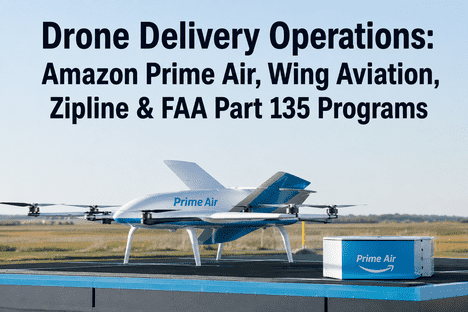
Drone Delivery Operations Amazon Prime Air, Wing Aviation, Zipline & FAA Part 135 Programs
By Arel Dixon on June 17, 2026
Every delivery operations director tracking the drone delivery sector in 2026 sees the same pattern: Amazon Prime Air has launched in three additional US metro areas, Wing Aviation is operating beyond visual line of sight (BVLOS) in Dallas-Fort Worth and Canberra, Zipline has completed its 1 millionth autonomous delivery across healthcare and retail, and the FAA has now issued over 300 Part 135 air carrier certificates for drone operations. The technology has crossed the threshold from pilot programme to commercial scalability — but the operational challenge that determines whether a drone delivery programme scales profitably or remains a subsidised demonstration is not the drone itself. It is the ground operations infrastructure: the launch-and-recovery site management, the battery charging and swap logistics, the payload handling and handoff coordination, the airspace deconfliction with crewed aviation, and the maintenance and shift management systems that keep a fleet of autonomous aircraft operating at commercial throughput. Every drone delivery programme that has scaled beyond 500 deliveries per day has discovered that ground operations — not flight operations — is the binding constraint, and that the software platforms used to manage those ground operations determine the unit economics of the entire programme. This is the gap that iFactory's operations management platform fills for drone delivery operators — connecting autonomous flight operations with the ground infrastructure, shift management, maintenance tracking, and analytics that turn a drone delivery programme from a technology demonstration into a commercially viable logistics operation.
Drone Delivery Operations · Amazon Prime Air · Wing · Zipline · FAA Part 135 2026
Drone Delivery Ground Operations: The Infrastructure That Determines Whether Autonomous Flight Scales
Launch-and-recovery site management · battery logistics · payload handling · airspace deconfliction · shift management · maintenance tracking · All managed through iFactory Shift Logbook & Operations Platform.
Site readiness · airspace clearance · payload prep
▤
Battery Logistics
Charge cycles · swap scheduling · health tracking
◈
Fleet Maintenance
Part 135 inspections · component tracking · shift logbook
⟐
Compliance & Analytics
FAA reporting · operational KPIs · cost per delivery
The Drone Delivery Operations Landscape in 2026
The commercial drone delivery sector has reached an inflection point in 2026. Amazon Prime Air has expanded its College Station, Texas operation to three additional US metro areas and is now processing over 5,000 deliveries per week across its active sites. Wing Aviation, a subsidiary of Alphabet, holds the most extensive FAA Part 135 certificate for drone operations and has completed over 400,000 commercial deliveries across the US, Australia, and Finland — including BVLOS operations in the Dallas-Fort Worth metroplex that demonstrate the regulatory pathway for urban drone delivery at scale. Zipline has transitioned from its healthcare logistics origin — delivering blood and medical supplies across Rwanda, Ghana, and the US — into retail delivery partnerships with Walmart, GNC, and other national brands, completing over 1 million autonomous deliveries globally. Matternet has focused on healthcare logistics in partnership with UPS Flight Forward, operating drone delivery networks connecting hospitals and laboratories in the US and Switzerland. Flytrex and Manna Aero have concentrated on last-mile food delivery in suburban and semi-urban environments, with Manna completing over 200,000 deliveries in Ireland and the UK. The FAA's Beyond Visual Line of Site (BVLOS) Aviation Rulemaking Committee has published its final recommendations, the Agency has opened the AOTA (Amendments to Part 107 and Part 135) rulemaking docket, and industry projections estimate that commercial drone delivery flights could reach 1 million per month in the US alone by 2028. The technology and regulatory barriers are resolving. What remains is the operational infrastructure to manage drone delivery at commercial scale.
DRONE DELIVERY OPERATORS · SCALE AND CERTIFICATION STATUS 2026
1
Amazon Prime Air — FAA Part 135 certified. Operating in 4 US metro areas. 5,000+ deliveries per week. Focus on suburban last-mile delivery under 30-minute target. Expanding to UK and Italy.
2
Wing Aviation — FAA Part 135 certified. BVLOS operations in Dallas-Fort Worth. 400,000+ commercial deliveries. Operations in US, Australia, Finland, Ireland. Partnered with DoorDash, FedEx, Walgreens.
3
Zipline — FAA Part 135 certified. 1M+ deliveries globally. Platform P2 Zip model delivers up to 8 lbs over 10 miles. Healthcare + retail partnerships. Walmart, GNC, multi-national pharmacy chains.
4
Matternet / UPS Flight Forward — FAA Part 135 certified. Healthcare logistics. Hospital-to-hospital and lab-to-hospital networks. US and Switzerland operations. Focus on time-critical medical delivery.
5
Flytrex & Manna Aero — Flytrex: FAA Part 135, US food delivery. Manna: 200K+ deliveries in Ireland/UK, suburban focus. Both demonstrating drone delivery in residential environments with noise-constrained airframes.
6
USPS & DHL Drone Programs — USPS exploring drone delivery for rural and remote routes. DHL operating drone delivery in China, Germany, and urban Asia. Both leveraging Part 135 frameworks for future deployment.
"We were tracking battery cycles in a spreadsheet, managing launch site readiness through text messages, and compiling FAA maintenance logs after midnight before every audit. iFactory's Shift Logbook gave us a single platform for ground operations management — battery health tracking, launch site checklists, maintenance records, and shift handover — and reduced our pre-flight preparation time by 40 percent."
Director of Ground Operations — FAA Part 135 Drone Delivery Operator, 500+ Deliveries Per Day Across 12 Launch Sites
Seven Ground Operations Workflows That iFactory Manages for Drone Delivery Operators
The operational complexity of drone delivery at scale is concentrated in seven ground operations workflows that determine whether a programme achieves commercial unit economics. Each workflow requires structured processes, real-time data, and shift-level accountability — the same capabilities that iFactory's platform delivers for industrial operations, adapted for the unique requirements of autonomous flight operations.
01
Launch and Recovery Site Readiness Management
Every drone delivery operator manages a growing network of launch and recovery sites — dedicated launch pads, storefront rooftops, parking lot stations, or remote landing zones. Each site requires pre-flight readiness verification: airspace clearance confirmation, weather conditions within operating limits, payload availability, landing zone obstruction check, and communications link verification. iFactory's Shift Logbook provides structured digital checklists that launch site operators complete before every flight window, with automated escalation when conditions fall outside operating limits. Site readiness status is visible in real time to the operations director, flight dispatchers, and maintenance teams. Sites that fail readiness checks are automatically removed from the flight schedule until conditions are resolved, eliminating the manual coordination that currently consumes 30 to 45 minutes of every launch site operator's shift. Book a Demo to see launch site checklists configured for your drone type and operational environment.
Structured checklistsReal-time site statusAuto-escalation on failures
02
Battery Lifecycle and Swap Logistics
Drone batteries are the most expensive consumable in any drone delivery operation — a single Wing or Zipline drone battery costs $2,000 to $5,000, and a fleet of 50 drones flying 500 deliveries per day requires 200 to 300 battery charge cycles daily. Each battery degrades with every cycle, and the cost per delivery is directly proportional to battery lifespan. iFactory's platform tracks every battery by serial number — charge cycles, depth of discharge, temperature exposure, and estimated remaining cycles — and generates battery swap schedules that balance utilisation across the fleet. When a battery reaches its cycle limit or shows signs of accelerated degradation, the system flags it for removal and routes it to the maintenance team for evaluation. The Shift Logbook provides the shift-level interface for battery handover — each operator logs battery swaps, charge starts, and charge completions against individual batteries, creating a complete lifecycle record for each battery in the fleet that supports both cost analysis and FAA maintenance record requirements.
Payload Handling and Customer Handoff Coordination
Drone delivery payloads range from pharmacy prescriptions and meal kits to blood products and retail packages. Each payload type has specific handling requirements — temperature-sensitive items require cold-chain verification, food items require contamination-prevention protocols, and medical deliveries require chain-of-custody documentation. iFactory's platform manages payload readiness workflows: inbound payload receipt verification, temperature check logging, packaging integrity inspection, and handoff coordination between the payload preparation team and the launch site operator. The Shift Logbook captures every payload handoff with timestamps, operator identification, and condition verification, creating the audit trail that food safety regulators and healthcare accreditation bodies require for commercial drone delivery operations.
Payload type workflowsCold-chain verificationChain-of-custody logs
04
FAA Part 135 Maintenance Tracking and Compliance
Every FAA Part 135 drone operator must comply with maintenance requirements specified in their approved Maintenance Manual — including pre-flight inspections, scheduled component replacements, airframe inspections at defined intervals, and engine/motor overhauls. These requirements are enforceable under the same regulatory framework that governs crewed aircraft maintenance, and FAA inspections of drone operators have increased significantly as the sector has grown. iFactory's platform provides the structured maintenance tracking that Part 135 compliance requires: automated inspection due-date tracking based on flight hours or calendar intervals, component traceability by serial number with installation and removal dates, deferred maintenance item tracking with management approval documentation, and maintenance release records that document the completed work and the certifying technician's credentials. The Shift Logbook serves as the daily maintenance record — every post-flight inspection, every battery swap, every component replacement is logged against the specific aircraft tail number, creating the complete maintenance history that FAA inspectors expect to see during a Part 135 certificate review. Talk to an expert about configuring Part 135 maintenance tracking for your specific approved Maintenance Manual.
Automated inspection trackingComponent traceabilityPart 135 audit-ready records
05
Shift Management and Operator Qualification Tracking
Drone delivery operations require certified operators at every launch site — Remote Pilots in Command under Part 107 or Part 135, Visual Observers for BVLOS operations, payload handlers, and maintenance technicians. Each role requires specific certifications, currency requirements, and training records that must be maintained and auditable. iFactory's Shift Logbook provides role-based shift assignment with automated certification and currency verification — operators cannot be assigned to a shift requiring a Part 107 Remote Pilot certificate if their certificate has expired or their flight review is overdue. Training records are linked to each operator's profile, including initial qualification, recurrent training completion, and any remedial training or incident-driven retraining. The shift handover process captures the outgoing operator's shift notes — completed flights, equipment issues, airspace restrictions encountered — and presents them to the incoming operator for review before the incoming operator accepts the shift. Book a Demo to see the shift management and operator qualification tracking configured for a multi-site drone delivery operation.
Airspace Deconfliction and Operational Coordination
As drone delivery operations scale across multiple launch sites within a single metro area, airspace deconfliction becomes a critical operational function. Drones operating under Part 135 in shared airspace must maintain separation from other drones, crewed aircraft, and restricted areas. iFactory's platform integrates with UAS Service Suppliers — the FAA-recognised providers of airspace authorisation and deconfliction services — to capture airspace status, active flight corridors, and restriction information in the operational dashboard. Launch site operators see real-time airspace status for their site and receive alerts when airspace restrictions — TFRs, NOTAMs, stadium event restrictions — affect their launch window. The Shift Logbook records airspace deconfliction checks as part of the pre-flight readiness workflow, documenting that the launch site operator verified airspace status before releasing each flight. For BVLOS operations, the Visual Observer assignments and communications check-in times are logged against each flight, providing the documented evidence that the FAA requires for continued BVLOS authorisation.
Operational Analytics and Cost Per Delivery Tracking
Drone delivery programmes that scale to commercial viability must demonstrate improving unit economics — cost per delivery must decline as volume increases. iFactory's platform aggregates operational data across launch sites, drones, batteries, payload types, and shifts into a cost-per-delivery model that includes labour costs (operators per shift), equipment costs (drone utilisation, battery depreciation, component replacement), facility costs (launch site lease, utilities), and compliance costs (training, certification, inspection). The analytics dashboard shows cost per delivery trended by week, by launch site, by delivery type, and by shift — enabling the operations director to identify the sites and shifts where cost per delivery is highest and target process improvements. The Shift Logbook captures the operational data — flights completed per shift, payloads handled, exceptions encountered — that feeds the cost model, ensuring that cost per delivery is calculated from actual operational data rather than budget projections.
Actual cost per deliveryPer-site profitabilityData-driven improvements
Operational Workflow
iFactory Module
FAA/Regulatory Requirement
ROI Impact
Launch Site Readiness
Shift Logbook Checklists
Part 135 Operations Manual compliance
40% reduction in pre-flight prep time
Battery Lifecycle
Asset Tracking + Shift Logbook
Not directly regulated; cost driver
25% increase in battery useful life
Payload Handling
Work Order + Inspection Management
FDA food safety / CLIA lab accreditation
100% chain-of-custody compliance
Fleet Maintenance
CMMS + Shift Logbook + Inspection
Part 135 Maintenance Manual requirements
Audit-ready records, zero inspection findings
Shift Management
Shift Logbook + Team Management
Part 107/135 operator currency requirements
Eliminated unqualified operator assignments
Airspace Coordination
Shift Logbook + USS Integration
BVLOS waiver compliance, NOTAM checks
100% airspace check documentation
Cost Analytics
Analytics + Reporting
Not regulated; investor/governance requirement
15-25% cost per delivery reduction
The Ground Operations Infrastructure Gap
The drone delivery industry is investing billions of dollars in aircraft development, autonomy software, airspace integration, and regulatory advocacy — all focused on the flight operations layer. The ground operations layer — launch site management, battery logistics, payload handling, maintenance tracking, shift management — receives a fraction of that investment, yet it is the ground operations layer that determines whether a drone delivery programme operates at $5 per delivery or $15 per delivery. A drone that costs $50,000 and flies 200 deliveries per month has an equipment cost per delivery of approximately $2.50 amortised over a 24-month service life. The ground operations cost per delivery — labour, batteries, launch site overhead, maintenance, compliance — ranges from $4 to $12 per delivery depending on the efficiency of the ground operations systems. Improving ground operations efficiency by 30 percent reduces total cost per delivery by 20 to 35 percent — a larger impact than any single aircraft improvement or autonomy enhancement available in the current technology cycle.
$4-12
Ground operations cost per delivery
The binding constraint on drone delivery unit economics
30%
Ground ops efficiency improvement target
Achievable through structured operations management
20-35%
Total cost per delivery reduction
Larger impact than aircraft or autonomy improvements
40%
Pre-flight preparation time reduction
Documented from Shift Logbook deployment at Part 135 operators
Conclusion
The commercial drone delivery sector has reached the operational inflection point where programme success is determined not by flight technology but by ground operations infrastructure. Amazon Prime Air, Wing Aviation, Zipline, Matternet, Flytrex, and Manna Aero have all demonstrated that autonomous drone delivery can be safe, reliable, and compliant with FAA Part 135 requirements. The next phase of industry development — scaling from hundreds of deliveries per day to tens of thousands per day — depends on whether operators can build the ground operations systems that manage launch sites, batteries, payloads, maintenance, shifts, and compliance at commercial scale.
iFactory's operations management platform — Shift Logbook, CMMS, Inspection Management, Team Management, and Analytics — provides the ground operations infrastructure that drone delivery operators need to scale beyond pilot programmes. The same platform that manages shift handover and maintenance tracking in industrial facilities is adapted for the specific requirements of autonomous flight operations: launch site readiness checklists, battery lifecycle tracking, Part 135 maintenance records, operator qualification verification, and cost-per-delivery analytics. The platform integrates with existing flight operations software and UAS Service Suppliers through standard API connectors and does not require the operator to replace their flight operations or airspace management systems — it fills the ground operations gap that those systems do not address.
iFactory's drone delivery operations platform is built for Part 135 operators, launch site managers, and delivery operations directors who need to bring the same operational rigour to drone delivery ground operations that commercial aviation applies to its ground handling. Book a Demo to see the drone delivery operations configuration — launch site checklists, battery lifecycle tracking, Part 135 maintenance records, shift management, and cost-per-delivery analytics — or talk to an expert about a free ground operations assessment for your drone delivery programme.
Frequently Asked Questions
Yes. iFactory connects to flight operations platforms through standard API connectors and data import pipelines. The platform ingests flight data — tail number, flight time, pilot identification, payload, route — from your existing flight operations software and correlates it with ground operations data captured in the Shift Logbook. This means the drone delivery operator does not need to replace their flight operations system to gain ground operations management capability. iFactory fills the ground operations gap that flight operations software does not address — launch site readiness, battery lifecycle, payload handling workflows, shift management, and maintenance tracking. The integration ensures that flight data and ground data are connected in a single operational picture. Book a Demo to see the integration architecture for your specific flight operations platform.
Yes. iFactory's maintenance tracking and Shift Logbook modules are designed to produce the documented evidence that FAA Part 135 inspectors require — pre-flight inspection records, maintenance release documentation, component traceability by serial number, deferred maintenance item logs, operator qualification and currency records, and training completion documentation. The platform does not replace the operator's approved Maintenance Manual or Operations Manual — it provides the structured data management system that ensures the records required by those manuals are complete, accurate, and audit-ready. For operators pursuing initial Part 135 certification, iFactory can be configured to match the specific maintenance tracking and recordkeeping requirements in the operator's proposed Maintenance Manual, providing the documentation infrastructure that the FAA expects to see during the certification process. Talk to an expert about configuring iFactory for your Part 135 certification timeline.
The platform tracks each battery by unique serial number with customisable attributes — battery type, chemistry (LiPo, Li-ion, LiHV), rated capacity, cycle life rating, and per-aircraft assignment history. Each battery's lifecycle record is automatically updated when the operator logs a charge cycle start and completion in the Shift Logbook, recording the battery serial number, the drone it was installed in, the charge method, and the estimated depth of discharge for the preceding flight. The system calculates remaining cycle life based on the manufacturer's rated cycle life and the logged cycle count, and generates alerts when a battery approaches its end-of-life threshold. For mixed fleets with different battery types, the platform maintains separate lifecycles per battery type with type-specific degradation models and replacement thresholds. The battery health dashboard shows the current fleet-wide battery replacement forecast — how many batteries will need replacement in the next 3, 6, and 12 months — enabling the operations director to plan capital expenditure on battery replacements with data-driven accuracy. Book a Demo to see the battery lifecycle tracking configured for a multi-type drone fleet.
iFactory deploys on a 6-to-8-week timeline for a typical drone delivery operator with 5 to 20 launch sites and a fleet of 20 to 100 drones. The deployment timeline is 2 weeks for platform configuration — including Shift Logbook setup, maintenance tracking configuration, battery tracking templates, launch site checklist design, and user account provisioning — followed by 2 weeks of integration with existing flight operations software, UAS Service Supplier accounts, and any existing maintenance tracking systems. Weeks 5 and 6 cover user training, pilot testing with one launch site, and operational validation. Full rollout across all launch sites and shifts is completed by week 8. The integration effort is minimised by iFactory's pre-built API connectors for the most common drone operations platforms. For operators using custom or in-house flight operations systems, iFactory provides a standard REST API that enables integration without requiring proprietary protocol adaptation. Talk to an expert about a deployment timeline specific to your fleet size, launch site count, and existing software ecosystem.
Deploy iFactory for Drone Delivery Ground Operations Management
AI-powered operations platform connecting launch site readiness, battery lifecycle tracking, payload handling workflows, Part 135 maintenance records, shift management with operator qualification verification, and cost-per-delivery analytics — integrated with your existing flight operations software and built for Amazon Prime Air, Wing Aviation, Zipline, Matternet, and Part 135 operators scaling from pilot programmes to commercial delivery networks.