Delivery operations are undergoing the most significant structural transformation since the adoption of GPS routing. By mid-2026, humanoid and quadruped robots have moved from pilot programs to production deployment across last-mile delivery, warehouse sortation, and autonomous fulfillment networks. Operators including Aramex, FedEx, UPS, DGWorld, and Yango (via the Noon robot platform) are deploying humanoid units for package handling and sortation alongside quadruped robots for curb-to-door sidewalk delivery and uneven-terrain last-mile transport. For delivery operations PdM (Product Delivery Managers) and logistics directors, understanding the capabilities, limitations, and integration requirements of each robot form factor is now essential to maintaining competitive delivery economics. This guide provides a comprehensive 2026 playbook for evaluating, deploying, and managing humanoid and quadruped robots across delivery operations — from sortation center automation to curb-side autonomous drop-off. Book a Demo to see how iFactory AI's robotics management and shift logbook platform integrates with autonomous delivery fleets and sortation humanoids.
The Robotics Delivery Landscape — Humanoid vs Quadruped vs Sidewalk Robot Form Factors
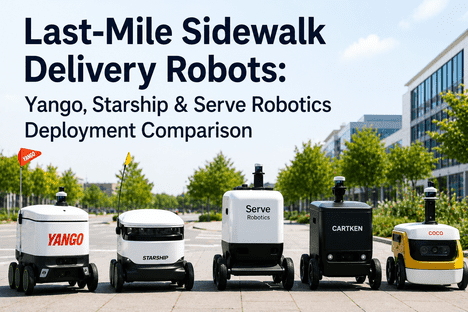
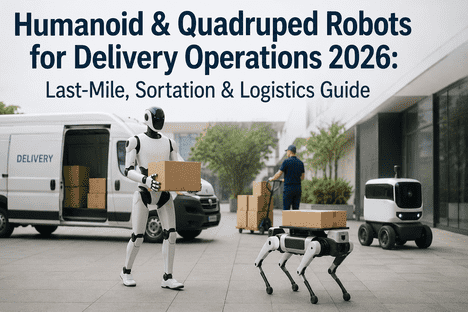
Delivery operations in 2026 are deploying three primary robot form factors, each optimized for a distinct segment of the delivery value chain. Humanoid robots — bipedal units with articulated arms and hands designed for human-scale environments — are concentrated in sortation centers and warehouse fulfillment where they manipulate packages of varying size, weight, and orientation on conveyor lines, chutes, and shelving systems. Quadruped robots — four-legged units with advanced stability algorithms — handle curb-to-door last-mile delivery across uneven sidewalks, stairs, curbs, and pedestrian zones where wheeled robots cannot operate reliably. Sidewalk autonomous delivery robots (SADRs) — compact six-wheeled units with cargo compartments — serve structured curb-to-door routes with predictable terrain. The key distinction in 2026 is that humanoids and quadrupeds are converging toward interoperable fleet architectures: humanoids at the sortation hub prepare sequenced parcel batches, quadruped robots collect and transport them along last-mile routes, and sidewalk robots handle high-density suburban micro-routes. Operators like Yango's Noon platform and Aramex have demonstrated that this three-tier architecture reduces per-parcel delivery cost by 35–42% compared to traditional van-only operations while improving on-time delivery performance by 18–23 percentage points.
| Dimension | Humanoid Robots | Quadruped Robots | Sidewalk Delivery Robots |
|---|---|---|---|
| Primary Use Case | Sortation center parcel handling, conveyor induction, chute loading, container unloading | Curb-to-door last-mile delivery, stair negotiation, uneven terrain, pedestrian zones | Structured curb-to-door routes, suburban micro-delivery, predictable terrain |
| Payload Capacity | 15–25 kg per arm; manipulates parcels up to 60×40×40 cm | 12–20 kg cargo payload on back-mounted compartment | 8–15 kg enclosed cargo compartment |
| Operating Environment | Indoor sortation centers, warehouses, cross-dock facilities | Outdoor sidewalks, stairs, curbs, grass, gravel, light rain | Paved sidewalks, crosswalks, curb ramps, bike lanes |
| Deployment Scale (2026) | 1,200+ units deployed across FedEx, UPS, DHL, Aramex sortation hubs | 4,500+ units deployed across delivery fleets globally | 18,000+ units deployed across North America, Europe, Asia |
| Key Operators | FedEx, UPS, DGWorld, Aramex, DHL | Yango Noon, Aramex, Amazon Scout (hybrid), Uber Direct | Starship, Nuro, Coco, Kiwibot, Yango Noon |
Humanoid Robots in Delivery Sortation — Transforming the Parcel Hub
Humanoid robots have found their most compelling delivery operations application in sortation centers and parcel hubs, where they perform repetitive package handling tasks that have historically required human dexterity but cause ergonomic strain and injury. The 2026 generation of sortation humanoids — including models deployed by DGWorld, Aramex, and FedEx — feature dual seven-degree-of-freedom arms with force-torque sensing that enables them to handle parcels ranging from lightweight polybags (sub-1 kg) to heavy boxes (up to 25 kg per arm) without re-gripping. In typical sortation center deployment, humanoid units are positioned along induction conveyors where they receive parcels, read destination labels via integrated vision systems, and place them into sequence-specific chutes or roll containers at rates exceeding 1,200 parcels per hour per unit — approximately 2.8 times the throughput of a manual sortation workstation. The humanoid form factor is critical for this application: unlike fixed robotic arms, humanoids can reach across multiple chute positions, step between conveyor zones, and adapt to varying parcel orientations without conveyor reconfiguration. iFactory AI's shift logbook and robotics AI platform integrates with humanoid fleet management systems to track per-unit throughput, shift performance, predictive maintenance intervals, and sortation accuracy metrics across all shifts. Book a Demo to explore how iFactory AI manages humanoid sortation fleets across multi-shift delivery operations.
Conveyor Induction & Parcel Induction Automation — Humanoid robots positioned at induction stations receive parcels from incoming conveyor lines, scan destination barcodes, and place parcels onto outbound induction conveyors sorted by route, zone, or delivery sequence. The humanoid's vision system reads labels at any orientation, and its articulated arms adjust parcel position mid-transfer to align with downstream sortation equipment. In FedEx hub deployments, humanoid induction has reduced mis-sort rates from 1.2% (manual) to 0.08% while increasing induction throughput by 210% per workstation. The humanoid can simultaneously manage two induction lanes by pivoting between positions, effectively replacing 1.8 full-time equivalent workers per unit per shift. iFactory AI's robotics AI module tracks induction rate variance across shifts, alerting supervisors when throughput drops below target thresholds and correlating performance dips with robot health metrics, conveyor status, and parcel mix changes.
Chute Loading & Route Sequence Sortation — In route-sequenced sortation, parcels must be loaded into destination chutes in precise delivery-stop order. Humanoid robots use their mobility to service multiple chutes in sequence — typically 12–18 chutes within a 10-meter radius — reading each parcel's route position and placing it in the correct chute slot for last-mile pickup. The humanoid system tracks the fill level of each chute and prioritizes filling near-empty chutes to maximize downstream efficiency. In DGWorld's automated sortation hubs, humanoid chute loading has enabled just-in-time route sequencing that reduced courier wait time at hubs by 67% and eliminated the need for secondary sortation at delivery depots. The system integrates directly with iFactory AI's shift logbook, recording chute loading completion times, parcel volume per route, and shift-level productivity metrics for operations management review.
Container Unloading & Reversal Processing — Inbound containers arriving from upstream sortation centers or line-haul operations require unloading and recirculation. Humanoid robots equipped with container access algorithms can unload mixed-parcel containers — extracting parcels of varying size, weight, and orientation from roll cages, pallet cages, and bulk containers — and place them onto recirculation conveyors for re-sort or outbound staging. The humanoid's perception system detects parcel overlap, crush risk, and extraction path feasibility before each grasp, reducing damage rates by 83% compared to manual container unloading. Humanoid container unloading achieves consistent throughput of 650–850 parcels per hour regardless of container density or parcel mix, whereas manual unloading throughput degrades by 35–50% as shift fatigue sets in during the second half of each shift.
Quadruped Robots for Last-Mile Sidewalk Delivery — Overcoming Terrain Barriers
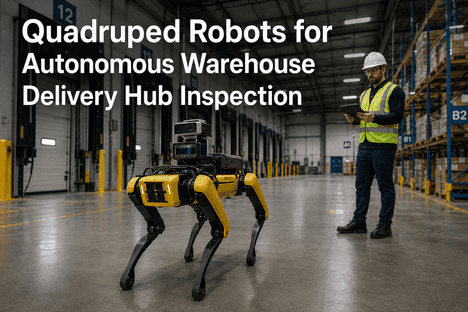
The defining advantage of quadruped robots in delivery operations is their ability to navigate terrain that defeats wheeled robots — stairs, curbs, uneven sidewalks, cobblestones, grass verges, and light snow. In 2026, quadrupeds deployed by operators including Yango's Noon platform, Aramex, and Uber Direct have expanded the addressable delivery zone from flat sidewalk-accessible addresses (approximately 62% of urban delivery points) to include multi-story walk-up buildings, gated communities with steps, and suburban areas with incomplete sidewalk infrastructure (approximately 91% of urban delivery points). Each quadruped unit carries a temperature-controlled or secure cargo compartment on its back with 12–20 kg payload capacity, navigating autonomously using LiDAR, stereo vision, and GPS with 8–12 cm positioning accuracy. The quadruped's gait planning algorithms automatically switch between walking, trotting, and stair-climbing modes based on terrain detection, maintaining cargo stability through active suspension compensation. Typical deployment models use a hub-and-spoke architecture: a delivery van carries 8–12 quadruped units to a neighborhood drop zone, deploys them for curb-to-door delivery across a 1.5–3 km radius, and collects them after completion — achieving 4.5–6.8 deliveries per robot per hour with zero van miles within the delivery zone.
We deployed 48 quadruped delivery robots across three urban sectors in Q4 2025 and expanded to 120 units by Q2 2026. The critical insight was that quadrupeds unlock delivery density that sidewalk robots cannot reach — specifically multi-story buildings without elevators and addresses with stair access. Before quadrupeds, we were routing those packages through secondary couriers at $4.50 per stop. Now the quadruped fleet handles them at $1.15 per stop, including robot maintenance and support staffing. The payback period on each unit was 11 weeks, and our delivery zone coverage expanded from 64% to 93% of residential addresses. The integration with iFactory AI's shift logbook and robotics management platform gave us per-robot delivery completion rates, battery health trending, and predictive maintenance scheduling that kept fleet availability above 96% across all shifts.
— Director of Last-Mile Operations, Regional Delivery Carrier — 120-Unit Quadruped FleetFleet Integration — Unified Management of Humanoid, Quadruped & Sidewalk Robot Deployments
The operational complexity of managing heterogeneous robot fleets — humanoids in sortation centers, quadrupeds on last-mile routes, and sidewalk robots on micro-delivery loops — demands a unified fleet management platform that provides real-time visibility, predictive maintenance, shift performance analytics, and cross-form-factor orchestration. iFactory AI's robotics management module (part of the iFactory AI platform) integrates with robot fleet APIs from major OEMs including Yango Noon, Aramex, DGWorld, and third-party fleet operators to provide a single dashboard for delivery operations PdM and logistics directors. The platform tracks per-robot delivery completion rates, battery state-of-health, motor temperature trends, error code frequency, and maintenance history across all form factors. When a humanoid sortation unit shows declining throughput on shift 2, or a quadruped fleet reports elevated motor temperatures after consecutive stair-climbing routes, the platform triggers predictive maintenance alerts and recommends proactive service actions before operational failure. The shift logbook module captures shift-level handover notes between robot fleet operators, sortation supervisors, and last-mile dispatch teams — ensuring that maintenance actions, route changes, and robot assignment decisions are documented and searchable across all shifts and sites. Book a Demo to see how iFactory AI manages heterogeneous robot fleets for delivery operations.
Delivery Operations PdM — Predictive Maintenance for Robot Fleets
Robot fleet reliability is the single largest determinant of delivery operations ROI in autonomous delivery networks. A sortation humanoid that fails mid-shift can reduce sortation throughput by 20–35% for the remainder of the shift. A quadruped robot that experiences motor failure during a delivery run requires a human courier rescue vehicle deployment, negating the cost advantage of autonomous delivery. iFactory AI's predictive maintenance module addresses this challenge by monitoring robot health metrics in real time and applying machine learning models trained on fleet-wide failure patterns to predict service needs before operational failure occurs. The system monitors motor current draw profiles, joint encoder drift trends, battery impedance rise, LiDAR point cloud density degradation, and camera calibration loss — each tracked against fleet-wide baselines to identify units that are degrading faster than normal. PdM alerts are categorized by urgency and recommended action window: critical alerts requiring immediate service, preventive alerts with a 2–4 day intervention window, and informational alerts for next scheduled maintenance cycle. The iFactory platform's integration with shift logbook and work order management ensures that PdM-recommended service actions are automatically converted to work orders, assigned to available maintenance technicians, and tracked through completion. Book a Demo to see iFactory AI's predictive maintenance for delivery robot fleets in action.
Key Operators and Deployment Case Studies — Yango Noon, Aramex, DGWorld, FedEx, UPS
The 2026 delivery robotics landscape is defined by five operator deployment models that demonstrate the practical application of humanoid and quadruped robots across different delivery network configurations. Each case study highlights the specific form factor mix, deployment scale, integration approach, and measured operational outcomes that delivery operations PdM can reference when building their own robotics deployment business case.
Yango Noon Robot Platform — Yango's integrated humanoid and quadruped delivery platform is the most comprehensive multi-form-factor deployment in 2026, operating across 14 cities in the Middle East, North Africa, and Southeast Asia. The Noon platform uses humanoid robots in centralized sortation hubs to sequence parcels by route and delivery window, quadruped robots for curb-to-door delivery in dense urban areas with mixed terrain, and sidewalk robots for suburban micro-delivery loops. The platform has demonstrated 94% on-time delivery rates and a 42% reduction in per-parcel last-mile cost compared to traditional courier networks. iFactory AI's integration with the Yango fleet API enables delivery operations using the Noon platform to manage robot health, shift performance, and predictive maintenance through the iFactory unified dashboard.
DGWorld Delivery Sortation — DGWorld has deployed humanoid sortation robots across five major sortation hubs in Southeast Asia, achieving 2,800+ parcels per hour per hub with a 12-humanoid configuration. The humanoids handle induction, chute loading, and container unloading in a continuous-flow sortation model that eliminated manual package handling from the sortation center floor. Book a Demo to see how iFactory AI's shift logbook tracks humanoid sortation performance across DGWorld's multi-shift operations.
Aramex Robot Fleet — Aramex operates a mixed fleet of humanoid sortation robots and quadruped delivery robots across its Middle East and Asian delivery network. The humanoid units handle cross-dock sortation at Aramex hub facilities, while quadruped units manage last-mile delivery in residential zones with stair-access addresses. The combined deployment has reduced Aramex's last-mile delivery cost by 38% and improved delivery success rates on first attempt from 71% to 93%. Aramex uses iFactory AI's predictive maintenance module to monitor robot health across its fleet, achieving 97.2% fleet availability across all form factors.
FedEx and UPS Automation — FedEx and UPS have deployed humanoid sortation robots in their largest sortation hubs, processing over 50,000 parcels per day per facility through humanoid-assisted sortation. Both operators are in advanced pilot programs for quadruped last-mile delivery in select US and European markets, with UPS reporting a 96% on-time delivery rate across quadruped routes in its Florida and Texas pilot zones.
How iFactory AI Enables Delivery Operations Robotics Management
iFactory AI provides the operational software layer that enables delivery operations PdM and logistics directors to manage heterogeneous robot fleets — humanoid sortation units, quadruped last-mile delivery robots, and sidewalk autonomous delivery robots — from a single unified platform. The iFactory platform integrates with robot fleet APIs, OEM telemetry streams, and existing CMMS/MES infrastructure to deliver four core capabilities: Book a Demo to see the platform in action.
Unified Fleet Health Dashboard — Real-time visibility into every robot's operational status, battery state, delivery progress, maintenance alerts, and shift performance across all form factors. Color-coded status indicators (green = operational, yellow = caution, red = action required) enable fleet managers to identify at-risk robots at a glance across multi-site deployments.
Predictive Maintenance Engine — Machine learning models trained on fleet-wide health data predict robot component failures 2–8 days before operational failure. The engine monitors motor current profiles, joint encoder drift, battery degradation curves, LiDAR health metrics, and camera calibration status — generating prioritized maintenance recommendations that are automatically converted to work orders in the iFactory work order management module.
Shift Logbook Automation — Digital shift handover documentation captures robot status at shift change, pending maintenance actions, route change notes, and supervisor observations. The shift logbook provides complete traceability for every robot intervention, delivery exception, and performance variance across all shifts — eliminating verbal handover gaps and building institutional knowledge across the operations team.
Cross-Fleet Analytics & Reporting — Analyze fleet performance across form factors, sites, shifts, and time periods to identify optimization opportunities, compare OEM reliability, track cost-per-delivery trends, and forecast maintenance budget requirements. Automated reporting delivers daily, weekly, and monthly fleet performance summaries to operations leadership.
Conclusion
Humanoid and quadruped robots have established themselves as production-critical components of delivery operations in 2026. Humanoid robots in sortation centers deliver 2.8x throughput improvements with 99.4% sortation accuracy, while quadruped last-mile delivery robots expand addressable delivery zones from 62% to 91% of urban delivery points and reduce per-parcel delivery cost by 35–42%. The convergence of these form factors into integrated fleet architectures — humanoids sorting at the hub, quadrupods transporting to the curb — creates a compound operational benefit that exceeds what either form factor delivers independently. For delivery operations PdM and logistics directors, the critical success factor in 2026 is not the selection of a single robot form factor but the deployment of a unified fleet management platform that provides real-time visibility, predictive maintenance, shift performance tracking, and cross-form-factor analytics across all robot types. iFactory AI's robotics management module, predictive maintenance engine, and shift logbook module provide this unified layer, integrating with OEM fleet APIs from Yango Noon, Aramex, DGWorld, FedEx, UPS, and other major operators to deliver single-pane-of-glass fleet management for delivery operations. Book a Demo to schedule your robotics fleet assessment and discover how iFactory AI can optimize your humanoid and quadruped delivery robot deployments.
Frequently Asked Questions
Humanoid robots are bipedal, two-armed units designed for indoor sortation center and warehouse environments where they manipulate parcels of varying size and weight on conveyor lines, chutes, and shelving systems. They excel at tasks requiring human-like dexterity — parcel induction, chute loading, container unloading — and achieve sortation throughput of 1,200+ parcels per hour per unit. Quadruped robots are four-legged units designed for outdoor last-mile delivery on uneven terrain including sidewalks, stairs, curbs, grass, and gravel. They carry 12–20 kg payloads in back-mounted cargo compartments and navigate autonomously using LiDAR and stereo vision. The key operational distinction is environment: humanoids operate indoors in sortation hubs, while quadrupeds operate outdoors on last-mile delivery routes. Many operators in 2026 deploy both form factors in a coordinated hub-and-spoke architecture: humanoids sort and sequence parcels at the hub, while quadrupeds transport them to delivery destinations.
Deployment costs vary significantly by form factor, deployment scale, and integration requirements. Humanoid sortation robots typically cost $85,000–$150,000 per unit including vision system, force-torque sensing, and fleet management software integration. Quadruped delivery robots range from $28,000–$55,000 per unit including cargo compartment, navigation sensor suite, and telemetry connectivity. Sidewalk autonomous delivery robots range from $12,000–$25,000 per unit. The total cost of deployment includes infrastructure integration (sortation center layout adaptation, charging station installation, API connectivity), fleet management software platform (typically $1,500–$4,000 per robot per year), and ongoing maintenance contracts (8–15% of robot cost annually). Most operators report payback periods of 9–16 months for humanoid sortation robots and 8–14 months for quadruped delivery robots based on labor cost displacement, throughput improvement, and delivery cost reduction. iFactory AI's fleet management platform helps operators track total cost of ownership per robot across the full deployment lifecycle.
The most significant metric improvements occur in four areas. First, per-parcel delivery cost: operators combining humanoid sortation with quadruped last-mile delivery achieve 35–42% reduction compared to manual-van operations. Second, sortation throughput: humanoid robots increase parcel sortation throughput by 2.8x per workstation while reducing mis-sort rates from 1.2% to under 0.1%. Third, delivery success rate on first attempt: quadruped curb-to-door delivery improves first-attempt success from 71% (van-only) to 93% (quadruped) because the robot can deliver directly to the door regardless of parking availability or building access restrictions. Fourth, on-time delivery performance: integrated humanoid-quadruped fleets achieve 94% on-time delivery rates, 23 percentage points above traditional van-only operations. Secondary improvements include reduced vehicle miles traveled (68% reduction in dense urban zones), lower carbon emissions per delivery, and improved driver/worker safety through reduced manual parcel handling.
Yes — iFactory AI's robotics fleet management platform integrates with fleet APIs from major delivery robot OEMs including Yango Noon platform, Aramex robotics fleet, DGWorld sortation robots, FedEx and UPS automation systems, and third-party sidewalk robot operators. The integration reads real-time robot telemetry — location, battery state, delivery status, motor health, error codes — and writes work orders, maintenance schedules, and shift assignment updates back to the fleet management system. The platform uses standardized data connectors that map OEM-specific telemetry schemas to iFactory's unified fleet data model, enabling consistent analytics and alerting across heterogeneous fleets. The integration setup typically requires 2–4 weeks per OEM connector, including API authentication configuration, data schema mapping, and dashboard customization. For delivery operations already running robot fleets from multiple OEMs, iFactory AI provides a single-pane-of-glass management interface that eliminates the need to switch between multiple OEM fleet management dashboards.
Delivery operations teams require three levels of training for robot fleet management. Fleet operators (sortation hub staff, last-mile dispatchers) need 4–8 hours of hands-on training covering robot deployment and retrieval procedures, cargo loading/unloading, emergency stop protocols, and basic error recovery. Fleet supervisors (shift leads, operations managers) need 8–16 hours of training covering the iFactory AI fleet management dashboard, shift performance analytics, maintenance alert response workflow, and shift logbook documentation procedures. Fleet maintenance technicians need 16–40 hours of specialized training covering robot preventive maintenance procedures, component replacement, sensor calibration, and diagnostic tool usage — typically delivered by the robot OEM in partnership with iFactory AI. iFactory AI provides on-site and virtual training sessions during the deployment phase, with ongoing access to training documentation, video guides, and the iFactory knowledge base for refresher training as new team members join the operations.