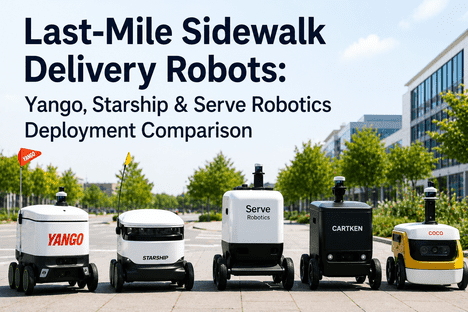
Sidewalk autonomous delivery robots have become the fastest-growing segment of last-mile delivery automation in 2026. Unlike humanoid or quadruped robots that require significant infrastructure investment and specialized operating environments, sidewalk robots operate on existing pedestrian infrastructure, carry payloads of 8–15 kg over 3–8 km ranges, and achieve per-delivery costs that undercut conventional courier services by 55–70%. The category has attracted five major operators Yango (via the Noon robot platform), Starship Technologies, Serve Robotics, Cartken, and Coco each pursuing a distinct deployment strategy across university campuses, dense urban centers, suburban micro-delivery zones, and restaurant corridors. For delivery operations PdM evaluating sidewalk robot deployment, understanding the operational differences between these platforms is essential to selecting the right form factor, fleet management approach, and integration architecture. This guide provides a structured comparison of the five leading sidewalk delivery robot platforms, their 2026 deployment data, and the fleet management considerations that determine deployment success. Book a Demo to see how iFactory AI's robotics fleet management platform integrates with Yango, Starship, Serve, Cartken, and Coco fleets for unified operations management.
Sidewalk Robot Platform Comparison Yango, Starship, Serve, Cartken, Coco
Each of the five major sidewalk robot operators brings a distinct approach to last-mile autonomous delivery — differing in robot design, payload capacity, navigation strategy, deployment density, and commercial focus. Understanding these differences is critical for delivery operations PdM deciding which platform to integrate into their delivery network. The table below provides a side-by-side comparison of the key deployment specifications as of mid-2026.
| Platform | Parent / Operator | Fleet Size (Q2 2026) | Payload | Range | Primary Use Case | Navigation |
|---|---|---|---|---|---|---|
| Yango Noon | Yango (UAE-based, global) | 4,200+ units | 12 kg | 6 km | Restaurant, grocery, parcel — urban mixed-use corridors | LiDAR + stereo vision + GPS |
| Starship Technologies | Starship (US/EU) | 5,500+ units | 10 kg | 5 km | University campus, food delivery, grocery | 12-camera vision + radar + GPS |
| Serve Robotics | Serve (US, spun from Postmates/Uber) | 3,800+ units | 15 kg | 8 km | Restaurant delivery, food delivery, dense urban | LiDAR + vision + GPS + cellular |
| Cartken | Cartken (US/Japan) | 2,400+ units | 8 kg | 4 km | Campus delivery, corporate parks, retail | Vision-only + GPS |
| Coco | Coco (US) | 2,100+ units | 15 kg | 5 km | Restaurant, alcohol, convenience — urban and suburban | Vision + GPS + remote teleops fallback |
Yango Noon The Multi-Form Factor Platform
Yango's Noon robot platform is unique among the five operators in offering an integrated multi-form-factor fleet — sidewalk robots, quadruped delivery robots, and humanoid sortation robots — all managed through a unified orchestration platform. The sidewalk component of the Noon fleet operates primarily in Middle Eastern, North African, and Southeast Asian markets, with the largest deployment concentrations in Dubai, Abu Dhabi, Riyadh, Cairo, and Jakarta. Noon sidewalk robots feature a 12 kg payload capacity with a temperature-controlled cargo compartment for food and grocery delivery, navigating urban sidewalks, pedestrian crossings, and covered walkways using LiDAR-primary perception with stereo vision fallback. Yango's deployment model uses a hub-and-spoke architecture where delivery vans deploy 6–10 sidewalk robots within a 2 km radius of a drop zone, managing them autonomously through the Noon fleet management platform. The robots communicate via 5G with real-time telemetry and remote teleoperation capabilities for edge cases. As of Q2 2026, the Noon sidewalk fleet has completed over 4.8 million deliveries with a 97.8% on-time rate. Book a Demo to learn how iFactory AI integrates with Yango's Noon fleet API for unified robot health monitoring and predictive maintenance scheduling.
Starship Technologies The Campus and Community Dominant Player
Starship Technologies operates the largest single sidewalk robot fleet in the world at 5,500+ units, with the majority deployed across university campuses in the United States, United Kingdom, Germany, and Finland. Starship's robots are the most recognizable in the category the six-wheeled white-and-orange design with a 10 kg payload capacity and distinctive flag-style communication mast. Starship's deployment strategy is campus-centric: the company has exclusive or preferred partnerships with over 60 universities including UCLA, Purdue, the University of Pittsburgh, and the University of Texas. On a typical campus, 15–25 Starship robots serve a population of 30,000–50,000 students and faculty, handling food delivery from on-campus dining halls, quick-service restaurants, and local partners. The robots navigate using a 12-camera computer vision system with radar for obstacle detection and GPS for route planning, achieving Level 4 autonomy on campus pathways with remote teleoperation support for complex intersections. Starship robots have completed over 10 million autonomous deliveries cumulatively, with an average delivery time of 18 minutes from order to drop-off. The platform's fleet management API provides real-time robot status, battery telemetry, delivery completion data, and maintenance alerts to integrated systems. iFactory AI's robotics management platform ingests Starship's fleet API data to provide unified fleet health monitoring, predictive maintenance scheduling, and shift-level delivery performance analytics. Book a Demo to see Starship fleet integration in the iFactory platform.
We deployed 32 Starship robots on a 40,000-student campus in Q3 2025. In the first six months, the robots completed 128,000 deliveries with a 98.2% on-time rate. The integration with iFactory AI's fleet management platform gave our operations team real-time visibility into robot health, battery status, and delivery completion rates across all three daily shifts. The predictive maintenance module flagged a wheel motor encoder drift pattern in 11 units two days before any operational failure occurred — we proactively serviced those robots during off-peak hours and avoided what would have been 6–8 hours of fleet downtime during peak dinner delivery windows. The unified dashboard across Starship robots and our humanoid sortation units in the campus logistics hub gave us a complete view of our last-mile delivery operation that no single OEM platform could provide.
— Director of Campus Logistics Operations, Large US University — 32-Robot Starship Fleet with iFactory AI IntegrationServe Robotics Urban Restaurant Delivery at Scale
Serve Robotics, spun out from Postmates and now an independent company with Uber as a strategic investor, operates the largest sidewalk robot fleet dedicated to restaurant and food delivery in dense urban environments. Serve's robots feature a 15 kg payload capacity — the highest in the category — and an 8 km operating range, optimized for the longer delivery distances typical of urban restaurant delivery where customers order from restaurants 2–4 km away. Serve's deployment strategy is city-density-focused: the company operates in Los Angeles, San Francisco, New York, Vancouver, and Toronto, with robots navigating dense pedestrian corridors, crosswalks, bike lanes, and mixed-use urban infrastructure. The robot's LiDAR-primary navigation system with vision and GPS redundancy achieves Level 4 autonomy on urban sidewalks with remote teleoperation backup. Serve has completed over 2.8 million deliveries as of Q2 2026, with per-delivery costs averaging $2.80 compared to $7.50 for traditional courier delivery in the same markets. The fleet management platform exposes a comprehensive API for robot telemetry, delivery status, battery health, and maintenance scheduling — enabling iFactory AI's platform to integrate Serve fleet data alongside other robot form factors for unified operations management.
Cartken and Coco Niche Specialists in Campus and Urban Micro-Delivery
Cartken and Coco represent the specialist tier of the sidewalk robot market, each optimized for specific deployment environments where their form factor and operational model deliver superior economics. Cartken's vision-only navigation approach (no LiDAR) reduces per-unit robot cost to approximately $8,000–$12,000 — significantly lower than the $18,000–$25,000 range for LiDAR-equipped robots from Yango, Starship, and Serve. This cost advantage makes Cartken particularly attractive for large-scale campus deployments where 50–100+ robots operate in controlled environments with predictable pathways. Cartken has deployed across university campuses, corporate research parks, and retail centers in the US and Japan, with particular strength in Japanese corporate campus delivery where pedestrian density and pathway discipline create ideal operating conditions. Coco takes a different approach, operating a teleoperation-assisted model where robots are primarily autonomous but have remote human operators available for complex edge cases — traffic intersections, construction zones, and pedestrian congestion. This model enables Coco to operate in more challenging urban environments than fully autonomous competitors while maintaining per-delivery costs of $3.20–$4.50. Coco's 15 kg payload and 5 km range make it competitive with Serve for restaurant and convenience delivery, particularly in US urban markets including Los Angeles, San Francisco, and Austin. Both Cartken and Coco expose fleet APIs that integrate with iFactory AI's unified fleet management platform for health monitoring, predictive maintenance, and shift performance analytics. Book a Demo to explore Cartken and Coco fleet integration with iFactory AI.
Fleet Management Integration Unified Operations Across Mixed Sidewalk Robot Fleets
Delivery operations that run sidewalk robots from multiple OEMs face a significant fleet management challenge: each platform has its own fleet management dashboard, telemetry format, maintenance workflow, and alert system. iFactory AI's robotics fleet management platform solves this fragmentation by integrating with fleet APIs from all five major sidewalk robot OEMs — Yango Noon, Starship, Serve Robotics, Cartken, and Coco — into a single unified dashboard. The platform ingests robot telemetry streams (location, battery state, motor health, delivery status, error codes), normalizes the data into a consistent schema, and presents fleet health, performance, and maintenance status across all robots regardless of OEM. The unified platform enables four capabilities that individual OEM dashboards cannot deliver: cross-platform fleet health comparison (identify which OEM's robots have higher failure rates in your specific operating environment), consolidated predictive maintenance (train ML models on fleet-wide failure patterns that span multiple robot models), shift-level performance analytics across OEMs (compare Starship vs Serve vs Cartken delivery completion rates on the same shift and route), and unified work order management (service requests for any robot from any OEM routed through a single maintenance workflow). Book a Demo to see the iFactory AI unified fleet dashboard configured for a mixed sidewalk robot fleet.
Deployment Economics — Sidewalk Robot Cost Comparison
The economic case for sidewalk delivery robots varies by platform, deployment density, and operating environment. The table below provides a per-delivery cost comparison across the five major platforms based on Q2 2026 deployment data from public filings, operator disclosures, and fleet management analytics. Costs include robot depreciation, maintenance, charging, telemetry connectivity, remote teleoperation support, fleet management software, and support staffing. Book a Demo to generate a customized cost comparison for your specific delivery routes and deployment parameters.
| Platform | Per-Delivery Cost | vs Courier Savings | Avg Deliveries/Robot/Day | Breakeven Fleet Size | Robot Unit Cost |
|---|---|---|---|---|---|
| Yango Noon | $2.45 | 62% | 18–24 | 18 units | $19,000 |
| Starship | $2.65 | 58% | 15–22 | 22 units | $22,000 |
| Serve Robotics | $2.80 | 56% | 20–28 | 14 units | $25,000 |
| Cartken | $2.15 | 68% | 12–18 | 12 units | $10,000 |
| Coco | $3.40 | 48% | 14–20 | 20 units | $18,000 |
Conclusion — Selecting the Right Sidewalk Robot Platform for Your Delivery Operations
Sidewalk autonomous delivery robots have matured from pilot programs into production-scale deployment across five major platforms — Yango Noon, Starship Technologies, Serve Robotics, Cartken, and Coco — with a combined global fleet exceeding 18,000 units as of Q2 2026. Each platform brings a distinct set of capabilities optimized for specific deployment environments: Yango's multi-form-factor integration for Middle East and Asian markets, Starship's campus-centric scale and maturity, Serve's dense urban restaurant delivery focus, Cartken's low-cost vision-only approach for controlled environments, and Coco's teleoperation-assisted model for challenging urban terrain. The selection decision depends on delivery route characteristics, regulatory environment, required payload and range, fleet management infrastructure, and integration requirements with existing delivery operations systems.
Regardless of which platform an operator selects, the critical success factor in 2026 is fleet management integration — the ability to manage robot health, delivery performance, predictive maintenance, and shift operations across all deployed units regardless of OEM. iFactory AI's unified fleet management platform addresses this requirement by integrating with Yango, Starship, Serve, Cartken, and Coco fleet APIs to deliver consolidated fleet health monitoring, cross-platform predictive maintenance, shift-level performance analytics, and unified work order management. The platform enables delivery operations PdM to manage mixed OEM fleets from a single dashboard, eliminating the fragmentation that undermines fleet efficiency at scale.
Book a Demo to see iFactory AI's unified sidewalk robot fleet management platform configured for your fleet mix, or contact our robotics fleet management team for a free deployment assessment covering platform selection guidance, integration roadmap, and ROI projection for your specific delivery routes and operating conditions.