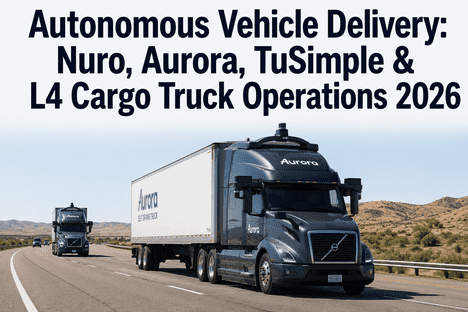
Autonomous vehicle delivery operations have entered a new phase in 2026. After a decade of pilot programmes, regulatory sandboxes, and technology demonstrations, L4 autonomous cargo trucks and last-mile delivery vehicles are now operating on commercial routes across the United States. Nuro's R3 pod is making local deliveries in California, Texas, and Arizona without a driver behind the wheel. Aurora Innovation's Aurora Driver platform is hauling freight on the I-45 corridor between Dallas and Houston in collaboration with Volvo Autonomous Solutions, Paccar, and Ryder. TuSimple continues to operate L4 autonomous trucking routes in Arizona, Texas, and New Mexico, while Kodiak Robotics has secured defence contracts and expanded its middle-mile autonomous freight network. Waabi, Plus.ai, and the autonomous divisions of Volvo, Daimler Truck, and Paccar are each advancing production-ready systems that target specific segments of the delivery operations value chain — from neighbourhood curb stops to interstate long-haul runs. The convergence of mature sensor stacks (solid-state LiDAR, 4D imaging radar, thermal cameras), production-grade domain controllers (NVIDIA Thor, Qualcomm Snapdragon Ride Flex), and regulatory frameworks (NHTSA AV exemptions, FMCSA pilot programs, state-level AV deployment permits) has shifted the industry conversation from "can autonomy work?" to "how do we operate autonomous fleets at scale?" For delivery operations managers and logistics fleet owners, the question is no longer whether to integrate autonomous vehicles — it is which platform, which deployment model, and which operational framework will deliver the highest route reliability, safety, and cost-per-mile improvement. Book a Demo to see how iFactory AI's Shift Logbook and delivery operations management platform supports autonomous fleet maintenance tracking, shift handovers, and inspection workflows for AV-equipped logistics fleets.
The L4 Autonomous Vehicle Delivery Landscape in 2026
The autonomous vehicle delivery ecosystem in 2026 is defined by platform specialisation. Unlike the one-size-fits-all autonomy approach of the late 2010s, today's L4 systems are purpose-built for specific segments of the delivery operations value chain. Last-mile delivery pods (Nuro R3) operate at SAE L4 on suburban and urban roads at speeds below 35 mph with no driver occupant. Middle-mile autonomous trucks (Kodiak Robotics, Aurora Driver) operate on highway-optimised L4 systems that handle interstate driving from depot to depot, with human drivers handling first-mile and last-mile segments on surface streets. Long-haul L4 trucks (TuSimple, Aurora, Waabi) aim for depot-to-depot L4 autonomy on major interstate corridors, reducing the need for driver rest stops and enabling continuous freight movement. The following table maps the key autonomous vehicle delivery platforms operating in the United States as of mid-2026, including their operational design domain, deployment status, and fleet partnership structure.
| Platform | Company | Segment | Operational Domain | Fleet Partners | Deployment Status |
|---|---|---|---|---|---|
| Nuro R3 | Nuro | Last-Mile Delivery | Suburban/residential roads, ≤35 mph, no occupant | Uber Eats, FedEx, Domino's, Kroger, Walmart | Commercial — CA, TX, AZ |
| Aurora Driver | Aurora Innovation | Middle-Mile / Long-Haul | Interstate highways, depot-to-depot, Class 8 trucks | Volvo AS, Paccar, Ryder, Werner, Schneider | Commercial launch — I-45 TX |
| TuSimple Autonomous Truck | TuSimple | Long-Haul | Interstate corridors, depot-to-depot, Class 8 | UPS, DHL, Werner, Penske | Operational — AZ, TX, NM |
| Kodiak Driver | Kodiak Robotics | Middle-Mile | Highway L4, surface street transfer, defence applications | U.S. Air Force, IKEA, Werner, CH Robinson | Commercial + Defence |
| Waabi Driver | Waabi | Long-Haul | Interstate L4, generative-AI based planning, simulator-first | Uber Freight, Volvo AS (evaluating) | Pilot programme |
| Plus.ai (PlusDrive) | Plus | Supervised L2+/L4 | Highway-capable, production-ready system, L4 upgrade path | FAW, Iveco, Traton Group | Production — global |
Each platform represents a distinct approach to the autonomy problem — from Nuro's purpose-built low-speed pod optimised for curb delivery to Aurora's scalable driver platform designed to integrate across multiple truck OEM platforms. The common thread across all six platforms is that fleet operators are not deploying autonomy in isolation; they are integrating autonomous vehicles into existing delivery operations fleets that include conventional trucks, vans, and last-mile delivery vehicles. This hybrid fleet reality means that maintenance workflows, shift scheduling, inspection protocols, and Parts & Inventory management must support both autonomous and conventional assets within the same operations management framework. iFactory AI's delivery operations management platform provides a unified Shift Logbook, work order management, and fleet maintenance tracking system that spans both autonomous and conventional fleet assets, ensuring that the transition to autonomy does not create operational silos. Book a Demo to see how iFactory unifies autonomous and conventional fleet operations in a single platform.
Nuro R3: Purpose-Built Last-Mile Autonomous Delivery
Nuro's third-generation autonomous delivery vehicle, the R3, represents the most mature purpose-built autonomous delivery platform in commercial operation. Unlike retrofitted passenger vehicles or light-duty trucks, the R3 is designed from the ground up for delivery — no steering wheel, no seats, no occupant compartment. The vehicle's exterior airbag system, pedestrian-friendly front-end design, and bi-directional driving capability are engineered specifically for the last-metre delivery task: pulling into driveways, navigating parking lots, and positioning at curb side for package retrieval. Nuro holds a NHTSA temporary exemption for its vehicle design and operates under California DMV AV deployment permits, Texas AV operator permits, and Arizona AV testing authorities. As of 2026, Nuro has completed over one million autonomous deliveries in partnership with Uber Eats, FedEx, Domino's, Kroger, and Walmart across three states — making it the highest-volume autonomous delivery fleet in the United States by a significant margin.
- Maximum speed: 35 mph (designed for suburban and urban residential roads)
- Payload capacity: approximately 500 lbs across multiple temperature-controlled compartments
- Sensor suite: solid-state LiDAR, 4D imaging radar, thermal cameras, ultrasonic proximity sensors
- Computing platform: NVIDIA DRIVE Orin (production) with upgrade path to NVIDIA Thor
- No driver occupant — vehicle operates SAE L4 with remote monitoring and tele-assist
- Bi-directional driving eliminates need for three-point turns in residential cul-de-sacs
- External human-machine interface (e-HMI) communicates intent to pedestrians and other road users
- Remote monitoring centre — fleet operators must staff tele-assist operators who can intervene in edge cases
- Maintenance schedule differs from conventional delivery vans — sensor calibration, LiDAR cleaning, thermal camera alignment are additional recurring tasks
- Charging infrastructure — R3 is battery-electric; fleet charging scheduling must account for delivery route timing
- Regulatory reporting — NHTSA exemption requires incident reporting; CA DMV requires annual deployment reports
- Weather limitations — heavy rain, snow accumulation, and dust storms can degrade sensor performance; fleet operators need contingency routing protocols
- Shift handover — autonomous fleet shift start requires vehicle health check, sensor verification, and route upload that differ from conventional vehicle pre-trip inspection
For delivery operations managers integrating Nuro R3 pods into an existing fleet, the most significant operational change is not the vehicle technology itself — it is the shift workflow. Autonomous delivery pods require a pre-trip sensor health verification, route validation, and tele-assist operator assignment that has no equivalent in conventional fleet operations. iFactory AI's Shift Logbook module provides a configurable pre-trip inspection template for autonomous delivery vehicles that covers sensor calibration status, LiDAR cleanliness, camera alignment, battery state of charge, and route plan confirmation — all logged with timestamp and operator ID for regulatory compliance. Book a Demo to see how iFactory's Shift Logbook adapts to autonomous fleet operations.
Aurora Driver, TuSimple, and Kodiak: Middle-Mile and Long-Haul L4 Trucking
While Nuro addresses the last mile, the highest-value segment of autonomous vehicle delivery — measured by revenue per mile, asset utilisation, and total addressable market — is middle-mile and long-haul L4 trucking. The US trucking market exceeds $875 billion annually, with approximately 75% of freight value moving on trucks. Driver shortages (estimated at 78,000 drivers in 2026), Hours of Service (HOS) restrictions limiting drive time to 11 hours per day, and an ageing driver workforce (median age 49) create structural demand for autonomous trucking solutions that can supplement — not fully replace — human-driven fleets. Three platforms lead this segment: Aurora Driver, TuSimple Autonomous Truck, and the Kodiak Driver system, each with distinct deployment models and OEM partnerships.
| Capability | Aurora Driver | TuSimple Autonomous | Kodiak Driver |
|---|---|---|---|
| Sensor Architecture | LiDAR + radar + cameras; designed for redundancy across all axes | Camera-first + LiDAR fusion; proprietary perception stack | Low-profile sensor bar (side mirrors); 6LiDAR + radar + cameras |
| OEM Integration | Volvo VNL Autonomous, Paccar Kenworth/Peterbilt, Stellantis | Navistar International (partner), OEM-agnostic integration | Class 8 truck platform via Kodiak integration kit |
| Operating Model | Aurora Driver as platform; fleet-owned trucks + Aurora-powered carrier | TuSimple-powered fleet service + carrier model | Kodiak-powered fleet; defence and commercial dual-use |
| Safety Approach | First L4 trucking company to publish voluntary safety self-assessment under NHTSA framework | L4 autonomous: no driver in cab on highway segments; remote monitoring | Driver-out on highway; automated emergency braking with proprietary safety stack |
| Regulatory Status | FMCSA pilot programme; AZ, TX, NM, OK, AR operations | AZ, TX, NM commercial operations; cross-state autonomous freight network | FMCSA exemption for driver-out operation; DoD autonomous logistics contracts |
Autonomous Fleet Integration: Maintenance, Inspection, and Shift Operations
The operational difference between a conventional delivery fleet and an autonomous delivery fleet is not limited to the vehicle technology — it extends into every aspect of fleet operations management. Autonomous vehicles require different maintenance schedules (sensor calibration cycles, LiDAR cleaning intervals, thermal camera alignment checks), different inspection workflows (pre-trip sensor health verification, post-trip data download verification, remote monitoring centre staffing), and different shift operations (tele-assist operator assignment, autonomous vehicle handover protocols, depot-side autonomous vehicle staging). Delivery operations managers who treat autonomous vehicles as "just another asset class" often discover six months into deployment that their Work Order Management, Parts & Inventory, and Shift Logbook systems were never designed to accommodate the unique operational requirements of L4 vehicles.
Phased Autonomous Vehicle Fleet Deployment Framework
The delivery operations managers achieving the fastest autonomous fleet integration results — measured by time from pilot to scaled deployment, not miles driven — follow a structured deployment framework that mirrors the predictive maintenance pilot checklist structure that industrial reliability teams use. Autonomous vehicle deployment is not a technology installation; it is an operational transformation that requires phased rollout with validation gates at each stage.
Expert Perspective
I have been involved in autonomous vehicle fleet deployment programmes since 2019, across last-mile delivery pods, middle-mile autonomous trucks, and long-haul L4 trucking operations. The fleets that scale from 5 vehicles to 50 vehicles in 18 months share one common characteristic: they treat autonomous vehicle deployment as an operations management transformation, not a technology installation. The fleets that stall at 10 vehicles treat autonomous vehicles as standalone technology projects managed by a separate AV team with separate systems, separate maintenance workflows, and separate shift operations. The difference is not the autonomy platform. The difference is whether the fleet operations management infrastructure — the Shift Logbook, the Work Order Management system, the Parts & Inventory tracking, the inspection templates, the compliance reporting — is designed from day one to span both conventional and autonomous fleet assets. When the AV fleet operations live in a separate system from the conventional fleet operations, scale becomes exponentially harder because every operational process must be duplicated. The fleets that scale unify their operations management platform first, then deploy autonomous vehicles into that unified framework.
Frequently Asked Questions
Six platforms are operating or deploying commercially in the United States as of 2026: Nuro R3 (last-mile delivery pod, commercial in CA/TX/AZ), Aurora Driver (middle-mile and long-haul L4 trucking, commercial on I-45 corridor), TuSimple Autonomous Truck (long-haul L4, operational in AZ/TX/NM), Kodiak Driver (middle-mile L4 trucking with defence and commercial operations), Waabi Driver (long-haul L4 in pilot programme), and Plus.ai PlusDrive (L2+/L4 production-ready system with global deployments). Each platform targets a specific operational design domain — last-mile suburban roads, middle-mile interstate corridors, or long-haul depot-to-depot routes — and fleet operators should select platforms based on route characteristics rather than vendor hype.
Autonomous vehicles introduce maintenance categories that have no equivalent in conventional fleet operations: sensor calibration (LiDAR alignment verification, radar boresight, camera intrinsic/extrinsic parameter validation), perception system cleaning (LiDAR window cleanliness, thermal camera lens inspection, radar dome debris check), domain controller health monitoring (compute temperature, GPU utilisation, data storage integrity), and actuator redundancy verification (brake-by-wire system test, steer-by-wire response time measurement). These maintenance tasks must be logged with calibration record traceability for regulatory compliance. iFactory AI's Inspection Management module supports configurable autonomous vehicle inspection templates with pass/fail criteria, calibration record attachment, and automated compliance reporting.
Aurora's 2025 economic analysis projects a $1.62 per-mile cost saving for autonomous trucking versus conventional Class 8 trucking on middle-mile and long-haul routes. The savings are driven by three factors: (1) fuel efficiency improvement of 8–12% from optimised cruising and reduced idling, (2) asset utilisation improvement from 11 hours/day (HOS-limited) to 22+ hours/day with staged autonomous operations, and (3) reduced labour cost as the number of drivers per truck-mile declines. However, these savings assume the autonomous fleet is operating at scale (20+ vehicles per route) with mature depot infrastructure. For pilot fleets of 3–5 vehicles, the cost per mile is typically higher than conventional operations due to tele-assist staffing costs, sensor calibration overhead, and infrastructure amortisation. The cost crossover point — where AV fleet cost per mile equals or beats conventional fleet cost per mile — typically occurs at 10–15 vehicles per route with at least 12 months of operational data.
Delivery operations managers should start by evaluating whether their existing Shift Logbook and Work Order Management system supports the following autonomous-vehicle-specific workflows before deployment: (1) AV pre-trip inspection templates with sensor health verification, calibration status, and remote monitoring assignment fields; (2) intervention event logging with vehicle ID, timestamp, route segment, environmental conditions, and operator notes; (3) sensor calibration and maintenance scheduling with component-level traceability by VIN; (4) compliance report generation for NHTSA, state DMV, and FMCSA reporting requirements; (5) unified Parts & Inventory tracking that manages both conventional truck parts and AV-specific sensor components. iFactory AI's platform provides all five capabilities in a single integrated system that spans both conventional and autonomous fleet assets — ensuring that the operations management infrastructure is ready before the first autonomous vehicle arrives at the depot.