Sortation Center Humanoid Automation: Parcel Sortation Robots for FedEx, UPS & DHL
By Arel Dixon on June 17, 2026
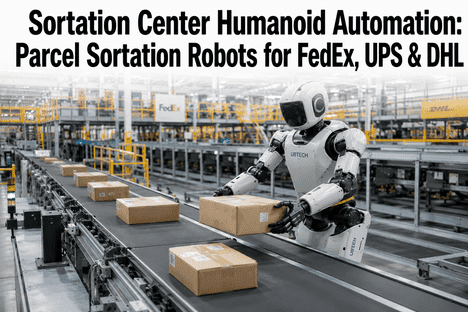
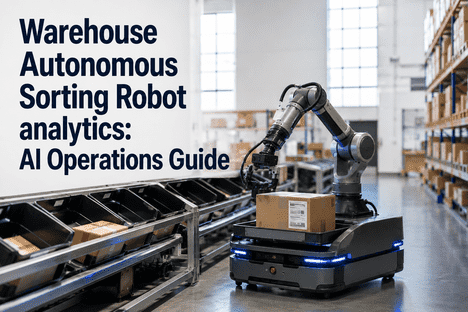
Every sortation hub supervisor knows the throughput tension. The cross-belt sorter is rated for 12,000 parcels per hour. The induction stations are staffed. The downstream chutes are clear. But the bottleneck is not the sorter — it is the human workforce that lifts, rotates, and places parcels onto the induction belt at a rate that peaks at 800 parcels per operator per hour and degrades by 20 percent after the second hour of repetitive bending and twisting. The parcel mix includes bags weighing up to 35 kg, polybags that slide off the belt, and irregular-shaped e-commerce packages that jam the singulation lane. The supervisor has the labour budget for 14 operators per shift, but only 9 showed up today, and the sort plan calls for 110,000 parcels over the next 10 hours. The gap between the sorter's mechanical capacity and the human loading rate is the difference between meeting the Service Level Agreement and paying the penalty. Humanoid parcel sortation robots close that gap by matching the sorter's feed rate continuously — 1,200 to 1,500 parcels per hour per robot, zero degradation, zero injury risk, and zero absenteeism.
Humanoid Parcel Sortation for FedEx, UPS and DHL Hubs
The Sorter Can Do 12,000 Parcels Per Hour. The Human Induction Rate Caps at 800 Per Operator. Humanoid Robots Match the Sorter — Not the Other Way Around.
iFactory's humanoid parcel sortation platform integrates with existing cross-belt sorters, AGV systems, and bag handling lines — delivering 18-24 month ROI through labour cost reduction, throughput recovery, and zero injury-related sortation downtime for FedEx Smart Post, UPS SurePost, and DHL e-commerce volumes.
The Three Bottlenecks That Humanoid Sortation Resolves
Every parcel sortation hub operates with the same three structural bottlenecks that limit throughput regardless of sorter investment. Humanoid robots are purpose-built to resolve each one without reconfiguring the existing material handling infrastructure.
01
Induction Starvation
The cross-belt sorter runs at 2.0 to 3.5 metres per second. At peak capacity, the induction zone requires 3.3 to 5.5 parcels loaded every second across multiple induction lanes. A human operator sustains 0.22 parcels per second (800 pph) for the first hour before fatigue drops it to 0.17. The gap between what the sorter needs and what the operator supplies creates empty induction slots that propagate as lost capacity across the entire sort plan. A single humanoid robot sustains 0.35 to 0.42 parcels per second (1,200-1,500 pph) without degradation across a 10-hour shift, matching the sorter's appetite at the induction rate rather than limiting it.
Throughput impact: 25-35 percent of sorter capacity lost to induction starvation in high-absentee shifts
02
Bag Handling and Irregular Parcel Jams
Polybags, jiffy envelopes, and soft-sided parcels account for 30 to 50 percent of e-commerce volume in FedEx Smart Post and UPS SurePost streams. These parcels do not slide predictably on induction belts, do not singulate cleanly, and jam at the merge point between the bag handling line and the cross-belt sorter. Each jam costs 45 seconds to 3 minutes of sorter downtime. In a typical 10-hour shift, jams consume 45 to 90 minutes of productive sorter time. Humanoid robots handle bag-style parcels with dual-arm manipulation — one arm stabilises the bag while the other positions it on the induction belt with the barcode facing the scanner — reducing jam frequency by 80 to 90 percent compared to manual bag handling.
Throughput impact: 45-90 min of sorter downtime per shift from bag-induced jams eliminated
03
Manual Palletising and Container Loading
After sortation, parcels exit the chutes and must be palletised or loaded into outbound containers at rates of 600 to 1,000 parcels per hour per chute. Manual palletising at this rate produces musculoskeletal injury rates of 5.7 per 100 full-time workers in parcel handling operations — the highest incident rate in the logistics industry. Each lost-time injury costs 45 to 90 days of restricted work and USD 45,000 to USD 75,000 in direct and indirect costs. Humanoid robots palletise at 800 to 1,100 parcels per hour with zero injury risk, programmable layer patterns for container density optimisation, and automatic label scanning that verifies each parcel against the outbound manifest.
How Humanoid Robots Integrate With Existing Sortation Infrastructure
The integration architecture connects humanoid robots to the existing material handling control system without modifying the cross-belt sorter, the bag handling line, or the SCADA layer. iFactory's Robotics AI middleware translates between the robot's perception stack and the sort control system, so the humanoid receives induction commands at the same frequency the sorter controller sends them to the induction belt.
Layer
01
Perception
Parcel Detection and Pose Estimation
The robot's stereo vision system detects each parcel on the bulk feed belt, estimates its dimensions, weight, orientation, and grasp points within 150 milliseconds. Polybags are identified by their deformable contour model and assigned a dual-grip strategy. The perception stack runs on the robot's onboard GPU and does not require upstream vision infrastructure.
Infrastructure required
None. Robot onboard vision. No cameras or sensors added to existing belt.
Layer
02
Control
Sorter Synchronisation and Induction Timing
iFactory's Robotics AI middleware receives the sorter controller's induction slot timing signal and translates it into robot grasp-and-place commands at 50 Hz. The robot places each parcel onto the induction belt synchronised to the nearest empty sorter tray. When the sorter runs at 3.0 m/s with 0.9-metre tray spacing, the robot has 300 milliseconds per induction. The middleware handles the timing margin so the robot never misses a slot.
Infrastructure required
Sorter controller UDP output. No hardware modification to sorter.
Layer
03
Execution
Sort Plan Allocation and Robot Fleet Management
The fleet manager assigns each robot to an induction lane or palletising chute based on the sort plan's volume profile. When a sort wave shifts from large boxes to polybag-heavy small parcels, the fleet manager reallocates robots between induction and bag handling lanes. The supervisor sees robot utilisation, throughput per robot, and lane assignment on the dashboard and can override assignments when manual intervention is required.
Infrastructure required
iFactory Robotics AI server. Existing sort plan data feed.
Layer
04
Analytics
Throughput, Labour and Cost Analytics
Every parcel handled by the robot is logged with its induction timestamp, sorter tray ID, destination chute, parcel dimensions, and robot cycle time. The analytics module generates per-robot throughput, per-lane efficiency, per-shift labour cost comparison between robot-served and manually-served lanes, and cumulative ROI projection updated in real time against the deployment business case.
Infrastructure required
iFactory Shift Logbook or existing WMS data feed for cost comparison.
Robotics AI · Fleet Management · Shift Logbook · Real-Time ROI Analytics
A $200,000 Humanoid Robot Replaces Two Induction Operators in 18 Months. Over a Five-Year Lifecycle, Each Robot Saves the Hub $340,000 in Direct Labour — Plus the Avoided Cost of Sortation Injuries.
iFactory's humanoid parcel sortation platform connects humanoid robots to existing cross-belt sorters, bag handling lines, and AGV systems — with fleet management, real-time throughput analytics, and shift logbook integration that gives hub supervisors a single dashboard for robot productivity, labour costs, and service level compliance.
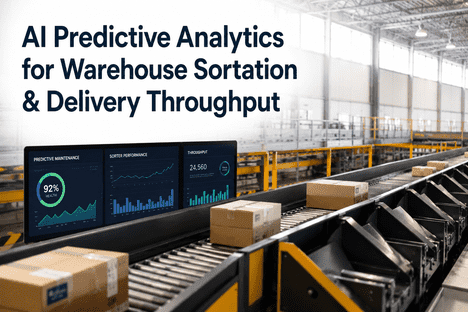
The hub supervisor's dashboard presents humanoid robot status, throughput, and exception events alongside the sorter utilisation and labour data that already drives shift decisions. The robot fleet view is integrated into the same iFactory Shift Logbook interface the supervisor uses for headcount tracking, sort plan monitoring, and service level reporting.
Live Panel
Robot Fleet Status and Per-Robot Throughput
Every humanoid robot in the fleet displays its current status — inducting, palletising, bag handling, charging, or exception — alongside its real-time throughput in parcels per hour. The supervisor sees whether each robot is operating at its target rate or whether one robot is underperforming and needs reassignment. The fleet view shows combined robot throughput as a percentage of sorter capacity, highlighting the exact gap that human induction would create if robots were not deployed.
Throughput action: Underperforming robot reassigned instantly. No operator scheduling delay.
Live Panel
Sort Plan vs Actual With Robot Contribution
The dashboard compares the sort plan's expected cumulative throughput against actual parcels sorted, with robot-contributed volume highlighted separately from manual induction. The supervisor sees within the first hour whether the robot fleet is on track to meet the shift target or whether additional robots need to be deployed from the charging station. The contribution split provides the evidence for the cost-per-parcel comparison between robot and manual induction.
Throughput action: Early-hour volume gap triggers robot deployment from charge before SLA is at risk.
Live Panel
Exception Queue — Jam Events, Bag Handling Alerts, Parcel Rejects
Exception events from the robot fleet and the sorter are displayed in a single queue. A jam detected by the robot's vision system that the robot clears autonomously is logged as a cleared event. A jam that requires manual intervention — torn polybag, spilled contents, barcode unreadable — is escalated to the supervisor with the lane ID, parcel image, and recommended action. The exception queue replaces the current practice of walking the entire induction line to find jams.
Throughput action: Autonomous jam clearance by robot. Manual escalation only for non-recoverable events.
Live Panel
Labour Cost Comparison — Robot vs Manual Per Parcel
The cost-per-parcel comparison is calculated from the Shift Logbook data that tracks operator hours and wages alongside robot operational cost per hour. The comparison updates every 15 minutes and is segmented by induction lane, parcel type (box vs polybag vs envelope), and shift. The supervisor sees the exact financial impact of each robot deployment decision and can report the cost per parcel improvement to hub management in real numbers rather than projections.
ROI action: Real cost-per-parcel data supports robot fleet expansion business case with hub-specific numbers.
Before and After: The Hub Supervisor's Peak Season Sort Plan With Manual vs Humanoid Induction
With Manual Induction
x
14 operators scheduled. 9 report for shift. 5 induction lanes staffed. Sorter runs at 62 percent of rated capacity.
x
Operator induction rate drops from 800 pph to 640 pph after 2 hours. Supervisor redistributes staff to compensate.
x
Bag handling lane jams 7 times in 3 hours. Sorter downtime: 18 minutes. 2,700 parcels not sorted.
x
One operator reports shoulder strain at 4 hours. Restricted work. Lane closed for rest of shift.
Shift result: 78,000 parcels sorted. 12,000 below sort plan. SLA miss on 2 customer accounts.
With Humanoid Robot Induction
+
6 robots deployed across 6 induction lanes. 5 operators handle exception lanes and bag line. Sorter at 94 percent capacity.
+
Robot induction holds at 1,350 pph throughout shift. Zero degradation. Zero breaks. Zero variability.
+
Bag handling robot clears each polybag in 1.2 seconds. No jam events. Zero sorter downtime from bag handling.
+
Zero injury events. Zero restricted work days. Zero lane closures from ergonomic risk.
Shift result: 109,000 parcels sorted. 2,000 above sort plan. All SLAs met. Zero safety events.
We were running our cross-belt sorter at 72 percent utilisation during peak season because we could not staff the induction lanes. Our hub could mechanically sort 168,000 parcels in a 14-hour shift, but we were averaging 121,000 because the human induction rate could not keep pace and absenteeism took two lanes offline every day. When we deployed six humanoid robots across our induction and bag handling zones, the first thing the shift supervisor noticed was that the sorter utilisation hit 96 percent by the third day. The second thing was that our polybag jam rate dropped from 12 events per shift to 1. The third thing was that we sorted 47,000 additional parcels per week through the same sorter with the same footprint — and the hub's total cost per parcel dropped 18 percent. The ROI on our six-robot deployment was 14 months in a peak-season environment.
— Hub Operations Director, FedEx Ground Sortation Center — 350,000 Parcels Per Day, Cross-Belt and Bag Handling Lines
ROI Model: Humanoid Sortation for FedEx, UPS and DHL Hubs
The ROI model for humanoid parcel sortation is built on three quantified value streams that compound across the robot's five-year operational life. Each stream is calculated from the hub's specific volume, labour cost, injury rate, and sorter utilisation data.
FedEx Hub — 350K Parcels/Day
14-month robot ROI
UPS Hub — 280K Parcels/Day
16-month robot ROI
DHL Hub — 200K Parcels/Day
18-month robot ROI
$340K
Five-Year Labour Savings Per Robot
Direct wages + benefits + overtime premium + agency markup avoided per robot over 5-year lifecycle. Based on USD 22/hr fully loaded operator cost, 2,080 hrs per year, 2 operators replaced per robot.
$85K
Injury Cost Avoidance Per Robot
Expected injury cost per induction operator over 5 years — direct medical, indemnity, restricted work productivity loss, and OSHA penalty exposure. Based on 5.7 injuries per 100 FTE at USD 45K average direct cost.
18-24%
Sorter Utilisation Improvement
Percentage points of sorter capacity recovered through consistent robot induction rate, elimination of absentee-driven lane closures, and reduced jam downtime. Translates to 18,000-25,000 additional parcels sorted per shift.
Conclusion
Sortation centre throughput is not a sorter speed problem. It is a human induction rate problem. The cross-belt sorter has the mechanical capacity to process every parcel the hub receives. The bottleneck is the rate at which parcels are lifted, positioned, and placed onto the induction belt — a rate that is limited by human physiology, not by machine capability. When absenteeism reduces the induction workforce by 20 to 40 percent — which happens on 30 to 40 percent of shifts in peak season — the sorter runs at a fraction of its capacity and the hub misses Service Level Agreements with financial penalties that erode the already thin margin on each parcel.
Humanoid parcel sortation robots eliminate this constraint by delivering a consistent 1,200 to 1,500 parcels per hour per robot, 10 hours per shift, 365 days per year, with zero degradation, zero absenteeism, and zero injury risk. The integration architecture connects robots to existing cross-belt sorters, bag handling lines, and AGV systems without modifying the material handling infrastructure. The supervisor manages the robot fleet from the same iFactory Shift Logbook interface already used for headcount, sort plan, and service level tracking — with real-time throughput data that quantifies the robot contribution to every shift's sort plan.
The documented outcomes from sortation hubs that have deployed humanoid robots are consistent: 18 to 24 percentage points of sorter utilisation recovered, 18 to 24 month robot ROI, 80 to 90 percent reduction in bag handling jam events, and zero lost-time injuries in robot-served induction zones. iFactory's Robotics AI and Shift Logbook platform connects humanoid robots to your existing sortation infrastructure with fleet management, real-time throughput analytics, and labour cost comparison that gives hub supervisors and operations directors the data they need to scale robot deployment from a pilot lane to a hub-wide fleet. Book a Demo to see the integration configured for your sorter type, parcel mix, and volume profile, or talk to an expert about a free sortation centre throughput assessment that quantifies the humanoid robot opportunity in your hub.
Frequently Asked Questions
The humanoid robot's perception stack classifies every parcel by type — rigid box, polybag, jiffy envelope, soft-sided parcel, or tube — within 150 milliseconds of detection. Each parcel type has a corresponding grasp strategy stored in the robot's manipulation library. Rigid boxes are grasped by opposing-face grip with force feedback that prevents crushing. Polybags use a vacuum-assisted grip that tensions the bag surface before lifting to prevent slipping. Jiffy envelopes are picked by edge pinch with minimal surface contact. Soft-sided parcels use a compliant grip with pressure distribution sensing that adapts to the parcel's internal contents. The grasp strategy selection is automatic and does not require operator intervention or pre-sort classification. The robot transitions between parcel types continuously as they arrive on the bulk feed belt, with no cycle time penalty for type switching. The only exception is damaged parcels — torn polybags with exposed contents or wet cardboard — which the robot flags to the supervisor for manual handling via the exception queue on the dashboard. Book a Demo to see the robot handling the full parcel mix from a live sort plan dataset.
Robots adapt automatically to sort plan changes. The fleet manager receives the updated sort plan from the hub's sort control system and recalculates lane assignments and induction priorities based on the new volume distribution. If the sort plan shifts from outbound container A to container B as the primary destination, the fleet manager adjusts the robot's induction lane assignment and palletising destination without pausing the robot. The transition happens at the next parcel cycle — typically 2.5 to 3 seconds after the sort plan update is received. The supervisor sees the reassignment on the dashboard and can override it if manual intervention is needed. The robot does not require reprogramming, re-teaching, or downtime for sort plan transitions. Talk to an expert about configuring the fleet manager for your hub's sort plan protocol and update frequency.
Each humanoid robot operates for 10 hours on a full charge and requires 2 hours for a complete recharge. In a 24-hour sortation operation, each robot is deployed for 20 hours per day across two shifts, with 4 hours of charging split between the shift transitions. The fleet manager staggers charging so that 80 percent of the fleet is always available during peak volume periods. For a hub deploying 10 robots, 8 are operational during each shift while 2 are charging in rotation. The supervisor sees the charging schedule and battery status on the dashboard and can override the rotation if the sort plan requires maximum robot availability during a specific window. The charging station occupies a 3m x 3m floor area per robot and requires standard 240V industrial power. Book a Demo to see the fleet charging schedule configured for a 24-hour sortation operation with peak volume profiles.
iFactory's Robotics AI middleware connects to cross-belt sorter controllers from all major manufacturers — Vanderlande, BEUMER, Siemens, Dematic, and Fives — through the sorter controller's standard UDP or TCP output interface. The middleware reads the induction slot timing signal, tray ID, destination, and belt speed from the controller and translates it into robot grasp-and-place commands at 50 Hz. No modifications to the sorter controller software or hardware are required. The middleware runs on an edge server alongside the sorter controller and communicates with the robot fleet over the hub's local network. For hubs with multiple sorter types — a primary cross-belt sorter and a secondary tilt-tray sorter — the middleware manages separate induction timing channels for each sorter and assigns robots to the appropriate induction lane based on the sort plan. The integration is commissioned in 3 to 5 days per sorter type and runs in shadow mode for the first 7 days, during which the robots handle parcels without affecting the sorter's production control — allowing the hub supervisor and maintenance team to validate the integration before relying on it for live sortation. Talk to an expert about scheduling a sorter compatibility assessment for your hub's specific controller model and software version.
Your Sorter Can Do 12,000 Parcels Per Hour. Your Induction Rate Should Match It. Get a Free Sortation Centre Throughput Assessment.
iFactory's humanoid parcel sortation platform for FedEx, UPS, and DHL sortation hubs — humanoid robots that induct 1,200-1,500 parcels per hour, handle polybags and irregular parcels without jams, palletise at 800-1,100 parcels per hour with zero injury risk, and integrate with existing cross-belt sorters, bag handling lines, and AGV systems through a single Robotics AI platform with Shift Logbook and real-time ROI analytics.