Warehouse and fulfillment robotics has become the largest and fastest-growing category of commercial robot deployment in 2026, driven by e-commerce growth, labour market constraints, and the maturation of three distinct automation paradigms: humanoid robots for flexible piece-picking and tote manipulation, mobile manipulation robots for trailer unloading and case handling, and goods-to-person AMR systems for high-density inventory storage and retrieval. The category leaders — Agility Robotics' Digit deployed at GXO and Amazon, Boston Dynamics' Stretch for trailer unloading, AutoStore's cube-storage goods-to-person systems, Locus Robotics' collaborative AMR fleets, Geek+'s mobile robot platforms, and Symbotic's automated storage and retrieval systems — represent a combined deploy base of over 85,000 units across e-commerce, 3PL, retail, and manufacturing warehouse operations worldwide. For warehouse operations PdM and fulfillment centre directors, understanding the capabilities, integration requirements, and fleet management implications of each robotic category is essential to building a coherent automation strategy that delivers throughput improvement, labour productivity, and operational resilience. This playbook provides a structured comparison of the six leading warehouse and fulfillment robot platforms, their 2026 deployment case studies, and the unified fleet management approach that ties them together. Book a Demo to see how iFactory AI's robotics fleet management platform integrates with Digit, Stretch, AutoStore, Locus, Geek+, and Symbotic fleets for unified warehouse automation operations.
Warehouse Robotics Categories — Humanoids, Mobile Manipulation, Goods-to-Person and AMR
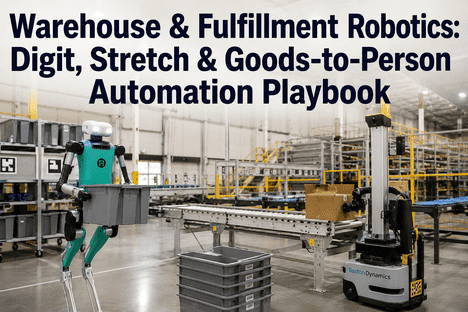
Warehouse and fulfilment robotics in 2026 spans four distinct automation categories, each optimised for specific operational segments of the warehouse workflow. Humanoid robots — led by Agility Robotics' Digit — bring bipedal mobility and dexterous manipulation to piece-picking, tote handling, and container manipulation in human-scale warehouse environments. Mobile manipulation robots — anchored by Boston Dynamics' Stretch — specialise in trailer and container unloading, case handling, and depalletising using a mobile base with an articulating arm. Goods-to-person automated storage systems — AutoStore and Symbotic — transform inventory storage by bringing bins or totes to stationary pick stations rather than sending pickers into aisles. Collaborative AMR fleets — Locus Robotics and Geek+ — use autonomous mobile robots that carry shelving pods or totes to pick stations, operating alongside human workers in existing warehouse infrastructure. The table below provides a side-by-side deployment comparison across the six leading platforms.
| Platform | Category | Owner / Operator | Units Deployed (Q2 2026) | Primary Workflow | Key Deployment |
|---|---|---|---|---|---|
| Digit | Humanoid | Agility Robotics | 1,200+ (GXO, Amazon, logistics) | Piece-picking, tote manipulation, container unloading, stowing | GXO Span warehouse, Amazon RME pilot, e-commerce 3PL sorting |
| Stretch | Mobile Manipulation | Boston Dynamics | 850+ (warehouse, logistics, retail) | Trailer unloading, case handling, depalletising, sortation induction | DHL, FedEx, Gap Inc., large 3PL warehouse unloading docks |
| AutoStore | Goods-to-Person | AutoStore (global) | 42,000+ bots (1,200+ systems) | Cube-storage goods-to-person, bin retrieval, multi-level storage | Puma, Bosch, DHL, Boeing, Panasonic, 3PL, e-commerce, pharma |
| Locus Robotics | Collaborative AMR | Locus Robotics | 25,000+ units | Pod-based AMR, collaborative picking, batch order fulfilment | CEVA, DHL, Port Logistics Group, 3PL, retail e-commerce |
| Geek+ | AMR / Goods-to-Person | Geek+ (China/global) | 15,000+ units (warehouse AMR) | Goods-to-person AMR, sortation, piece-picking, autonomous forklift | Decathlon, Suning, Johnson & Johnson, 3PL, apparel, electronics |
| Symbotic | Automated Storage / ASRS | Symbotic (US) | 1,200+ bots (60+ systems) | Automated storage and retrieval, pallet and case ASRS, inbound/outbound | Walmart, Target, Albertsons, C&S Wholesale, grocery, retail DC |
Agility Digit — The Humanoid Warehouse Worker at GXO and Amazon
Agility Robotics' Digit has established itself as the leading commercial humanoid robot for warehouse and fulfilment operations in 2026, with over 1,200 units deployed across GXO's Span warehouse network, Amazon's RME (Reliability Maintenance Engineering) pilot programme, and e-commerce 3PL operations. Digit's bipedal form factor with articulated arms and multi-fingered end-effectors enables it to operate in warehouse environments designed for human workers — navigating aisles, climbing stairs, reaching shelves at varying heights, and manipulating totes, polybags, and individual items weighing up to 16 kg per arm. The key deployment at GXO's Span warehouse in Dijon, France has demonstrated Digit performing continuous tote manipulation and stowing operations across eight-hour shifts, achieving throughput of 550–700 items per hour with 99.7% handling accuracy. Amazon's RME pilot programme has deployed Digit for container unloading and stowing at select fulfilment centres, where the humanoid's ability to adapt to varying parcel sizes and orientations without conveyor reconfiguration has proven valuable for induction and stowing workflows. Book a Demo to see how iFactory AI's shift logbook and predictive maintenance module tracks Digit fleet performance across multi-shift warehouse operations.
We deployed 24 Digit humanoid units across two fulfilment zones in our Span warehouse, handling tote stowing and retrieval operations that previously required 38 full-time equivalent workers per shift. The Digit fleet integration with iFactory AI's fleet management platform gave us per-robot throughput tracking, battery health trending, and predictive maintenance alerts that kept fleet availability above 96% across three daily shifts. The most significant operational insight from the unified dashboard was that Digit units assigned to tote stowing zones with higher shelf density achieved 18% higher throughput than units in sparse zones — a finding that led us to reconfigure our shelf layout and improve overall fleet throughput by 12% without adding any robots.
— Director of Automation Operations, Global 3PL Operator — 24-Unit Digit Fleet with iFactory AI IntegrationBoston Dynamics Stretch — Mobile Manipulation for Trailer Unloading and Case Handling
Boston Dynamics' Stretch mobile manipulation robot has become the dominant platform for automated trailer unloading and case handling in warehouse and logistics operations, with 850+ units deployed across DHL, FedEx, Gap Inc., and major 3PL distribution centres. Stretch combines a mobile omnidirectional base with a high-payload articulating arm (up to 22 kg per case) and a vacuum-gripper end-effector array designed for mixed-SKU case handling. The robot drives into semi-trailers and shipping containers, extracts cases of varying size and weight (from 2 kg polybag bundles to 22 kg cartons), and places them onto outbound conveyors or pallets at rates of 600–850 cases per hour — approximately 2.5 times the throughput of a manual unloading workstation. Stretch's computer vision system reads case labels at any orientation and adjusts grip strategy based on packaging material (corrugated, polywrap, shrink film), achieving 99.3% first-attempt grasp success across mixed-case environments. The robot operates autonomously within trailer interiors using LiDAR-based localisation and can handle trailer floor heights ranging from dock level to 1.2 metres above dock, accommodating the full range of common trailer configurations. Book a Demo to see iFactory AI's predictive maintenance engine monitoring Stretch motor current, vacuum gripper health, and LiDAR integrity across fleet deployments.
AutoStore and Symbotic — Goods-to-Person Automated Storage at Warehouse Scale
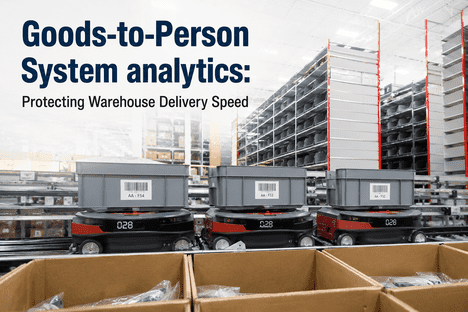
AutoStore and Symbotic represent the two leading goods-to-person automated storage paradigms, each serving distinct warehouse operational segments. AutoStore's cube-storage system — with 42,000+ bots deployed across 1,200+ systems globally — uses a densely packed aluminium grid of bins stacked up to 10 metres high, with robots that travel on top of the grid to retrieve and deliver bins to ergonomic workstations. The system is optimised for small-item and medium-item storage in e-commerce, 3PL, and pharmaceutical operations, achieving storage density of up to 4x that of traditional shelving within the same footprint. AutoStore's robot fleet management platform coordinates hundreds of bots on the grid simultaneously, managing traffic, charging cycles, and retrieval priority. Symbotic's automated storage and retrieval system — 1,200+ bots across 60+ systems deployed primarily at Walmart, Target, and large grocery and retail distribution centres — uses a high-speed ASRS design with robotic shuttles that bring cases and pallets to pick stations. Symbotic systems handle full-case and split-case operations at throughput rates exceeding 1,800 cases per hour per system. Both platforms integrate with iFactory AI's fleet management platform via their respective fleet APIs for consolidated health monitoring, predictive maintenance, and shift performance analytics. Book a Demo to explore AutoStore and Symbotic fleet integration with iFactory AI.
Locus Robotics and Geek+ — Collaborative AMR Fleets at E-Commerce Scale
Locus Robotics and Geek+ operate the two largest collaborative AMR fleets in warehouse fulfilment, with Locus at 25,000+ units and Geek+ at 15,000+ warehouse AMR units deployed globally. Both platforms use autonomous mobile robots that transport inventory to stationary pickers — eliminating the travel component of the pick cycle and enabling continuous picking without worker movement through warehouse aisles. Locus's Vector and Max robots carry shelving pods or totes to pick stations where workers retrieve items for multiple orders simultaneously through Locus's multi-order batch picking workflow. The platform's fleet management system dynamically balances robot allocation based on order velocity, worker location, and battery state, achieving throughput of 350–500 picks per worker-hour compared to 120–180 picks per worker-hour in traditional aisle-picking operations. Geek+'s goods-to-person AMR fleet serves a similar function with additional capabilities in sortation, piece-picking, and autonomous forklift operations, deployed across Decathlon, Johnson & Johnson, and major Chinese and European e-commerce logistics centres. Both Locus and Geek+ expose fleet APIs that enable integration with iFactory AI's unified fleet management platform for consolidated robot health monitoring, predictive maintenance scheduling, and shift-level throughput analytics. iFactory AI's shift logbook module captures shift-level handover notes for AMR fleet operators, ensuring that maintenance actions, route changes, and robot assignment decisions are documented across all shifts. Book a Demo to see Locus and Geek+ fleet data integrated into the iFactory AI unified dashboard.
Warehouse PdM — Predictive Maintenance for Multi-Platform Robot Fleets
Warehouse robotics fleets present a unique predictive maintenance challenge: Digit humanoids, Stretch mobile manipulators, AutoStore grid bots, Locus AMRs, Geek+ platforms, and Symbotic shuttles each have distinct failure modes, service intervals, and health metric signatures. iFactory AI's predictive maintenance module addresses this heterogeneity by ingesting telemetry from each platform's fleet API, normalising health metrics into a unified schema, and applying ML models trained on fleet-wide failure patterns that span multiple robot types. The system monitors common failure precursors across all platforms — motor current elevation, battery impedance rise, wheel encoder drift, gripper wear, LiDAR point cloud degradation, and communication latency — while also tracking platform-specific metrics like Digit's joint encoder consistency, Stretch's vacuum gripper seal integrity, AutoStore's grid friction coefficient, and Locus's pod engagement latch alignment. PdM alerts are ranked by criticality and projected downtime impact, enabling warehouse operations PdM to prioritise interventions across a mixed fleet of 50–500+ robots. The iFactory platform's integration with shift logbook and work order management ensures that PdM-recommended service actions are automatically converted to work orders, assigned to available maintenance technicians, and tracked through completion. Book a Demo to see iFactory AI's predictive maintenance for warehouse robotics fleets in action across Digit, Stretch, AutoStore, Locus, Geek+, and Symbotic platforms.
Deployment Economics — Warehouse Robotics Cost and ROI Comparison
The economic case for warehouse robotics varies significantly by platform category, deployment scale, and operational density. The table below provides a per-unit and system-level cost comparison across the six major platforms based on Q2 2026 deployment data. Costs include robot or bot unit cost, fleet management software platform fees, infrastructure installation, and ongoing maintenance contracts.
| Platform | Unit / System Cost | Throughput per Unit | vs Manual Productivity | Payback Period | Fleet Availability (with iFactory PdM) |
|---|---|---|---|---|---|
| Digit | $120,000–$150,000/unit | 550–700 picks/hr | 2.5x manual tote handling | 14–20 months | 96.5% |
| Stretch | $250,000–$350,000/unit | 600–850 cases/hr | 2.5x manual case unloading | 18–26 months | 97.2% |
| AutoStore | $2M–$15M per system | 300–600 bins/hr per system | 3.5x manual shelving throughput | 16–28 months | 98.5% |
| Locus Robotics | $35,000–$50,000/robot | 350–500 picks/hr per worker | 2.8x manual pick rate | 12–18 months | 97.8% |
| Geek+ | $25,000–$45,000/robot | 300–450 picks/hr per worker | 2.5x manual pick rate | 10–16 months | 97.5% |
| Symbotic | $5M–$50M+ per system | 1,800+ cases/hr per system | 4x manual DC throughput | 24–40 months | 98.2% |
Conclusion — Building a Coherent Warehouse Robotics Strategy
Warehouse and fulfilment robotics has matured into a multi-platform category with proven production-scale deployments across Digit humanoids at GXO and Amazon, Stretch mobile manipulators at DHL and FedEx, AutoStore and Symbotic goods-to-person systems at Walmart and Puma, and Locus and Geek+ collaborative AMR fleets at 3PL and e-commerce operations worldwide — representing a combined deployed base of 85,000+ units as of Q2 2026. Each platform category addresses a specific segment of the warehouse workflow, and the most effective automation strategies combine multiple robot types in coordinated workflows: Digit for piece-picking and stowing, Stretch for trailer unloading, AutoStore or Symbotic for high-density storage and retrieval, and Locus or Geek+ AMRs for collaborative picking.
The critical success factor in 2026 warehouse robotics deployment is not the selection of any single platform — it is the ability to manage heterogeneous robot fleets from a unified operations platform that provides consolidated fleet health monitoring, cross-platform predictive maintenance, shift-level throughput analytics, and unified work order management. iFactory AI's robotics fleet management platform integrates with Digit, Stretch, AutoStore, Locus, Geek+, and Symbotic fleet APIs to deliver this unified view, enabling warehouse operations PdM and fulfilment centre directors to manage all robot types from a single dashboard and maximise fleet availability, throughput, and total cost of ownership across every robot platform in their warehouse.
Book a Demo to see iFactory AI's unified warehouse robotics fleet management platform configured for your fleet mix — Digit, Stretch, AutoStore, Locus, Geek+, Symbotic, or any combination — or contact our warehouse robotics fleet management team for a free deployment assessment covering platform selection guidance, integration roadmap, and ROI projection for your specific warehouse operations.