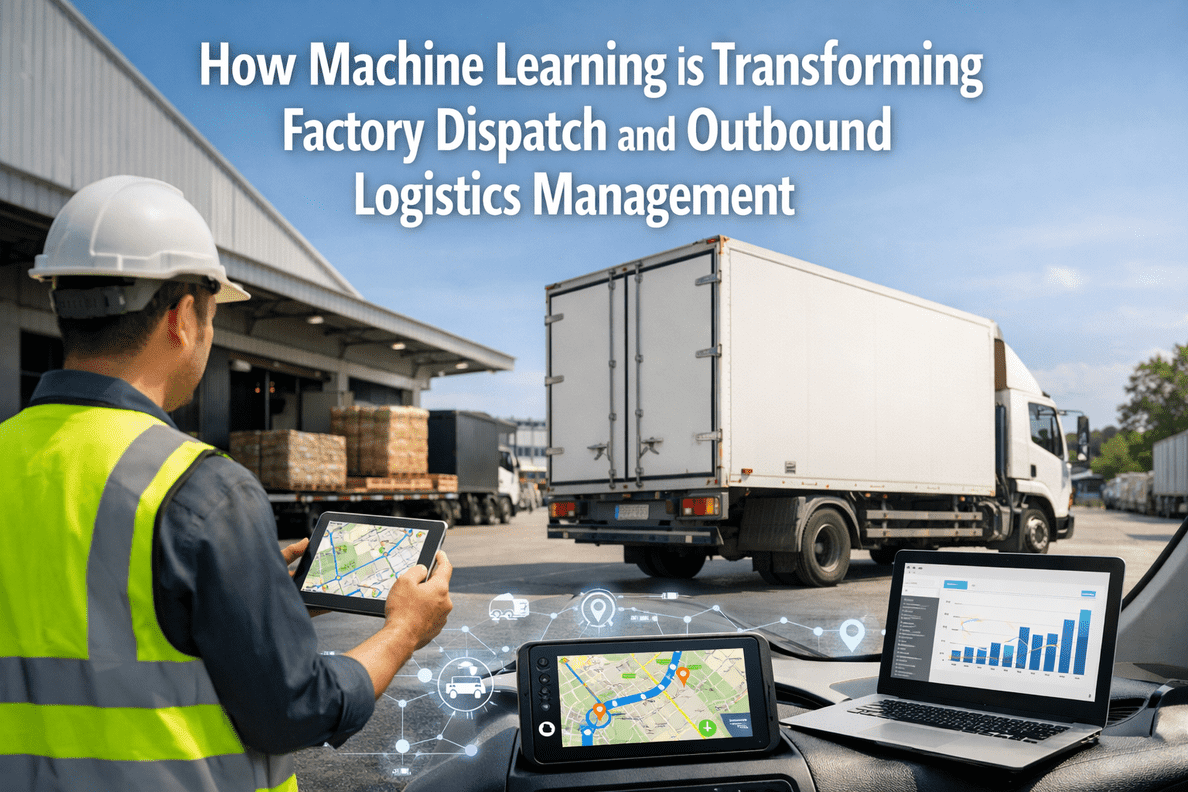
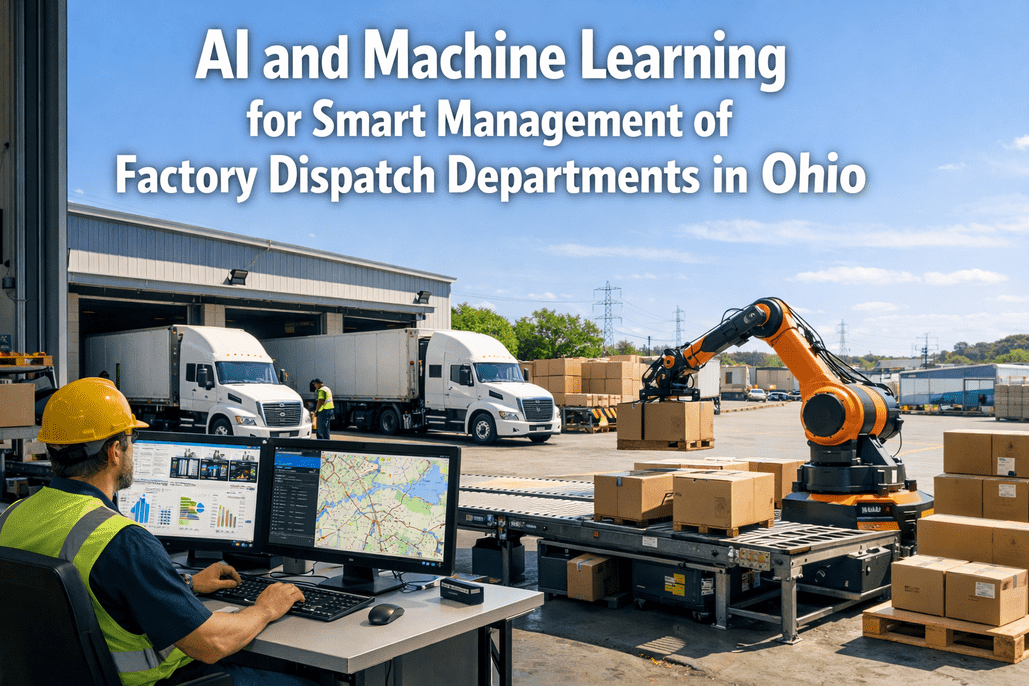
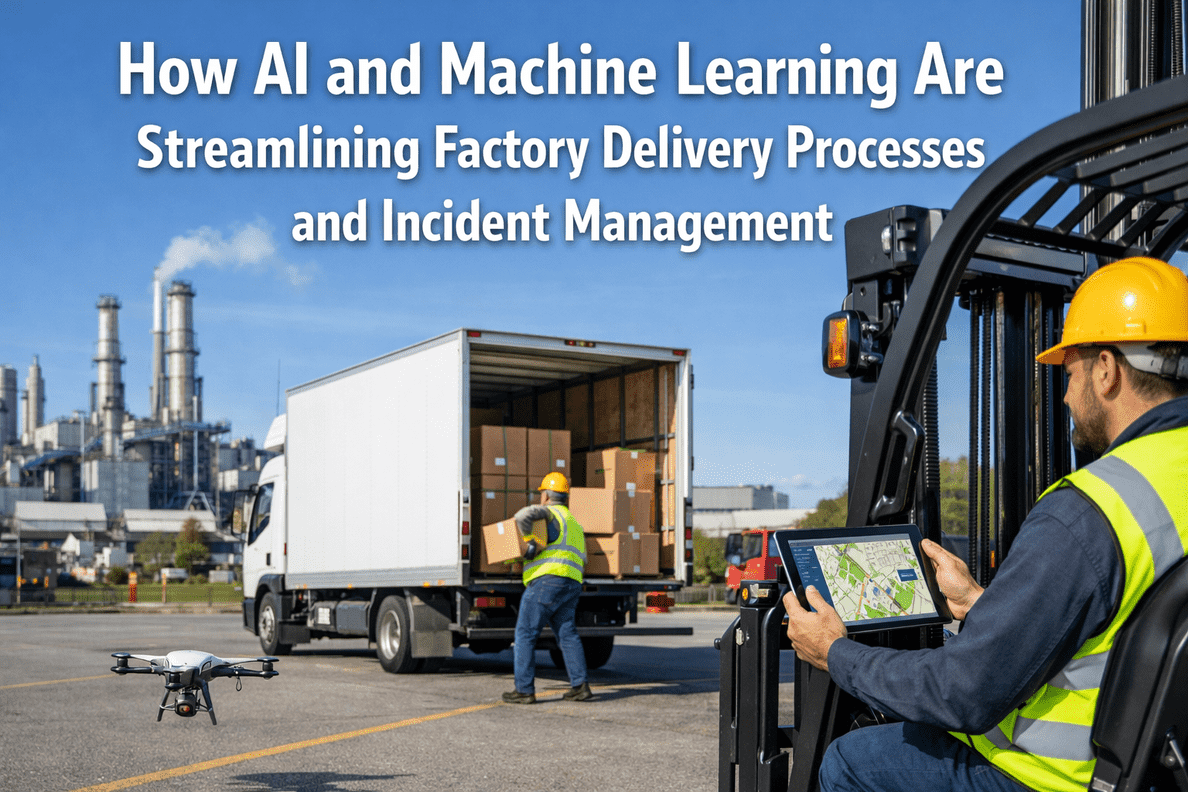
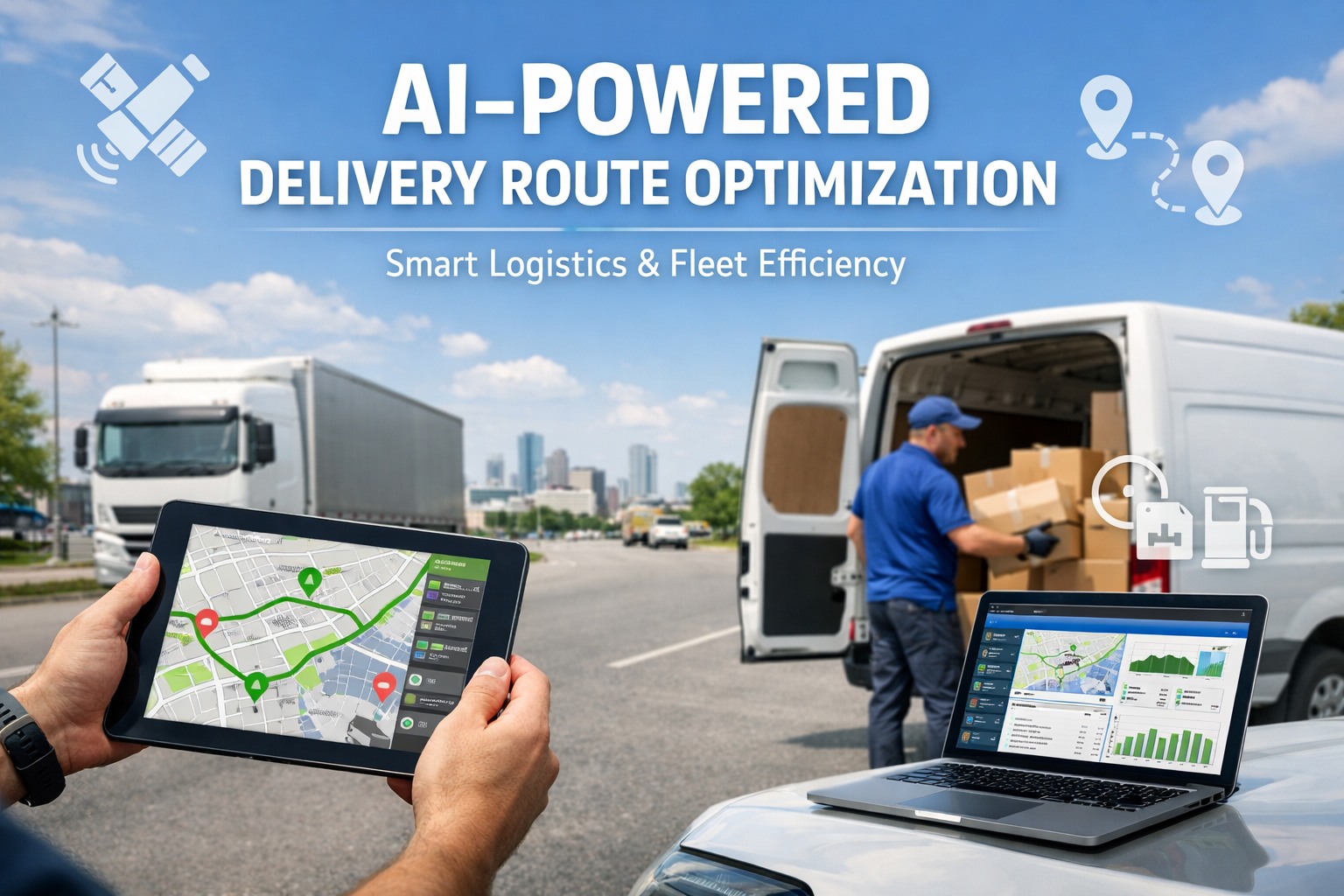
Factory dispatch and outbound logistics — the final link between your production floor and your customer — has long been managed by clipboards, phone calls, and spreadsheets. In 2026, that operational model is being dismantled by machine learning at a pace most plant managers have not fully absorbed. This is not a technology story about the future. It is an operational story about right now: factories that have deployed ML-powered dispatch sequencing, route optimization, and predictive load planning are cutting outbound delivery costs by 18–32%, reducing SLA breaches by over 85%, and generating the kind of real-time dispatch visibility that was impossible with manual systems. This guide covers how machine learning is reshaping every layer of factory dispatch — from gate release sequencing to multi-stop route optimization to driver behaviour scoring — and what your delivery department needs to do to catch up. For questions about deployment, talk to our support team directly.
AI in Logistics · Factory Dispatch · 2026
How Machine Learning is Transforming Factory Dispatch and Outbound Logistics Management
Manual dispatch sequencing is costing factories thousands in avoidable SLA penalties, re-delivery expenses, and idle vehicle time every single week. ML-powered dispatch platforms eliminate these losses — and generate the operational data that drives continuous improvement.
32%
Average outbound delivery cost reduction reported by factories using ML dispatch optimization
85%
Reduction in SLA breaches within 60 days of deploying AI-powered dispatch sequencing
$760
Average daily cost of a single vehicle breakdown due to undetected maintenance issues
14 days
iFactory deployment timeline from decision to fully live factory dispatch operations
The Core Problem
Why Manual Factory Dispatch Is Failing — And Why It Is Getting Worse
Factory dispatch departments were built for a world of predictable order volumes, stable delivery windows, and simple two-stop routes. That world no longer exists. Modern outbound logistics involves dynamic customer SLAs, multi-stop optimisation requirements, live traffic variables, and vehicle compliance tracking — all happening simultaneously, every day. Manual systems cannot process these variables fast enough to make good decisions.
01
Sequencing by Gut, Not Data
Dispatch supervisors manually assign vehicles and sequence routes based on habit and experience — without access to real-time SLA deadlines, vehicle load capacity data, or live traffic conditions. The result is suboptimal route sequences that inflate mileage by 20–40% per day.
02
SLA Breaches Discovered Too Late
Manual dispatch provides no predictive SLA monitoring. Supervisors learn about SLA breaches from customer complaints — not from dispatch alerts. By that point, the breach has already occurred, the penalty is already triggered, and the customer relationship is already damaged.
03
Vehicle Breakdowns Destroying Schedules
Vehicles dispatched without predictive maintenance visibility break down mid-route at a rate of 2–4 incidents per month for a 20-vehicle factory fleet. Each breakdown triggers re-routing, emergency recovery costs, and customer SLA exposure — averaging $760 per incident in total operational cost.
04
Zero Continuous Improvement Loop
Manual dispatch generates no usable performance data. There is no record of which routes performed, which drivers under-delivered, or which SLA categories are chronically at risk. Without data, there is no improvement — just repeated errors on a monthly cycle.
How ML Solves This
The 5 Machine Learning Capabilities Reshaping Factory Dispatch in 2026
Machine learning is not a single technology — it is a set of distinct capabilities that each address a specific failure point in factory dispatch operations. Here is how each capability works, and what it eliminates.
ML 01
Intelligent Dispatch Sequencing — SLA Priority Automation
ML sequencing models ingest every active dispatch order simultaneously — pulling SLA deadline, delivery distance, load weight, vehicle availability, and current traffic data — and compute the optimal release sequence that maximises on-time delivery rates across the entire day's schedule. This is not rule-based scheduling. It is a continuously recalculating optimisation model that re-sequences remaining orders in real time as conditions change. A factory dispatching 40 vehicles per day using ML sequencing recovers an estimated 180–220 minutes of SLA buffer time that manual sequencing loses to suboptimal ordering.
SLA breach prevention
Real-time re-sequencing
Capacity utilisation
ML 02
Dynamic Route Optimisation — Live Traffic and Constraint Handling
Traditional route planning calculates the shortest path. ML route optimisation calculates the fastest path under current and predicted conditions — incorporating live traffic data, historical congestion patterns by time of day, delivery time window constraints per customer, vehicle height and weight restrictions, and driver-specific performance data. Routes are not just planned at dispatch — they are continuously updated during transit. When an unexpected delay occurs, the system recalculates the remaining stop sequence to recover the maximum delivery windows possible within the current trip.
Live traffic integration
Multi-constraint routing
In-transit recalculation
ML 03
Predictive Vehicle Health — Breakdown Prevention Before Departure
ML maintenance prediction models analyse vehicle sensor data — engine temperature, brake wear indicators, tyre pressure trends, fuel consumption variance, mileage against service schedule — to calculate breakdown probability before each vehicle is dispatched. Vehicles flagged above a risk threshold are automatically blocked from dispatch and routed to maintenance, while the system reassigns their loads to available compliant vehicles. The result: breakdown rate reduction of 30–45% within the first quarter of deployment, and elimination of mid-route failures that trigger the most expensive recovery costs.
Pre-dispatch health scoring
Auto-block on risk threshold
Predictive service scheduling
ML 04
Demand Forecasting — Load Planning 72 Hours Ahead
ML demand models trained on historical order patterns, seasonal cycles, customer reorder cadence, and production schedule outputs forecast outbound dispatch volume 48–72 hours in advance with 87–92% accuracy. This forward visibility allows dispatch managers to pre-position vehicles, pre-schedule driver shifts, and pre-assign load bays — eliminating the morning chaos of reactive dispatch that characterises manual operations. Factories using ML-driven load planning report 22–28% improvements in dock utilisation and a 35% reduction in vehicle idle time during loading windows.
72-hour dispatch forecasting
Driver shift optimisation
Dock utilisation improvement
ML 05
Driver Performance Intelligence — Behaviour Scoring at Scale
ML behaviour models score each driver against a composite of route adherence, delivery success rate, vehicle handling (acceleration, braking, idle time), SLA performance by delivery type, and customer satisfaction data. Scores update continuously and are surfaced to dispatch supervisors during vehicle assignment — enabling intelligent matching of drivers to routes based on performance fit rather than availability alone. High-SLA routes are matched to high-scoring drivers. Long-distance routes are matched to drivers with lower idle and fuel consumption scores. The compound effect across a 20-vehicle fleet is a measurable 12–18% improvement in overall SLA compliance without adding a single vehicle.
Continuous driver scoring
SLA-to-driver matching
Fuel and idle optimisation
Before vs After
Factory Dispatch Department — Manual Operations vs ML-Powered Platform
Dispatch Function
Manual Operations
ML-Powered iFactory
Route Planning
Static maps, estimated times, 20–40% longer routes daily
Live ML optimisation, real-time rerouting, constraint-aware routing
Dispatch Sequencing
Supervisor judgment, SLA misses undetected until complaint
Automated SLA-priority sequencing, real-time re-sequencing
Vehicle Health
Reactive maintenance, 2–4 breakdowns/month, $760/incident
Predictive health scoring, pre-dispatch block, 30–45% fewer breakdowns
Load Planning
Same-day reactive planning, dock bottlenecks, idle vehicles
72-hour ML forecasting, pre-positioned vehicles, 22–28% dock improvement
Driver Assignment
Availability-only matching, no performance data used
ML score-to-route matching, 12–18% SLA compliance gain
Audit and Compliance
Paper logs, hours of assembly per audit, incomplete records
Auto-generated digital records, retrievable in under 60 seconds
Performance Improvement
No usable data, recurring errors, no improvement feedback loop
Continuous ML model refinement, weekly performance reporting
Machine Learning Dispatch Is Not Future Technology. It Is Operational Now — And Competitors Are Already Deploying It.
iFactory's ML dispatch platform deploys in 14 days, requires no IT infrastructure, and begins generating measurable SLA and cost improvements within the first month.
Talk to our support team about your factory's current dispatch volume and SLA exposure.
Measured Outcomes
What iFactory Customers Measure Within 90 Days of ML Dispatch Go-Live
32%
Delivery Cost Reduction
ML route optimisation eliminates the 20–40% excess mileage that manual routing generates daily — recovering fuel, driver time, and vehicle wear costs across the entire fleet simultaneously.
Manual: 20–40% excess mileageML: 32% cost reduction
85%
Fewer SLA Breaches
SLA-priority ML sequencing ensures that the highest-risk deliveries are dispatched first, with real-time re-sequencing as conditions change. SLA breach rates drop from 8–12% to under 1.5% within 60 days.
Manual: 8–12% breach rateML: under 1.5%
45%
Fewer Failed Deliveries
ML delivery window optimisation and driver performance matching combine to reduce failed first-attempt deliveries by 45% — eliminating the $17 per failed delivery re-attempt cost that compounds across high-volume operations.
Manual: 8–15% fail rateML: 45% reduction
30%
Vehicle Breakdown Reduction
Predictive health scoring flags at-risk vehicles before departure. Factories report 30–45% breakdown rate reduction within the first quarter, eliminating the $760/incident average cost of mid-route failures.
Manual: 2–4 breakdowns/monthML: 30–45% reduction
28%
Dock Utilisation Improvement
72-hour ML demand forecasting eliminates reactive dock management. Pre-positioned vehicles, pre-scheduled loading bays, and pre-assigned driver shifts recover 22–28% of dock time lost to same-day planning chaos.
Manual: reactive, bottleneckedML: 28% utilisation gain
3–5 mo
Full ROI Payback
Fuel savings, SLA penalty elimination, failed delivery cost recovery, and breakdown prevention combine to deliver full iFactory platform payback within 3–5 months — with deployment completed in 7–14 days.
Legacy: 18–24 mo paybackiFactory: 3–5 months
How iFactory Works
How iFactory's ML Engine Connects to Your Factory Dispatch Department
iFactory's machine learning dispatch layer operates across four connected data streams — vehicle data, order data, route data, and driver data — and produces a continuously optimised dispatch decision at every point in the daily cycle.
Data Input Layer
What the ML Model Ingests
Active dispatch orders with SLA deadlines and delivery windows
Vehicle availability, load capacity, and predictive health scores
Live traffic conditions and historical congestion by time-of-day
Driver performance scores and current fatigue/shift status
Customer location constraints, access restrictions, and preferences
ML Processing Layer
What the Model Computes
Optimal dispatch sequence ranked by SLA risk and delivery value
Minimum-cost route per vehicle with constraint satisfaction
Best-fit driver assignment per route based on performance history
Breakdown probability per vehicle — block or release decision
In-transit rerouting recommendations when conditions change
Output and Action Layer
What Your Dispatch Team Receives
One-click dispatch approval with full ML rationale visible
Real-time SLA risk alerts with intervention recommendations
Live vehicle tracking with ETA accuracy scoring
End-of-day performance report per vehicle, driver, and route
Compliance documentation auto-generated for every dispatch event
Industry Insights
Key Market Data: Machine Learning in Factory Logistics — 2025 to 2030
$25.5B
Delivery Management Software Market by 2035
The global delivery management software market grows from $11.6B in 2025 to $25.5B by 2035. ML-powered route optimisation and dispatch automation are the two fastest-growing segments — driven by manufacturing and industrial logistics adoption accelerating ahead of commercial delivery.
72%
Manufacturers Partially Using Smart Factory Tech
72% of manufacturers have partially implemented smart factory strategy — but delivery departments lag every other function. ML has reached production, quality, and maintenance first. Dispatch is the last function to be digitalised in most facilities.
40%
Still Rely on Manual Dispatch Tools
40% of factory dispatch departments still use manual planning tools — spreadsheets, whiteboards, or phone-based coordination. These operations are accumulating a growing competitive disadvantage against ML-enabled peers every month they delay digitalisation.
53%
Last-Mile Costs as a Share of Total Shipping
Last-mile and outbound delivery costs consume up to 53% of total logistics spend. ML route optimisation is the highest-ROI intervention available in this cost category — delivering measurable savings within the first dispatch cycle after go-live.
Deployment
How iFactory ML Dispatch Deploys in 14 Days — Without an IT Project
01
Days 1–3: Data Onboarding
Upload your vehicle registry, driver roster, active customer list, and SLA contract parameters. iFactory's onboarding team connects your existing dispatch records and configures the ML model baseline using your historical order data. No custom development required.
02
Days 4–7: Configuration and Training
SLA priority tiers, vehicle inspection thresholds, driver performance scoring weights, and dispatch approval workflows are configured to your operation. Dispatch supervisors, drivers, and gate staff complete mobile app training in 2–4 hours each.
03
Days 8–14: Go-Live and ML Calibration
Live dispatch operations begin with iFactory support monitoring data quality and ML sequencing accuracy. The model calibrates against your actual order patterns during the first week — improving route and sequencing accuracy with every dispatch cycle completed.
Frequently Asked Questions
Machine Learning in Factory Dispatch — What Operations Leaders Ask First
How is machine learning different from the route planning tools we already use in our dispatch department?
Most existing route planning tools are rule-based optimisation engines — they calculate the shortest path given a fixed set of inputs and produce a static route plan. Machine learning is fundamentally different: it learns from historical performance data, updates its models continuously, and produces recommendations that improve in accuracy over time. A rule-based system will produce the same route for the same inputs every time. An ML system will produce a better route next week than it did this week, because it has learned from the outcomes of this week's dispatches. The practical difference shows up most clearly in three areas: first, ML systems predict delivery time windows with 87–92% accuracy versus 60–70% for static planners; second, ML systems identify driver-to-route fit that no rule can capture; and third, ML systems detect emerging SLA risk in real time and recommend intervention — not just generate the initial plan.
Talk to our support team to compare your current tool against iFactory's ML capabilities directly.
Does iFactory's ML dispatch system require historical data to start working, or can it be useful from day one?
iFactory's ML dispatch platform operates in two phases. From day one, the system uses its pre-trained baseline models — trained on aggregate manufacturing logistics data across hundreds of facility types — to generate immediate route optimisation and SLA sequencing recommendations. These baseline recommendations are measurably better than manual dispatch within the first week. From week two onwards, the system begins incorporating your specific order patterns, customer delivery behaviour, driver performance history, and vehicle maintenance data to personalise its models. By the end of the first month, the ML models have calibrated to your operation specifically — improving recommendation accuracy materially over the baseline. Most iFactory customers report their highest performance gains in months two and three, as the models accumulate enough facility-specific data to outperform general baseline recommendations significantly.
What happens when the ML system makes a dispatch recommendation that the supervisor disagrees with?
iFactory is designed as a decision-support system, not an autonomous dispatcher. Every ML recommendation is surfaced to the dispatch supervisor with full rationale visible — showing exactly which SLA, vehicle health, traffic, and driver scoring factors produced the recommendation. Supervisors retain full override authority on every decision. When an override is made, the supervisor's decision and the ML recommendation are both logged. This creates a feedback dataset that the ML system uses to refine its models over time — understanding where experienced supervisor judgment consistently outperforms the model and incorporating that pattern into future recommendations. The result is a system that gets smarter from human expertise rather than replacing it. In practice, iFactory customers report that supervisors override ML recommendations in fewer than 8% of cases after the first month of operation — as the model's accuracy builds confidence.
How does iFactory's ML platform handle the gate pass and compliance documentation that our factory requires for every outbound dispatch?
iFactory integrates gate pass management directly into the ML dispatch workflow — not as a separate system. Every vehicle released by the ML dispatch engine triggers an automatic digital gate pass record capturing vehicle ID, driver identity, load manifest, departure timestamp, vehicle health status, and SLA tier of the assigned deliveries. This record is not generated manually — it is produced automatically as a byproduct of the ML dispatch decision. For compliance requirements, this means every outbound dispatch is fully documented from gate release to return — with timestamped, person-attributed records available for CARB, DOT, FMCSA, and customer SLA audit purposes. Gate supervisors verify departure on mobile in under 90 seconds per vehicle, compared to 10–15 minutes for manual paper-based gate processing. The compliance documentation and operational efficiency improvements are delivered simultaneously through the same workflow.
What is the total cost of ownership for iFactory ML dispatch, and what does the ROI calculation actually look like for a mid-size factory?
The ROI calculation for a mid-size factory operating 15–25 delivery vehicles has five independent components, each of which stands on its own. Fuel and mileage savings: ML route optimisation reducing excess mileage by 25% on a 20-vehicle fleet running 150 miles per vehicle per day saves approximately $4,200–$6,800 per month in fuel costs alone. SLA penalty elimination: a factory with 10% SLA breach rate on 200 deliveries per day at $45 average penalty per breach saves $27,000–$36,000 per month by reducing breaches to under 1.5%. Failed delivery recovery: eliminating 45% of failed first-attempt deliveries at $17 per re-attempt on a high-volume operation saves $8,000–$15,000 monthly. Breakdown prevention: avoiding 2 mid-route breakdowns per month at $760 per incident saves $1,500+ monthly. Compliance overhead: automating audit documentation saves 4–8 staff-hours per audit event and eliminates the risk of enforcement penalties. Combined, these savings deliver full iFactory payback within 3–5 months for a standard mid-size factory deployment.
Talk to our support team for an ROI model specific to your facility's vehicle count and delivery volume.
Can iFactory ML dispatch manage multi-site factory operations, and does it support international regulatory requirements beyond the US?
iFactory is built as a multi-depot, multi-site platform from the ground up. A single deployment can manage all factory sites in your network under one unified dashboard — with site-specific ML model configuration, vehicle fleet segmentation, and compliance documentation templates per location. Corporate operations leadership sees consolidated performance reporting across all sites, while site-level dispatch supervisors work within their own facility view. For international regulatory coverage, iFactory's compliance documentation framework adapts to local requirements at each site. In India, the platform supports Schedule M documentation and FSSAI requirements for food and pharmaceutical manufacturing delivery departments. In the UK, it covers Supply Chain Due Diligence and operator licence obligations. In Germany, it aligns with LkSG supply chain traceability requirements. In the UAE, it supports Vision 2030 smart logistics documentation standards. The ML dispatch engine and performance data layer operate consistently across all sites regardless of local regulatory variation.
Book a demo to see multi-site dispatch configuration in a live environment.
Your Dispatch Department Is the Last Manual Function in Your Factory. Machine Learning Changes That in 14 Days.
iFactory's ML dispatch platform optimises every outbound decision — route, sequence, vehicle assignment, driver matching, and load planning — and generates complete compliance documentation automatically. 32% delivery cost reduction. 85% fewer SLA breaches. 14-day deployment. No IT infrastructure project. Book a demo to see ML dispatch running in a live factory environment.