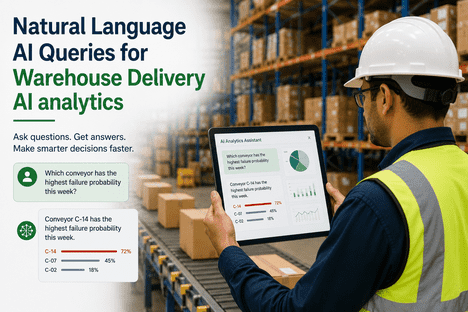
A warehouse operations manager at a 400,000 sq ft distribution centre handling 85,000 outbound shipments per week needs to know which dock doors have vehicles approaching detention, which conveyor zones are showing abnormal vibration, and whether the afternoon shift has enough pickers allocated to clear the 4:00 PM carrier wave. Getting those answers today means opening three separate dashboards WMS for dock status, CMMS for conveyor health, and the labour management system for headcount then manually correlating time stamps across systems that were never designed to talk to each other. By the time the picture is assembled, two trucks have already hit detention. Natural language AI queries change this entirely. An operator asks "Which conveyor has the highest failure probability this week?" or "Show me all dock doors where vehicles are approaching detention with picker availability below target" and the AI retrieves, correlates, and presents the answer from across every connected system in seconds. No dashboard navigation. No SQL. No waiting.
Ask your warehouse data anything in plain English. Get answers in seconds, not spreadsheets.
iFactory AI's natural language query engine connects to your WMS, TMS, fleet telematics, dock systems, and equipment sensors letting every operator, supervisor, and manager ask complex operational questions without dashboards, SQL, or data team support.
What natural language AI analytics delivers for warehouse delivery operations
These results are measured across warehouse and logistics deployments where AI-powered natural language querying replaced manual dashboard navigation and SQL-dependent reporting processes.
From natural language question to verified answer in under five seconds
iFactory's natural language query engine processes questions through a multi-agent AI architecture that understands warehouse and delivery operations context — not just generic language patterns. Every question is mapped to your actual operational data with governed business logic and security rules.
Natural language understanding
The router agent classifies your intent — data query, document retrieval, performance analysis, or operational alert. Warehouse-specific terminology like "detention", "carrier cutoff", "pick rate", "dock turnaround", and "OEE" are mapped to their precise operational definitions in your data model.
Cross-system data retrieval
The SQL agent generates and validates queries against your connected systems — WMS, TMS, fleet telematics, dock PLCs, IIoT sensors, and CMMS — all through a unified semantic layer that knows where every metric lives and how to join across systems.
Context-aware answer synthesis
The analysis agent interprets query results against operational context — shift timing, carrier schedules, equipment health trends — and returns a plain-language answer with supporting data. A follow-up question like "break that down by zone" maintains context without re-specifying the original query.
Real-time streaming response
Answers stream progressively — the user sees data appearing as the engine retrieves and correlates it across systems. Simple lookups resolve in under two seconds. Complex multi-system analysis completes in under 30 seconds. Every answer is validated before delivery.
Governed data access
Every query enforces tenant-specific security rules and row-level permissions. A floor supervisor sees their zone. A regional manager sees their facilities. An executive sees portfolio-level aggregates. No data leaks across permission boundaries.
Conversational context retention
The engine remembers previous questions within a session — enabling layered analysis. "Show me on-time delivery for the West region" followed by "Which carriers are driving the misses?" retrieves the correlated answer without re-specifying region, metric, or time period.
Real natural language queries that warehouse and delivery teams use every day
These are examples of actual questions operations teams ask through iFactory's natural language query engine — each one retrieving correlated answers from across WMS, TMS, fleet telematics, dock systems, and equipment sensors in seconds.
"Which conveyor has the highest failure probability this week?"
The engine retrieves vibration, temperature, and cycle-time data from every conveyor zone's IIoT sensors, cross-references against historical failure patterns, and returns a ranked list with failure probability scores and recommended maintenance windows. Traditional approach: open CMMS → run asset health report → export to spreadsheet → manually sort by risk score. Total time with natural language query: under five seconds.
"Show me all dock doors where vehicles are approaching detention with picker availability below target"
The engine correlates dock PLC data (vehicle dwell time), WMS data (outbound wave progress), and labour management data (picker headcount vs plan) in a single query — returning the specific doors where both conditions are true. Traditional approach: open dock dashboard → note dwell times → switch to WMS for wave status → switch to LMS for labour variance → manually identify matches. Total time with natural language query: under eight seconds.
"What was our on-time delivery rate by carrier for the East region last week?"
The engine queries TMS route completion data, carrier scorecards, and telematics ETA logs — computing on-time delivery rate per carrier against contracted SLA thresholds and returning a ranked comparison with trend indicators. Traditional approach: extract carrier data from TMS → pull ETA logs from telematics → join in spreadsheet → calculate rates manually. Total time with natural language query: under four seconds.
"Which SKUs in the forward pick area have pick velocity below threshold and are approaching expiry?"
The engine joins WMS pick frequency data with inventory age and batch expiry records — identifying slow-moving SKUs in premium storage locations that should be considered for relocation or promotion. Traditional approach: run slow-mover report from WMS → cross-reference expiry data from inventory module → manually identify overlap → spreadsheet for review. Total time with natural language query: under six seconds.
What iFactory's natural language AI engine does that traditional dashboards can't
Conventional BI tools require users to know which dashboard to open, which filter to apply, and which metric to select — before they can get an answer. Natural language AI eliminates every one of those intermediate steps and makes the entire operational data footprint queryable by anyone on the team.
- Require navigating predefined report menus and filter panels
- Only answer questions the dashboard builder anticipated
- Cannot correlate data across WMS, TMS, and telematics in a single view
- Need SQL or data team support for ad hoc questions
- Return static tables that require manual interpretation
- No conversational context — each question starts from scratch
- Answer any question by typing it in plain English — no navigation required
- Answer questions no one thought to build a dashboard for
- Automatically join across WMS, TMS, telematics, dock systems, and CMMS
- Any team member — floor supervisor to VP — can query data independently
- Return plain-language answers with context, not raw tables
- Maintain context across follow-ups — "break that down by zone" just works
Industry view on natural language AI in warehouse delivery operations
"The future of warehousing is not just having access to WMS data, but having access to context and decisions. We are moving toward an autonomous ecosystem where systems sense, decide, act, and learn. By giving decision agents a voice and the ability to explain their logic, we are empowering frontline workers to make faster, smarter decisions without the crushing weight of decision overload. The warehouse operators who deploy natural language AI today are not just saving a few minutes per query — they are restructuring how their entire team interacts with operational data."
Why traditional BI creates bottlenecks in warehouse delivery operations
A mid-size warehouse operation running 50,000+ shipments per week generates data across a WMS, a TMS, a fleet telematics platform, dock PLC controllers, IIoT sensors on conveyor systems, and a CMMS for equipment maintenance. Each system has its own dashboard with its own login, its own terminology, and its own refresh cycle. Getting a cross-system answer — like "Which carrier routes are at risk of missing tonight's cutoff given current pick rates and dock congestion?" — requires opening four dashboards, manually correlating timestamps, and making a judgment call on stale data. This is not a data problem. It is an access problem. The data exists. The pipelines work. But the people who need answers cannot ask the questions in a way the systems understand. Natural language AI closes this gap by putting a conversational interface on top of the entire operational data footprint — no dashboard navigation, no report requests, no SQL tickets.
You don't need more dashboards. You need answers you can ask for. Book a Demo and see how iFactory's natural language AI query engine connects to your existing WMS, TMS, and telematics systems in under 30 minutes.
From system connection to live queries in six weeks
iFactory's natural language AI engine deploys alongside your existing warehouse and delivery infrastructure — connecting to your systems through standard APIs and database connectors without replacing, modifying, or disrupting any operational workflow.
Connect your data sources
We connect to your WMS, TMS, fleet telematics platform, dock plc network, IIoT sensors, and CMMS through pre-built connectors. iFactory's semantic layer maps each system's data model into a unified operational ontology that the natural language engine understands.
Train on your operational vocabulary
The language model is fine-tuned on your specific terminology — carrier names, facility zones, SKU categories, SLA definitions, equipment types, and shift patterns. The engine learns that "detention" means dwell time beyond the grace period and "cutoff" means the last dispatch window for a carrier wave.
Configure permissions and governance
Row-level security, tenant isolation, and metric definitions are configured so every query returns data appropriate to the user's role. A floor supervisor sees zone-level data. A regional VP sees cross-facility aggregates. No data crosses permission boundaries.
Go live with natural language queries
Within six weeks, every operator, supervisor, and manager on your team can ask any operational question in plain English — from "What is the pick rate on line 4 right now?" to "Show me a 30-day SLA breach trend by carrier across all East region facilities."
FAQ: Natural language AI queries for warehouse delivery analytics
Natural language AI is the interface the warehouse has been waiting for
The gap between the data warehouse delivery operations generate and the answers operators need has never been about data availability. It has always been about access. Traditional dashboards force every question through a predefined filter menu designed by someone who could not anticipate every analytical need. SQL-based reporting puts answers behind a skills barrier that excludes most of the team. Natural language AI eliminates both constraints — making the full operational data footprint queryable by anyone who can ask a question in plain English. For operations leaders evaluating natural language AI platforms, the question is no longer whether the technology understands warehouse terminology. It is whether your team can afford to spend another year navigating dashboards that were built for yesterday's questions, not tomorrow's.
If your warehouse and delivery teams are spending more time finding data than acting on it, iFactory's natural language AI engine can have your first three systems connected and queryable within one week. Book a Demo to see a live walkthrough of natural language queries running against your operational data.
Ready to ask your warehouse data anything?
You've seen what natural language AI queries can do. Now see iFactory AI running against your own WMS, TMS, and telematics data. We'll set up a live walkthrough of cross-system natural language queries in under 30 minutes — no dashboard navigation required.