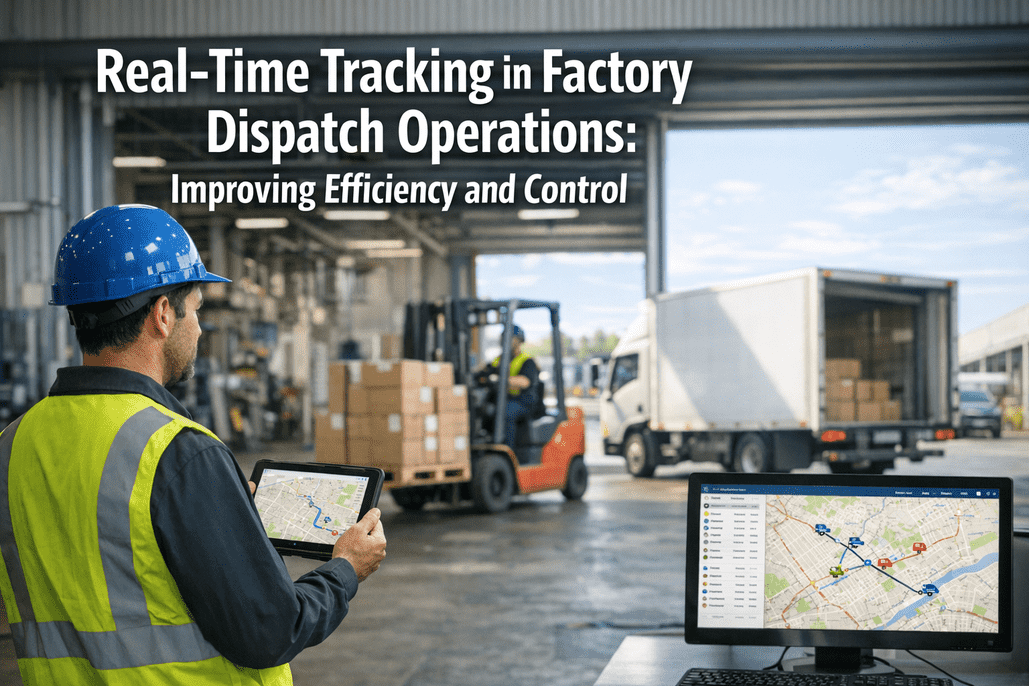
Your production floor sends real-time signals from every machine, every sensor, every shift change — yet the factory delivery department feeding that floor runs on paper gate logs, verbal handoffs, and spreadsheets updated hours after the fact. This is the defining data gap of 2026: 72% of manufacturers have adopted Industry 4.0 technology, and 92% believe smart manufacturing drives long-term competitiveness — but the delivery department, the function controlling everything entering and exiting the plant, remains the most data-blind operation on site. The consequences are not abstract. A factory receiving 20 vehicles per day loses 280+ minutes of dock time daily to manual gate pass processing alone. Dispatch SLA misses are discovered after the customer complaint. Materials physically present on the floor are generating production stoppages because nobody knows where they are. Real-time data sharing within the factory delivery department is not a technology upgrade — it is a structural operational requirement that the US manufacturing sector has been deferring far too long. This guide breaks down exactly what real-time data sharing delivers inside a factory delivery department, what it costs to operate without it, and how iFactory closes the gap in 7–14 days. For a data gap review specific to your plant, talk to our support team.
Data & Delivery · US Factory Operations · 2026
How Real-Time Data Sharing is Optimizing US Factory Delivery Networks
Real-time data sharing transforms factory delivery departments from the least-instrumented function in the plant to the most visible — connecting every gate pass, inbound receipt, dispatch event, vehicle inspection, and material transfer into a live operational picture. 92% of manufacturers say smart manufacturing drives competitiveness. Almost none have applied it to the delivery department yet.
72%
Of manufacturers have adopted Industry 4.0 technology — delivery departments lag behind every other function
57%
Of supply chain professionals cite insufficient visibility as their biggest operational challenge in 2026
$11.6B
Global delivery management software market 2025 — growing to $25.5B by 2035 as real-time data becomes the core capability
14 days
iFactory go-live timeline — from decision to fully real-time factory delivery department, no IT project required
iFactory · Factory Delivery Department Module
Your production floor has dashboards. Your delivery department deserves the same visibility.
iFactory digitizes every gate pass, inbound receipt, material transfer, vehicle inspection, dispatch event, and incident report — giving your operations team real-time data visibility into the department that controls everything that enters and exits your plant. Deploy in 7–14 days. No IT project. No hardware procurement. Results visible from day one.
87%Gate pass time reduction
78%Faster inbound receiving
100%Audit trail coverage
14 DaysFull deployment
The Visibility Gap
Where Real-Time Data Has Reached in Your Factory — and Where It Has Not Yet
Already Tracked in Real Time
Production OEE — tracked live by 86% of manufacturers
Machine uptime, cycle times, and output per shift
Quality defect rates and inspection results per run
Maintenance work orders and equipment history
Finished goods inventory and warehouse bin locations
Energy consumption per production zone
Outbound shipment status via carrier integrations
ERP production scheduling and MRP updates
Still Running Blind — No Real-Time Data
Gate pass dwell time — unknown until a complaint arrives
Inbound vehicle status — no pre-arrival data, no dock coordination
Receiving cycle time — no measurement, no benchmark, no visibility
Dispatch queue status — whiteboard updated manually, stale within minutes
SLA cut-off proximity — misses found after customer files complaint
Internal material location — unknown after dock entry
Vehicle inspection status — paper checklists, no live failed-vehicle alert
Incident escalation — paper forms reaching management days late
8 Delivery Data KPIs
8 Real-Time Data KPIs Your Factory Delivery Department Should Track — and What iFactory Delivers on Each
87%
Gate Dwell Time Reduction
Pre-arrival digital registration and mobile verification cut gate processing from 15–20 min to under 2 min. Dwell time per vehicle is captured automatically — a data point that manual gate logs structurally cannot produce.
Manual: 15–20 min, no recordReal-time: under 2 min + full log
78%
Faster Receiving Cycle
Real-time PO matching and mobile confirmation cuts inbound receiving from 45–60 min to under 10 min per shipment — eliminating the 30–45 min documentation lag that disrupts production schedules daily.
Manual: 45–60 min/shipmentReal-time: under 10 min
90%
Dispatch Error Reduction
Live SLA-priority queue updates reduce dispatch sequencing errors from 2–3% to under 0.3%. Real-time cut-off alerts prevent SLA breaches before they occur — not after the customer has already complained.
Manual: 2–3% error rateReal-time: under 0.3%
100%
Audit Trail Coverage
Every gate event, receiving record, inspection result, material transfer, and dispatch decision is timestamped and person-attributed automatically. Retrievable in under 60 seconds for any vehicle, any date, any event type.
Manual: fragmented, hours to assembleReal-time: 60-second retrieval
40%
Inbound Delay Reduction
Real-time pre-arrival coordination and live dock assignment eliminate vehicle queue buildup. A factory processing 20 vehicles per day recovers 280+ minutes of dock capacity daily — improving production schedule adherence directly.
Manual: 280+ min wasted per dayReal-time: 40% delay reduction
30–40%
Production Stoppages Eliminated
Real-time internal material location tracking eliminates locating failures behind 30–40% of production stoppages recorded as "material unavailability." Most are not stock-outs — they are location failures that data prevents.
Manual: no location after dock entryReal-time: live location at every transfer
3–6 mo
Full Platform Payback
Recovered dock time, eliminated dispatch errors, production stoppage prevention, and compliance overhead reduction combine to deliver full payback in 3–6 months — versus 18–24 months for legacy system implementations.
Legacy: 18–24 mo paybackiFactory: 3–6 months
295%
Average ROI on Real-Time Data Integration
Organizations deploying real-time data integration platforms average 295% ROI over 3 years, with top performers reaching 354%. Factory delivery departments represent the largest untapped real-time data opportunity in manufacturing operations today.
Without integration: fragmented data silosWith integration: 295% average ROI
57% of supply chain professionals cite insufficient visibility as their biggest challenge. Your delivery department is the most data-blind function you are running.
iFactory captures gate dwell times, receiving cycles, dispatch errors, material locations, and inspection status in real time — automatically, from day one of deployment.
Talk to our support team for a data gap assessment specific to your facility.
5 Data Workflows
How iFactory Creates a Real-Time Data Layer Across Every Factory Delivery Workflow — Without Hardware or IT Projects
Real-time delivery department data does not require sensors, servers, or a software implementation project. It requires the operational data your team already generates — captured digitally at the point of action rather than reconstructed on paper hours later. iFactory creates this data layer across 5 workflows that run every day in every factory.
01
Gate Pass Data — Pre-Arrival to Exit, Every Vehicle, Every Day
Drivers submit pre-arrival data on mobile before reaching the gate — vehicle details, driver credentials, cargo manifest, expected arrival time. Security receives a verified queue of expected arrivals instead of an unannounced stream of vehicles. Gate processing completes in under 2 minutes with mobile verification against pre-loaded data. Every gate event is captured in real time: arrival timestamp, dock assignment, dwell time, exit — creating a continuous, queryable data stream that manual gate logs cannot produce. Operations managers see live gate queue status, current dwell times, and daily throughput from any device — without asking anyone to compile a report.
Live gate queue dashboard
Per-vehicle dwell time data
Pre-arrival dock coordination
02
Inbound Receiving Data — Real-Time PO Confirmation and Discrepancy Capture
Receiving staff scan barcodes, match against purchase orders, and photograph discrepancies on mobile at the dock. Every shipment generates an immediate digital record — supplier, carrier, material, quantity received vs. ordered, condition, and timestamp — shared in real time with procurement, stores, and production. The 30–45 minute lag between physical dock arrival and system confirmation is eliminated entirely. Discrepancies are photo-documented before the vehicle leaves the yard, creating evidence that paper PODs cannot match. Production schedulers see incoming material confirmation in real time and can adjust schedules based on actual receiving status rather than estimated arrivals. 57% of supply chain teams cite visibility gaps as their top challenge — this workflow eliminates the gap at the most critical handoff point.
Real-time system confirmation
Photo discrepancy evidence
Live material availability signal
03
Dispatch Data — Live SLA Queue with Real-Time Cut-Off Alerts
Dispatch orders are scored and ranked live by SLA priority tier, cut-off window proximity, vehicle availability, and load capacity. The queue updates continuously as new orders arrive, vehicles become available, and conditions change — replacing the static whiteboard dispatchers update manually each hour. When an SLA window is closing with insufficient queue position to complete on time, a real-time escalation alert reaches the dispatcher before the breach occurs. This converts SLA management from reactive — discovering a miss after the complaint — to proactive — preventing the miss 15–30 minutes before it becomes irreversible. Dispatch error rate drops from 2–3% to under 0.3% on the first day of deployment. Real-time data sharing here alone justifies the entire platform investment for most mid-size factories.
Live SLA priority queue
Real-time cut-off alerts
Proactive breach prevention
04
Vehicle Inspection Data — Real-Time Status, Auto-Block on Failures
Yard vehicles complete digital pre-use inspection checklists on mobile at the start of each shift. Results are shared in real time with dispatch — vehicles that pass are immediately available for assignment, vehicles that fail are automatically blocked from all dispatch queues until a verified repair work order is completed and closed. This eliminates the scenario where a failed vehicle enters service because the paper checklist never reached the dispatcher. Real-time inspection data also gives operations managers live fleet readiness — what percentage of yard vehicles are available, blocked, or under repair — without a phone call or a walk to the maintenance board. For US operations, this data layer satisfies DOT pre-trip inspection documentation requirements automatically as a byproduct of daily operations.
Auto-block on failed inspections
Live fleet readiness dashboard
DOT pre-trip record generation
05
Internal Material Tracking — Live Location at Every Transfer Point
Materials are logged at every internal handoff — dock to receiving inspection, inspection to stores, stores to production floor, production to quality holding, quality to dispatch staging. Each transfer generates a real-time, timestamped, person-attributed record visible to every authorized user on any mobile device. Production supervisors query current material location without walking the floor or calling anyone. This eliminates the locating failures behind 30–40% of production stoppages and removes the unnecessary yard vehicle movements generated by physical material searches. In US manufacturing plants operating JIT schedules, this single data layer directly reduces the "material unavailability" stoppage category that ERP records as a procurement failure — when the root cause is a data gap, not a stock-out. Real-time data sharing across all five workflows means every stakeholder — from security at the gate to the VP of Operations — sees the same live picture simultaneously.
Real-time material location
Full internal chain of custody
JIT schedule protection
Measured Results
What Real-Time Data Sharing Delivers — Measured Within 90 Days of iFactory Go-Live
87%
Gate Pass Time Reduction
Processing time drops from 15–20 minutes to under 2 minutes per vehicle. A 20-vehicle/day plant recovers 280+ minutes of dock capacity daily — now measurable on a live dashboard rather than invisible in a paper gate log.
78%
Faster Receiving Completion
Inbound receiving drops from 45–60 minutes to under 10 minutes per shipment with real-time PO matching. Materials appear in the production system immediately — schedulers see confirmed availability in real time, not end-of-shift.
90%
Fewer Dispatch Errors
Manual 2–3% dispatch error rate drops below 0.3% with live SLA-priority queue management. Real-time cut-off alerts prevent SLA breaches before they occur — eliminating the reactive penalty cycle that manual operations generate structurally.
100%
Real-Time Audit Trail
Every delivery department event is captured live with timestamp and operator attribution. OSHA, DOT, and internal compliance records are retrievable in under 60 seconds — not 4–8 hours of manual binder search and spreadsheet assembly.
3–6 mo
Full Platform Payback
Recovered dock time, eliminated dispatch errors, production stoppage prevention, and compliance overhead reduction deliver full payback within 3–6 months of go-live. ROI accumulation begins from the first week of operations.
14 days
Go-Live Timeline
From decision to fully real-time delivery department in 7–14 days. Cloud-based, mobile-first deployment. No servers, no hardware procurement, no IT department project. Security staff and receiving teams generating live data from day one.
Before vs. After
Factory Delivery Department — Manual Data Gaps vs. iFactory Real-Time Data Layer
iFactory · Factory Delivery Department Module
Your Delivery Department Generates Operational Data Every Hour. iFactory Captures All of It — Live, From Day One.
Gate dwell times, inbound receiving cycles, dispatch queue status, vehicle inspection results, material locations, SLA compliance rates — captured automatically as a byproduct of daily delivery operations. No separate data program. No analytics implementation. No IT project. Live in 7–14 days with the same real-time visibility your production floor already has. Book a demo to see iFactory's real-time delivery department dashboard running in a live factory environment.
Frequently Asked Questions
Real-Time Data Sharing in US Factory Delivery Departments — What Operations Leaders Ask First
What does real-time data sharing mean specifically for a factory delivery department — and how is it different from the production floor data systems already in place?
Real-time data sharing in a factory delivery department means every operational event — vehicle gate entry and exit, inbound material receipt confirmation, dispatch assignment, vehicle inspection result, internal material transfer, and incident occurrence — is captured digitally at the moment it happens and made instantly visible to every authorized stakeholder, with no manual reporting step or time delay. This is operationally distinct from production floor data systems in a critical way. Production floor systems — MES, SCADA, OEE platforms — capture data from machines and sensors at high frequency: equipment parameters, cycle times, energy consumption. These are machine-generated data streams that require sensor infrastructure and integration layers. Delivery department real-time data captures human-executed workflow events: vehicle arrivals, cargo verifications, inspection decisions, dispatch assignments, material handoffs. The data is event-driven and variable — which is why standard production floor systems cannot extend their data capture into the delivery department without purpose-built workflows designed for mobile execution by operational personnel. iFactory is built specifically to capture delivery department workflow events in real time through the mobile devices your security staff, receiving teams, dispatch coordinators, and vehicle operators already carry — creating the same live visibility layer your production floor has, applied to the function that controls everything entering and exiting your plant.
Talk to our support team about mapping iFactory's data layer to your facility's specific workflows.
Why do real-time data gaps in the factory delivery department cause production disruptions — and how direct is the connection between gate data and production schedule adherence?
The connection between delivery department data gaps and production disruptions operates through three distinct pathways that are frequently invisible to operations managers because no current system measures them. The inbound velocity pathway is the most direct: when gate processing takes 15–20 minutes per vehicle and receiving confirmation takes 45–60 minutes per shipment, the total time from vehicle arrival to material confirmed available in the production system can exceed 90 minutes. For JIT production schedules, this 90-minute confirmation lag is a structural disruption risk on every inbound shipment. It is invisible because no system currently measures it — it is simply absorbed as "normal" delay. The material location pathway is the most underestimated: when inbound material is received without real-time internal transfer records, its location within the facility is known only to the receiving staff who handled it. Shift changes, parallel receiving operations, and multi-zone plants produce regular locating failures — materials physically present but unconfirmable as available. These generate production stoppages that ERP records as "material unavailability," masking the actual root cause as a data gap rather than a procurement problem. Research consistently shows 30–40% of stoppages in this category are locating failures, not true stock-outs. The dispatch cascade pathway compounds both: a manual dispatch sequencing error at 2–3% requires a 30–45 minute re-dispatch recovery that propagates downstream delays through the rest of the shift. Real-time dispatch data eliminates this source entirely.
Book a demo to see how iFactory connects delivery department data directly to production schedule protection.
How does iFactory generate real-time delivery department data without hardware, sensors, or an IT infrastructure project?
iFactory generates real-time delivery department data entirely through mobile devices already carried by your operational staff — no sensors, no hardware installations, no server infrastructure, and no IT department involvement required for core deployment. The data generation mechanism is human-action capture at the point of execution. When a security officer verifies a vehicle at the gate using the iFactory mobile app, that action generates a timestamped gate pass record in real time. When a receiving staff member scans a barcode and confirms a shipment quantity, that action generates a confirmed receipt record in real time. When a vehicle operator completes a digital inspection checklist, that action generates a timestamped inspection record and updates the vehicle's dispatch availability status in real time. The data is generated as a byproduct of the operational actions your staff already perform — the difference is that those actions are captured digitally at the moment of execution rather than transcribed onto paper forms that reach management days later. Cloud-based architecture means the data is immediately shared across all authorized users simultaneously — operations managers see live gate activity while a dispatch coordinator sees updated vehicle availability — without any server installation or network infrastructure investment. The mobile-first design means your operational staff, not IT specialists, are the data source. Typical learning curve to full productivity is 2–4 hours per role. iFactory goes live in 7–14 days because deployment is configuration and training, not infrastructure.
Book a demo to walk through the exact deployment model for your facility type.
What does real-time delivery department data enable that monthly reporting cannot — and how does the timing difference translate into measurable operational value?
The operational value of real-time data versus monthly reporting in a factory delivery department is not a convenience difference — it is a fundamental difference between whether intervention is possible before harm occurs. Monthly reporting converts operational data into historical records. By the time a monthly dispatch error rate report reaches a manager, the errors have already produced SLA penalties, customer complaints, and re-dispatch costs. The report confirms that damage happened — it cannot prevent it. Real-time data enables intervention before harm completes. When an SLA cut-off window is approaching with the relevant delivery still in queue position 7, a real-time alert 20 minutes before the breach enables immediate re-sequencing that prevents the miss. Monthly reporting would record the miss 30 days later. The same distinction applies everywhere. Real-time gate queue data lets security managers call additional staff before a queue builds — monthly dwell time data confirms queues built and dock capacity was lost. Real-time material location data lets a production supervisor find a delayed material in 30 seconds — monthly tracking data confirms stoppages occurred. Real-time vehicle inspection status blocks a failed vehicle before dispatch — monthly records confirm uninspected vehicles were used. For a mid-size US factory, this prevention difference represents the elimination of $50,000–$200,000 in annual dispatch penalty exposure, $12,000–$15,000 in production stoppage costs per quarter, and 4–8 hours per audit event in compliance documentation assembly time. The ROI of real-time data is the prevention of outcomes that monthly data can only document after the damage is done.
Talk to our support team for an ROI calculation specific to your facility's volume and SLA structure.
What US compliance requirements does iFactory's real-time data layer satisfy automatically for factory delivery departments?
iFactory's real-time delivery department data layer satisfies four categories of US regulatory documentation requirements as a byproduct of daily operations — without any separate compliance reporting workflow. DOT pre-trip and post-trip inspection documentation is generated automatically from iFactory's digital vehicle inspection checklists — timestamped, person-attributed, and stored in a searchable audit log. FMCSA driver and vehicle record requirements are satisfied through the gate pass and dispatch records that capture vehicle ID, driver credentials, departure timestamps, and route information for every movement. OSHA incident documentation requirements are met through iFactory's real-time incident capture module — incidents are photographed, timestamped, escalated automatically, and stored in an immutable record linked to the vehicle and driver involved. For plants operating under FDA supply chain traceability standards or FSMA requirements, iFactory's inbound receiving module generates the chain-of-custody records linking supplier, carrier, material, quantity, and receipt timestamp that these regulations require. All five documentation categories are retrievable through iFactory's audit dashboard in under 60 seconds — versus the 4–8 hours of manual binder search and spreadsheet assembly that paper-based operations require per audit event. For operations with specific state-level compliance requirements — California's CARB standards, New York's supply chain transparency requirements, or Texas's industrial safety documentation standards — iFactory's templates are configurable to local documentation requirements during the setup phase.
Book a demo to see the compliance documentation dashboard running with live data.
Can iFactory's real-time data sharing scale across multiple US plant locations — and how does multi-site visibility work for operations directors managing several facilities?
iFactory is built as a multi-depot, multi-site platform from the ground up — designed specifically for manufacturing organizations that need real-time delivery department visibility across multiple plants from a single corporate dashboard. Each site generates its own real-time data stream — gate events, receiving confirmations, dispatch queue status, inspection records, and material transfers — while a corporate-level dashboard aggregates all sites simultaneously. Operations directors and VPs can see live gate processing times across all facilities, compare dispatch error rates between plants, identify which receiving docks are running behind, and see fleet readiness at every depot — without logging into each facility system separately or waiting for site managers to compile and send weekly reports. The multi-site comparison capability is operationally significant because it makes visible the performance differences between facilities that single-site reporting conceals. When one plant's average gate dwell time is 40% longer than comparable facilities, the difference is immediately actionable — it identifies a workflow configuration or staffing issue that would remain invisible without cross-site real-time data. For US manufacturing organizations with plants across multiple states, iFactory handles variation in state-level compliance documentation requirements — each site's data capture templates can be configured to local OSHA, DOT, or state-specific documentation standards while sharing the unified corporate reporting layer. Multi-site deployments follow the same 7–14 day timeline per site, with staggered rollout options for organizations that prefer to pilot one facility before full network deployment.
Talk to our support team about multi-site configuration and phased rollout options for your facility network.
iFactory · Factory Delivery Department Module
72% of US Manufacturers Have Adopted Industry 4.0. Almost None Have Applied Real-Time Data to the Delivery Department. iFactory Closes That Gap in 14 Days.
Gate dwell time. Inbound receiving cycles. Dispatch SLA compliance. Material location data. Vehicle fleet readiness. Incident escalation status — all captured in real time, automatically, as a byproduct of daily delivery operations. No IT project. No hardware. No separate analytics program. The same real-time visibility your production floor has, now available for the department that controls everything entering and exiting your plant. Book a demo today.