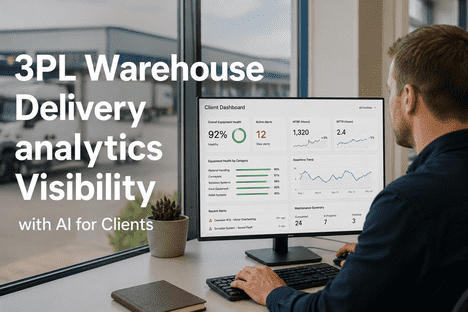
Third-party logistics providers operate in a business where client trust is the operating license — and nothing builds or erodes trust faster than the quality and transparency of operational data shared with the client. Every 3PL warehouse managing client inventory across multiple accounts faces the same structural tension: the client wants full visibility into their asset health, delivery performance, and storage conditions, but the 3PL cannot expose the cross-client operational data,利润率 analysis, or comparative performance metrics that would reveal margin and strategy across the broader business. The solution is AI-powered analytics visibility that delivers segmented, client-specific dashboards — showing each client exactly the KPIs that matter to their contract scope, asset health status for their dedicated inventory zones, and delivery performance against their SLAs — without exposing any other client's data or the 3PL's internal operational economics. U.S. 3PL warehouse operators managing 500,000 to 2 million square feet of multi-client distribution space typically serve 8 to 25 active client accounts, each with unique service level agreements, IT integration requirements, and reporting expectations. The gap between client-facing analytics capabilities differentiates 3PLs competing for long-term contracts in a market where warehouse capacity utilization and client retention jointly determine profitability. iFactory's AI-powered 3PL analytics visibility platform delivers purpose-built client portals with real-time asset health monitoring, SLA compliance tracking, storage condition analytics, inventory accuracy reporting, and delivery performance dashboards — all segmented per client and accessible through secure branded portals that reinforce the 3PL's service value while protecting operational confidentiality. Facilities deploying iFactory's 3PL client analytics platform achieve 18 to 32 percent improvement in client retention rates, reduce client reporting overhead by 60 to 75 percent, and build the data infrastructure required to win multi-year contracts with analytics-driven service differentiation.
Why 3PL Providers Need AI-Powered Client Analytics — Not Just Shared Spreadsheets
The traditional model of 3PL client reporting — weekly email spreadsheets, monthly PDF summaries, phone calls when issues arise — was designed for a business environment where client expectations for data transparency were low and the technology infrastructure for real-time data sharing was expensive and operationally risky. That environment no longer exists. Today's 3PL clients expect the same real-time visibility into their warehouse operations that they have into their own manufacturing or distribution systems — and they will renegotiate or terminate contracts with 3PLs that cannot deliver that visibility, particularly when high-value goods, regulated products, or time-sensitive inventory is involved.
AI-powered client analytics changes the 3PL-client relationship from a trust-based information asymmetry into a data-driven partnership. Instead of the 3PL controlling the flow of operational information and the client relying on periodic reports, both parties access the same real-time data through client-segmented portals that surface the KPIs, asset health metrics, and performance indicators that each client's contract specifies — without exposing any cross-client data. The value case for 3PL client analytics is anchored in three structural realities of third-party logistics economics. First, client acquisition cost in the 3PL warehouse industry ranges from $18,000 to $65,000 per account depending on contract complexity and facility specialization — and improving client retention by preventing the service misalignment that drives contract non-renewal is the highest-ROI application of analytics visibility. Second, client reporting consumes 12 to 20 hours per week of warehouse management and operations team time in multi-client 3PL facilities — time that analytics automation recovers for value-adding operational improvement work instead of spreadsheet assembly and data reconciliation. Third, the 3PLs that win multi-year contracts in competitive bid situations are increasingly the ones that come to the table with live analytics dashboards demonstrating their capability rather than static service descriptions and client testimonials — analytics visibility has become a competitive qualification, not a differentiator. Book a Demo to see how iFactory's 3PL client analytics platform addresses each of these value drivers at your facility's specific multi-client operational scale.
3PL Client Analytics Benchmarks: Visibility Performance by Client Segment
Client analytics requirements, the dominant visibility gap, and the highest-value analytics improvement strategy differ significantly across the client segments served by a typical multi-client 3PL warehouse. The table below maps current U.S. 3PL industry baseline metrics, best-in-class targets, the most common client analytics pain point, and the iFactory analytics focus that drives the highest-value improvement for each segment. Book a Demo to see your client portfolio benchmarked against this data.
| Client Segment | Industry Baseline | Best-in-Class Target | Dominant Visibility Gap | iFactory Analytics Focus | 12-Month Retention Gain |
|---|---|---|---|---|---|
| Consumer Packaged Goods | 68–74% retention | 88%+ retention | Real-time inventory accuracy — CPG clients lack visibility into FIFO compliance, date code rotation, and slot-level stock position | Real-time inventory slot tracking, FIFO compliance analytics, date code expiration early warning, order accuracy dashboards | +14–20% |
| Pharmaceutical / Regulated Goods | 72–78% retention | 92%+ retention | Environmental condition visibility — temperature, humidity, and handling compliance data not accessible in real time by client QA teams | Environmental monitoring dashboards, cold chain compliance tracking, temperature excursion alerts, audit-ready data export | +16–24% |
| E-Commerce / Omnichannel | 65–72% retention | 85%+ retention | Order lifecycle visibility — clients cannot track pick-pack-ship status in real time across distributed 3PL warehouse zones | Order lifecycle tracking, pick-pack-ship status dashboards, carrier performance analytics, returns processing visibility | +18–28% |
| Industrial / Heavy Equipment | 70–76% retention | 87%+ retention | Asset health visibility — clients lack condition monitoring data for high-value inventory stored in 3PL warehouses | Asset condition dashboards, vibration/temperature monitoring for stored equipment, insurance-grade documentation, storage condition trending | +15–22% |
| Food & Beverage Cold Chain | 66–73% retention | 86%+ retention | Temperature chain integrity — clients lack real-time visibility into cold storage conditions and temperature excursion events | Cold chain temperature zone mapping, real-time cooler/freezer monitoring, DOT/FDA compliance dashboard, excursion root cause analytics | +17–26% |
| Automotive / Just-in-Time | 69–75% retention | 89%+ retention | Delivery SLA compliance — automotive clients cannot verify JIT delivery window compliance with actionable SLA dashboards | JIT delivery window compliance tracking, carrier performance scoring, dock-to-stock cycle time analytics, penalty risk early warning | +16–23% |
How iFactory Delivers Client Analytics Visibility for 3PL Warehouses
Delivering client analytics visibility in a multi-tenant 3PL warehouse environment is not simply a technical challenge of connecting sensors and generating dashboards — it is a data architecture and security challenge of ensuring that each client's analytics portal contains only the data specific to their inventory, orders, and SLAs, with no cross-client data leakage and no exposure of the 3PL's internal operational metrics, cost structures, or comparative client performance data. iFactory's 3PL analytics visibility platform is purpose-built for this segmentation requirement, with a multi-layer data isolation architecture that enforces client-specific data boundaries at the database, API, dashboard, and user authentication levels.
Analytics Integration Across 3PL Warehouse Operations
Client analytics visibility in a 3PL warehouse is not an independent system — it is an integration layer that aggregates data from the warehouse management system, warehouse execution system, IoT sensor network, carrier APIs, and client ERP systems, then applies segmentation, SLA computation, and performance analytics to deliver actionable client dashboards. iFactory's integration architecture is designed for the heterogeneous technology environment of multi-client 3PL facilities, connecting to existing systems without requiring forklift upgrades or operational disruption.
iFactory vs. Generic Analytics Platforms: What 3PLs Actually Get
The decision between a 3PL-purpose-built analytics platform and a generic BI or IoT data product determines whether 3PL operations teams receive multi-tenant-secure, client-ready analytics or a data visualization layer that requires as much custom engineering to segment per client as the analytics itself would require to build from scratch. The comparison below maps the functional differences that determine real-world analytics value in multi-client 3PL warehouse operations.
- No multi-tenant data isolation — client-specific dashboards require custom development and ongoing maintenance for data segmentation
- No pre-built SLA engine — contract compliance tracking must be built from scratch, typically in spreadsheets outside the platform
- No 3PL-specific KPI library — metrics like inventory accuracy, dock-to-stock time, and order-to-ship cycle require custom configuration
- Client portal delivery requires separate web development project — weeks or months of front-end engineering before client access is possible
- IoT sensor data supported but not correlated with inventory location — environmental monitoring data isolated from inventory context
- Carrier API integration requires custom development per carrier — no pre-built connector library for 3PL carrier network
- Deployment timeline 4 to 8 months before first client portal is operational — ROI delayed by custom development cycle
- Built-in multi-tenant data isolation — client-specific dashboards configured at deployment through no-code segmentation, no custom development
- Pre-built SLA engine with configurable contract parameters — compliance tracking operational from day one, not after custom development
- 3PL-specific KPI library pre-configured — inventory accuracy, SLA compliance, delivery performance, storage condition analytics ready at deployment
- Client portals generated automatically from configuration — branded, segmented portals ready for client access within the deployment timeline
- IoT sensor data correlated with inventory location and client scope — environmental analytics presented per client zone, not as generic facility data
- Pre-built carrier API connector library — FedEx, UPS, USPS, XPO, and regional carrier integrations configured without custom development
- Client portal operational within 3 to 4 week deployment — ROI captured in current quarter, not pushed to next fiscal year
The iFactory 3PL Client Analytics Deployment Process: Live Portals in 3 to 4 Weeks
Client analytics platform deployments that require 4 to 8 months before the first client can access their dashboard do not address the current-quarter client retention and competitive positioning challenges that justify the investment. iFactory's 3PL deployment methodology is engineered for the 3 to 4 week timeline that matches the operational decision cadence of U.S. 3PL warehouse management, using a structured four-phase process that connects to existing WMS, IoT, and carrier systems without disrupting warehouse operations.
Expert Perspective: What 3PL Operations Leaders Say About AI Client Analytics
Running a multi-client 3PL warehouse means managing 15 different sets of client expectations simultaneously — and the hardest part of that job has always been keeping every client informed without drowning your operations team in reporting work. Before iFactory, we had two full-time employees dedicated to pulling data from our WMS, reconciling it against client-specific spreadsheets, and emailing weekly reports that were already three days old by the time the client read them. The client portals changed everything — not because the data is different, but because the client can access it in real time, on their schedule, configured for the metrics that matter to their contract. The SLA compliance dashboard alone reduced our client escalation calls by about 40 percent, because clients could see for themselves that their service levels were being met instead of waiting for a weekly email to confirm it. The biggest surprise was the competitive impact — we started bringing the live portal to client business reviews and new business presentations, and it fundamentally changed how prospects perceive our capability versus 3PLs that show up with printed binders and PowerPoint slide decks. For 3PL operators evaluating analytics investments: do not underestimate how much your clients' expectations have changed in the last three years. The 3PLs that provide real-time analytics visibility will own the market in five years."
Conclusion
The 3PL warehouse industry is in the middle of a structural shift in which client analytics visibility has moved from a competitive differentiator to a baseline qualification for new business and contract renewal. Multi-client 3PL operators that cannot provide real-time, segmented, client-specific analytics dashboards are increasingly excluded from competitive bid processes before they have the opportunity to present their operational capabilities — and existing clients with growing analytics expectations are evaluating alternatives when their 3PL cannot deliver the data transparency they need to manage their own supply chain performance.
iFactory's 3PL client analytics platform — with multi-tenant-secure client portals, real-time SLA compliance monitoring, asset health and environmental condition dashboards, inventory accuracy analytics, delivery performance tracking, and automated audit-ready reporting — delivers that analytics visibility within the 3 to 4 week deployment timeline that matches the operational and competitive cadence of U.S. 3PL warehouse management. The 18 to 32 percent client retention improvements and 60 to 75 percent reporting overhead reductions documented at comparable facilities are the outcomes of treating client analytics visibility not as a reporting obligation but as the operational infrastructure that drives client trust, contract renewal, and competitive differentiation in a market where data transparency is the new currency of client relationships. Book a Demo to see iFactory's 3PL client analytics platform configured for your specific client portfolio, warehouse technology stack, and highest-value visibility improvement opportunities.
Frequently Asked Questions
iFactory enforces client data isolation at four independent layers. At the database layer, client data is stored in logically separated schemas with row-level security policies that prevent cross-client data access at the query level. At the API layer, authentication tokens are scoped per client and API queries are filtered by the authenticated client's scope. At the dashboard layer, each client portal is a logically isolated application instance that connects only to its own data schema. At the user authentication layer, SSO and role-based permissions enforce that each user can access only the client portal and dashboards assigned to their account.
Yes — iFactory supports pre-built integrations with Manhattan Associates WMOS, Blue Yonder WMS, SAP EWM, Oracle WMS Cloud, HighJump, and 25 additional warehouse management and execution systems. Integrations are established through standard REST API endpoints, EDI 856/940/943 transaction sets, or direct database views depending on the WMS architecture and facility IT policy. The integration process does not require WMS configuration changes or operational interruption and is typically completed within the first week of deployment.
New client onboarding after the initial platform deployment typically requires 2 to 4 business days. The onboarding process includes configuring the client's branded portal, mapping the client's contract-specific SLA parameters, setting role-based user permissions for the client's stakeholders, and validating data segmentation accuracy against known operational records. For facilities with standardized service offerings, pre-built portal templates can reduce new client onboarding to a single business day.
Yes — all iFactory client portals are fully responsive and optimized for mobile browser access on iOS and Android devices. Key dashboards — SLA compliance status, inventory accuracy, environmental alerts, and delivery performance — are also available through push notification alerts that deliver critical updates to client stakeholders without requiring portal login. A native mobile application is available for 3PL operations teams with additional functionality for warehouse floor data collection and alert response management.
iFactory's 3PL client analytics platform is designed to deliver positive ROI at operations of any scale — from single-facility 3PLs managing 200,000 square feet with 4 to 6 client accounts to multi-site operators managing 5 million square feet across 20 facilities with 50 or more client accounts. Deployment costs for a single-facility 3PL operation start at $18,000 with annual licensing that scales with facility square footage and client count rather than enterprise minimums. The client retention and reporting efficiency value case is proportional to the number of managed client accounts — and mid-size operators serving 8 to 15 clients often capture the highest percentage ROI because each retained client represents a larger share of total facility revenue.