Pallet Conveyor analytics for Warehouse Delivery Operations Using AI
By Arel Dixon on June 3, 2026
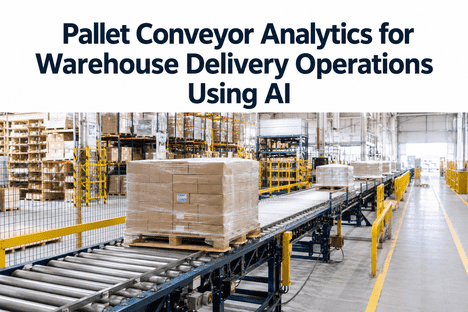
Pallet conveyor systems are the circulatory system of warehouse delivery operations — inbound staging, sortation, accumulation, and outbound dispatch all depend on uninterrupted conveyor flow. Yet most conveyor maintenance strategies remain reactive: a motor overheats, a roller seizes, a belt drifts, and the line stops until a technician arrives. Every unplanned conveyor stoppage during a sort wave or dispatch window cascades into missed SLAs, overtime labour, and expedited shipping costs. AI-powered pallet conveyor analytics fuses vibration, motor current draw, thermal imaging, and acoustic signatures from IIoT sensors with adaptive machine learning models that detect developing faults in drives, rollers, belts, and bearings 48–72 hours before they cause a shutdown — reducing unplanned conveyor downtime by 30–50% and eliminating the delivery delays that follow every mechanical failure on the line. Book a Demo to see how iFactory connects your conveyor telemetry to predictive analytics and shift-logged maintenance actions.
Adaptive ML conveyor fault detection accuracy vs 83.7% fixed-threshold monitoring
30–50%
Reduction in unplanned conveyor downtime across documented deployments
48–72 hr
Advance warning of motor, roller, belt, and bearing failures
22%
Improvement in on-time dispatch completion from conveyor reliability
Why Conveyor Reliability Is the Critical Path in Warehouse Delivery
In a modern warehouse, the pallet conveyor system connects every operational zone — inbound receiving, put-away, pick modules, pack stations, sortation, staging, and outbound dispatch. A single motor failure on the main take-away conveyor during a 3-million-package sort wave stops not just that zone but every upstream process that feeds into it. The typical warehouse conveyor system includes hundreds of drive motors, thousands of rollers, miles of belt, and dozens of control panels — each a potential failure point. Fixed-threshold alarm systems in most warehouses trigger only after a parameter has exceeded its configured limit, by which point the conveyor component has already been degrading for hours or days and the unplanned stoppage is imminent. iFactory's AI-powered conveyor analytics platform closes this gap by fusing multi-modal sensor data with adaptive ML models that learn normal operating baselines per asset — flagging a motor current drift, a bearing vibration signature shift, or a belt tracking deviation before any threshold is breached and before any package is delayed. Book a Demo to discuss how iFactory monitors your specific conveyor topology.
Pallet Conveyor Analytics — The AI Predictive Maintenance Stack
Sense
IIoT Sensor Fusion
Vibration · motor current · thermal · acoustic · speed
Multi-modal edge inference
Detect
Anomaly Detection
Adaptive ensemble ML · autoencoder · trending
94.2% detection accuracy
Predict
Failure Forecast
CNN-LSTM remaining useful life · 48–72 hr horizon
RUL per asset
Act
Auto Work Orders
CMMS integration · parts reservation · shift scheduling
Three Conveyor Failure Categories iFactory Predicts and Prevents
01
Drive Motor & Gearbox Degradation That Stops the Mainline
Conveyor drive motors and gearboxes operate under continuous load during sort waves, and bearing degradation, shaft misalignment, and gear wear develop gradually over weeks. Fixed-threshold alarms detect the failure only after vibration or current exceeds the configured limit — by which point the motor is already shutting down on thermal overload or the gearbox has suffered irreversible tooth damage. iFactory monitors vibration waveforms, motor current draw, thermal trends, and acoustic signatures on every critical drive motor and gearbox. Adaptive ensemble ML models trained on 6–12 months of historical data detect developing faults 48–72 hours before they trigger a stoppage. Alerts include the specific fault type, affected motor ID, predicted remaining useful life, and recommended corrective action — enabling maintenance teams to schedule replacement during a planned changeover window rather than during a live sort wave.
48–72hr advance warning94.2% detection accuracyAuto work order generation
02
Roller & Bearing Failures That Create Accumulation Blockages
Seized rollers and worn bearings are the most common cause of accumulation zone blockages on pallet conveyor systems. A single seized roller on a live-roller accumulation section stops pallet flow, backs up the upstream zone, and forces the sortation system to recirculate or stop. These failures are typically detected only when an operator notices the blockage during a walk-through — by which point the accumulation line is already stalled and downstream dispatch is starved. iFactory monitors roller and bearing condition through vibration sensors at strategic accumulation zone intervals combined with motor current draw on each zone drive. Anomaly detection models identify the gradual increase in rolling resistance and current draw that precedes a seizure, flagging the specific roller or bearing set for replacement before it blocks the line. Predicted failures are logged in iFactory's Shift Logbook with the zone ID, component location, and recommended replacement part.
Per-zone roller monitoringPre-blockage detectionAuto parts reservation
03
Belt Tracking & Wear That Causes Jam Events and Product Damage
Conveyor belts drift laterally as edge wear accumulates, idler pulleys misalign, and belt tension changes with component wear. A belt that drifts 2–3 mm beyond its tracking tolerance can jam against the conveyor frame, stall the drive motor, damage the belt edge, and damage any product on the belt at the moment of the jam. Most warehouses detect belt tracking issues only when a jam occurs — by which point the belt may already be damaged beyond repair. iFactory monitors belt tracking through laser displacement sensors and edge-detection cameras at critical transfer points, combined with motor current and speed data. Adaptive ML models learn the normal tracking range per belt and detect the gradual drift that precedes a jam event — typically providing 24–48 hours of advance warning. Alerts include the belt ID, current tracking deviation, predicted time to jam threshold, and recommended adjustment procedure.
24–48hr jam predictionLaser tracking sensorsBelt damage prevention
What iFactory Delivers for Pallet Conveyor Analytics
94.2%
Adaptive ML conveyor fault detection accuracy
vs 83.7% for non-adaptive baselines
30–50%
Reduction in unplanned conveyor downtime
48–72hr prediction vs reactive response
22%
Improvement in on-time dispatch completion
18%
Reduction in conveyor maintenance spend
Planned vs emergency repairs
Pallet Conveyor Analytics Use Cases in Warehouse Delivery
Drive Motors
Predictive Analytics for Mainline Drive Motors & Gearboxes
Continuous
iFactory monitors vibration, motor current, temperature, and acoustic signatures on every critical conveyor drive motor and gearbox. Adaptive ensemble ML models detect bearing degradation, shaft misalignment, and gear wear patterns 48–72 hours before they produce a stoppage. Alerts include the specific fault type, affected motor ID, remaining useful life, and recommended corrective action. Work orders are auto-generated in the connected CMMS and logged in the Shift Logbook with full traceability.
Roller & Bearing Health Monitoring for Accumulation Zones
Continuous
Seized rollers and worn bearings cause accumulation blockages that stop pallet flow and starve downstream dispatch. iFactory monitors vibration and motor current draw at strategic zone intervals, detecting the increasing resistance that precedes a seizure. Every predicted failure is flagged with the zone ID, component location, and recommended replacement part. Book a Demo to see how zone-level monitoring integrates with your conveyor control system.
Belt Tracking & Wear Analytics to Prevent Jam Events
Continuous
Belt drift beyond tracking tolerance causes jam events that stall product flow and damage belts. iFactory uses laser displacement sensors and edge-detection cameras with motor current and speed data to predict jams 24–48 hours in advance. Alerts include the belt ID, current deviation, predicted time to jam threshold, and recommended adjustment — enabling correction during planned downtime.
iFactory is an AI software intelligence layer — not a hardware vendor. The platform integrates with existing IIoT sensor networks, PLCs, SCADA systems, and conveyor control systems via standard protocols including OPC UA, Modbus TCP, MQTT, and REST API. If your conveyor system already has vibration sensors, motor current monitoring, or thermal imaging, iFactory can ingest that data. For facilities that need additional sensing, iFactory provides hardware specifications and works with your preferred integrator. The Shift Logbook module also allows operators to log conveyor observations directly from a mobile device, supplementing automated sensor data with human intelligence.
iFactory's adaptive ML models require 6–12 months of historical conveyor sensor data to establish baseline health thresholds per asset. If this data is available in your existing historian or SCADA database, initial models can be trained in under four weeks. For facilities without historical conveyor data, iFactory deploys baseline models using fleet-wide patterns and begins learning facility-specific baselines within 2–3 weeks of installation. Models continuously adapt as new data is collected, improving detection accuracy over time.
iFactory's conveyor analytics platform monitors drive motors, gearboxes, bearings, rollers, belts, idler pulleys, sprockets, chains, and control panel components. The platform supports all major conveyor types including live-roller accumulation, belt-over-roller, slider bed, lineshaft, chain-driven, and sortation conveyors. Custom component types can be configured through the platform's asset hierarchy builder. Each monitored asset receives an individual health score, failure prediction horizon, and recommended maintenance action. Book a Demo to discuss your conveyor system topology.
iFactory deploys in 1–2 weeks against pre-built conveyor analytics templates covering drive motors, accumulation zones, and belt systems. Sensor integration and data pipeline setup typically takes 3–5 days. Model training requires 6–12 months of historical data if available; with data in your existing systems, the initial models can be trained in under four weeks. The full deployment including integration, training, and go-live runs 8–12 weeks with 90-day implementation support. The Shift Logbook module is operational within the first week, providing immediate value for conveyor observation logging and handover documentation.
Deploy iFactory AI for Pallet Conveyor Analytics
AI-powered pallet conveyor analytics platform connecting IIoT sensors, adaptive ML models, failure prediction, and automated work order generation — with 48–72 hour advance warning of drive motor, roller, bearing, and belt failures, real-time Shift Logbook traceability, and closed-loop CMMS integration for planned maintenance execution.