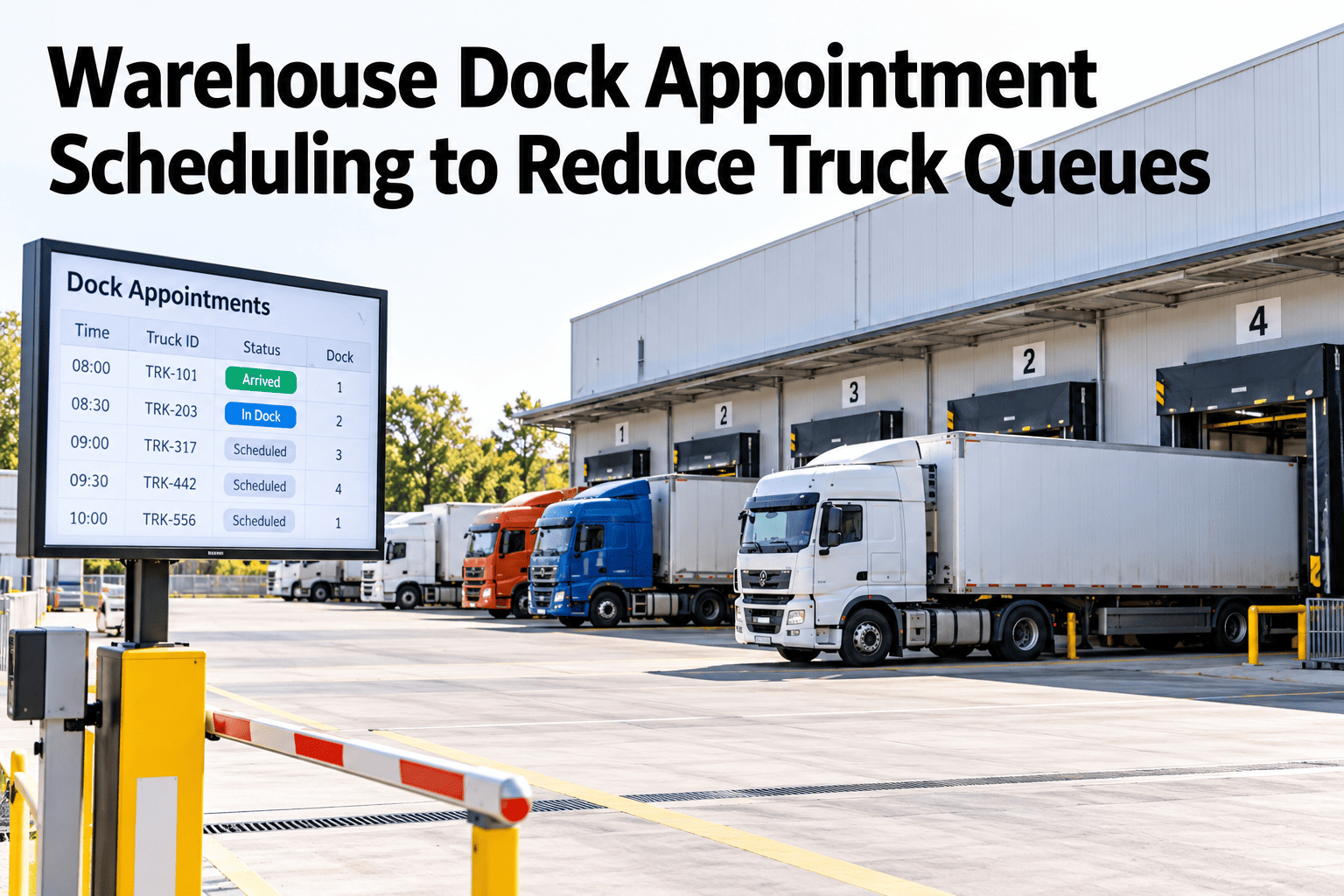
When every truck arrives at the same time, the dock is a car park. Drivers wait, doors sit idle during gaps and the warehouse team swings between rushing and waiting. Appointment scheduling spreads arrivals across the day, matches each slot to the type of load and gives everyone, from the carrier to the yard marshal, the same view of what is coming next. It does not create dock capacity, but it uses the capacity that exists far better. Warehouse and logistics teams that want to test a slot plan on their own doors can talk through a dock appointment plan built around their own doors and shifts in a short session.
Spread the Arrivals, Shorten the Queue
A practical guide to appointment slots, dock capacity and queue visibility, so trucks flow through the doors instead of piling up outside them.
Dock Capacity in One Line
Slot planning starts with how many trucks the doors can really handle. The arithmetic is simple, and the inputs are measured, not assumed.
Slot Length by Load Type
One slot length for every truck wastes time on the quick ones and causes overruns on the slow ones. The table shows illustrative lengths, and yours should come from measured turn times.
| Load Type | Typical Slot | Buffer | Why |
|---|---|---|---|
| Palletised, fork-loaded | 45 to 60 minutes | 10 minutes | Fast, predictable handling |
| Floor-loaded cartons | 2 to 3 hours | 20 minutes | Manual handling and counting |
| Mixed or multi-drop | 90 to 120 minutes | 15 minutes | Sorting and verification |
| Live unload with checks | 60 to 90 minutes | 15 minutes | Quality or temperature checks |
Find Out How Many Trucks Your Doors Can Really Take
Share your door count, hours and a sample of turn times. We will work through slot lengths and capacity with you, and show where a queue forms today.
Carriers Do Not Arrive on the Minute
A schedule has to survive real arrival behaviour. The columns show an illustrative split of arrivals against their slots.
18%
52%
24%
6%
Waiting Time With and Without Appointments
Appointments flatten the morning peak. The columns show illustrative average waiting time across eight periods of the day, and teams can compare their own waiting peaks with a planned schedule in a short walkthrough.
Rules for Late, Early and No-Show Trucks
The schedule is only as good as the rules around it. Written rules stop each shift from inventing its own.
Yard to Dock: Four Steps That Cannot Break
Many delays happen between the gate and the door, not at the door. A clear handoff closes that gap.
What to Ask When Evaluating Scheduling Software
Slot booking is easy to demonstrate and hard to run well. These questions test the hard part.
A Composite Scenario: A Queue That Moved Inside
A distribution centre moved from first-come service to booked slots. The figures below are illustrative.
Expert Review: Appointment Scheduling That Works
Appointments fail when they are not enforced. This review sets out how experienced warehouse leaders judge a scheduling approach.
Frequently Asked Questions
Do appointments work for both inbound and outbound?
Yes, though the rules differ. Inbound trucks follow supplier and carrier schedules, and outbound loads follow dispatch cut-offs and route plans. Many sites plan the two together so the same doors and labour serve both. Our team can talk through a combined plan for your sites.
How do we get carriers to follow slots?
Make booking easy, give them fair slots and apply the rules consistently. Share their on-time performance and agree what happens to repeat late arrivals. Carriers that gain faster turnaround with an appointment usually follow it. Clear communication in the first weeks matters more than penalties.
What if we have a small yard?
Then appointments matter more, because trucks have nowhere to wait. Use shorter, tighter windows and keep open slots near the peak. Queue visibility lets the yard marshal call trucks in early. See a small-yard schedule worked through in a short walkthrough using your own layout.
How do we handle urgent loads?
Reserve a few flex slots and set a clear rule for who may use them. Urgent loads can then be served without breaking the schedule. Record each use, so the number of flex slots can be adjusted. Without that rule, urgent loads quickly become the norm and the schedule loses its value.
Which measures show it is working?
Track average wait time, share of trucks served on time, door utilisation and turn time by load type. Review them weekly at first. Ask for a sample dock scorecard to use in your operations reviews.
Turn the Dock From a Car Park Into a Schedule
Talk through your doors, shifts and carriers with a warehouse operations specialist, and see what a workable appointment plan would look like.