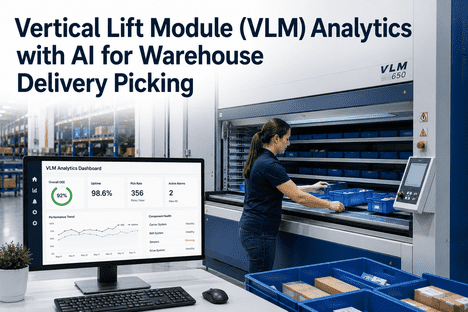
Vertical Lift Module (VLM) analytics with AI for Warehouse Delivery Picking
By Arel Dixon on June 3, 2026
The picking supervisor at a high-volume UK distribution centre watches the VLM operator terminal freeze mid-cycle. A vertical lift module servicing the fast-moving consumer goods pick zone has stopped responding — its carrier retrieval belt has slipped 12mm off track, jamming the extraction mechanism. Behind the frozen terminal, 47 delivery orders are queued. Every minute the VLM is down, eight orders slip past the carrier cut-off window. The maintenance technician arrives 18 minutes later, diagnoses the belt misalignment, and restores the machine — but 144 orders have already missed their dispatch slot, triggering £12,000 in carrier rebooking fees and a 3-hour delay cascade through the outbound sorter. This scenario repeats across warehouses operating VLMs: a single mechanical failure in a high-throughput picking module freezes the entire order queue because the VLM serves as the critical bottleneck between bulk storage and packing. iFactory's AI-driven VLM analytics platform monitors carrier belt tension, extractor motor current, vertical lift chain vibration, and photo-eye registration accuracy in real time — predicting mechanical degradation 48–72 hours before failure and enabling planned intervention during changeover windows instead of mid-shift emergencies. Book a Demo to see how iFactory keeps your VLM picking modules at peak uptime across every shift.
VLM Analytics · AI · Warehouse Picking 2026
Vertical Lift Module Analytics with AI for Warehouse Delivery Picking
Real-time VLM health monitoring · Carrier belt tension & tracking · Extractor motor current analysis · Vertical lift chain vibration · Photo-eye registration accuracy · Predictive alerts 48–72h before failure.
Why VLM Failures Are the Most Expensive Bottleneck in Warehouse Picking
Vertical lift modules form the mechanical heart of high-density automated picking operations. A single VLM can store 500–900 trays or bins and cycle at 60+ picks per hour — meaning one failed module can strand 500–900 SKUs and delay 40–60 delivery orders per hour of downtime. Unlike conveyor systems where product can be rerouted around a failed section, a VLM serves a fixed picking zone with no alternate path. When the VLM stops, the picker stands idle, the order queue freezes, and the downstream pack and ship operations starve for throughput. The dominant failure modes on VLMs — carrier belt degradation, extractor mechanism wear, vertical chain stretch, photo-eye misalignment, and motor drive overload — all develop over measurable degradation windows of 2–7 days before functional failure. iFactory's AI platform transforms these degradation signatures into predictive alerts, giving maintenance teams a 48–72 hour intervention window to schedule belt replacement, chain tension adjustment, or sensor recalibration during planned picking breaks or shift changeovers — eliminating the mid-shift crisis entirely.
Three Critical Failure Modes iFactory Predicts on Warehouse VLMs
01
FAILURE MODE
Carrier Belt & Extractor Mechanism Degradation
The carrier retrieval belt is the single most failure-prone subsystem on any VLM. As the belt ages, it stretches, loses tracking alignment, and develops edge fraying that eventually triggers the belt-tension sensor and stops the module. Traditional maintenance waits for the sensor trip — a reactive response that forces an emergency belt replacement during picking hours. iFactory's VLM analytics platform monitors carrier belt tension via drive motor current signature analysis and belt position via photo-eye registration timing. When the system detects the belt tension trending 8% above baseline or the registration timing drifting by more than 50ms, it generates a predictive alert with the belt part number, estimated remaining cycles, and a recommended replacement window. The extractor mechanism — the fork assembly that slides under trays — is monitored through linear actuator current profiling and position encoder accuracy tracking. Extractor guide rail wear appears as increased current draw and position drift 3–5 days before binding occurs, enabling planned lubrication or rail replacement during scheduled maintenance windows.
Belt tension trendingPhoto-eye registrationExtractor current profiling
02
FAILURE MODE
Vertical Lift Chain & Drive Motor Fatigue
The vertical lift mechanism that raises and lowers carriers between storage levels relies on chains, sprockets, and a drive motor that cycles thousands of times per day. Chain stretch is a known wear pattern that develops gradually over 3–6 months of continuous operation — detectable as increased slack in the chain tensioning system and observable in the lift position accuracy over multiple cycles. iFactory monitors vertical lift health through multiple parameters simultaneously: drive motor current over the full lift cycle profile, chain tension via load cell or motor torque signature, lift position accuracy via encoder vs. demand position comparison, and vibration on the drive sprocket bearings. The AI models learn the normal lift cycle profile for each VLM — acceleration, steady-state travel, deceleration, and settling time — and flag deviations as indicators of chain wear, sprocket tooth fatigue, or motor bearing degradation. A typical prediction horizon of 5–7 days before functional failure gives maintenance teams ample time to schedule chain replacement or tensioning during a planned picking break.
VLMs depend on an array of photo-eyes, proximity sensors, and limit switches to confirm carrier position, tray presence, extractor home position, and safety zone clearance. When a photo-eye drifts out of alignment — due to vibration, thermal expansion, or accumulated dust and debris — the VLM controller receives ambiguous or false signals that cause cycle delays, missed carrier picks, or full safety-stop events. iFactory tracks every sensor event on the VLM: registration timing, signal strength, false-trigger frequency, and the distribution of sensor response times across thousands of cycles. When a photo-eye's registration timing starts showing increased variance — the standard deviation of response time rising above the learned baseline — the platform alerts the maintenance team to clean, realign, or replace the sensor. Since sensor drift typically develops over 7–14 days before causing functional failures, the predictive window is generous for planned intervention. Each photo-eye is tracked individually, so the alert specifies exactly which sensor in which VLM zone requires attention — eliminating the diagnostic scavenger hunt that consumes 40% of emergency VLM repair time.
I/O response monitoring · safety circuit cycle test logging · diagnostic event frequency
Safety system faults cause hard stops requiring engineering override — 30+ minutes per event
Warehouse VLM Use Cases: What iFactory Delivers on the Picking Floor
Carrier Belt
Predictive Carrier Belt Replacement with Parts Pre-Order
Monitoring: Continuous
A 24-VLM warehouse picking zone serving e-commerce, wholesale, and marketplace channels was experiencing 3–4 carrier belt failures per quarter, each causing 45–90 minutes of unplanned downtime and £8,000–£15,000 in carrier rebooking penalties. The belt failures always occurred on the third-shift picking window when order volume peaked. iFactory deployed motor current sensors and photo-eye timing monitors across all 24 VLM carrier belts. Within 30 days, the platform identified 6 belts with tension trending above the degradation threshold — 2 with estimated remaining life of 72 hours. Maintenance replaced those 2 belts during a planned weekend changeover and scheduled the remaining 4 for the following weekend. After the initial intervention, the platform's belt tension models continued to track all 24 belts, generating predicted replacement dates 7–14 days in advance with specific belt part numbers, enabling the parts team to pre-order belts and have them on-site before the scheduled replacement. Unplanned VLM belt failures dropped from 3–4 per quarter to 0 in the subsequent 6 months.
Failures3–4 per quarter → 0 in 6 months
Prediction lead7–14 days with specific belt part number
Vertical Lift Chain Stretch Detection with Tension Scheduling
Monitoring: Continuous
A 16-VLM centre supporting retail replenishment picks was experiencing recurring lift chain stretch across its highest-utilization modules — each operating 18 hours per day, 6 days per week. The maintenance team was manually measuring chain slack every 2 weeks and adjusting tension on a calendar basis, but 2 of the 16 VLMs still experienced unexpected chain-slip events that dropped carriers mid-cycle, locking the module for 4–6 hours while the chain was re-seated and re-tensioned. iFactory's lift cycle profiling detected the early signs of chain stretch in those 2 modules 6 days before the slip events occurred — increased peak motor current on the lift drive, extended settling time at destination levels, and encoder position error rising above the learned baseline. The platform alerted the maintenance team to schedule chain tensioning during the upcoming weekend. Following the predictive intervention, iFactory adjusted the tensioning interval for high-utilization VLMs from calendar-based 2-week intervals to condition-based 600-hour intervals, extending the average chain service life by 40% across the fleet.
Detection6-day advance warning before chain slip event
Chain life40% extension through condition-based tensioning
Photo-Eye Alignment Drift Detection for Zero Unplanned Stops
Monitoring: Continuous
A 32-VLM installation supporting automotive spare parts picking was experiencing 6–8 unexplained VLM stoppages per week attributed to "sensor faults" — each requiring a technician to climb the module, inspect all 40+ photo-eyes, clean or realign the culprit, and restart the machine. Diagnostic time averaged 35 minutes per event, and the root cause — gradual vibration-induced misalignment of specific carrier-present photo-eyes — was never addressed because the failures appeared random. iFactory deployed photo-eye signal strength and response-time monitoring across all 32 VLMs. Within 14 days, the platform identified 12 photo-eyes with signal strength trending below the minimum threshold across 3 specific VLMs located near a high-traffic packing area where floor vibration was highest. The maintenance team realigned all 12 sensors during a single planned 2-hour window, and the weekly unexplained stop rate dropped from 6–8 events to 0. The platform continues to track all 1,280 photo-eyes daily, generating per-sensor alignment trending that enables targeted maintenance on individual sensors rather than blanket inspection cycles.
Unexplained stops6–8 per week → 0 per week
Sensors tracked1,280 photo-eyes across 32 VLMs
What iFactory Delivers for VLM-Centric Warehouse Operations
89%
Reduction in VLM-related picking downtime across monitored modules
48–72hr predictive alerts with condition-based maintenance scheduling
6.2×
ROI from avoided carrier rebooking fees and lost pick capacity
Each VLM failure avoided saves £8K–£15K in direct and cascading costs
12
Critical subsystems monitored per VLM — full machine coverage
Platform deployment with pre-built VLM monitoring templates
VLM templates for all major OEMs — automated configuration per VLM make and model
FAQ: VLM Analytics with AI for Warehouse Delivery Picking
iFactory is designed to work with the sensors already embedded in your VLM or with minimal additional hardware. The platform integrates directly with VLM PLC controllers via Modbus TCP, OPC-UA, or REST API to extract drive motor current, encoder position, photo-eye status, and cycle event logs. For VLMs without networked PLC access, iFactory's wireless sensor kit adds motor current clamps (CTs), vibration MEMS sensors on lift drive bearings, and wireless photo-eye signal strength sensors — all installed in under 2 hours per module. The platform also supports manual walk-around data entry via the Shift Logbook mobile app for operators to record visual observations. Pre-built VLM templates cover all major OEMs including Kardex Remstar, SSI Schaefer, Modula, Ferretto Group, Hänel, and Vidmar — with automated configuration of sensor mapping, failure mode libraries, and alert thresholds per VLM make and model.
The AI models use a multi-parameter classification approach that distinguishes between normal operational variation and genuine degradation. For carrier belts, the platform tracks three independent indicators: motor current at peak extraction load, belt registration photo-eye timing variance, and accumulated cycle count. A belt that shows elevated current but stable registration timing is classified as "monitor" — likely a load variation rather than degradation. A belt showing elevated current AND increasing registration timing variance is classified as "planned intervention" — the belt is stretching and alignment is drifting. The same logic applies to lift chains: drive motor current profile shape is analysed alongside encoder position error and chain tension sensor data. The classification thresholds are calibrated during the first 30 days of deployment as the model learns each VLM's normal operating envelope. False alert rates on VLM installations average under 3% after the initial calibration period.
iFactory's VLM analytics platform delivers positive ROI starting at 8–12 VLMs in a single picking zone. For smaller installations, the platform can be deployed as a shared resource across multiple warehouse functions — VLM monitoring, conveyor monitoring, dock equipment tracking, and racking inspection management — all managed from a single iFactory instance. The VLM-specific return comes primarily from avoiding carrier rebooking penalties and lost pick capacity, which scale with the number of modules and the pick volume per module. A typical 12-VLM installation with 60 picks per hour per module generates approximately £180,000–£300,000 in annual downtime risk, against which iFactory's 89% downtime reduction delivers a clear ROI within the first 3 months. For facilities with fewer than 8 VLMs, iFactory recommends the combined warehouse analytics deployment that covers all automated equipment types.
Yes. iFactory integrates bi-directionally with leading WMS platforms and warehouse control systems via REST API, message queue, or database connector. When the AI platform predicts a VLM fault, it can send a capacity advisory to the WMS for the affected picking zone — enabling the WMS to dynamically redirect orders to alternate pick modules or zones before the failure occurs. The platform also integrates with CMMS platforms for auto-creation of work orders with VLM-specific parts lists and estimated repair times. Standard integrations cover Manhattan Associates, SAP EWM, Blue Yonder, Oracle WMS, Körber, HighJump, and 20+ other platforms. For facilities with proprietary WCS platforms, iFactory provides a standard API that maps VLM status codes, health classifications, and predicted failure events to the WCS messaging protocol.
iFactory deploys in 1–2 weeks against pre-built VLM templates that cover all major OEMs. The full programme — sensor deployment (if needed), platform configuration, VLM baseline learning, and team training — runs 8–12 weeks end-to-end for up to 32 VLMs. Most warehouse operations achieve positive ROI within 90 days of go-live, driven by avoided carrier rebooking fees, reduced emergency maintenance labour (typically 3–5× planned maintenance cost), elimination of unexplained sensor-fault diagnostic time (35+ minutes per event), and extended VLM component life through condition-based rather than calendar-based replacement. Typical annual savings for a 24-VLM installation range from £180,000 to £420,000 depending on pick volume, delivery order value, and current failure frequency. The programme includes 90-day implementation support from a dedicated warehouse automation specialist.
Deploy AI-Driven VLM Analytics for Your Warehouse Picking Operations
iFactory AI monitors every critical subsystem on your vertical lift modules — carrier belts, extractor forks, lift chains, drive motors, photo-eye arrays, and safety systems — with predictive alerts 48–72 hours before failure. Pre-built VLM templates for all major OEMs. 1–2 week deployment with 90-day implementation support. Positive ROI within 90 days.