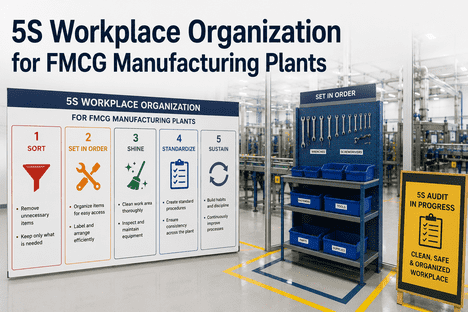
The 5S workplace organization methodology — Sort, Set in Order, Shine, Standardize, Sustain — originated in Japanese manufacturing and has been a cornerstone of lean production systems for over four decades. For FMCG manufacturers operating high-speed packaging lines, food-grade processing environments, and multi-shift production schedules, 5S is not merely a housekeeping program — it is the foundational layer upon which food safety compliance, operational efficiency, and workforce engagement are built. A frozen food plant in the Midwest United States producing 180,000 tonnes of packaged meals annually implemented a digital 5S program across 12 production lines using iFactory AI's inspection management and audit tracking platform, achieving a 94% 5S audit score, 28% reduction in changeover time, 33% decrease in food safety non-conformances, and $1.6M in annual operational savings with full program ROI achieved within six months. This case study documents the 5S methodology adapted for FMCG production environments, the digital audit framework that sustains the program, and the measurable outcomes that result from systematic workplace organization.
5S WORKPLACE ORGANIZATION FOR FMCG
Implement Digital 5S Across Your FMCG Production Lines with AI-Powered Audit Tracking.
iFactory delivers a digital 5S platform purpose-built for FMCG manufacturing: sort verification, shadow boards, shine schedules, standardized audits, and sustain analytics with food safety integration.
5S audit score achieved across 12 production lines
iFactory digital audit tracking
Reduction in product changeover time
Standardized tool shadow boards
Reduction in food safety non-conformances
Integrated 5S and FSMA compliance
Time to full program ROI
Digital 5S implementation ROI
THE FIVE S PILLARS
Sort, Set in Order, Shine, Standardize, Sustain: 5S Adapted for FMCG Production
Each of the five pillars of 5S addresses a specific dimension of workplace organization, and each must be adapted to the realities of food-grade and beverage-grade FMCG production — where sanitation requirements, allergen control, food contact surfaces, and regulatory compliance impose constraints that do not exist in general manufacturing environments. The iFactory digital platform supports each pillar with inspection checklists, photo documentation, real-time scoring, and trend analytics that transform 5S from a manual paper-based exercise into a data-driven continuous improvement program. Book a Demo to see iFactory's digital 5S platform configured for your FMCG plant's production areas and food safety requirements.
1. Sort — Seiri
Remove all items from work areas that are not needed for current production operations. In FMCG environments, this includes obsolete packaging materials, unused change parts, expired ingredient samples, redundant tools, and non-essential equipment. Digital sort verification uses photo-based checklists with area-specific red-tag workflows for items identified for removal, relocation, or disposal.
Photo documentation · Red-tag workflow · Area-specific checklists
▼
2. Set in Order — Seiton
Organize tools, equipment, and materials so they are instantly accessible and clearly identified. For FMCG lines, this means shadow boards for change parts and tools, labelled storage locations for packaging materials, colour-coded cleaning equipment by zone, and visual indicators for consumable inventory levels. iFactory's digital shadow board templates define exact tool locations with photo references.
Shadow board templates · Location labelling · Colour coding by allergen zone
▼
3. Shine — Seiso
Clean and inspect work areas thoroughly. In FMCG production, shine is inseparable from sanitation — cleaning food contact surfaces, removing product residue, inspecting equipment for wear and damage during cleaning, and documenting that cleaning meets FSMA Preventive Controls standards. iFactory connects shine inspection checklists to sanitation standard operating procedures with automated photo verification.
SSOP integration · Photo verification · Equipment inspection during cleaning
▼
4. Standardize — Seiketsu
Create consistent standards for how the first three S's are performed, documented, and audited. Standardized work instructions define exactly how each area should look after sort, set in order, and shine. iFactory's digital standard library stores area-specific 5S standards with photo reference images, clear visual criteria, and links to relevant SOPs and SSOPs.
Visual standard library · Digital SOP links · Area-specific criteria
▼
5. Sustain — Shitsuke
Maintain and continuously improve the 5S program through regular audits, performance tracking, and management review. Digital sustain analytics track audit scores by area, by shift, and by team over time — identifying trends that indicate program degradation before scores drop below acceptable thresholds. Automated audit scheduling and escalation ensures no area goes unchecked.
Automated audit scheduling · Trend analytics · Performance dashboards
FMCG PRODUCTION ZONES
5S Application Across Seven FMCG Production Zones
Each zone in an FMCG plant has distinct 5S requirements driven by food safety risk classification, equipment type, material flow, and regulatory compliance obligations. The digital 5S platform adapts audit criteria, checklists, and standards to each zone's specific requirements while maintaining consistent scoring and reporting across all areas.
R
Raw Material Receiving
Ingredient staging areas, pallet storage, quarantine zones, packaging material receiving, inspection hold areas
FIFO verification, allergen segregation, temperature-controlled storage organization, pallet condition inspection
P
Processing & Mixing
Blending vessels, ingredient addition stations, heat exchangers, homogenizers, transfer pumps, in-line sensors
Tool shadow boards, ingredient staging, cleaning tool organization, spill response kit location, line clearance verification
F
Filling & Packaging
Fillers, cappers, labelers, date coders, film wrappers, cartoners, case packers, palletizers
Change part organization, packaging material staging, reject bin management, lubrication station organization, waste bin labelling
C
CIP & Sanitation
CIP skids, chemical storage, hose stations, cleaning tool storage, sanitation equipment, waste collection points
Chemical segregation by zone, hose management, colour-coded cleaning tools, sanitation log organization, PPE staging
W
Warehouse & Storage
Finished goods storage, cold storage, dry ingredient storage, pallet racks, staging lanes, loading docks
Aisle marking, rack labelling, FIFO lane organization, spill containment equipment, dock leveler organization, inventory zone marking
M
Maintenance Workshops
Tool cribs, parts storage, workbenches, calibration equipment, welding stations, lubricant storage, maintenance carts
Tool inventory system, shadow board management, spare parts organization, calibration tool staging, work-in-progress area marking
L
Labs & Quality
Quality control lab, microbiological testing area, retained sample storage, chemical reagent storage, documentation station
Sample organization by date, chemical inventory by hazard class, equipment calibration status board, document control station, waste segregation
DIGITAL 5S IN PRACTICE
How FMCG Plants Achieve and Sustain 5S Excellence with Digital Audit Platforms
The following facilities represent operational examples of FMCG plants that have implemented digital 5S programs using iFactory's platform — achieving measurable improvements in audit scores, changeover efficiency, food safety compliance, and overall equipment effectiveness.
Frozen Food Plant
Midwest US — 180,000 tonnes annual capacity
12 Lines
Coverage
12 production lines, 24 production zones, 7 warehouse areas, 4 maintenance workshops — 47 total audit areas
Implementation
Digital 5S standards library with 168 area-specific checklists. Automated weekly audit scheduling with photo-documented findings. Real-time score dashboards at zone, line, and plant level. Integration with shift handover for corrective action tracking.
Outcome
94% average audit score within 4 months. 28% reduction in changeover time through standardized tool shadow boards. 33% reduction in food safety non-conformances. $1.6M annual savings from reduced waste, improved changeover efficiency, and food safety risk reduction.
Beverage Production Plant
Southeast US — 240 million litres annual capacity
8 Lines
Coverage
8 high-speed filling lines, 2 syrup rooms, 3 warehouse areas, packaging material staging, CIP systems, maintenance shop
Implementation
Digital 5S with integrated SSOP checklists. Colour-coded zone marking by allergen category. Shadow board deployment for 32 filler change part sets. Automated shine inspection with photo evidence. Sustain analytics with departmental scorecards.
Outcome
91% average audit score. 22% reduction in filler changeover time. 41% reduction in foreign object contamination incidents. 18% improvement in OEE from reduced downtime during changeovers. Full ROI in 5 months.
Dairy Processing Plant
Northeast US — 120 million litres annual capacity
6 Lines
Coverage
6 filling lines, 3 pasteurization areas, CIP system, cold storage, ingredient receiving, lab, maintenance workshop
Implementation
Zone-based 5S standards with USDA dairy compliance integration. Temperature-controlled area checklists. Colour-coded cleaning tool organization by pathogen risk zone. Digital shadow boards for CIP parts. Quarterly 5S kaizen events tracked in platform.
Outcome
96% audit score on third quarter. 31% reduction in product changeover time. 27% reduction in sanitation chemical usage through standardized shine procedures. Zero regulatory non-conformances in two consecutive USDA inspections.
Snack Food Plant
Southwest US — 85,000 tonnes annual capacity
10 Lines
Coverage
10 packaging lines, 3 fryer/finishing areas, seasoning application zones, bulk ingredient storage, packaging warehouse, maintenance
Implementation
Allergen-segregated 5S zones with colour-coded tools and cleaning equipment. Seasoning room organization with allergen cross-contact prevention. Shadow boards for packaging format change parts. Digital sustain analytics with shift-by-shift score tracking.
Outcome
89% initial score improving to 93% by month 6. 35% reduction in packaging changeover time. 44% reduction in customer complaints related to foreign material. $1.2M annual savings from waste reduction and changeover efficiency.
TRANSFORM YOUR FMCG PLANT'S WORKPLACE ORGANIZATION
Your FMCG Plant Can Achieve 90%+ 5S Audit Scores in 90 Days with a Digital 5S Platform.
iFactory's digital 5S platform includes pre-configured standards libraries for FMCG production zones, automated audit scheduling, photo-documented findings, real-time score dashboards, and integrated corrective action tracking. Purpose-built for food-grade and beverage-grade environments.
DIGITAL 5S TECHNOLOGY STACK
How iFactory's Platform Powers a Complete 5S Program Across Your FMCG Plant
The iFactory platform connects the five pillars of 5S with the digital tools that make workplace organization measurable, sustainable, and continuously improving. Each component serves a specific function within the 5S framework while contributing to the overall audit and compliance data ecosystem.
S
5S Standards Library
Pre-configured standards for 7 FMCG zones
168 area-specific checklists with photo references
Visual standard images for each production area
Links to relevant SOPs and SSOPs
A
Audit Scheduling & Execution
Automated weekly audit assignments by area
Mobile-first audit interface with photo capture
Real-time scoring with pass/fail and severity
Escalation workflow for failed audit items
H
Shadow Board Templates
Pre-designed shadow board layouts by equipment type
Photo reference for correct tool placement
Tool inventory tracking with missing tool alerts
Change part set organization by product format
iFactory 5S Platform Core
Area-specific 5S standards
Photo-documented audits
Real-time score dashboards
Corrective action tracking
Shift-to-shift handover integration
Trend analytics and reporting
C
Corrective Action Management
Auto-generated corrective actions from failed audits
Root cause analysis with 5-Why methodology
Task assignment with due dates and photo verification
Escalation for overdue corrective actions
D
Sustain Analytics & Dashboards
Audit score trends by area, shift, and team
Changeover time correlation with 5S scores
Food safety incident correlation analysis
Departmental scorecards with KPI targets
K
Kaizen Event Management
5S kaizen event planning and tracking
Pre- and post-event score comparison
Photo-documented before/after evidence
Best practice library for cross-plant sharing
FREQUENTLY ASKED QUESTIONS
What FMCG Plant Managers Ask About Digital 5S Implementation
How does 5S differ for FMCG food-grade environments compared to general manufacturing?▼
FMCG food-grade environments add food safety, allergen control, and sanitation requirements that do not exist in general manufacturing. Tools and equipment must be made of food-grade materials, cleaning procedures must follow SSOPs validated for pathogen control, and organization must account for allergen segregation zones. Colour-coded tools by zone (raw, RTE, allergen) prevent cross-contact. Shadow boards must be designed for sanitation — no hollow handles, no crevices where product can accumulate. iFactory's 5S standards library includes food-grade specific criteria for each FMCG production zone, with checklists that reference FSMA Preventive Controls and applicable FDA 21 CFR requirements.
How long does it take to implement a digital 5S program in an existing FMCG plant?▼
A full digital 5S implementation across a single-site FMCG plant with 10-15 production lines typically runs 8 to 12 weeks. The implementation includes zone-by-zone 5S standard development with photo references, shadow board design and deployment, audit checklist configuration, team training, and initial baseline audits. The first 4 weeks focus on Sort and Set in Order in one pilot area to demonstrate the methodology and refine digital checklists. Weeks 5 through 8 expand to all production zones with full audit deployment. The final 4 weeks focus on standardizing the program and establishing the sustain analytics cadence with weekly management reviews.
How does digital 5S integrate with existing food safety and quality management systems?▼
iFactory's platform integrates 5S audit data with the plant's existing food safety and quality management systems. Audit findings that relate to food safety risks are automatically flagged and routed to the HACCP/FSMA corrective action workflow. 5S audit scores are correlated with food safety incident data to identify areas where workplace organization degradation precedes food safety events. The platform supports integration with SQF, BRC, FSSC 22000, and other GFSI-benchmarked food safety standards, enabling 5S audit evidence to be included in certification and customer audit documentation. Photo-documented standards and audit results provide objective evidence for regulatory inspections by FDA, USDA, and state food safety authorities.
What is the typical ROI for a digital 5S program at an FMCG plant?▼
ROI materializes across four categories. Changeover efficiency: standardized shadow boards and organized change parts reduce changeover time by 20-35%, recovering 100-300 production hours annually per line. Waste reduction: organized ingredient staging and material management reduces product waste and packaging damage by 15-25%. Food safety risk reduction: systematic shine procedures and organized sanitation equipment reduce food safety non-conformances by 25-45%, avoiding potential recall costs ranging from $1 million to $10 million. Maintenance efficiency: organized tooling and spare parts reduce maintenance technician travel and search time by 15-25%. For a mid-size FMCG plant with 8-12 production lines, annual savings typically range from $1.2 million to $2.5 million against a platform investment of $40,000 to $80,000, yielding a 15-30x return.
How does the platform sustain 5S performance after the initial implementation?▼
Program sustainment is achieved through automated audit scheduling, real-time score dashboards, and corrective action escalation. Weekly audits are auto-assigned to designated area owners with mobile checklists that include photo capture for objective evidence. Scores are displayed on real-time dashboards visible at zone, line, department, and plant levels. Any audit finding scoring below the acceptable threshold automatically generates a corrective action assigned to the area supervisor with a due date. If the corrective action is not completed within the defined timeline, it escalates to the plant manager. Monthly 5S performance reviews use trend data from the platform to identify areas requiring management attention before scores degrade below acceptable levels. The platform also tracks individual auditor consistency to ensure scoring reliability across shifts and teams.
DIGITAL 5S FOR FMCG MANUFACTURING
Leading FMCG Plants Achieve 90%+ 5S Audit Scores with Digital Workplace Organization Platforms. Is Yours Next?
iFactory's digital 5S platform transforms workplace organization from a paper-based exercise into a data-driven continuous improvement program. Pre-configured standards for FMCG production zones, automated audit scheduling, photo-documented findings, and sustain analytics that keep your plant organized shift after shift.