The quality control manager at a frozen pizza plant in Pennsylvania reviews the monthly production report and sees a number that demands action: 4.7% of every mozzarella batch lost to yield variation. Not because the recipe was wrong, but because the recipe was static. The formulation assumed constant incoming moisture content, consistent protein-to-fat ratios in the cheese, and uniform oven conditions across all six lines. None of those assumptions held in practice. Moisture in the flour shipments varied 1.2% between suppliers and 0.6% between deliveries from the same supplier. Cheese protein content shifted seasonally as dairy herds changed feed. Oven zone temperatures drifted differently on each line depending on maintenance state and ambient conditions. The result: operators manually adjusted ingredient ratios and process parameters shift by shift based on experience and intuition, producing inconsistent product and significant waste. After deploying iFactory AI-driven recipe optimization, that facility reduced ingredient waste by 61%, cut batch-to-batch quality variation by 74%, and improved first-pass yield from 93.8% to 98.2% — all while using the same raw materials, the same equipment, and the same operators. Book a Demo to see how iFactory connects AI recipe optimization to your production data for measurable results.
From Static Recipes to Adaptive Formulations — AI Recipe Optimization for Food Production Efficiency
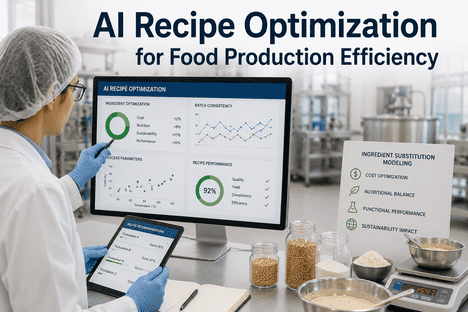
Static recipes assume constant conditions that never exist in real production. Raw material properties vary by supplier, season, and lot. Equipment performance degrades between maintenance cycles. AI recipe optimization transforms fixed formulations into adaptive systems that respond to actual conditions — producing consistent quality from inconsistent inputs.
AI Recipe Optimization Across Every Production Stage
AI recipe optimization delivers measurable impact across all major food production processes — from mixing and blending to thermal processing, extrusion, frying, coating, and fermentation. The table below presents the key variables AI optimizes for each process type, the equipment dependencies that influence performance, and the typical yield gains achievable through adaptive recipe control.
| Process Type | Key Variables AI Optimizes | Equipment Dependencies | Typical Yield Gain |
|---|---|---|---|
| Mixing and Blending | Ingredient ratios, mixing time, speed profile, addition sequence | Mixer blade wear, motor torque curves, vessel cleanliness | 2–5% yield improvement |
| Baking and Thermal Processing | Zone temperatures, belt speed, humidity, bake time per zone | Burner efficiency, heat exchanger fouling, conveyor speed accuracy | 3–6% waste reduction |
| Extrusion | Barrel temperatures, screw speed, moisture injection, die pressure | Screw wear profile, barrel liner condition, die plate erosion | 4–8% yield improvement |
| Frying | Oil temperature, residence time, oil turnover rate, breading adhesion | Fryer heat exchanger condition, oil filtration effectiveness, conveyor calibration | 2–4% oil reduction |
| Coating and Enrobing | Coating viscosity, application temperature, curtain height, air knife settings | Pump wear, nozzle condition, temperature controller accuracy | 5–10% coating savings |
| Fermentation | Temperature profile, pH targets, culture dosing, timing | Jacket heat transfer, agitator condition, probe calibration | 3–7% consistency improvement |
The Four-Step Process for AI-Driven Recipe Optimization
iFactory's AI recipe optimization platform follows a systematic workflow — from data ingestion through continuous learning — ensuring that every formulation adjustment is grounded in real production data and material science.
Data Ingestion
Connect to existing PLC, SCADA, CMMS, and lab systems. Incoming material properties, process parameters, equipment health data, and quality measurements feed the AI engine in real time.
Baseline Modeling
The AI observes production variability across 4–6 weeks, building accurate models that distinguish between ingredient-driven variation and equipment-driven variation — a distinction most static recipe systems cannot make.
Adaptive Optimization
Models adjust ingredient ratios, process parameters, and timing in real time based on actual material properties, equipment condition, and target quality specifications — producing consistent output from inconsistent inputs.
Continuous Learning
Quality and yield results feed back into the model, improving prediction accuracy. When equipment drift is detected, the system adjusts parameters short-term and generates maintenance work orders to resolve root causes.
Measurable Impact — What Food Plants Achieve with AI Recipe Optimization
Food manufacturers deploying iFactory's AI recipe optimization consistently report measurable improvements across yield, waste, quality, and financial metrics. The results below represent the range observed across mixing, baking, extrusion, frying, coating, and fermentation processes at mid-size to large food production facilities.
Conventional Recipe Management vs AI-Driven Adaptive Optimization
The financial and quality impact of AI recipe optimization becomes clear when the cost structure and performance metrics of conventional static recipe management are compared side by side with AI-driven adaptive formulation control. The comparison below presents the per-batch cost breakdown and quality outcomes for a mid-size food production facility running 2,000 batches per year.
Conventional — Static Recipes
- Ingredient cost: $4,200 per batch at nominal formulation
- Waste and rework: $380 per batch (4.7% average material loss)
- Quality reject rate: 6.2% of batches require reprocessing or disposal
- Operator adjustment time: 45 minutes per shift for manual recipe tuning
- First-pass yield: 93.8%
- Annual material loss: $912,000 at 2,000 batches per year
Optimized — AI Adaptive Recipes
- Ingredient cost: $3,800 per batch (dynamic adjustment reduces overuse)
- Waste and rework: $148 per batch (61% reduction in material loss)
- Quality reject rate: 1.8% of batches require reprocessing
- Operator adjustment time: 10 minutes per shift (AI recommends parameters)
- First-pass yield: 98.2%
- Annual material loss: $296,000 (savings of $616,000 per year)
AI Recipe Optimization Readiness — What Your Plant Needs to Get Started
Implementing AI-driven recipe optimization requires preparation across five areas — data infrastructure, material characterization, equipment connectivity, quality measurement, and team readiness. The checklist below covers the essential elements that iFactory's implementation team reviews during deployment at each food production facility.
Incoming material characterization data
Moisture, protein, fat, viscosity, or other properties relevant to your products. Most plants already collect this data at receiving — the AI platform integrates existing sources rather than requiring new instrumentation.
Process parameter logs from PLC or SCADA systems
Temperatures, times, speeds, pressures, and other process variables currently recorded by your control systems. iFactory connects directly to existing data infrastructure without displacing your primary control system.
Output quality measurements
Yield data, lab results, reject rates, and sensory scores that define product quality. The AI correlates these outcomes with input variables to build accurate prediction and optimization models.
Equipment condition data from CMMS
Equipment health data explains variation that ingredient and process data alone cannot account for. AI models that incorporate equipment condition achieve 40–60% better prediction accuracy than ingredient-only models.
Team training and change management
Operators, quality lab staff, and maintenance teams receive training on the AI platform's workflow — from data entry and model interpretation to executing optimization recommendations and verifying outcomes.
Real-time monitoring dashboard deployment
iFactory configures production dashboards displaying yield, waste, quality variation, and equipment condition metrics — with automated alerts when parameters drift outside control limits.
What Food Production Managers Say About AI Recipe Optimization
I have managed production at three food processing plants over fourteen years — two in the Midwest and one in the Southeast — and the single most persistent challenge I have seen is the assumption that a recipe, once developed, will perform the same way batch after batch, shift after shift, season after season. It will not. Raw materials vary. Equipment wears. Ambient conditions change. At my second plant, we were running a snack food extrusion line where the moisture content of the incoming corn meal varied by 1.8% between summer and winter deliveries from the same supplier. The recipe never changed. The operators compensated by adjusting screw speed and barrel temperature based on feel — sometimes getting it right, sometimes not, and the first-pass yield oscillated between 89% and 94%. When we deployed iFactory's recipe optimization module, the AI learned the correlation between incoming moisture and optimal barrel temperature within two weeks. Within six weeks, the first-pass yield had stabilized at 97.3% and has stayed within a ±0.5% range for the following nine months. The recipe did not change. What changed was the feedback loop between material characterization, process parameter adjustment, and quality measurement — a loop that was happening in the operators' heads, shift by shift, replaced by a system that makes data-informed recommendations every minute of every batch.
— Production Manager, Food Processing — 14 Years Production Management — IFT Member — Six Sigma Black BeltCommon Questions About AI Recipe Optimization in Food Production
Adaptive Recipes Are the Fastest Path to Consistent Quality and Lower Cost — If You Have the Data to Sustain Them
Every food production facility in the United States operates with raw material variability, equipment degradation, and changing environmental conditions. These are not anomalies — they are the normal operating conditions of food manufacturing. The barrier to consistent quality and lower cost is not the absence of good recipes. It is the gap between the data that characterizes what is entering the process and the control system that determines how the process runs. The plant that closes that gap — with an AI platform that moves material characterization data from receiving inspection to the recipe model to the process parameter setpoint in minutes instead of shifts — can sustain a 61% reduction in ingredient waste, a 74% reduction in quality variation, and a 4.4-percentage-point improvement in first-pass yield. These are not theoretical targets. They are the results that food production managers achieve when they replace static formulations with adaptive systems that respond to actual conditions.
iFactory AI's Recipe Optimization module provides food production managers with the digital infrastructure to characterize every incoming material, model every formulation adjustment, control every process parameter, and track every quality metric — replacing the shift-by-shift operator adjustment approach with a closed-loop optimization system that delivers sustained results from day one of deployment. Book a Demo to see how iFactory's platform manages material characterization, recipe optimization, process parameter control, and quality tracking for your food production lines.
Every Percentage Point of Waste Reduction Is Real Money and Real Quality Improvement
Your production data already contains the signals. iFactory connects them — turning material variability, equipment condition, and quality measurements into sustained recipe optimization that saves $800K to $2.1M per year. Book a demo and see the system running on a food production network today.