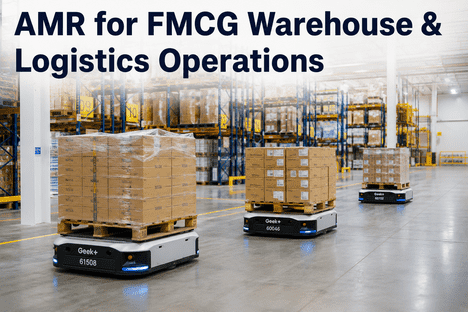
p>A regional FMCG distribution center handling 1,200+ SKUs across a 320,000-square-foot facility faced a warehouse logistics crisis driven by manual material transport: 23 workers on powered industrial trucks moving pallets and cases across an average of 1.8 miles per shift, with pick-and-place cycle times averaging 14 minutes per order line and labor turnover exceeding 45% annually in the material handling team. After deploying a mixed fleet of 18 autonomous mobile robots configured for pallet transport, case picking, and return handling — managed through iFactory's Robotics AI fleet orchestration platform — the facility reduced material transport labor costs by 62%, cut average order cycle time from 14 minutes to 4.3 minutes, and achieved a 22-month fleet ROI driven by labor savings and throughput gains. Book a Demo to see how iFactory Robotics AI orchestrates AMR fleets in FMCG warehouse environments.
Robotics & Automation · FMCG Logistics 2026
Autonomous Mobile Robots for FMCG Warehouse & Logistics Operations
AMR fleet orchestration · Autonomous case picking and pallet transport · Real-time inventory integration · Uptime analytics and predictive maintenance · All powered by iFactory Robotics AI.
62% labor cost reduction · 4.3-min cycle times · 22-month ROI
⟐
iFactory Integration
WMS · CMMS · Shift Logbook · AI Analytics
Why FMCG Warehouse Logistics Is Ripe for AMR Deployment
FMCG distribution centers operate under punishing throughput requirements: high case volumes, short order-to-delivery windows, seasonal demand surges, and razor-thin margins that leave no room for inefficient material flow. Despite decades of warehouse management system optimization, the physical movement of goods within the four walls — pallet transport from receiving to storage, case picking from storage to staging, empty pallet and return handling — remains predominantly manual, labor-intensive, and structurally inefficient.
The material handling workforce in FMCG DCs faces chronic challenges: physically demanding work, repetitive motion injuries, shift work attrition, and competition from last-mile delivery and construction for the same labor pool. Turnover rates of 40–60% are common, with every departing worker representing $4,000–$8,000 in recruiting, onboarding, and productivity ramp costs. Meanwhile, manual pallet transport via sit-down counterbalance trucks and walkie riders achieves average travel speeds of 4–6 mph with operator breaks, shift changes, and congestion-related idle time reducing effective throughput to 55–65% of theoretical capacity.
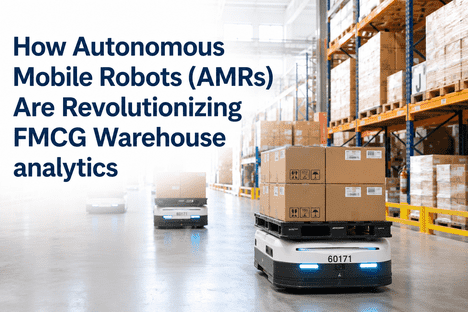
Autonomous mobile robots address these structural challenges by automating the material transport layer of warehouse operations. Unlike automated guided vehicles that require fixed magnetic tape or wire guidance paths, AMRs navigate dynamically using LiDAR, vision cameras, and on-board mapping — adapting to changing warehouse layouts, avoiding obstacles, and rerouting in real time. When orchestrated through a unified fleet management platform like iFactory Robotics AI, AMR fleets can handle pallet transport, case picking, return handling, and trash removal while maintaining real-time inventory visibility and feeding operational data back into the CMMS and shift logbook systems for continuous improvement. To explore how iFactory Robotics AI configures AMR fleets for FMCG DCs, Book a Demo with iFactory's warehouse automation team.
AMR ENABLERS IN FMCG WAREHOUSE LOGISTICS
1
Dynamic navigation — LiDAR and vision-based routing eliminates fixed infrastructure; AMRs adapt to layout changes and obstacles in real time
2
Fleet orchestration — centralized AI assigns tasks, optimizes routes, balances battery charging, and manages traffic across 10+ AMRs simultaneously
3
WMS integration — real-time inventory synchronization with WMS ensures AMRs pick the correct locations and update stock positions on every move
4
Continuous operation — opportunity charging and hot-swap batteries enable 20+ hours of daily operation across the fleet with zero manual intervention
Three AMR Deployment Models for FMCG Distribution Centers
01
Pallet Transport AMRs: Full-Pallet Movement From Receiving to Storage to Staging
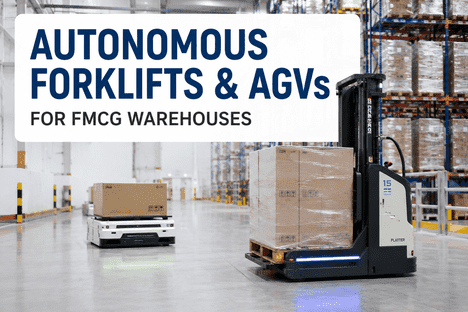
Pallet transport is the highest-volume material handling task in FMCG distribution, accounting for 40–55% of total material movement labor hours. Conventional sit-down counterbalance trucks and walkie riders move pallets from receiving docks to reserve storage, from storage to pick-face replenishment, and from pick faces to outbound staging. Each move requires a licensed operator, consumes fuel or battery charge, and adds labor cost per pallet move of $0.85–$1.40. Pallet transport AMRs — equipped with fork attachments, roller beds, or tow hitches — automate these moves by receiving transport requests directly from the WMS, navigating to the pick-up location, collecting the pallet, and delivering it to the destination without human intervention. iFactory Robotics AI integrates with major WMS platforms (SAP EWM, Manhattan, Blue Yonder, Oracle WMS) to receive transport orders, confirm delivery, and update inventory positions in real time. A fleet of 8 pallet transport AMRs typically replaces 12–15 manual forklift operators across a three-shift schedule, delivering 60–70% labor cost reduction on pallet moves with payback periods of 18–24 months.
WMS integration24/7 operation18–24 month payback
02
Case Pick AMRs: Goods-to-Person Automation for High-Volume Order Fulfillment
Case picking — selecting individual cases from pallet or flow-rack locations to build outbound orders — is the most labor-intensive activity in FMCG DCs, consuming 30–45% of total warehouse labor hours. Conventional pickers walk an average of 8–12 miles per shift, pulling cases onto pallet jacks or conveyor induction belts. Case pick AMRs transport pick carts or totes to pick zones, follow pickers through the aisle (pick-to-cart collaboration), or transport completed pallets from pick zones to stretch wrapping and outbound staging. In goods-to-person configurations, AMRs deliver pallets or cartons from reserve storage to dedicated pick stations where operators pick without walking — effectively eliminating travel time from the pick cycle. iFactory Robotics AI optimizes pick AMR task assignment based on order batching, pick-face location, and AMR battery state, achieving 3.2× pick productivity improvements in goods-to-person configurations and 1.8× improvements in collaborative pick-to-cart models.
Return and Empty Handling AMRs: Automating the Low-Value, High-Labor Material Flows
Return handling, empty pallet removal, and trash/dunnage removal collectively account for 12–18% of material handling labor hours but generate minimal throughput value. Empty pallets accumulate at pick faces, stretch wrappers, and outbound doors, requiring dedicated workers with pallet jacks to collect and stage them. Returned goods from retail customers must be transported from receiving to inspection to disposition. Cardboard, plastic wrap, and other dunnage must be removed from pick zones. These low-complexity, repetitive material flows are ideal candidates for AMR automation because the routes are predictable, the loads are standardized, and the labor savings are direct. iFactory Robotics AI configures dedicated AMR workflows for empty pallet collection — using LiDAR to detect pallet stacks and automatically transport them to the pallet storage area — and for return handling, where AMRs transport return pallets from dock to quality inspection to put-away or disposal. These AMRs typically operate in the background of the DC, autonomously clearing material bottlenecks that would otherwise require dedicated workers with powered industrial trucks.
Fully autonomous routingZero dedicated operatorsPayback under 14 months
Manual vs AMR-Enabled FMCG Warehouse Operations
Operational Metric
Manual Forklift Operation
iFactory AMR Fleet
Improvement
Pallet transport cost per move
$0.85–$1.40 per pallet
$0.28–$0.45 per pallet
60–68% cost reduction
Average order cycle time
14 minutes per line
4.3 minutes per line
69% faster cycle time
Worker miles walked per shift
8–12 miles per picker
0.2 miles (goods-to-person)
98% travel elimination
Labor turnover impact
45–60% annual turnover
12–18% turnover (retained)
Lower attrition in skilled roles
Fleet utilization
55–65% effective (breaks, shifts)
88–94% effective (opportunity charging)
29–33 point utilization gain
Peak season scalability
Requires 30–50% temp labor
Add AMRs to fleet in days
Elastic capacity, no hiring lag
Maintenance cost per vehicle
$3,200–$5,800 annually
$1,800–$2,600 annually (predictive)
44–55% maintenance savings
iFactory Robotics AI: The Fleet Orchestration Layer That Makes AMRs Work
Deploying AMRs without a unified fleet orchestration platform is like deploying computers without an operating system — each robot operates in isolation, tasks collide, battery management is manual, and the data generated by the fleet is siloed from the WMS, CMMS, and shift logbook systems that need it. iFactory's Robotics AI platform serves as the fleet operating system: receiving transport orders from the WMS, assigning AMRs intelligently based on location, battery state, and task priority, optimizing route paths dynamically to avoid congestion, and feeding operational data — robot hours, moves completed, error events, battery cycles — back into the iFactory CMMS for predictive maintenance and into the Shift Logbook for operator handovers. This unified orchestration layer is the difference between a collection of AMRs and a high-performance warehouse automation system. Book a Demo to see iFactory Robotics AI orchestrating AMR fleets in live FMCG distribution environments.
Fleet Orchestration
Pallet Transport AMR Fleet: 18 Robots Replacing 23 Forklift Operators
Continuous
A 320,000-square-foot FMCG DC handling 8,400 pallet moves per day deployed 18 pallet transport AMRs managed through iFactory Robotics AI. The AMRs received transport orders directly from the Manhattan WMS, navigated dynamically across 12 aisles, 4 dock zones, and 6 staging areas, and completed pallet moves in an average of 7.2 minutes vs 14.3 minutes with manual forklifts. congestion management was automated through iFactory's traffic controller module, which prevented deadlocks and prioritized urgent outbound staging requests. The fleet achieved 91% effective utilization across three shifts using opportunity charging at integrated charging stations. The 18-AMR fleet replaced 23 forklift operator positions, reducing annual material handling labor cost from $1.38 million to $524,000 — a 62% reduction that drove a 22-month fleet ROI. Talk to an Expert
Labor Savings$856K annually
Cycle Time7.2 min vs 14.3 min
Goods-to-Person
Case Pick Productivity: 3.2× Improvement With Goods-to-Person AMR Model
Continuous
A high-volume FMCG DC processing 28,000 order lines per day deployed 12 AMRs in a goods-to-person pick configuration through iFactory Robotics AI. Instead of pickers walking 9 miles per shift, the AMRs delivered pallets from reserve storage to 20 dedicated pick stations where operators picked cases onto outbound pallets without leaving their stations. The iFactory fleet orchestrator optimized AMR task sequencing to minimize wait time at pick stations — delivering the next pallet to the station before the operator finished picking the current one. Pick productivity increased from 98 cases per labor hour to 315 cases per labor hour, a 3.2× improvement. Order accuracy improved to 99.87% because pickers worked from single-SKU pallet deliveries rather than walking through multi-SKU aisles. The system integrated with the existing voice-picking WMS through iFactory's API layer, requiring no changes to the host WMS.
Return and Empty Pallet Automation: 14 AMRs Handling 1,800 Returns/Day
Daily
A multi-temperature FMCG DC processing returns from 240 retail locations deployed 14 AMRs for automated empty pallet collection and return handling. The AMRs patrolled outbound staging areas, stretch wrapping stations, and dock zones on configurable routes, using LiDAR to detect accumulated pallet stacks and automatically transport them to the pallet storage or return processing area. Returned goods arriving at inbound docks were scanned with the WMS handheld, generating an AMR transport request that the nearest available robot executed. The fleet eliminated two dedicated empty-pallet handler positions and one return material handler position per shift — six FTE total — while completing empty pallet cycles 71% faster than the previous manual operation. The AMR fleet was fully managed through iFactory Robotics AI, with battery charging integrated into idle routing and maintenance alerts linked to the iFactory CMMS for predictive component replacement.
iFactory Robotics AI AMR Fleet Performance Outcomes
62%
Material handling labor cost reduction with AMR fleet deployment
18 AMRs replacing 23 operators across 3 shifts
3.2×
Pick productivity improvement with goods-to-person AMR configuration
98 to 315 cases per labor hour
91%
Fleet effective utilization via opportunity charging and AI routing
vs 55–65% with manual forklift operations
22
Months to achieve full AMR fleet ROI
Based on labor savings + throughput gains
FAQ: Autonomous Mobile Robots in FMCG Warehouse Logistics
iFactory Robotics AI integrates with major WMS platforms — SAP EWM, Manhattan Associates, Blue Yonder, Oracle WMS, and Microsoft Dynamics — through REST API connectors and flat-file integration pipelines. The platform receives transport order data from the WMS (pick-up location, drop-off location, priority, SKU, quantity), assigns the optimal AMR based on proximity, battery state, and current task load, and confirms delivery completion to update WMS inventory positions in real time. The integration layer handles all message queuing, error recovery, and transaction logging required for high-throughput DC operations. Book a Demo to see the WMS integration architecture in detail.
A phased AMR deployment in an operating FMCG DC typically completes within 8–14 weeks from contract to full production. Phase 1 (weeks 1–4) covers warehouse mapping, Wi-Fi site survey, WMS integration configuration, and AMR software deployment. Phase 2 (weeks 5–8) includes AMR hardware delivery, fleet commissioning, operator training, and a controlled go-live on a single picking zone or dock area. Phase 3 (weeks 9–14) expands the fleet to full coverage, ramps throughput to target levels, and completes iFactory CMMS and Shift Logbook integration. The phased approach ensures the DC maintains full throughput during deployment with zero operational interruption.
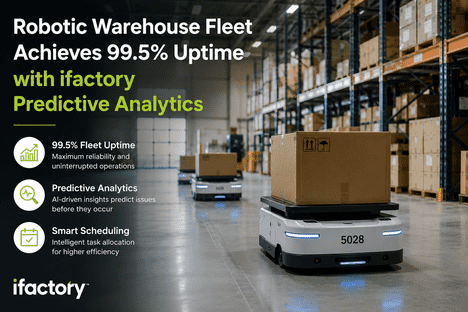
iFactory Robotics AI manages AMR battery state as a routing constraint in the fleet orchestration engine. When an AMR's state of charge drops below a configurable threshold (typically 25–35%), the platform routes the robot to the nearest available charging station automatically, without requiring manual intervention. Opportunity charging — 15–25 minute charging sessions during low-demand periods — keeps the fleet operating across three shifts with no dedicated charging downtime. The platform can also stagger charging across the fleet to maintain minimum available robot count at all times. Battery health data is fed into the iFactory CMMS for predictive maintenance, alerting the maintenance team when battery capacity degradation reaches replacement threshold.
Yes. iFactory AMRs are equipped with multiple safety systems: 360-degree LiDAR with configurable warning and stop zones, vision cameras for object detection and classification, audible and visual warning signals, and speeds limited to 1.2 m/s in pedestrian zones and 1.8 m/s in aisle zones. The fleet orchestrator maintains a real-time map of AMR positions and plans routes that avoid high-traffic forklift zones where possible. When AMRs and forklifts share aisle space, the AMR detects the forklift using LiDAR and yields or stops based on configurable right-of-way rules. All iFactory AMRs meet ANSI/ITSDF B56.5 safety standards for autonomous industrial vehicles.
AMR fleets offer elastic capacity that manual forklift operations cannot match. During seasonal peaks — holiday season, promotional events, new product launches — FMCG DCs can temporarily add AMRs to the fleet without hiring, training, or onboarding delays. iFactory Robotics AI adds the new AMRs to the fleet orchestration pool automatically, redistributing transport tasks across the expanded fleet. AMR units can be leased or rented for seasonal periods and returned to the provider post-peak, converting a fixed labor cost into a variable capacity cost that scales with demand. Typical peak season AMR deployments add 30–50% fleet capacity within 5–7 days of the request date.
iFactory Robotics AI integrates directly with the iFactory CMMS to manage AMR preventive maintenance automatically. The platform tracks robot operating hours, motor cycles, battery charge cycles, wheel wear, LiDAR cleanliness, and camera lens condition, generating PM work orders based on actual usage rather than calendar intervals. Typical AMR maintenance requirements include weekly LiDAR and camera cleaning, monthly wheel and bearing inspection, quarterly battery performance testing, and annual motor and gearbox service. The predictive maintenance module alerts the maintenance team 7–14 days before components reach replacement threshold, enabling planned maintenance during low-demand periods rather than emergency repairs during peak operations.
Deploy AMR Fleet Automation for Your FMCG DC
iFactory Robotics AI orchestration platform with pallet transport AMRs, case pick goods-to-person configurations, return handling automation, and full WMS integration — reducing material handling labor costs by 62% and achieving fleet ROI within 22 months. Phased deployment with zero operational interruption.