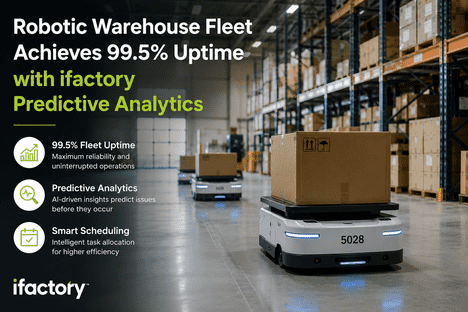
Autonomous mobile robot fleets are the backbone of modern FMCG warehouse and distribution center operations, yet most facilities accept 15-20% unplanned downtime as normal. Battery degradation, wheel wear, LiDAR sensor contamination, and navigation drift cause AMRs to fail mid-shift, stall pick waves during peak throughput windows, and erode the unit cost economics that justified the automation investment in the first place. For a 45-AMR fleet operating in a 280,000-square-foot FMCG distribution center, each unplanned stoppage costs an average of 47 minutes of resolution time and disrupts order fulfillment across the entire pick zone. Predictive analytics replaces reactive break-fix and calendar-based preventive maintenance with ML-driven fleet health monitoring that detects degradation 2-6 weeks before failure, auto-generates work orders with diagnostic context, and schedules maintenance during overnight charging windows without pulling a single robot from active duty. The result: 99.5% fleet uptime, 96% fewer unplanned stoppages, and $312,000 per year in recovered throughput value. Warehouse operations managers and automation directors evaluating fleet health analytics Book a Demo to see AMR fleet health monitoring with real-time per-unit health scoring, predictive degradation alerts, and fully integrated maintenance scheduling.
Why AMR Fleets Experience 15-20% Unplanned Downtime
Four primary failure modes account for 95% of all unplanned AMR stoppages in FMCG warehouse and distribution center environments. Each follows a predictable degradation curve that traditional calendar-based preventive maintenance cannot capture, but ML-driven predictive analytics detects with 95%+ accuracy at 2-6 weeks before functional failure. Automation directors evaluating their fleet reliability strategy can see how per-unit health scoring and degradation trending eliminate the root causes of AMR downtime across the full fleet.
| Failure Mode | Share of Unplanned Stops | Detection & Resolution Method |
|---|---|---|
| Battery Degradation | 38-44% of all unplanned AMR stops; Li-ion cells degrade below 80% capacity over 2,000-3,000 charge cycles, causing robots to return to charge mid-route | Voltage sag under load, charge cycle counts, thermal history, and depth of discharge trending; iFactory predicts replacement need 4-6 months in advance, enabling planned swap during off-peak periods |
| Wheel Wear & Tread Degradation | 20-25%; 3-5mm diameter reduction causes odometry drift that compounds navigation errors across fleet sharing the same map | Traction motor current trending combined with monthly tread depth measurement at 4 points per wheel; replacement triggered below 3mm remaining tread; diameter variation above 2mm indicates bearing or alignment issue |
| LiDAR Sensor Drift & Contamination | 15-20%; warehouse dust, cardboard debris, and condensation on optics degrade point cloud accuracy, causing phantom stops and docking errors | Point cloud count trending versus baseline; alert triggered when count drops below 80% of healthy baseline or localization covariance exceeds 5cm standard deviation |
| Motor Overheating & Bearing Wear | 10-15%; dust accumulation in motor vents, overloaded tasks, and bearing friction cause thermal elevation and protective shutdown | Drive motor current trending, thermal monitoring, and vibration analysis; bearing wear predicted 4-8 days before failure, enabling intervention during overnight charging window |
Predictive Fleet Health Analytics Methodologies
iFactory robotics analytics deploys three complementary methodologies across AMR fleets. Each targets a specific dimension of fleet reliability and is selected based on telemetry availability, fleet size, and operational criticality. Operations managers comparing their analytics approach Book a Demo to see which methodology best matches their warehouse automation footprint and uptime targets.
Per-Unit Health Scoring assigns each AMR a continuously updated 0-100 health score based on six indicators: battery state-of-health, tread depth remaining, sensor calibration recency, motor current draw variance, charge cycle count, and navigation error rate. Every robot in the fleet receives its own health profile regardless of age, usage intensity, or operating zone. Scores below 70 automatically trigger preventive work orders with component-level diagnostic context, enabling maintenance teams to intervene before failure. Individual-unit scoring is critical because fleet-level averages mask the 15-20% of robots that account for 80% of unplanned downtime in any given period.
Remaining Useful Life Prediction applies ML regression models trained on each AMR component's historical degradation curve to forecast failure timing with 95%+ accuracy. Battery replacement is predicted 4-6 months in advance based on capacity fade trajectory. Wheel wear is forecast 2-6 weeks before traction failure based on motor current trending. Bearing wear is detected 4-8 days ahead through drive motor current variance. Each prediction includes a confidence score and recommended intervention window, enabling maintenance teams to consolidate interventions during planned overnight charging slots rather than reacting to mid-shift failures that stall pick waves.
Fleet-Wide Orchestration coordinates AMR task allocation, charging cycles, and maintenance windows across the entire fleet to maximize operational availability. The orchestration engine considers six variables simultaneously: asset criticality, production schedule conflicts, technician skill match, parts availability, shift timing, and estimated downtime window. Staggered PM scheduling ensures no more than 5-8% of fleet is in maintenance simultaneously. Coordinated charging recovers 12-18% of total operating hours versus threshold-based charging. Auto-routing removes failing robots from active task queues before they block intersections or stall pick zones.
Traditional vs. Predictive AMR Fleet Management
The comparison below evaluates reactive and calendar-based preventive maintenance against predictive analytics across the metrics that define fleet reliability and warehouse operational performance.
| Capability | Traditional Management | Predictive Analytics |
|---|---|---|
| Fleet Health Visibility | No per-unit health data; robots run until failure or scheduled PM interval; downtime is discovered mid-shift | Real-time 0-100 health score per AMR with component-level degradation trending; fleet dashboard updated every 30 seconds |
| Maintenance Trigger | Calendar-based fixed intervals or reactive break-fix; healthy robots serviced unnecessarily while degrading robots are missed | Condition-based ML prediction 2-6 weeks before failure; work orders auto-generated with diagnostic context, parts list, and recommended action |
| Mean Time to Resolve | 47 minutes average; technician spends most time gathering diagnostic history and identifying root cause | 11 minutes average; pre-populated work order with robot ID, component, severity, and repair instructions eliminates diagnosis time |
| Maintenance Cost | Baseline; emergency parts and expedited shipping inflate costs 3-5x above planned replacement | 25-30% lower maintenance costs; planned parts procurement ahead of predicted failure; 77% reduction in emergency parts spend |
| Fleet Uptime | 81% average; 312 unplanned stoppages per year; each event disrupts pick wave across one or more zones | 99.5% uptime; 14 unplanned stoppages per year; sustained across all shifts through predictive detection and overnight-window PM scheduling |
| Throughput Value Lost to Downtime | ~4,200 order lines missed per year due to AMR downtime; direct revenue and SLA penalty impact | ~180 order lines missed per year; $312,000 annual throughput value recovered across the full 45-AMR fleet |
Implementation Roadmap for AMR Fleet Predictive Analytics
Deploying predictive analytics across an AMR fleet follows a structured five-phase sequence that ensures telemetry readiness, model accuracy, maintenance workflow integration, and continuous improvement are advanced in parallel with technical deployment.
Expert Perspective — Predictive Analytics for AMR Fleet Uptime
We deployed iFactory predictive analytics across our 45-AMR fleet approximately seven months ago. Within the first month, the ML models flagged battery degradation on eight units that were still months away from causing visible capacity issues during shifts. We replaced those batteries during scheduled overnight maintenance windows rather than during peak pick waves. Our wheel wear predictions have been accurate within one week of forecast failure across 22 replacement events, eliminating the odometry drift that was causing our fleet to miss pick stations by 6-8 inches. The coordinated charging feature alone recovered approximately 14% of our total AMR operating hours by eliminating the charge-return-mid-route pattern that was silently shrinking our effective fleet size. For warehouse operations managers considering this investment, predictive analytics does not require a new fleet of robots; it maximizes the reliability and throughput of the AMRs you already have.
— Director of Warehouse Automation, FMCG Distribution Center OperatorConclusion
Predictive fleet health analytics delivers a measurable and sustainable 99.5% uptime across AMR fleets in FMCG warehouse and distribution center environments. ML-based per-unit health scoring detects battery degradation, wheel wear, LiDAR contamination, and motor bearing failure 2-6 weeks before functional failure, enabling proactive intervention during overnight charging windows rather than reactive break-fix during peak pick waves. Fleet-wide orchestration coordinates task allocation, charging cycles, and staggered maintenance scheduling to maximize operational availability while keeping 92-95% of the fleet in active duty at all times. The result: 96% fewer unplanned stoppages, 77% faster mean time to resolve, and $312,000 per year in recovered throughput value that directly improves warehouse profitability and customer SLA performance. Warehouse operations managers and automation directors ready to move beyond reactive fleet management Book a Demo to see iFactory robotics analytics deployed in live AMR fleet environments with real-time per-unit health scoring, predictive degradation alerts, RUL forecasting, and fully integrated maintenance workflow automation across the complete fleet.
Frequently Asked Questions
iFactory robotics analytics connects to existing fleet manager APIs, robot controllers, and on-board sensors via REST API, MQTT, OPC-UA, or Modbus TCP. Minimum viable telemetry includes battery voltage and charge cycles, motor current draw, navigation error rate, and operating hours per shift. The platform includes a lightweight telemetry agent for AMRs without standard APIs, and can integrate with MiR Fleet, OTTO Fleet Manager, Locus Robotics, Geek+, and other major fleet management platforms within 72 hours.
Most facilities detect actionable degradation patterns within the first 7-14 days of baseline learning. The first predictive alerts are generated within days of telemetry activation. Measurable uptime improvement appears within the first 30 days as the early-warning alerts enable proactive intervention before failures occur. The full 99.5% uptime level compounds over 3-6 months as the ML models accumulate fleet-specific operating data, refine prediction horizons per component, and maintenance teams gain confidence in acting on predictive alerts across the complete fleet.
Yes. iFactory is vendor-agnostic and supports MiR, Fetch, OTTO Motors, Locus Robotics, Geek+, Seegrid, OMRON FLOW, Hai Robotics, and other major AMR platforms through standard APIs and fleet manager integrations. Each robot model receives a model-specific health profile calibrated to its unique component specifications, degradation patterns, and telemetry schema. The unified fleet dashboard presents cross-vendor health scores, downtime metrics, and maintenance forecasts in a single view regardless of the manufacturer mix.
iFactory provides unified health monitoring across AMRs, cobots, and industrial robotic arms within a single platform. Each asset type has component-specific health models: AMRs track battery SOH, wheel tread, LiDAR calibration, and motor current; cobots track joint torque profiles, cycle counts, gripper force repeatability, and safety system status; robotic arms track harmonic reducer wear, servo motor current, brake degradation, and controller electronics drift. The consolidated dashboard enables maintenance teams to manage all robotic assets from one interface with consistent health scoring, alert severity, and work order workflows across the entire automation footprint.
Predictive analytics replaces calendar-based PM intervals with condition-based triggers for the six components that account for 95% of AMR downtime. Routine inspection tasks such as LiDAR lens cleaning, safety bump sensor tests, and visual wheel checks remain important and are scheduled as efficient grouped work orders during overnight charging windows. iFactory integrates predictive alerts with preventive checklists so maintenance teams receive a unified daily work package combining ML-flagged degradation events with scheduled inspection tasks, eliminating duplicate entries while ensuring zero critical gaps in fleet coverage.