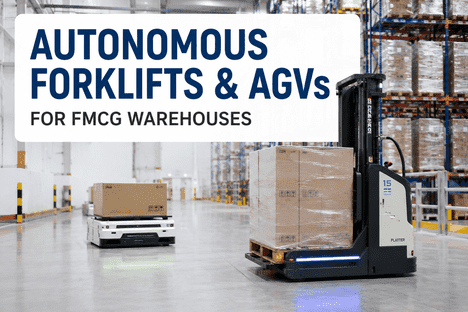
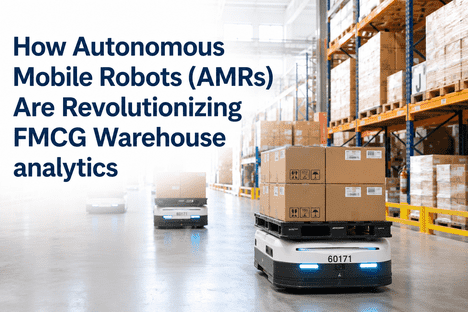
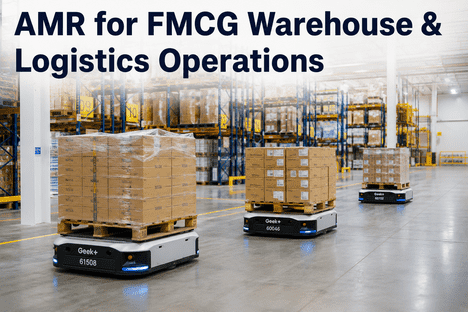
Autonomous forklifts and automated guided vehicles (AGVs) have become the backbone of material movement in FMCG warehousing — where pallet turnover cycles of 45 minutes or less, SKU counts exceeding 100,000, and 24-hour multi-shift operations make manual forklift fleets the single largest constraint on warehouse throughput. A typical FMCG distribution center running two shifts moves 3,500 to 5,200 pallets per day through receiving, put-away, replenishment, and outbound staging. When even one forklift operator shift goes unfilled — and FMCG cold storage facilities report 74% annual operator turnover — throughput drops immediately, truck turnaround times extend, and service-level agreements with retailers begin to slip. The autonomous forklift market is projected at $8.76B in 2026, growing at 12% CAGR to $13.79B by 2030, driven almost entirely by FMCG, e-commerce, and third-party logistics operators who can no longer find enough qualified operators to run their material handling fleets. iFactory AI's Shift Logbook and Equipment Analytics platform provides the fleet management, shift tracking, and maintenance analytics layer that FMCG warehouses need to integrate autonomous forklifts and AGVs into their existing WMS-driven operations — replacing manual shift handovers with digital turnover records, paper maintenance logs with predictive service scheduling, and operator-dependent throughput with fleet-optimized autonomous material flow. Book a Demo to see how iFactory's autonomous fleet analytics platform applies to your FMCG warehouse's material handling profile and current pallet throughput requirements.
Deploy autonomous pallet movers, reach trucks, and tugger AGVs across your FMCG warehouse operation — with fleet management, shift analytics, and predictive maintenance that maximize throughput and eliminate operator-dependent bottlenecks.
Why Autonomous Forklift Failures in FMCG Warehouses Follow a Predictable Pattern — And Why Most Facilities Miss the Warning Signs
Autonomous forklift and AGV failures in FMCG warehouse environments are rarely sudden — they are the accumulated result of sensor degradation, missed maintenance cycles, battery health decline, navigation drift, and pallet handling wear that accumulate over hundreds of operating hours without visible symptoms until a vehicle stops mid-aisle during a peak shipping wave. The failure modes of autonomous material handling equipment are well understood: LiDAR sensor contamination from warehouse dust and condensation, drive motor encoder drift, wheel wear from continuous pallet maneuvering, battery capacity fade under opportunity charging cycles, fork position sensor misalignment, and onboard computer thermal shutdown in unconditioned warehouse environments. Each of these failure modes presents observable precursor indicators — navigation path deviation increasing by millimeters per month, charge retention dropping by fractions of a percent per cycle, motor current draw trending upward — that can be detected, trended, and acted upon through a properly executed digital fleet analytics program. The FMCG warehouses that experience the most unplanned AGV downtime are not the ones with the oldest equipment. They are the ones with the worst maintenance intelligence: preventive maintenance performed on fixed calendar intervals that do not reflect actual vehicle utilization, battery health tracked on spreadsheets rather than through automated charge-cycle analytics, and shift handovers conducted verbally or on paper without structured data transfer between the outgoing and incoming fleet managers. iFactory's fleet analytics platform transforms AGV maintenance execution from a reactive break-fix cycle into a predictive intelligence feed, capturing every shift event, maintenance action, and vehicle performance data point in a structured digital record that surfaces actionable insights before failures occur.
Autonomous Forklift & AGV Failure Progression — From Observable Precursor to Unplanned Downtime
Stage 1
Early Wear Indicators
LiDAR dust accumulation causing intermittent scan gaps at low-contrast racking surfaces, battery capacity declining from 100% to 92% of rated Ah, minor wheel wear pattern development, navigation path deviation within tolerance at ±1–2 cm. Detectable through periodic digital inspection with diagnostic data capture.
Detection Window: 8–14 weeks before failure
Stage 2
Progressive Degradation
LiDAR field intermittency at 3+ meter range, battery capacity declining to 80–85%, drive motor current draw increasing 8–12% above baseline, wheel tread depth nearing replacement threshold, navigation deviation reaching ±3–5 cm requiring trajectory recalibration.
Detection Window: 3–8 weeks before failure
Stage 3
Critical Condition
Safety-rated LiDAR reports PL-d field violation false positives, battery capacity below 70% causing operational range constraints, drive motor thermal trip events during peak shifts, wheel tread worn to replacement indicator, navigation system reporting localization loss events during pallet handoff.
Detection Window: 1–2 weeks before failure
Stage 4
Failure / Unplanned Downtime
Vehicle stops mid-route with safety system lockout, battery system failure during opportunity charge cycle, drive motor failure requiring replacement, navigation system unable to localize within warehouse map. Production stoppage on picking lane, missed shipping wave, cascading labor reallocation, and multi-day vehicle outage.
Outcome: $25K–$150K+ in lost throughput per shift
+49%
Increase in daily pallet throughput when deploying autonomous forklifts alongside digital fleet management
77%
Lower unplanned maintenance cost vs manual forklift fleets in FMCG cold storage deployment
98%+
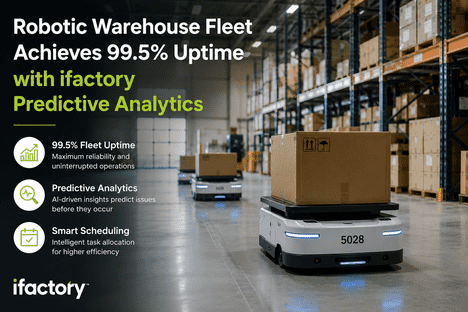
Autonomous fleet uptime with LiDAR SLAM navigation and lithium-ion opportunity charging
74%
Annual forklift operator turnover rate in FMCG cold storage — the primary driver of automation ROI
Autonomous Forklift and AGV Types for FMCG: Technology Coverage by Application and Navigation Standard
The table below maps each major autonomous forklift and AGV type deployed in FMCG warehousing operations to its typical application, navigation technology, governing safety standard, infrastructure requirements, and the iFactory feature that manages its fleet integration and maintenance documentation. This reflects the actual vehicle types and standards that FMCG warehouse operators evaluate when building an autonomous material handling fleet.
Vehicle Type
Typical FMCG Application
Navigation Technology
Safety Standard
Load Capacity
Infrastructure Required
iFactory Feature
Autonomous Pallet Mover
Floor-level pallet transport between receiving docks, bulk storage, and staging lanes
LiDAR SLAM natural feature navigation
ISO 3691-4 / ANSI B56.5
1,500–3,300 lbs
None — deploys onto existing warehouse floor without tape or reflectors
Heavy pallet or container transport between process zones and automated storage
LiDAR SLAM or magnetic tape
ISO 3691-4 / UL 3100
500–5,000+ lbs
Magnetic tape for tape-guided systems; none for SLAM-based
Load manifest tracking; transport cycle analytics; conveyor handoff interface monitoring
VNA / Turret Truck AGV
Very narrow aisle high-density storage at heights up to 56 ft
Laser triangulation + rail guidance in aisle
ISO 3691-4 / ASME B56.5
Up to 1,500 kg (3,300 lbs)
Floor rails or laser reflectors inside each very narrow aisle for sub-centimeter positioning
Aisle utilization analytics; storage density reporting; specialized mast PM and calibration scheduling
Core AGV Technology Modules: Navigation, Battery, Safety, and Fleet Management for FMCG Warehousing
The four technology domains that determine autonomous forklift and AGV performance in FMCG warehouse environments — navigation accuracy, battery and charging infrastructure, safety system compliance, and fleet management software — each have distinct failure modes, maintenance requirements, and operational trade-offs that FMCG warehouse operators must manage across a mixed fleet that may include vehicles from multiple OEMs on the same warehouse floor. iFactory's fleet analytics platform provides the cross-OEM monitoring layer that tracks each technology domain across every vehicle in the fleet.
LiDAR SLAM · Visual SLAM · Laser Triangulation · QR Code Grid
Navigation Technology — Accuracy, Reliability, and Degradation Monitoring
Natural feature navigation using LiDAR SLAM is the dominant technology for new AGV and autonomous forklift deployments in FMCG warehousing as of 2026 — offering ±1 cm / ±1° accuracy with zero floor infrastructure, enabling layout changes without tape replacement, and performing reliably in the dusty, variable-lighting conditions of warehouse environments. However, SLAM-based navigation accuracy degrades as LiDAR optics accumulate dust, warehouse racking layouts change without map updates, and wheel odometry encoder drift introduces localization error over time. iFactory's fleet analytics module tracks navigation health indicators — localization confidence score, path deviation trend, relocalization success rate, and LiDAR diagnostic data — across every vehicle in the fleet and generates maintenance notifications when a vehicle's navigation system shows degradation trends that will require map recalibration or sensor cleaning before accuracy falls below operational tolerance.
Navigation Health Monitoring Capabilities
Localization confidence trend per vehiclePath deviation alert with tolerance thresholdsLiDAR surface contamination detectionMap staleness notification after racking changesWheel odometry drift trendingRelocalization success rate dashboard
Operational Outcome
Navigation-related unplanned stops are reduced by identifying degradation patterns before they cause localization loss at high-throughput zones such as pallet handoff stations and dock doors. Planned sensor cleaning and map update intervals are scheduled based on actual navigation performance data rather than fixed calendar periods, reducing unnecessary maintenance while eliminating navigation-related throughput interruptions.
Battery Technology and Opportunity Charging Infrastructure for 24-Hour FMCG Operations
Lithium iron phosphate (LiFePO4) is the dominant battery chemistry for autonomous forklifts and AGVs in FMCG warehousing — delivering 4,000 to 10,000+ charge cycles, 98% energy efficiency, and 1–2 hour full charge time that enables opportunity charging in 5–15 minute bursts during loading/unloading dwell periods. The result is 18–22 hours of operational availability per day without dedicated battery rooms, watering, or ventilation. However, battery capacity degrades over cycles, and in a multi-shift FMCG operation where 20+ vehicles are opportunity-charging simultaneously across 8–12 charging stations, the fleet manager needs visibility into which vehicles have adequate charge for assigned missions, which batteries are approaching end-of-life, and whether charging station utilization is balanced across the fleet. iFactory's battery analytics module tracks charge cycle count, daily charge throughput, capacity retention trend, and charging station utilization across every vehicle and charger — generating battery replacement recommendations 8–12 weeks before a vehicle's range becomes operationally constraining.
Battery Analytics Capabilities
Per-vehicle charge cycle and capacity trackingLiFePO4 capacity retention trend vs cycle countCharging station utilization heat mapOpportunity charge duration and frequency analysisEnd-of-life battery prediction with 8-week lead timeState of charge visibility across entire fleet
Operational Outcome
Battery-related throughput interruptions — vehicles stranded with insufficient charge during peak shipping waves — are eliminated through predictive capacity management. Charging infrastructure investment decisions are guided by actual utilization data rather than estimates, and battery replacement is scheduled proactively during planned maintenance windows rather than reactively after a vehicle fails mid-shift.
Safety System Compliance — Autonomous Vehicle Safety Standards for Human-Shared Warehouse Environments
FMCG warehouses are shared environments where autonomous forklifts, manual forklifts, pickers on foot, and dock workers operate in overlapping zones. ISO 3691-4 (international) and ANSI/ITSDF B56.5 (United States) govern the safety requirements for driverless industrial trucks, mandating safety-rated LiDAR scanners with PL-d performance level, configurable warning and protection fields, speed-dependent field switching, and tested emergency stop systems. Most autonomous forklifts are equipped with dual safety LiDAR scanners providing 360° coverage, with active detection fields that expand and contract based on vehicle speed and operating zone. Safety system components — LiDAR scanner optical surfaces, emergency stop buttons, audible and visual warning devices, and speed control calibration — require periodic inspection and documented testing under the applicable standard. iFactory's safety compliance module manages inspection and test records for every safety system component on every vehicle in the fleet, with automated test scheduling per ISO 3691-4 requirements and deficiency-to-corrective-action routing for any safety device that fails its functional test.
Safety Compliance Capabilities
Safety LiDAR functional test scheduling and recordsWarning and protection field verification documentationEmergency stop test record per ISO 3691-4Audible/visual warning device inspection logSpeed control zone calibration trackingSafety-related deficiency auto-routing to corrective action
Safety Outcome
Every safety system component on every autonomous vehicle has a documented, timestamped test record satisfying ISO 3691-4 and ANSI B56.5 documentation requirements. Safety deficiencies are corrected before vehicles return to operation — eliminating the regulatory exposure and liability risk of operating autonomous equipment with undocumented safety system compliance. AI-based fork detection systems have reduced pallet handling accidents by 95% in monitored deployments.
Fleet Management Software — Cross-OEM Orchestration and WMS Integration for FMCG Operations
Fleet management software (FMS) is the operational brain that connects WMS/WES transport orders to individual vehicle execution — receiving mission requests from the warehouse management system, assigning them to vehicles based on proximity, battery state, and availability, managing intersection traffic and zone congestion, and reporting mission completion status back to the WMS. The VDA 5050 protocol has emerged as the leading manufacturer-independent standard for mixed-fleet communication, enabling FMCG operators to deploy vehicles from different OEMs on the same warehouse floor managed by a single FMS instance. iFactory's Shift Logbook and Equipment Analytics platform operates alongside the FMS as the maintenance and operations intelligence layer — capturing shift-level fleet performance data, vehicle availability and utilization metrics, maintenance event records, and operator shift handover notes that the FMS does not manage. This integration provides FMCG warehouse operators with a single digital record that connects fleet operations performance to maintenance history, shift productivity, and compliance documentation.
Fleet Management Integration Capabilities
Cross-OEM fleet performance dashboardShift-level throughput and availability analyticsWMS transport order completion trackingVehicle utilization rate by shift and zoneMaintenance event correlation with throughput dipsDigital shift handover with fleet status summary
Operational Outcome
Fleet supervisors and warehouse managers have unified visibility into fleet performance, maintenance status, and shift productivity across all autonomous vehicles regardless of OEM. Maintenance events that impact throughput are identified within the shift rather than during the next day's review. Shift handover quality improves from verbal summary to structured digital turnover with fleet status, open issues, and priority actions documented for the incoming shift.
Maximize Autonomous Fleet Uptime and Throughput Across Your Entire FMCG Warehouse Operation
iFactory's Shift Logbook and Equipment Analytics platform covers every autonomous forklift and AGV type in your FMCG warehouse — with fleet management analytics, battery health monitoring, preventive maintenance scheduling, and digital shift handover records that connect fleet operations data to maintenance intelligence.
Preventive Maintenance and Fleet Health Analytics: From Fixed-Interval Schedules to Utilization-Driven Predictive Service
Preventive maintenance for autonomous forklifts and AGVs is not a matter of applying the OEM's recommended service intervals uniformly across the fleet. A pallet mover running 22 hours per day across 3 shifts in a 500,000 sq ft FMCG distribution center accumulates wear at 3–4 times the rate of a backup vehicle used only during peak periods — yet most facilities apply identical maintenance schedules to both. The difference matters because the cost of unplanned AGV downtime in an FMCG warehouse — a single vehicle down during a peak shipping wave can delay 200–400 pallets and trigger $25,000–$50,000 in missed service-level penalties — is an order of magnitude higher than the cost of preventive maintenance on that same vehicle. iFactory's preventive maintenance scheduling engine calculates utilization-adjusted service intervals from actual vehicle operating data — drive hours, lift cycles, distance traveled, charge cycles, and navigation correction events — and generates maintenance work orders that reflect the actual wear state of each vehicle rather than a calendar date that has no relationship to how the vehicle is actually used.
Utilization-Based Service Interval Calculation
iFactory's scheduling engine ingests vehicle operating data — drive motor hours, lift pump cycles, distance traveled, and opportunity charge events — from the FMS or direct telemetry feed and calculates wear-adjusted maintenance intervals for each component group: drive motors, lift chains and forks, wheel and tire assemblies, LiDAR optics and calibration, and battery system maintenance. High-utilization primary fleet vehicles receive compressed intervals; low-utilization peak-season or backup vehicles receive extended intervals that match their actual wear accumulation rate.
Predictive Component Health Monitoring
Drive motor current draw trends, LiDAR navigation localization confidence, battery capacity retention curves, and wheel wear progression are tracked continuously across every vehicle in the fleet. When any parameter crosses a configurable threshold — for example, drive motor current draw increasing 15% above baseline or battery capacity dropping below 80% of rated Ah — the system generates a predictive maintenance work order with a recommended intervention date calculated from the degradation rate, ensuring components are replaced before they cause an unplanned stop during a peak shipping wave.
Shift Logbook Integration and Digital Turnover
iFactory's Shift Logbook captures structured shift-level data for every autonomous vehicle: missions completed, exceptions encountered, battery state at shift end, maintenance actions taken, and operator or fleet supervisor notes. Incoming shift supervisors review the digital turnover record before assuming fleet management responsibility — eliminating the information loss that occurs with verbal handoffs and ensuring that maintenance issues identified during one shift are not forgotten during the next. The Shift Logbook provides the audit trail that connects daily fleet operations to maintenance history and compliance records.
ROI Analytics and Fleet Investment Planning
iFactory's fleet ROI dashboard aggregates total cost of ownership data — maintenance cost per vehicle per month, unplanned downtime cost, battery replacement cost projections, and throughput contribution per vehicle — and presents fleet-level economics that support vehicle replacement planning, fleet expansion justification, and charger infrastructure investment decisions. The 12–24 month typical payback period for autonomous forklift deployments on multi-shift FMCG operations is tracked against actual fleet performance with variance reporting that identifies which vehicles and routes are generating the strongest return.
Autonomous Forklift Deployment Workflow: From Site Assessment to Full Fleet Operation
The deployment of autonomous forklifts and AGVs in an FMCG warehouse follows a structured workflow that spans site assessment, vehicle selection and configuration, navigation mapping, safety validation, WMS integration, and phased ramp-up to full fleet operation. Each phase requires documented execution that feeds into the ongoing fleet management and maintenance program. iFactory's platform supports every phase of this deployment with structured digital records that carry the deployment configuration data into the operational maintenance and analytics system.
iFactory Autonomous Fleet Deployment Workflow — Site Assessment to Full Fleet Operation
01
Site Assessment and Infrastructure Evaluation
Warehouse layout review, floor condition assessment, WiFi coverage mapping (or private 5G evaluation), racking configuration and aisle width verification, dock door and staging area handoff zone design, and charging station location planning. Aisle width requirements are verified against vehicle specifications — autonomous pallet movers operate in standard aisles, while very narrow aisle operations require 1.8m aisles with guidance infrastructure.
02
Vehicle Specification and Fleet Configuration
Vehicle type selection per application — pallet movers for horizontal transport, reach trucks for high-bay put-away, counterbalance AGVs for dock-to-staging, tuggers for multi-trailer trains. Fleet sizing based on peak throughput requirements with redundancy for planned maintenance coverage. Vehicle parameters configured in iFactory: asset register entry, component hierarchy, PM interval baselines, and shift schedule assignment.
03
Navigation Mapping and Safety Validation
SLAM map creation by driving each route with the vehicle in manual teaching mode. Safety field configuration per ISO 3691-4 — protection field distances set per vehicle speed and zone classification. Integration testing of vehicle-to-FMS communication over VDA 5050 or OEM protocol. iFactory platform configuration: vehicle-to-analytics data feed established, shift logbook initialized, compliance schedule set.
04
Phased Ramp-Up and Continuous Optimization
Initial deployment on 2–3 routes with manual operator ride-along shadowing. Expansion to full route coverage after 2–4 weeks of validated performance. WMS integration tuning to optimize transport order batching and vehicle task assignment. iFactory analytics calibration: utilization-adjusted PM intervals validated against first-month operating data, shift logbook review cadence established, fleet performance baseline set for ongoing ROI tracking.
Expert Perspective: What FMCG Warehouse Operators Learn From Their First Autonomous Fleet Deployment
"
I have managed material handling operations at FMCG distribution centers for 18 years — ambient grocery, refrigerated, and frozen — and I led the autonomous forklift deployment at a 750,000 sq ft mixed-temperature facility that now runs 32 autonomous pallet movers and 8 autonomous reach trucks across three shifts. The single most important lesson I would share with any warehouse operations manager evaluating autonomous material handling is that the vehicle technology is ready — the LiDAR SLAM navigation is reliable, the lithium-ion opportunity charging works, and the safety systems are proven across millions of production miles. The place where most deployments struggle is not the vehicles; it is the maintenance intelligence and shift management infrastructure that sits alongside the fleet. We ran our first 12 vehicles for six months before we deployed iFactory's Shift Logbook and fleet analytics platform, and in those six months we had two unplanned stops caused by battery capacity issues that we should have seen coming — one vehicle stopped in the middle of the frozen aisle during Thanksgiving peak because its battery was at 14% and the opportunity charge station was occupied by another vehicle. We had no way to see that coming because we were checking battery status on individual vehicle displays rather than from a dashboard. After iFactory, we have a single screen that shows state of charge across all 40 vehicles, charge station utilization, and battery capacity trends — and we have gone from two unplanned battery stops per quarter to zero in the 14 months since deployment. The fleet availability improvement alone paid for the platform in the first three months."
— Senior Director of Warehouse Operations, National FMCG Distribution Network (Ambient, Refrigerated, Frozen) — 40 Autonomous Vehicles Deployed Across 750K sq ft Facility — iFactory Reference Customer 2026
Conclusion
Autonomous forklift and AGV deployment in FMCG warehousing is no longer a pilot project question — it is a scale operation question. The technology maturity of LiDAR SLAM navigation, lithium-ion opportunity charging, ISO 3691-4 safety compliance, and VDA 5050 mixed-fleet management has reached the point where the primary constraint on autonomous fleet performance in FMCG warehouses is not vehicle reliability but the maintenance intelligence and shift management infrastructure that surrounds the fleet. The facilities achieving the highest autonomous fleet uptime, the lowest unplanned maintenance cost, and the fastest ROI are those that have invested not only in the vehicles but in the analytics platform that connects vehicle performance data to maintenance decisions, shift handover quality, and fleet investment planning.
iFactory AI's Shift Logbook and Equipment Analytics platform provides that infrastructure for FMCG warehouse operators — covering autonomous pallet mover fleet management, battery health monitoring with 8-week capacity fade prediction, utilization-adjusted preventive maintenance scheduling across mixed OEM fleets, shift-level throughput and availability analytics, and the digital shift handover records that eliminate information loss between shifts. The documented results — 49% increase in daily pallet throughput, 77% reduction in unplanned maintenance cost, and 98%+ autonomous fleet uptime at monitored FMCG facilities — are the measurable outcomes of replacing manual fleet management processes with structured digital operations. Book a Demo to see how iFactory's autonomous fleet analytics platform applies to your FMCG warehouse's specific vehicle types, throughput profile, and current fleet management infrastructure.
Frequently Asked Questions
The platform supports all major autonomous forklift and AGV types found in FMCG warehousing: autonomous pallet movers (LiDAR SLAM), counterbalance AGVs, autonomous reach trucks, tugger/tow tractor AGVs, unit load carriers, and VNA turret trucks — across all major OEMs including Dematic, Toyota, Jungheinrich, Balyo, Seegrid, Vecna, Mitsubishi Logisnext, and Hyster-Yale. The fleet analytics and Shift Logbook modules are OEM-agnostic and integrate with any vehicle that provides telemetry data through VDA 5050, REST API, or OPC UA protocols.
The battery health module tracks charge cycle count, charge throughput (kWh per cycle), and capacity retention ratio for every LiFePO4 or LTO battery in the fleet. Capacity fade is modeled per cycle chemistry — LiFePO4 typically retains 80% of rated capacity after 3,500–5,000 cycles — and the system generates battery replacement recommendations when the projected trend crosses the 80% capacity threshold, providing 8–12 weeks of lead time for planned replacement during a scheduled maintenance window rather than emergency replacement after a vehicle fails mid-shift.
Yes. iFactory's scheduling engine accepts operating data — drive motor hours, distance traveled, lift cycles, and charge events — from the FMS or direct vehicle telemetry feed and calculates wear-adjusted maintenance intervals for drive motors, lift chains, wheels and tires, LiDAR optics calibration, and battery system maintenance. Vehicles running 22 hours per day on primary routes receive compressed intervals; backup or peak-season-only vehicles receive extended intervals. All interval calculations are traceable to the operating data inputs and update automatically with each new data cycle.
The Shift Logbook captures structured shift-level data: missions completed per vehicle, exceptions and route interruptions, vehicle state of charge at shift end, maintenance actions taken during the shift, and free-form notes from the fleet supervisor. The incoming shift supervisor reviews the digital turnover record before assuming fleet management responsibility — eliminating the information loss inherent in verbal handoffs. The logbook also provides the audit trail connecting daily fleet operations performance to maintenance history, charge cycle records, and compliance documentation — a single source of truth that paper handover logs cannot provide.
Typical payback for multi-shift autonomous forklift deployments in FMCG warehousing ranges from 12 to 24 months when accounting for labor savings, throughput improvements, and maintenance cost reduction. iFactory's fleet ROI dashboard tracks total cost of ownership per vehicle — including maintenance cost, battery replacement projections, unplanned downtime cost, and throughput contribution — and presents fleet-level economics that validate the actual payback trajectory against the deployment business case. Variance reporting identifies which vehicle types and routes are generating the strongest return, supporting data-driven fleet expansion and replacement investment decisions.
Replace Manual Fleet Management and Paper Shift Handovers With Autonomous Fleet Analytics Built for FMCG Warehousing.
iFactory's Shift Logbook and Equipment Analytics platform tracks every vehicle, every shift event, and every maintenance action across your autonomous forklift and AGV fleet — without manual logbooks or shift supervisor overhead.