Robotic Palletizing & Depalletizing for FMCG Operations
By Seren on June 4, 2026
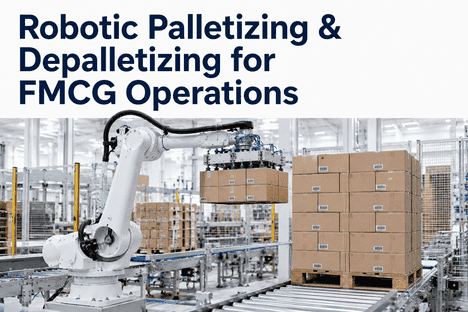
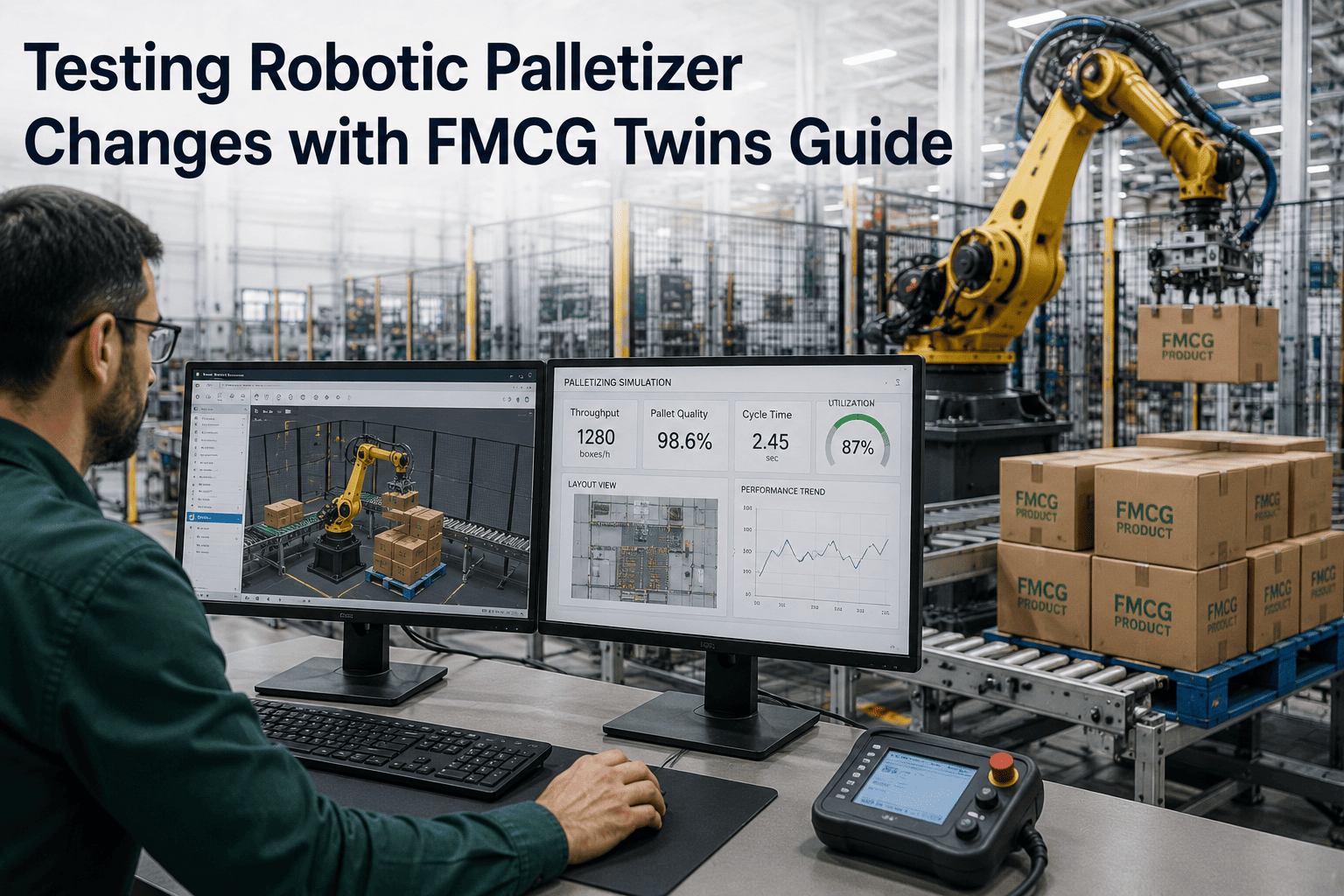
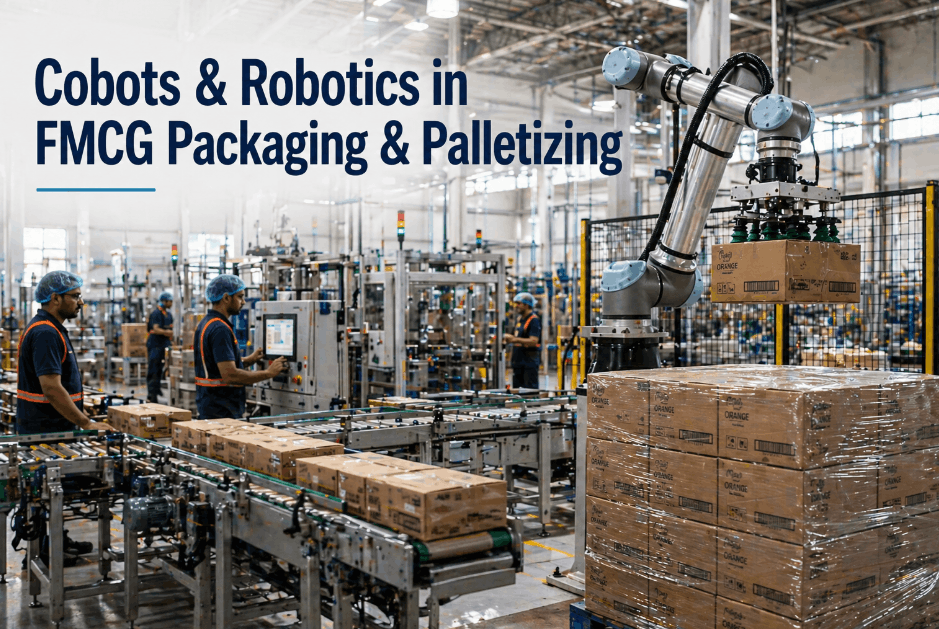
Robotic palletizing and depalletizing have become essential automation investments for FMCG operations facing SKU proliferation, labour shortages, and rising retailer demands for consistent pallet quality. Modern robotic systems achieve 800-1,800 cases per hour with 99.4% pallet pattern accuracy — outperforming manual teams that average 300-450 cases per hour with fatigue-driven inconsistency. For operations seeking to evaluate robotic palletizing, iFactory AI's industrial software platform enables palletizer maintenance tracking, OEE analytics, and cycle-count-based preventive maintenance scheduling. Book a Demo to see how iFactory applies CMMS and analytics integration for robotic palletizing operations.
Robotics & Automation · FMCG · 2026
Robotic Palletizing & Depalletizing for FMCG Operations
Layer building, pattern optimization, multi-SKU palletizing, and depalletizing with iFactory AI analytics and preventive maintenance schedules for distribution operations — reducing unplanned downtime, eliminating manual stacking injuries, and delivering consistent retailer-compliant pallet quality across every shift.
Why Traditional Palletizing Is Hitting Its Ceiling in FMCG
The traditional approach — fixed shift teams, manual stacking, calendar-based maintenance, and paper inspection logs — treats every shift and every pallet identically regardless of actual operating conditions. A three-person manual stacking crew operating for eight hours produces 300-450 cases per hour, but throughput drops predictably in hour six of every shift. Pallet quality degrades on night shifts where error rates increase 25%. Repetitive strain injuries remain the single largest category of OSHA recordable incidents in FMCG warehousing. Four specific ceilings are visible across every mature FMCG operation running manual end-of-line palletizing.
01
Fixed Shift-Based Throughput
Manual teams average 300-450 cases/hour but slow predictably after hour six of an eight-hour shift. Night shift output drops further with 25% higher error rates. Robotic cells sustain 800-1,800 cases/hour across all shifts with identical accuracy — no fatigue curve, no overtime premiums.
Gap: Fixed crew vs 24/7 robotic throughput
02
No Multi-SKU Flexibility
Each SKU changeover requires 8-15 minutes for operator briefing and physical reconfiguration. Facilities running 40+ SKUs across multiple lines lose hours per shift to changeover downtime. Robotic cells switch programmes in under 60 seconds with no physical tooling change.
Gap: Manual changeover vs software switching
03
Reactive Maintenance Model
Calendar-based PM schedules ignore actual wear on grippers, servos, vacuum generators, and conveyor belts. A palletizer running 16-24 hours/day accumulates cycle counts that calendar intervals cannot predict. Unplanned downtime in facilities without CMMS integration averages 7-12%.
Gap: Calendar-based vs cycle-count-based PM
04
Fragmented End-of-Line Data
Robot controller data, conveyor PLC logs, pallet quality records, and maintenance history all live in separate systems. No unified view connects palletizer performance to OEE, maintenance cost, or throughput trends. iFactory AI unifies these streams into a single asset monitoring platform.
Gap: Fragmented vs unified visibility
What Robotic Palletizing Actually Adds to FMCG Operations
The misconception some FMCG operations carry: robotic palletizing replaces existing conveyors, stretch wrappers, or CMMS systems. It does not. Your conveyor network continues feeding cases. Your stretch wrapper continues securing finished pallets. Your CMMS continues managing work orders and parts inventory. What changes is the intelligence layer connecting these systems. Manual stacking crews are replaced by robotic cells that execute retailer-specified patterns with 99.4% accuracy. Calendar-based PM schedules migrate to AI-driven condition-based predictions using cycle counts and runtime hours. iFactory AI's Shift Logbook, OEE Analytics, and preventive maintenance engine provide operators and maintenance teams with a unified interface for shift handovers, equipment status, and AI-generated maintenance recommendations integrated with existing end-of-line workflows.
Capability
Manual Palletizing
Robotic Palletizing + iFactory AI
Throughput rate
300-450 cases/hour with 3-5 operators, declining each shift hour
800-1,800 cases/hour continuous, identical across all shifts
Pallet pattern accuracy
88-91% — fatigue-affected, especially night shifts
99.4% consistent — every pallet, every shift
Injury risk
Leading MSK injury source in FMCG warehousing
Zero — operator oversight only
Labour cost per shift
3-5 FTE at $28-$42/hour each
0.5 FTE oversight
Multi-SKU switchover
8-15 min briefing + physical reconfiguration
Under 60 seconds — programme switch only
Night shift performance
25% error increase vs day shift
Identical 24/7 performance tracked in iFactory OEE
Unplanned downtime
N/A — crew-dependent
<2% with cycle-count-based iFactory PM scheduling
Critical Palletizing & Depalletizing Technologies — What AI and Automation Catch That Manual Operations Miss
FMCG packaging demands palletizers that handle high-speed changeovers between SKUs, mixed-case pattern building, and continuous multi-shift operation. Each technology serves a different operational profile — and each creates distinct maintenance requirements that CMMS tracking must address.
6A
6-Axis Articulated Arm Palletizing
The dominant configuration for FMCG mixed-case requirements. Six-axis robots handle complex stacking patterns, multiple pick points, and varied case orientations within a compact footprint. Pattern changes execute via software in under two minutes with no physical tooling swap. Payload capacities range from 50 kg to 210 kg.
Best for: High-volume, multi-SKU FMCG lines
CO
Cobot Palletizing Cells
Collaborative robots operate without safety fencing in low-speed, shared-space applications. Ideal for FMCG lines with moderate throughput up to 400 cases/hour and frequent product changeovers. Cobots reduce integration costs by 30-40% versus industrial robots with typical deployment of 4-6 weeks.
Best for: Moderate-throughput, high-changeover lines
AI
AI-Powered Mixed-Case Palletizing
AI-driven systems compute pallet patterns in real time — under 100 milliseconds per placement — from unsequenced case flow. No pre-programming, no robot re-teaching, and no upstream sequencing infrastructure. Handles unlimited SKUs with weight-balanced, transport-safe pallet output.
Best for: Co-packers, variety lines, 40+ SKU facilities
VD
Vision-Guided Depalletizing
Inbound depalletizing uses 3D vision and AI to identify mixed-height, non-uniform layers from supplier pallets — removing raw materials and packaging for line-side feed. Modern systems achieve 92-96% success rates on mixed incoming loads without pre-sorting.
Best for: Inbound material handling, mixed-load suppliers
The Keep / Retire / Transform / Replace Decision Matrix for Palletizing Automation
Migration discipline starts here. Every end-of-line asset management artifact in your current operation falls into one of four categories. Getting the categorization right in week one saves quarters of debate and millions in misallocated capital.
Keep
Core end-of-line foundations
CMMS work order engine
Conveyor infeed and accumulation
Stretch wrapper and label applicator
WMS warehouse execution system
Safety system and light curtains
Established capabilities. No business case to replace. iFactory AI predictive maintenance writes work orders to existing CMMS and integrates with conveyor PLCs.
Retire
Legacy manual operations
Manual case stacking teams
Paper pallet quality checklists
Calendar-based gripper replacement
Manual throughput data collection
Email-based maintenance alerts
Replaced by robotic cells, automated quality inspection, and AI-driven condition-based PM. 70-90% reduction in manual labour at end-of-line.
Transform
Analysis and monitoring workflows
OEE tracking per palletizer cell
Cycle-count-based PM scheduling
Pallet pattern quality trending
Changeover time SMED analysis
Shift handover reporting
Become AI-driven insights grounded in real-time palletizer data. Intelligence upgraded via iFactory Shift Logbook and OEE Analytics.
Replace
Manual data and alert systems
Manual throughput logging
Paper-based shift logs
Standalone palletizer dashboards
Separate conveyor and robot monitoring
Siloed maintenance records
Event-driven iFactory AI alert engine replaces manual tracking. Unified OEE dashboard with automated work order creation from palletizer anomalies.
Want this matrix applied to your specific end-of-line configuration in a working session? Book a Demo to walk through every palletizer asset class and prioritize your automation and maintenance rollout.
Three Deployment Paths for FMCG Palletizing Automation
Same starting point, three valid destinations. The right path depends on current throughput, SKU complexity, conveyor infrastructure, and maintenance maturity. Operations that pick the wrong path spend 12 months in pilot purgatory. Operations that pick the right path deploy in 8-16 weeks.
Path A
Augment in Place
6-10 weeks
Robotic palletizer cells operate alongside existing manual stations. Shadow mode for 4 weeks while operators validate throughput projections. iFactory CMMS tracks palletizer OEE and cycle counts alongside existing processes. No legacy systems retired.
Best fit
First-time automation adopters · operations building the business case · facilities with existing conveyor infrastructure
Wk 1-3 Assessment & cell specification
Wk 4-8 Cell install + iFactory CMMS integration
Wk 9-10 Production ramp + validation
Path B
Hybrid Migration
10-14 weeks
Robotic cells replace primary manual stations. AI on-the-fly palletizing deployed for mixed-SKU lines. iFactory platform provides unified OEE, cycle-count PM, and shift logbook across all end-of-line assets. Conveyor and wrapper systems preserved.
Best fit
Mature FMCG plants · 20+ SKU facilities · operations with maintenance team ready for digital upgrade
Wk 1-4 Full end-of-line audit + matrix
Wk 5-10 Robotic cell deployment + CMMS setup
Wk 11-14 Cutover + iFactory analytics live
Path C
Full Modernization
12-16 weeks
All manual palletizing stations retired. Full robotic deployment across all lines with AI mixed-case capability. iFactory platform provides complete end-of-line asset management, predictive maintenance, and OEE analytics across the entire fleet.
Best fit
Large multi-line FMCG plants · 40+ SKU operations · strategic digital transformation programs
Wk 1-5 Full asset inventory + technology selection
Wk 6-12 Multi-cell deployment + iFactory platform
Wk 13-16 Cutover + legacy system sunset
Pick the Right Palletizing Path for Your FMCG Operation
iFactory AI's FMCG practice runs a focused workshop against your specific production lines, SKU mix, conveyor layout, and maintenance configuration. You leave with a defended path recommendation, a 14-week deployment plan, and a cost reduction projection grounded in your operational data.
Generic robotic vendors handle the robot hardware. FMCG-aware vendors handle the integration reality — mixed-SKU case formats, high-speed changeover requirements, conveyor synchronization, retailer-compliant pallet patterns, and zero-disruption deployment. Eight criteria separate vendors who have done FMCG palletizing modernizations from vendors selling a demo.
01
Throughput capability vs peak demand
Ask:
"Can your palletizing cell sustain our peak seasonal throughput (typically 20-30% above average) without cell expansion or overtime?"
Robotic cells should deliver 800-1,800 cases/hour continuous with headroom for peak season. Systems that require multiple cells for peak demand increase capital cost and floor space requirements.
02
Multi-SKU changeover speed
Ask:
"How does your system handle changeover between different case sizes, weights, and pallet patterns without operator intervention?"
Programme switchover should execute in under 60 seconds with no physical tooling change. AI on-the-fly systems eliminate switchover entirely by computing patterns mid-cycle from live order data.
03
Case format compatibility
Ask:
"Does your end-of-arm tooling handle cardboard cases, corrugated trays, shrink-wrapped multipacks, and polybags without changeover?"
Mixed-format capability is essential for FMCG facilities running multiple packaging types. Tooling that requires physical changeover between formats defeats the purpose of robotic flexibility.
04
Conveyor and system integration
Ask:
"Does your solution integrate with our existing conveyor infeed, accumulation tables, case turners, and stretch wrappers without replacing them?"
Brownfield integration is critical. Solutions requiring conveyor replacement or reconfiguration add 40-60% to deployment cost and timeline. iFactory CMMS unifies all end-of-line assets in one platform.
05
Maintenance and CMMS integration
Ask:
"Can your system trigger maintenance work orders by cycle count, gripper cycles, and runtime hours into our existing CMMS?"
Cycle-count-based PM scheduling is critical for palletizers running 16-24 hours/day. iFactory AI integrates directly with existing CMMS to auto-generate work orders from palletizer operating data.
06
OEE and performance analytics
Ask:
"Does your system provide real-time OEE per palletizer cell with availability, performance, and quality breakdown?"
Granular OEE tracking at the individual palletizer level is essential for continuous improvement. iFactory OEE Analytics captures cycle-level data from robot controllers and presents it in unified dashboards.
07
Safety compliance and guarding
Ask:
"Does your solution comply with OSHA 1910.212, ANSI/RIA R15.06, and NFPA 79 with documented safety validation?"
Robotic palletizers require light curtains, E-stops, interlocks, and documented quarterly inspections. iFactory auto-generates safety compliance work orders with photo-verified completion records.
08
Deployment timeline and ROI commitment
Ask:
"What is the firm deployment timeline from order to full production, and what payback period do you commit to?"
8-16 weeks is the production-grade benchmark. Path A is 6-10 weeks. Path B is 10-14 weeks. Path C is 12-16 weeks. Vendors quoting 6+ months are building custom development from scratch.
Want to score your shortlisted palletizing vendors against this 8-criterion framework? Our FMCG automation team can help you evaluate vendor capabilities against your specific operational requirements.
The ROI Math — What Robotic Palletizing Delivers for FMCG
The business case for robotic palletizing in FMCG is not about robot hardware cost — it is about cost avoidance on labour, injury, product damage, and throughput constraints. Operations moving from manual to robotic end-of-line with iFactory CMMS integration see measurable improvements across four metrics in the first quarter post-deployment.
4-5x
Throughput improvement
Robotic cells sustain 800-1,800 cases/hour vs 300-450 cases/hour for manual teams. No fatigue curve, no overtime premiums, identical performance across all shifts.
<2%
Unplanned downtime
Cycle-count-based PM scheduling in iFactory CMMS keeps unplanned downtime below 2% compared to 7-12% industry average for calendar-based maintenance.
50-70%
Injury reduction
Elimination of manual repetitive lifting removes the leading MSK injury source in FMCG warehousing. Workers' compensation savings deliver 20-30% of total automation ROI.
14-18 mo
Typical payback period
Full investment recovery through labour elimination, injury reduction, throughput increase, and pallet quality improvement. Multi-shift plants see fastest payback.
Expert Perspective
"The single biggest mistake FMCG operations make in palletizing automation is treating it as a robot purchase decision rather than an end-of-line system transformation. The robot arm is a commodity — the value is in the pattern software, the conveyor integration, the gripper design, and most importantly the maintenance and analytics infrastructure that keeps the cell running at 98%+ uptime. Facilities that integrate their palletizers with a CMMS for cycle-count-based PM scheduling and real-time OEE tracking see 14-18 month payback reliably. Facilities that buy the robot and figure out maintenance later see payback stretch to 24+ months and downtime eat their ROI. The architectural decision isn't robot-or-no-robot — it's end-of-line system-plus-analytics versus standalone hardware."
— FMCG Automation Practice, 2026 industry insight
8-16 wk
complete deployment with pre-configured iFactory templates
70-90%
reduction in manual end-of-line labour
Zero rip
of existing conveyor, wrapper, or CMMS required
Conclusion: The Modernization Decision Has Three Right Answers
Manual palletizing operations are not failing in FMCG — they are hitting an architectural ceiling that fixed-crew, calendar-based analysis cannot cross. Robotic palletizing and depalletizing cells add the condition-based throughput and intelligence layer that traditional end-of-line operations were never designed to deliver: continuous 24/7 stacking at 800-1,800 cases/hour, 99.4% pattern accuracy across unlimited SKUs, zero injury risk, and real-time OEE visibility grounded in actual production data. The modernization conversation has three valid answers depending on current throughput and maintenance maturity — augment in place (6-10 weeks), hybrid migration (10-14 weeks), or full modernization (12-16 weeks). All three keep existing conveyor and wrapper infrastructure intact and reuse current CMMS. All three deliver 4-5x throughput improvement and sub-2% unplanned downtime within the first quarter. The decision worth making in 2026 is not whether to automate palletizing — it is which of the three paths fits your specific FMCG operation. Our FMCG automation team can help you assess your specific production lines, SKU mix, and palletizing requirements.
Run the Palletizing Automation Workshop Built for Your FMCG Operation
iFactory AI's FMCG practice runs a 90-minute workshop against your real production lines, SKU profiles, conveyor layout, and maintenance configuration. You leave with a defended path recommendation, the keep/retire/transform/replace matrix applied to your end-of-line assets, a 14-week deployment plan, and a cost reduction projection grounded in your operational data.
Does robotic palletizing replace our existing conveyor and stretch wrapper systems?
No. Your conveyor infeed, accumulation tables, case turners, and stretch wrappers continue operating exactly as today — these are mature, reliable systems with no business case to replace. Robotic palletizer cells integrate downstream of existing conveyors, receiving cases from the same infeed lanes. The robot replaces only the manual stacking station, not the material handling infrastructure. iFactory AI CMMS unifies all end-of-line assets — robots, conveyors, wrappers — in a single maintenance and OEE tracking platform.
Can robotic palletizers handle mixed-SKU pallets without pre-programming?
Yes — modern AI-driven systems compute pallet patterns in real time from unsequenced case flow with no pre-programming or robot re-teaching. Pattern decisions execute in under 100 milliseconds per placement, sustaining throughput up to 1,000 cases per hour per cell with unlimited SKU support. These systems integrate with WMS platforms via REST API to receive order data and build store-ready pallets sequenced by route or drop point without operator intervention.
What is the typical payback period for robotic palletizing in FMCG?
Most FMCG operations see payback in 14-18 months based on labour elimination, injury reduction, throughput increase, and pallet quality improvement. Multi-shift plants see faster payback because the robot operates continuously without overtime premiums. Plants that integrate their palletizers with iFactory CMMS for cycle-count-based PM scheduling achieve sub-2% unplanned downtime and the fastest payback. Plants without CMMS-integrated maintenance typically see payback stretch to 20-24 months due to reliability issues.
What maintenance is required for robotic palletizers?
Daily visual inspection and gripper check (15 minutes), weekly servo and joint lubrication (45 minutes), monthly safety system and sensor calibration (2 hours), and 6-monthly full mechanical inspection and wear part replacement (4-6 hours). Cycle-count-based PM scheduling in iFactory CMMS ensures maintenance occurs at actual wear intervals rather than calendar dates. Most FMCG facilities using cycle-based PM report palletizer uptime above 96% compared to 88-91% with calendar-based schedules.
Which deployment path fits a multi-line FMCG plant with 40+ SKUs?
Path B (Hybrid Migration) or Path C (Full Modernization) depending on your maintenance maturity and capital budget. Path B replaces primary manual stations with robotic cells while keeping selected manual stations for flexibility — ideal for facilities running promotional packs and seasonal SKUs alongside core production. Path C deploys robotic cells across all lines with AI mixed-case capability — suitable for facilities with stable SKU portfolios and strategic commitment to full automation. Both paths deploy iFactory platform for unified OEE tracking and cycle-count-based PM scheduling from day one.