AI implementation in FMCG manufacturing plants represents a transformative shift from traditional manual operations to intelligent, data-driven production systems. For food and beverage manufacturers, successful AI deployment requires a structured approach that addresses asset digitization, food safety compliance workflows, GMP alignment, and comprehensive staff training. This AI implementation guide provides a step-by-step framework for FMCG plants to execute AI rollout projects that deliver measurable operational improvements while maintaining regulatory compliance across HACCP, FSMA, and GFSI standards.
Deploy AI Systems Built for Food Production Environments
iFactory's AI platform delivers pre-configured FMCG workflows, asset registry automation, GMP-aligned monitoring, and comprehensive training programs—designed specifically for food and beverage manufacturing operations.
Pre-Implementation Assessment: Evaluating AI Readiness in FMCG Manufacturing Facilities
Before deploying AI systems in FMCG manufacturing environments, plants must conduct a thorough readiness assessment covering data infrastructure, process documentation, and organizational capability. FMCG manufacturers who book a demo typically discover that 40–60% of their existing operational data is already AI-ready but remains siloed across disconnected systems. The pre-implementation phase identifies which data streams deliver immediate AI value and which require integration work before deployment.
Data Infrastructure Audit: Mapping Existing Systems for AI Integration
AI implementation success depends on identifying all data sources that feed production intelligence—PLC/SCADA systems, environmental sensors, LIMS platforms, ERP inventory modules, and quality management databases. Plants should inventory every instrumented control point, sensor location, and manual data entry touchpoint to build a complete data topology map. This audit reveals integration complexity early and prevents mid-deployment surprises that delay go-live timelines.
Process Documentation Review: Converting Tribal Knowledge into AI Training Data
FMCG facilities often operate on institutional knowledge held by experienced operators and quality managers—knowledge that exists outside formal documentation systems. AI implementation requires converting this tribal knowledge into structured process definitions, deviation response protocols, and decision trees that machine learning models can learn from. Facilities that systematically document their actual operational practices before AI deployment achieve model accuracy rates 35–50% higher than those attempting to train on idealized SOPs that don't reflect real production behavior.
Sensor Coverage Analysis
Identify all instrumented critical control points and environmental monitoring zones. Map sensor density against contamination risk areas to determine where additional IoT deployment is needed before AI activation.
Data Quality Baseline
Audit historical data for completeness, accuracy, and consistency. AI models trained on incomplete or inaccurate data produce unreliable predictions. Establish data quality thresholds before deployment to ensure model performance.
Integration Complexity Scoring
Rate each system connection by technical difficulty, vendor cooperation requirements, and timeline impact. This scoring helps sequence integration work and allocate resources appropriately across the implementation roadmap.
Change Management Readiness
Assess organizational capacity to adopt AI-driven workflows. Survey floor staff, quality teams, and management to identify resistance points and training needs before deployment begins.
Building the AI-Ready Asset Registry: Digital Twin Creation for FMCG Equipment
AI-powered predictive maintenance and process optimization require a comprehensive digital asset registry that maps every piece of production equipment to its operational parameters, maintenance history, and sensor instrumentation. FMCG plants implementing AI systems must create this digital twin foundation before activating predictive models. Manufacturers who schedule a demo receive asset registry templates pre-configured for common FMCG equipment categories including filling lines, pasteurization systems, mixing vessels, packaging equipment, and refrigeration units.
Equipment Classification and Hierarchy Structure
Organize assets into a hierarchical structure that reflects production flow and maintenance responsibility zones. This typically includes site-level organization, production line grouping, equipment type classification, and individual asset identification with unique IDs. The hierarchy enables AI models to learn failure patterns at both equipment-specific and line-wide levels, improving prediction accuracy across similar asset types.
Sensor-to-Asset Mapping and Data Stream Assignment
Every sensor monitoring an asset must be explicitly mapped in the registry with data stream identifiers, measurement units, normal operating ranges, and critical threshold values. This mapping allows AI systems to automatically correlate sensor deviations with specific equipment and trigger appropriate predictive maintenance workflows. Plants that complete detailed sensor mapping before AI go-live reduce false alert rates by 60–70% compared to those that attempt mapping during production operations.
Configuring AI Food Safety Workflows: HACCP Integration and Automated Compliance Monitoring
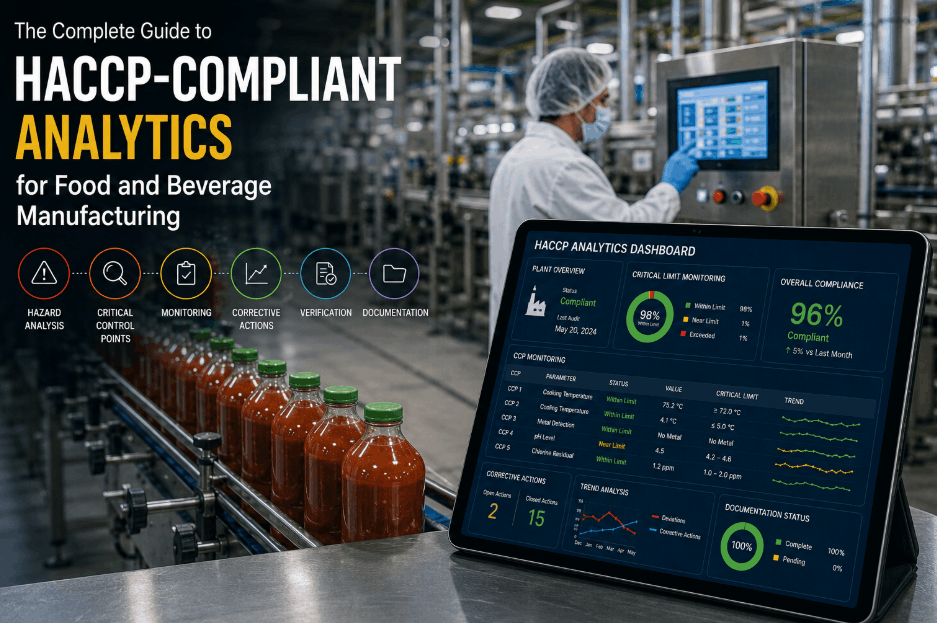
AI implementation in FMCG manufacturing must align with existing HACCP plans and food safety management systems. This requires configuring AI workflows to monitor critical control points, trigger corrective actions automatically, and generate compliance documentation that meets FDA, GFSI, and internal audit requirements. Food manufacturers can request a demo to see pre-built HACCP workflow templates for common FMCG product categories including dairy, bakery, ready-to-eat foods, beverages, and protein processing.
CCP Monitoring Automation and Real-Time Deviation Detection
AI systems continuously monitor every critical control point and compare real-time measurements against HACCP limits. When deviations occur, the platform automatically initiates corrective action workflows, logs the event with verified timestamps, and escalates to quality personnel if operator response is not detected within defined timeframes. This automation converts reactive HACCP monitoring into proactive deviation prevention—identifying trend patterns that indicate an upcoming limit breach before it occurs.
Automated Compliance Documentation and Audit Trail Generation
AI platforms generate continuous compliance records that document every CCP measurement, deviation event, corrective action, and verification activity. These records are inspector-ready and exportable in formats that meet regulatory requirements. Facilities that implement automated compliance logging reduce audit preparation time from 4–6 days to under 18 hours while improving documentation accuracy and completeness.
| Food Safety Process | Traditional HACCP Approach | AI-Enabled Workflow | Implementation Complexity |
|---|---|---|---|
| CCP Temperature Monitoring | Manual log entry every 2–4 hours | Continuous automated monitoring with predictive alerts | Low—direct sensor integration |
| Pathogen Risk Detection | 24–72 hr microbiological testing | Real-time environmental risk scoring | Medium—requires environmental sensors |
| Allergen Changeover Validation | Visual inspection + ATP swabbing | AI-driven cleaning verification with residue prediction | Medium—requires swab data integration |
| Supplier Ingredient Screening | Manual COA review at receiving | Automated lot-level risk scoring with rejection workflow | High—requires supplier data feeds |
| Sanitation Effectiveness | Post-CIP testing, 24–48 hr results | Real-time ATP trend analysis with predictive failure alerts | Low—ATP sensor integration |
| Compliance Record Generation | Manual compilation for audits, 3–5 days | Continuous automated logging, inspector-ready exports | Low—built into platform |
GMP Compliance Configuration: Aligning AI Systems with Good Manufacturing Practices
AI deployment in food manufacturing must support and enhance GMP compliance rather than creating new compliance gaps. This requires configuring AI workflows to enforce personnel hygiene monitoring, environmental condition control, sanitation verification, and traceability requirements mandated by GMP regulations. FMCG facilities implementing AI systems must ensure every automated decision and recommendation aligns with documented GMP procedures.
Personnel Hygiene and Zoning Enforcement Through AI
AI platforms integrated with access control systems can enforce hygiene protocols by tracking personnel movement between zones, verifying handwashing compliance, and monitoring gowning procedures. When violations occur, the system can prevent zone entry, trigger supervisor alerts, and log the incident for GMP compliance records. This automation eliminates manual enforcement gaps while reducing contamination risk from human error.
Environmental Monitoring and Automated GMP Deviation Response
AI systems monitor environmental conditions across production zones—temperature, humidity, air pressure differentials, particle counts, and microbial load. When conditions drift outside GMP-defined ranges, the platform automatically initiates corrective action workflows including HVAC adjustments, enhanced monitoring protocols, and production hold decisions if conditions breach critical thresholds. Manufacturers who book a demo can review how AI environmental monitoring integrates with existing GMP programs and building management systems.
Automated Hand Hygiene Compliance Monitoring
AI-enabled handwashing stations verify compliance through sensor verification and badge integration. The system tracks individual compliance rates, triggers retraining for repeat violators, and generates GMP audit-ready documentation automatically.
AI-Driven Zone Access and Cross-Contamination Prevention
Access control systems integrated with AI platforms enforce zone segregation rules, prevent unauthorized cross-zone traffic, and log all personnel movements for GMP traceability. Violations trigger immediate alerts and supervisor escalation.
Predictive Sanitation Effectiveness Scoring
AI models analyze ATP trends, cleaning chemical usage, water quality, and CIP cycle parameters to predict sanitation effectiveness before verification testing. This enables proactive re-cleaning interventions that prevent GMP deviations.
Staff Training and Change Management: Building AI Competency Across FMCG Operations
Successful AI implementation requires comprehensive training programs that build technical competency, operational confidence, and organizational trust in AI-driven decision-making. FMCG manufacturers must train multiple stakeholder groups—production operators, quality managers, maintenance technicians, and plant leadership—each requiring role-specific AI literacy and workflow proficiency.
Role-Based Training Curriculum Design
Training programs should be segmented by role with curriculum tailored to each group's interaction with AI systems. Production operators need workflow execution training focused on responding to AI alerts and verifying system recommendations. Quality managers require deeper training on model performance evaluation, threshold calibration, and compliance reporting. Maintenance teams need predictive maintenance dashboard proficiency and work order prioritization based on AI failure predictions. Leadership requires strategic training on ROI tracking, continuous improvement opportunities, and system expansion planning.
Hands-On Simulation and Production Pilot Programs
Before full deployment, conduct hands-on training in simulation environments that replicate production scenarios without impacting actual operations. Follow simulation training with limited production pilots on non-critical lines where staff can gain confidence working alongside AI systems with reduced risk. Plants that invest in thorough simulation and pilot training achieve 85%+ staff adoption rates within the first 90 days of full deployment compared to 45–60% adoption in facilities that skip these preparation phases.
Foundation Training: AI Literacy and System Overview
Introduce all stakeholders to AI fundamentals, platform capabilities, and implementation goals. Cover how AI models learn from production data, what decisions the system automates, and where human judgment remains essential. Establish baseline AI literacy across the organization.
Role-Specific Workflow Training
Deliver targeted training by role covering specific workflows each group will execute. Operators learn alert response procedures. Quality teams learn deviation analysis and compliance reporting. Maintenance learns predictive work order management. Include hands-on practice in simulation environment.
Production Pilot and Live Support
Launch limited production pilot on selected lines with intensive on-floor support. Trainers work alongside staff during shifts to reinforce workflows, troubleshoot issues, and build confidence. Collect feedback to refine training materials and address knowledge gaps before full deployment.
AI Implementation Timeline: A Phased Deployment Strategy for FMCG Manufacturing
Effective AI rollout follows a structured timeline that builds capability incrementally while minimizing production disruption. The roadmap below reflects typical deployment phases for mid-size FMCG facilities implementing comprehensive AI systems across quality, maintenance, and operational intelligence functions.
Discovery and Planning
Conduct readiness assessment, build asset registry, map data infrastructure, and design implementation roadmap. Establish project governance, define success metrics, and secure stakeholder alignment on deployment scope and timeline.
Infrastructure Setup and Integration
Deploy additional sensors as needed, integrate data sources, establish data historian, and configure core platform. Connect PLC/SCADA, LIMS, ERP, and quality systems. Complete baseline data collection for model training.
Model Training and Workflow Configuration
Train AI models on historical production data, calibrate alert thresholds, configure food safety workflows, and build compliance reporting templates. Conduct simulation testing and refine model parameters based on facility-specific patterns.
Staff Training and Pilot Deployment
Execute role-based training programs, conduct hands-on simulation exercises, and launch production pilot on selected lines. Provide intensive on-floor support during pilot phase and collect feedback for workflow refinement.
Full Production Deployment
Roll out AI systems across all production lines. Activate predictive maintenance, food safety monitoring, and compliance automation. Transition from pilot support to standard operational model with ongoing optimization and continuous improvement.
Optimization and Expansion
Refine model performance based on production results, expand monitoring coverage, integrate additional workflows, and pursue continuous improvement opportunities. Measure ROI, track KPIs, and plan expansion to additional facilities.
AI Implementation Challenges in FMCG: Addressing Common Barriers to Successful Deployment
FMCG manufacturers encounter predictable obstacles during AI implementation. Understanding these challenges in advance allows project teams to build mitigation strategies into deployment plans. The barriers below represent the most frequently encountered issues across food and beverage AI rollouts.
Legacy System Integration Complexity
Older production equipment often lacks native IoT connectivity or uses proprietary communication protocols that resist integration. This requires retrofit sensor deployment, protocol conversion middleware, or manual data entry workflows that reduce automation benefits.
Data Quality and Completeness Issues
AI models require clean, consistent, complete data for accurate predictions. Many FMCG facilities discover their historical data contains gaps, inconsistencies, and quality issues that prevent reliable model training. Poor data quality produces unreliable AI recommendations that erode user trust.
Organizational Resistance and Change Fatigue
Production floor staff may resist AI-driven workflows due to technology skepticism, fear of job displacement, or past negative experiences with poorly implemented automation projects. Without strong change management, even technically successful AI deployments fail to achieve adoption.
False Alert Fatigue and Trust Erosion
Poorly calibrated AI systems generate excessive false alerts that train operators to ignore recommendations. Once trust erodes, recovering credibility requires months of demonstrated accuracy—significantly delaying ROI realization and adoption progress.
Deploy AI Systems Purpose-Built for Food Manufacturing Operations
iFactory's AI platform delivers pre-configured FMCG workflows, automated asset registry, GMP-aligned monitoring, and comprehensive training programs—designed specifically for food and beverage manufacturers navigating AI implementation.
AI Implementation Best Practices: Proven Strategies for FMCG Success
Successful AI implementations in food manufacturing share common characteristics that separate high-performing deployments from projects that stall or underdeliver. These best practices reflect lessons learned across dozens of FMCG AI rollouts spanning beverage, dairy, bakery, protein, and ready-to-eat manufacturing environments.
Start with High-Value, Low-Complexity Use Cases
Launch AI deployment with workflows that deliver measurable ROI quickly while requiring minimal integration complexity. Temperature monitoring automation, predictive maintenance on instrumented equipment, and automated compliance logging typically offer this combination. Early wins build organizational confidence and secure budget for more ambitious phases.
Establish Clear Success Metrics Before Deployment
Define measurable KPIs that demonstrate AI value to stakeholders. These might include: reduction in unplanned downtime, decrease in quality deviations, improvement in compliance documentation time, or increase in OEE. Track baseline performance before implementation to demonstrate improvement objectively.
Invest in Comprehensive Training and Support
Allocate 15–20% of total implementation budget to training and change management. Provide role-specific curriculum, hands-on simulation practice, and intensive on-floor support during go-live. Facilities that skimp on training investment experience adoption rates 40–50% lower than those with robust programs.
Build Feedback Loops for Continuous Model Improvement
Establish processes for operators and quality teams to provide feedback on AI recommendations. When the system makes incorrect predictions, capture those events and feed them back into model training. AI accuracy improves continuously only when feedback mechanisms exist to correct errors and refine decision logic. Manufacturers can book a demo to see how feedback collection and model retraining workflows integrate into daily operations.
Plan for Scalability from Day One
Design data architecture, platform selection, and integration patterns with multi-facility expansion in mind even if initial deployment targets a single plant. Retrofitting scalability after deployment is significantly more expensive than building it into the foundation. Consider how workflows, asset registries, and training materials can be replicated across additional sites.
AI Implementation KPIs: Measuring Success in FMCG Manufacturing
Tracking the right performance indicators allows project teams to demonstrate AI value, identify optimization opportunities, and secure continued investment. The benchmarks below represent typical results achieved within 12 months of full AI deployment across food and beverage manufacturing operations.
AI Implementation for FMCG — Frequently Asked Questions
How long does a typical AI implementation take in FMCG manufacturing?
Full AI deployment in mid-size FMCG facilities typically requires 20–28 weeks from project kickoff to production go-live. This includes readiness assessment, infrastructure setup, model training, staff training, and pilot deployment. Facilities with strong existing data infrastructure can sometimes compress this timeline to 14–18 weeks.
What data infrastructure is required before AI implementation can begin?
AI systems require continuous data streams from production equipment, quality systems, and environmental sensors. Minimum infrastructure includes PLC/SCADA connectivity, environmental monitoring sensors at critical zones, and integration with LIMS or quality management systems. Most FMCG facilities have 60–75% of required infrastructure already in place.
How do AI systems maintain compliance with HACCP and GMP requirements?
AI platforms are configured to enforce HACCP plans and GMP procedures rather than override them. All automated decisions follow documented food safety protocols, and the system generates verified compliance records that meet FDA and GFSI audit requirements. AI enhances compliance through continuous monitoring and automated documentation—not by replacing established procedures.
What level of staff training is required for AI system adoption?
Comprehensive training programs typically require 2–3 weeks per role group and include foundation AI literacy, role-specific workflow training, and hands-on simulation practice. Production operators need 12–16 hours of training, quality managers require 20–24 hours, and maintenance technicians need 16–20 hours. Leadership teams receive 8–12 hours of strategic training on ROI tracking and continuous improvement.
Can AI systems integrate with legacy production equipment?
Yes, though integration complexity varies by equipment age and manufacturer. Modern equipment with IoT-enabled controllers integrates directly. Older equipment may require retrofit sensors, protocol conversion middleware, or edge computing devices to enable connectivity. Pre-implementation equipment audits identify integration requirements and budget implications.
What ROI should FMCG manufacturers expect from AI implementation?
Typical payback periods range from 12–18 months driven by reduced unplanned downtime, lower quality deviation rates, decreased compliance labor, and improved OEE. Facilities that prevent even one major recall event through AI-enabled food safety monitoring often recover total implementation investment in a single year.