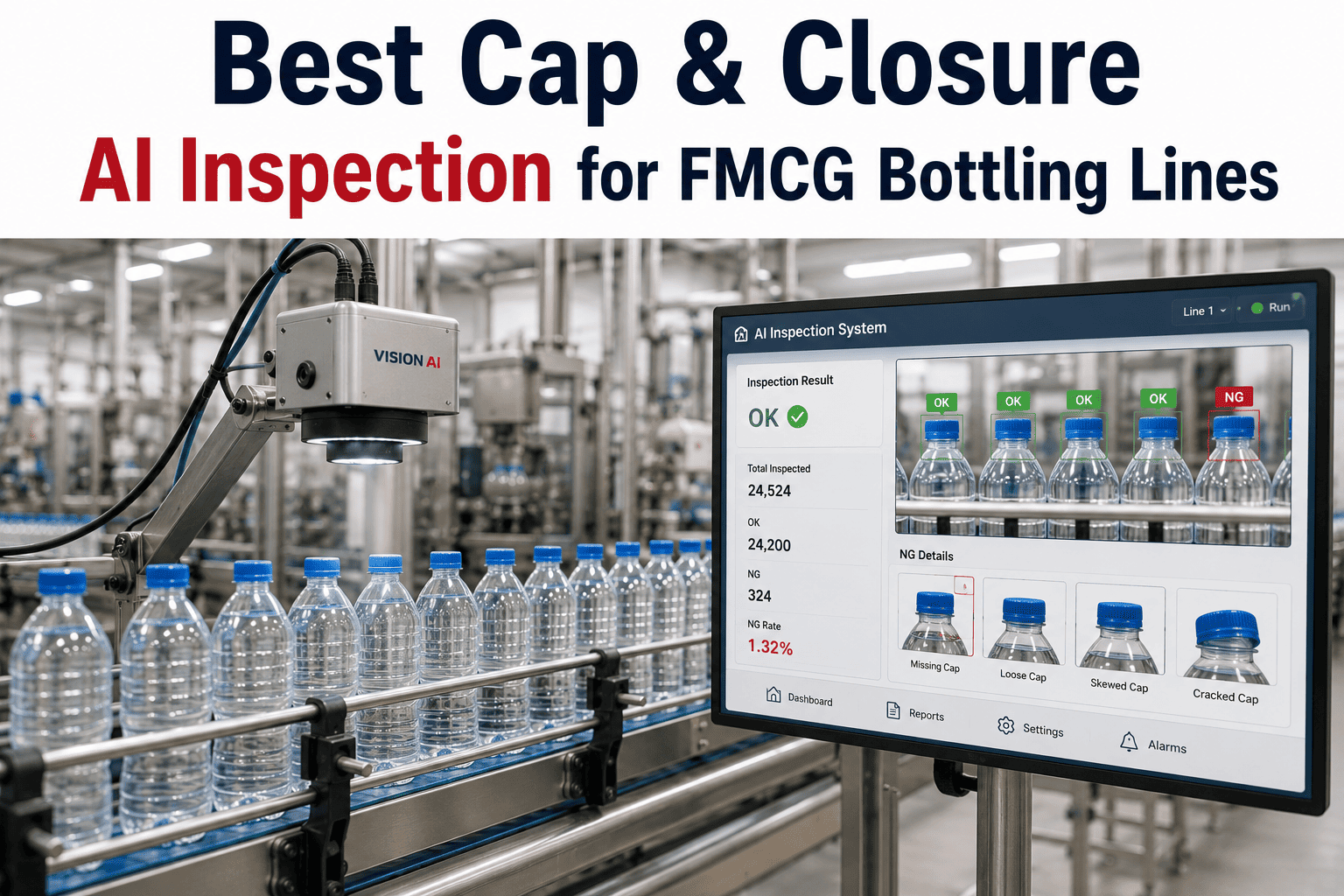
Material feeding problems are the most under-diagnosed category of downtime on an FMCG line, because each stoppage looks small enough to wave off as an operator adjustment rather than a pattern worth tracing. A bulk ingredient feeder that chokes every forty minutes, a film roll that drifts out of tension on a flow wrapper, a cap sorter that jams on an orientation it should never see, and a closure feed track that starves the capper all read as separate nuisances on the floor log. In practice they trace back to a short list of repeating root causes across material condition, mechanical wear, and changeover drift, and treating them as one category rather than four unrelated annoyances is what turns a diagnosis into a fix. Plants that want this mapped against their own feeders and sorters can walk a feed line through this diagnostic with the iFactory AI team.
Diagnose Bulk Feed, Film Tension, Cap Sorter and Closure Feed Issues Before They Cost a Shift
iFactory AI turns recurring feeder micro-stops into a structured diagnosis, separating material variance from mechanical wear across bulk feeders, film unwinders, cap sorters, and closure tracks on a packaging line, so maintenance stops guessing and starts narrowing.
Why Feeding Micro-Stops Get Misdiagnosed
Feeding stops rarely trigger a formal investigation because each one lasts only seconds to a few minutes. Strung together across a shift, though, they are often the single largest source of unplanned stop time on a packaging line, outweighing the larger mechanical breakdowns that actually get a maintenance ticket and a root-cause review.
Logged as No Fault Found
An operator clears a jam in seconds and moves on. Without a reason code attached, the stop disappears into a generic bucket that tells maintenance nothing about why it happened. Over a month, dozens of these unrecorded clears can represent more lost output than a single major breakdown that actually gets investigated.
Blamed on the Operator
A recurring jam at the same station often gets labeled a training issue, when the underlying cause is a worn guide, a stale calibration, or a material batch that changed without anyone noting it. Retraining the operator rarely fixes a jam that a worn part or a shifted material lot is actually causing.
Treated One Stop at a Time
Each jam gets cleared on its own instead of being compared against the last twenty jams at that station, so a pattern that would be obvious in aggregate stays invisible shift to shift. A pattern that spans three shifts is easy to miss when each shift only sees its own slice of the data.
Feed Issue, Symptom, and First Diagnostic Check
Before assuming a feeder needs mechanical repair, a short diagnostic check against the symptom usually narrows the cause to material, calibration, or wear in under a minute.
| Feed Type | Common Symptom | Typical Root Cause | First Check |
|---|---|---|---|
| Bulk Hopper Feed | Flow surges then stalls | Bridging or rat-holing in the hopper | Fill level and vibration setting |
| Vibratory Feeder | Inconsistent fill weight | Amplitude drift from wear or buildup | Tray amplitude against baseline |
| Film Unwinder | Wrinkling or seal failure | Tension drifting outside band | Dancer arm travel and roll diameter |
| Cap Sorter Bowl | Jam at the orientation gate | Mixed batch or static cling | Cap lot number and humidity |
| Closure Feed Track | Track runs empty intermittently | Elevator feed rate mismatch | Track level sensor trend |
| Label Applicator Feed | Skipped or doubled labels | Web tension or sensor misread | Peel edge angle and sensor gain |
A first check that takes under a minute is usually enough to tell a material problem apart from a mechanical one, which changes who gets called and how long the line stays down.
Clearing a Jam Versus Diagnosing One
Most lines already clear feed jams quickly. The gap is rarely speed of response, it is whether the clearance leaves behind any record a maintenance team can actually learn from.
Clearing the Jam
Diagnosing the Jam
The clearance step takes the same ten seconds either way. The only added work is tagging the zone and symptom, which is what turns a week of jams into a pattern someone can actually fix.
How Feed Behavior Differs by Material Category
A feeder tuned well for one material category rarely performs the same way on another, because powders, liquids, rigid caps, and flexible film each fail for different physical reasons under the same symptom of a stopped line.
Powders and Granules
Fine powders bridge and compact under their own weight, while coarser granules tend toward segregation instead, so a fix tuned for one often makes the other worse rather than better. The feeder setting that stops one material from bridging can actually accelerate segregation in the other, which is why a single universal setting rarely works across a plant's full ingredient list.
Liquids and Pastes
Viscosity shifts with temperature far more than most lines account for, so a filler calibrated in the morning can drift out of spec by afternoon without a single mechanical part changing. A seasonal temperature swing in the plant can produce the same drift, which is why viscosity should be checked before a pump or valve is replaced.
Rigid Caps and Closures
Mold-to-mold variation, static cling, and bowl speed all interact, and a sorter tuned against one cap lot's tolerances can jam repeatedly on the next lot for reasons no one logged. Without a lot number attached to each jam, this interaction is nearly impossible to separate from a genuine mechanical fault after the fact.
Flexible Film and Labels
Roll diameter, ambient humidity, and print registration all shift tension and feed behavior together, which is why film issues often look inconsistent even when nothing on the machine has changed. A roll that ran cleanly last week can behave differently this week purely because the plant's humidity shifted with the season.
Grouping feed diagnostics by material category, rather than by machine type alone, is what lets a maintenance team reuse a diagnosis across lines running the same ingredient or packaging format.
Bulk Material Feed Variance
Bulk feeders for powders, granules, and small components fail in patterns that repeat across ingredient types once the hopper geometry and material behavior are understood.
Hopper Bridging
Vibratory Amplitude Drift
Ingredient Moisture Swing
Most bulk feed variance is a material condition problem wearing a mechanical disguise, which is why checking the lot and the humidity log before opening the feeder saves the most time, and why mechanics who skip that step often replace parts that were never actually worn.
Film Tension Problems on Wrappers and Form-Fill-Seal
Film tension sits in a narrow working band, and a line can drift out of it in either direction without anyone changing a setting on purpose.
Wrinkling and Seal Gaps
A dancer arm riding too low lets film ripple into the seal jaw, producing a weak or incomplete seal that only shows up once the pack is handled downstream.
Tearing and Registration Drift
Excess tension stretches the film past its print registration mark, causing the printed graphic to shift relative to the pack and the web to tear at a weak point in the roll.
Roll Diameter Compensation Lag
As a roll unwinds, braking torque needs to adjust continuously. A compensation curve that was never recalibrated for the current roll size drifts tension across the length of the roll.
A film tension problem that only appears near the end of a roll, rather than from the start, almost always points to the diameter compensation curve rather than the dancer arm itself, so recalibrating the arm alone will not resolve a drift that only shows up late in the roll.
See Your Own Feeder Data Diagnosed Live
Book a 30-minute session and watch iFactory AI read micro-stop patterns from your bulk feeders, wrappers, cap sorters, and closure tracks to separate material issues from mechanical wear.
Cap Sorter Jams at the Orientation Gate
A cap or closure sorter jam almost never comes from a single bad part. It comes from a condition in the bowl that makes a small share of caps unreadable to the orientation gate.
Mixed Cap Batches
A new cap lot with a slightly different mold or wall thickness changes how it sits in the gate track, jamming at a rate the previous lot never produced. The mold itself may be within spec, yet the small dimensional shift is enough to change how the gate reads the cap.
Static Cling
Low humidity lets caps cling together in the bowl, feeding two at once into a gate built to read one, which jams the track within seconds of startup. This pattern is often most visible during the first hour of a cold-weather shift, before the plant's humidity has stabilized.
Bowl Speed Mismatch
A bowl running faster than the downstream track can accept creates a backlog at the gate, and the backlog itself causes the jam the speed was supposed to prevent. Slowing the bowl rather than speeding it up is often the counterintuitive fix that actually resolves this kind of jam.
Worn Orientation Rail
A rail that has worn past its tolerance lets misoriented caps pass the first check and jam one station further down, where the real cause is harder to trace. Because the jam shows up downstream of the actual wear, maintenance teams often replace the wrong component first.
Logging the cap lot number against every sorter jam for even one week is usually enough to show whether the problem is a material batch or a wearing part. Ask about lot-linked jam tracking for your sorter.
Closure Feed Track Starvation
A capper that runs out of closures is rarely a supply problem. It is almost always a mismatch somewhere between the elevator feed rate and what the capper is actually consuming.
Track Empty Alarm Ignored
Elevator Feed Rate Mismatch
Changeover Not Recalibrated
Vibration Dislodging Orientation
Before and After: A Composite Line Scenario
A composite FMCG packaging line ran bulk feeding, film wrapping, and cap sorting with no shared diagnostic process. The figures below are an illustrative composite, shown as a relative index with the starting point set at 100.
Most of the reduction came from catching material-condition causes, like moisture and lot variance, before they were escalated as mechanical failures requiring a technician.
A Five-Step Diagnostic Path for Any Feed Stop
The same five steps apply whether the stop happened at a bulk hopper, a film unwinder, a cap sorter, or a closure track, which is what makes the path repeatable across an entire packaging line.
Identify the Stop Pattern
Check whether the stop is isolated or part of a recurring sequence at the same station across the shift, rather than reacting to it as a one-time event. A single isolated stop may genuinely be nothing, but the same stop twice in one shift is worth a closer look before it becomes a pattern no one tracked.
Isolate the Feed Zone
Narrow the stop to a specific zone, such as the hopper throat, the dancer arm, the sorter gate, or the elevator, instead of treating the whole station as suspect. Naming the zone, not just the machine, is what makes the next step of the diagnosis fast instead of a guessing exercise.
Check Material Condition First
Compare the current lot, humidity, or roll diameter against the baseline before assuming a mechanical fault, since material condition is the faster and more common cause. This step takes only a minute and rules out the most common cause before any tool gets picked up.
Check Mechanical Wear Second
If material condition checks out, inspect the component most likely to drift with use, such as a rail, a tray, or a dancer bearing, against its commissioning baseline. Comparing against a documented baseline, rather than a general sense of how the part looks, is what turns an inspection into an actual measurement.
Apply the Fix and Log the Cause
Clear the stop, but record the actual cause against the reason code, so the next occurrence at that station starts from a pattern instead of a blank slate. This is the step most lines skip under time pressure, and it is the single step that makes every future stop at that station faster to diagnose.
Logging the real cause, not just clearing the jam, is the single step most lines skip, and it is the one that turns a diagnosis into a pattern worth acting on. See this path applied to your own feed data.
Feeding Diagnosis Self-Check
Use these ten checks to see whether feed stops on your line are being diagnosed or simply cleared.
Each unchecked box is a place where the same feed stop will repeat next week, costing the same minutes for the same undiagnosed reason.
Frequently Asked Questions
How do I tell a material feed problem from a mechanical one?
Start with what changed. If a new lot, humidity shift, or roll change lines up with the stop, treat it as material first. If the stop happens regardless of lot or batch, it is more likely a worn component drifting from its baseline. Ask the iFactory AI team to review your stop log.
Why does a cap sorter jam more on some lots than others?
Cap molds and wall thickness vary slightly between production runs, even within the same specification, and a sorter gate tuned tightly for one lot can read a different lot as misoriented. Logging the lot number against every jam usually confirms this pattern within about a week of normal production, without needing any new sensor on the sorter itself.
Does film tension need to be recalibrated for every roll?
Not for every roll, but the diameter compensation curve does need periodic verification, since tension genuinely drifts as the roll unwinds from full to empty. A line that only sees tension issues near the end of a roll, rather than from the first wrap, usually has a compensation curve problem rather than a dancer arm problem worth adjusting.
How quickly can a feed diagnosis process be set up on an existing line?
Most lines can start logging zone-level stop reasons within a single shift, since it mainly requires agreeing on reason codes rather than installing new hardware. Set up a feed diagnosis walkthrough for your own line in a short call.
Can one system track bulk feed, film tension, cap sorting, and closure feed together?
Yes, provided the system captures zone-level stop data and material lot context across all four feed types rather than treating each machine as a separate silo with its own log and its own reason codes. A shared view across the line is what actually surfaces cross-machine patterns, such as a humidity swing that affects both the hopper and the cap sorter on the same shift.
Get Your Feed Stops Diagnosed, Not Just Cleared
iFactory AI captures zone-level feed data across bulk hoppers, film unwinders, cap sorters, and closure tracks, separating material variance from mechanical wear automatically. Book a walkthrough built around your own line.