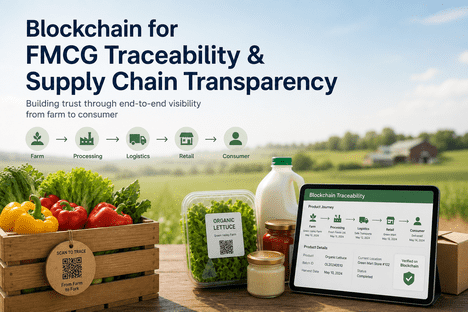
Foodborne illness outbreaks cost the global food industry an estimated $110 billion each year in medical expenses, legal liability, product recalls, and brand damage. In the United States alone, the average food recall costs a company $10 million in direct expenses, not counting long-term revenue loss from eroded consumer trust. The root cause in nearly every case is the same: supply chain data that is fragmented across paper records, incompatible digital systems, and manual handoffs that create weeks-long delays in identifying contamination sources. Blockchain-enabled traceability solves this by creating an immutable, shared record of every transaction across the FMCG supply chain — from farm to processing facility to distribution center to retail shelf. iFactory AI's blockchain traceability module integrates with existing ERP, warehouse management, and quality control systems to create a tamper-proof audit trail that reduces recall trace-back time from weeks to seconds. Book a Demo to see how blockchain traceability transforms your FMCG supply chain transparency.
From Farm to Fork: Immutable Traceability for Every Transaction in Your FMCG Supply Chain
iFactory's blockchain traceability platform connects growers, processors, distributors, retailers, and regulators on a single permissioned ledger — delivering real-time provenance verification, automated recall response, and fraud prevention for FMCG supply chains.
Why Traditional FMCG Traceability Fails When It Matters Most
The modern FMCG supply chain spans dozens of organizations — growers, processing facilities, co-packers, logistics providers, distributors, and retailers — each maintaining its own record-keeping system. When a contamination event occurs, the investigative team must manually trace the affected product backward through each organization's records, a process that typically takes 7 to 14 days. By the time the source is identified, the contaminated product has moved further through the supply chain, widening the recall and increasing consumer health risk. Traditional centralized databases cannot solve this problem because no single organization controls every step of the chain, and paper-based or siloed digital systems create data gaps that render rapid trace-back impossible.
7 to 14 day trace-back delays during contamination events
When a food safety incident occurs, every hour matters. Traditional manual trace-back across fragmented supplier records takes days or weeks — during which contaminated products continue moving through the supply chain, widening recall scope and increasing consumer exposure.
Data tampering and fraud vulnerability in centralized systems
Centralized databases controlled by a single organization create single points of failure for data integrity. Records can be altered retroactively, audit trails can be manipulated, and fraudulent suppliers can inject falsified documentation without detection — eroding trust across the entire supply chain.
Siloed systems across grower, processor, distributor, and retailer organizations
Each participant in the FMCG supply chain maintains its own ERP, WMS, or quality management system — none of which communicate with each other. A grower's lot number, a processor's batch code, and a distributor's SKU may refer to the same product, but no integrated system connects them for end-to-end traceability.
Consumer trust erosion and regulatory pressure for transparency
Consumers increasingly demand visibility into product origin, ingredient sourcing, and ethical production practices. Regulatory bodies including the FDA (FSMA Section 204), EU Food Information Regulation, and global food safety standards are mandating electronic traceability — making blockchain deployment a compliance imperative, not an optional investment.
Manual compliance reporting for FSMA, EU FIR, and GFSI standards
Food safety compliance documentation for FSMA Section 204 Traceability Rule, EU Food Information Regulation, and GFSI-recognized certification standards (BRC, FSSC 22000, SQF) requires manually compiling traceability records across multiple supplier systems — consuming hundreds of person-hours annually per facility.
Six Capabilities That Transform FMCG Supply Chain Transparency
iFactory's blockchain traceability platform integrates with your existing ERP, WMS, and quality control systems to create a permissioned Hyperledger Fabric-based ledger purpose-built for FMCG supply chain requirements. The platform delivers six interconnected capabilities that collectively transform traceability from a reactive compliance exercise into a proactive operational advantage.
Immutable Batch-Level Recording
Every production batch receives a unique digital batch ID recorded on the blockchain at the point of origin. Subsequent supply chain events — processing, packaging, cold chain handoffs, distribution — append records to the same immutable batch history.
Smart Contract Verification
Smart contracts automatically verify each supply chain transaction against predefined business rules — confirming temperature compliance, inspection certifications, chain-of-custody documentation, and regulatory requirements before appending to the ledger.
Real-Time Provenance Queries
Authorized stakeholders — suppliers, retailers, regulators, and consumers — can query the complete provenance history of any batch in under two seconds via dashboard or API, viewing every transaction from farm origin to retail shelf.
Automated Recall Response
When a contamination event is detected, the platform instantly identifies all affected batches, their current locations across the supply chain, and all downstream recipients — enabling targeted recalls that reduce scope by up to 63% compared to blanket recalls.
Fraud Prevention & Anomaly Detection
Smart contract-based fraud scoring evaluates each transaction for inconsistencies, duplicate entries, out-of-sequence events, and unauthorized modifications. Fraud detection accuracy reaches 95% in deployed systems using pattern-based anomaly detection.
Automated Regulatory Reporting
FSMA Section 204 Traceability Rule records, EU Food Information Regulation documentation, and GFSI certification audit trails are generated automatically from blockchain ledger data — eliminating manual compilation and reducing regulatory reporting time by 90%.
Traditional FMCG Traceability vs. Blockchain-Enabled Traceability
Without Blockchain
- Trace-back during contamination events takes 7–14 days of manual record chasing across suppliers
- Centralized databases vulnerable to retroactive data manipulation and unauthorized modifications
- No single view of batch provenance across grower, processor, distributor, and retailer systems
- Recall response requires blanket notification — 100% of product pulled regardless of actual contamination scope
- Supplier certifications, lab results, and inspection reports maintained in separate, non-integrated systems
- Compliance documentation assembled manually from emails, spreadsheets, and paper records before each audit
- Consumer trust limited by opaque supply chain visibility — no mechanism to verify product claims
With iFactory Blockchain
- Trace-back completed in under 2 seconds — every batch transaction visible on the immutable ledger
- Cryptographically signed, tamper-proof records on a permissioned blockchain — zero retroactive alteration
- Unified provenance view across every supply chain participant — from farm lot to retail UPC
- Targeted recall identifies exact affected batches, current locations, and downstream recipients — 63% scope reduction
- Supplier certifications, COAs, and inspection reports recorded on-chain with smart contract validation
- FSMA, EU FIR, and GFSI compliance reports generated automatically from blockchain ledger data
- Consumer-facing QR code provenance provides verifiable product origin and handling transparency
See Blockchain Traceability Running on a Live FMCG Supply Chain Configuration
iFactory's blockchain traceability platform is deployed on Hyperledger Fabric with on-chain/off-chain data partitioning for enterprise scalability. Book a demo to see the provenance dashboard, smart contract verification, and automated recall response modules running on actual FMCG supply chain data.
Blockchain Traceability Value by FMCG Sub-Sector
The value drivers for blockchain traceability vary across FMCG sub-sectors based on product perishability, regulatory requirements, supply chain complexity, and consumer transparency demand. The table below compares the primary traceability value across major FMCG categories.
| FMCG Sub-Sector | Primary Traceability Driver | Key Regulatory Framework | Critical Blockchain Capability | Est. Recall Cost Reduction |
|---|---|---|---|---|
| Fresh Produce | Farm-to-fork provenance; contamination source identification | FDA FSMA Section 204; EU FIR | Real-time batch tracking from harvest to retail | 55–70% |
| Dairy & Perishables | Cold chain integrity; shelf-life management | FDA Pasteurized Milk Ordinance; HACCP | IoT temperature integration with smart contract verification | 45–60% |
| Beverages | Ingredient authenticity; counterfeiting prevention | FDA FSMA; TTB compliance | Fraud scoring and anomaly detection | 40–55% |
| Packaged Foods | Supplier certification; allergen cross-contact tracking | FDA FSMA; GFSI (BRC/FSSC 22000/SQF) | Supplier document verification via smart contracts | 50–65% |
| Meat & Poultry | Full chain-of-custody; USDA traceability compliance | USDA FSIS; COOL requirements | Immutable chain-of-custody from slaughter to retail | 60–75% |
iFactory Blockchain Traceability Platform — Architecture and Deployment
iFactory deploys a permissioned Hyperledger Fabric-based blockchain infrastructure designed specifically for enterprise FMCG supply chain requirements — supporting private transactions between trading partners, on-chain/off-chain data partitioning for scalability, and integration with existing ERP, WMS, and IoT sensor systems.
Multi-Source Integration & On-Chain/Off-Chain Partitioning
The platform ingests data from ERP systems (SAP, Oracle, Microsoft Dynamics), warehouse management systems, IoT temperature/humidity sensors, laboratory information management systems, and supplier portals. Critical traceability data — batch IDs, transaction records, certification hashes, and chain-of-custody events — is recorded on-chain. High-volume environmental sensor data, laboratory COAs, and shipping manifests are stored off-chain with cryptographic hash pointers on the blockchain to ensure data integrity while maintaining scalability. Throughput exceeds 200 transactions per second on a 4-node Fabric network, with block finalization under 3.2 seconds.
Automated Verification, Fraud Detection & Recall Execution
Smart contracts deployed on the Fabric channel enforce business rules for each supply chain transaction type — verifying that cold chain temperature records fall within specified ranges before releasing shipments, validating that supplier certifications are current before accepting raw materials, and checking that chain-of-custody documentation is complete before processing payments. Fraud detection smart contracts calculate a fraud score for each transaction based on pattern analysis, flagging anomalies for human review. When contamination is confirmed, recall smart contracts automatically identify affected batches, generate notification lists for downstream recipients, and trigger hold orders in connected WMS systems.
Provenance Dashboard, Compliance Reporting & Consumer Portal
The application layer provides role-specific interfaces: supply chain managers access a real-time provenance dashboard with batch-level drill-down, quality assurance teams receive automated alerts for smart contract verification failures, compliance officers generate FSMA and GFSI audit reports with a single click, and consumers scan QR codes on product packaging to view a verifiable provenance summary — farm origin, processing dates, cold chain records, and certification status — directly from the blockchain ledger.
What Supply Chain and Food Safety Professionals Say About Blockchain Traceability
Over twelve years managing quality and food safety systems across fresh produce, dairy, and packaged foods supply chains, the single most persistent operational failure I observed was not in the physical handling of product — it was in the information handling. The produce supply chain I managed spanned 14 growing regions, 6 packing houses, 3 distribution centers, and a network of 200-plus retailers. When we had a suspected contamination event in the third year, the manual trace-back consumed 11 days of every QA and supply chain person's time across four organizations. We pulled product from every retailer in three states — 47,000 cases — only to confirm after the investigation that the contamination was isolated to a single lot that had been delivered to 12 stores. The cost of that blanket recall was $8.2 million. The contamination cost was zero because the product had never reached consumers. The entire $8.2 million was waste from not being able to trace. We deployed a blockchain traceability pilot the following year on a single commodity category. When a supplier documentation discrepancy was detected by the smart contract six months later, we identified the affected batch, its current location at a single DC, and its downstream allocation to 23 stores — in under 30 seconds. The recall cost was $42,000. That was the moment I understood that blockchain traceability is not a technology project. It is a risk management transformation that directly protects the P&L statement.
— VP Quality & Food Safety, National Fresh Produce and Packaged Foods Distributor — 12 Years Supply Chain Quality Management — SQF Practitioner — PCQI CertifiedBlockchain Traceability Features Purpose-Built for FMCG Supply Chains
The iFactory blockchain traceability platform is pre-configured for FMCG supply chain requirements and integrates with existing enterprise systems without rip-and-replace. The following capabilities are available out-of-the-box and configurable to your specific supply chain structure, regulatory environment, and product categories.
Permissioned Hyperledger Fabric blockchain network
Private, permissioned blockchain infrastructure with multi-channel architecture for confidential trading partner transactions. Participants, roles, and data access permissions are fully configurable per supply chain relationship.
ERP, WMS & LIMS integration adapters
Pre-built integration connectors for SAP S/4HANA, Oracle JD Edwards, Microsoft Dynamics 365, and leading warehouse management and laboratory information management systems — no custom API development required for most deployments.
IoT cold chain sensor integration
Connects to temperature, humidity, and location sensor networks from leading IoT providers — automating cold chain data ingestion, smart contract verification of temperature compliance, and automatic alert generation for out-of-spec conditions.
Consumer-facing QR code provenance portal
Generates scannable QR codes for product packaging that link directly to the blockchain provenance record — allowing consumers to verify product origin, ingredient sourcing, certifications, and handling history from any mobile device.
Automated FSMA Section 204 & GFSI compliance reporting
FSMA Traceability Rule key data elements (KDEs), critical tracking events (CTEs), GFSI certification audit trails, and EU Food Information Regulation records generated automatically from blockchain ledger data — reducing manual reporting time by 90%.
Multi-party smart contract templates for supply chain transactions
Pre-built smart contract templates for common FMCG supply chain transactions — purchase order issuance, goods receipt, quality inspection release, cold chain handoff, and payment milestone — configurable to your specific business rules without custom blockchain development.
Blockchain Traceability Is No Longer Optional — It Is a Competitive and Compliance Necessity
The FSMA Section 204 Traceability Rule, EU Food Information Regulation, and GFSI certification standards are mandating electronic, interoperable traceability across the global food supply chain. At the same time, consumers are demanding verifiable proof of product origin, ingredient authenticity, and ethical sourcing practices. Organizations that continue to rely on paper-based records, siloed digital systems, and manual trace-back processes face escalating regulatory risk, recall cost exposure, and competitive disadvantage.
iFactory's permissioned Hyperledger Fabric blockchain platform delivers the traceability infrastructure that FMCG supply chains need — immutable batch-level recording, smart contract verification, automated recall response, and regulatory reporting — without requiring custom blockchain development or rip-and-replace of existing enterprise systems. Book a Demo to see the provenance dashboard, smart contract verification, and automated FSMA compliance reporting modules running on a live FMCG supply chain configuration.
Common Questions About Blockchain Traceability for FMCG Supply Chains
Build a Tamper-Proof, Audit-Ready Traceability System for Your FMCG Supply Chain
iFactory's permissioned Hyperledger Fabric blockchain platform delivers immutable batch-level traceability, smart contract verification, automated recall response, and FSMA/GFSI compliance reporting — integrated with your existing ERP and WMS systems. Book a demo to see the platform configured for your supply chain structure and regulatory environment.