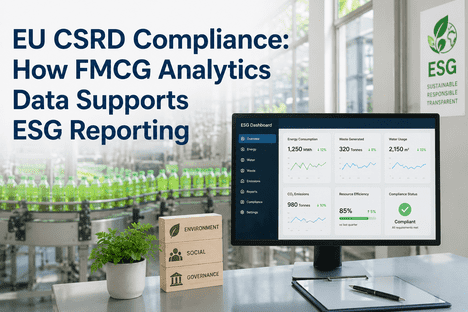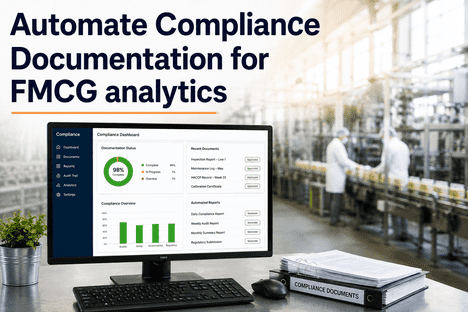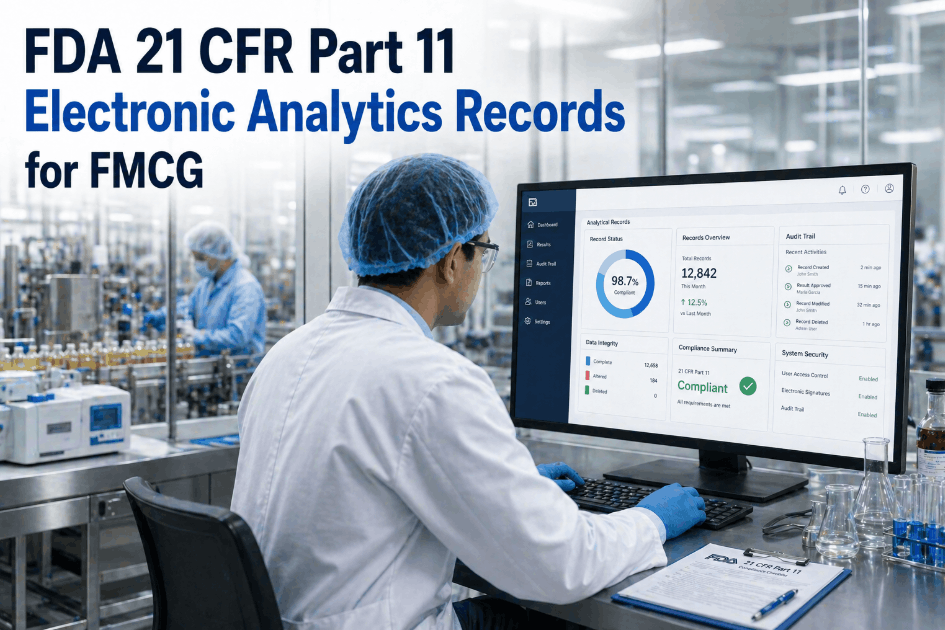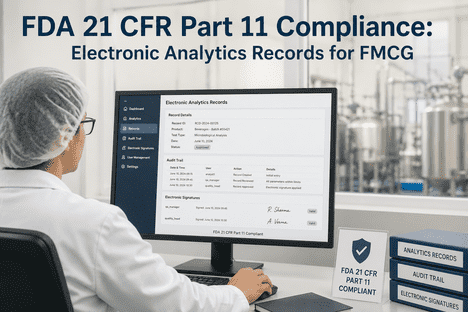
The FDA investigator reviewed the temperature records for the cold-fill line and asked a question that has become the central compliance challenge of the digital age: how do you know these records have not been altered since they were created? For FMCG manufacturers subject to FDA jurisdiction, the answer lies in Title 21 of the Code of Federal Regulations Part 11 — the rule that establishes the criteria under which electronic records and electronic signatures are considered trustworthy, reliable, and legally equivalent to paper records. As food safety and quality management systems move from paper binders to digital platforms, understanding and implementing Part 11 compliance is no longer optional for FMCG facilities that manufacture, pack, or hold food products regulated by the FDA. iFactory AI's audit trail and electronic signature capabilities are purpose-built to meet these requirements, giving compliance teams a platform that treats data integrity as a foundational design principle rather than an afterthought.
FDA 21 CFR Part 11 Compliance: Electronic Records & Signatures for FMCG Analytics
A comprehensive framework for FMCG manufacturers navigating FDA electronic record and signature requirements, with AI-driven audit trails and data integrity controls built into the analytics platform.
What FDA 21 CFR Part 11 Means for FMCG Manufacturers
FDA 21 CFR Part 11 applies to electronic records that are created, modified, maintained, archived, retrieved, or transmitted under any FDA record requirement. For FMCG manufacturers, this encompasses a broad range of systems: electronic quality management platforms, laboratory information systems, production batch records, sanitation logs, supplier documentation, and analytics dashboards that capture CCP monitoring data. The regulation has three fundamental requirements that every electronic record system must satisfy: the data must be trustworthy (integrity), the person generating the record must be verifiable (authentication), and the system must perform as intended (validation). iFactory AI addresses all three pillars through its audit trail engine, electronic signature framework, and system validation toolset. Book a Demo to see how the platform maps each Part 11 requirement to specific system controls.
| Part 11 Requirement | What It Means for FMCG | iFactory AI Implementation |
|---|---|---|
| 11.10(a) — Validation | Systems must be validated to ensure accuracy, reliability, and consistent intended performance. | Built-in validation documentation package including IQ/OQ/PQ protocols, automated test scripts, and change control workflows. |
| 11.10(b) — Audit Trail | Systems must generate secure, computer-generated, time-stamped audit trails of all record creation, modification, and deletion events. | Immutable audit trail logging every data transaction with user ID, timestamp, before/after values, and reason for change. |
| 11.10(c) — Authority Checks | Systems must ensure only authorized individuals can access, modify, or sign electronic records. | Role-based access controls with granular permissions, multi-factor authentication support, and configurable authority matrices. |
| 11.10(d) — Device Checks | Systems must determine the validity of the source of data input or instruction. | Sensor and equipment identity verification at data ingestion, with device-level authentication and calibration status tracking. |
| 11.50 — Electronic Signatures | Electronic signatures must include printed name, date/time, and meaning of signature; must be unique to each individual. | Configurable electronic signature workflows with dual authentication for high-risk actions, unique user credentials, and complete signature manifest. |
| 11.300 — Sign/Record Linking | Electronic signatures must be legally bound to their respective electronic records and cannot be excised, copied, or otherwise transferred. | Cryptographic binding of signatures to records with tamper-evident seals; signature verification tools for audit and inspection readiness. |
Validate Your Part 11 Compliance Readiness
iFactory AI's compliance framework maps every 21 CFR Part 11 requirement to specific system controls. Book a demo to see how your current electronic record processes measure up against FDA expectations.
Data Integrity: The Foundation of Part 11 Compliance
The FDA's data integrity framework rests on the ALCOA+ principles — Attributable, Legible, Contemporaneous, Original, Accurate, plus Complete, Consistent, Enduring, and Available. For FMCG manufacturers managing electronic analytics records, each principle maps to specific system capabilities that iFactory AI implements natively. The platform ensures every data point captured from production equipment, quality inspection stations, and environmental monitoring sensors is attributable to a specific source and operator, recorded at the moment of generation, preserved in its original form, and available for FDA inspection within minutes rather than days. Book a Demo to see how ALCOA+ principles are enforced automatically across your entire electronic record landscape.
Attributable & Legible
Every electronic record in iFactory AI carries a verified source identifier — whether from a PLC, a sensor, a mobile entry by an operator, or an automated analytics calculation. Records are displayed in human-readable format with full context. The platform prevents anonymous data entry and ensures that every action is traceable to a specific individual or device with verified credentials.
Contemporaneous & Original
Data timestamps are generated at the system level at the moment of capture, not at the moment of human entry. Sensor readings, CCP monitoring data, and electronic signatures are all stamped with NTP-synchronized time sources. The original record is preserved in its native format; any subsequent viewing or reporting generates a representation of the original, not a transformation that could alter meaning.
Accurate & Complete
Validation rules at the point of entry prevent out-of-range values, incomplete records, and unauthorized modifications. The audit trail captures all metadata changes including the reason for any amendment. Deletion is either prevented entirely for regulated records or logged with full context including regulatory justification and supervisory approval.
AI-Driven Audit Trails: Beyond the Static Log
Traditional audit trails are passive — they record what happened but provide no analysis of whether the pattern of activity indicates a compliance risk. iFactory AI's analytics-driven audit trail engine goes beyond static logging by applying machine learning to detect anomalous data access patterns, unusual modification sequences, and potential data integrity issues before they become FDA observations. The system continuously monitors audit trail data and flags deviations from normal usage patterns. Book a Demo to see how proactive audit analytics reduces your FDA inspection risk.
Capture
Every data transaction — creation, modification, deletion, viewing, export, signature — is captured in real time with full context including user ID, device ID, timestamp, IP address, and the specific data elements affected.
Analyze
AI models learn baseline audit trail patterns for each user role and system function. Anomalies — such as a quality manager accessing batch records outside normal hours or a supervisor approving records without reviewing linked data — trigger automated alerts.
Report
Audit trail data is organized into FDA-inspection-ready reports that can be filtered by date range, user, record type, or data element. A single export produces the complete audit history for any electronic record in the system.
Respond
When anomalies are detected, the system notifies compliance personnel with context and recommended investigation steps. Corrective actions are tracked within the same audit framework, creating a closed-loop compliance management cycle.
Electronic Signatures: Binding Identity to Action
FDA 21 CFR Part 11 Subpart C establishes the requirements for electronic signatures that are legally equivalent to handwritten signatures. For FMCG manufacturers, this means every quality approval, batch release, deviation disposition, and specification change must be signed electronically with a unique combination of user ID and password — or through biometric methods for higher-risk actions. iFactory AI's electronic signature framework supports both single-signature workflows for routine approvals and dual-signature workflows for critical actions such as deviation closure or batch disposition. Every electronic signature is cryptographically bound to the signed record in a manner that makes separation impossible without detection. The signature manifest provides a complete view of all signatures applied to any record, including the printed name of the signer, the date and time of signing, and the meaning of the signature. Book a Demo to see how electronic signature workflows streamline approval processes while maintaining full Part 11 compliance.
Unique User Identity
Each user is assigned a unique user ID and password combination. Shared or generic accounts are prohibited. Password policies enforce complexity requirements, periodic rotation, and account lockout after failed attempts. Biometric authentication is supported for facilities requiring additional assurance.
Signature Manifest
Every signed record includes a complete signature manifest showing the printed name of each signer, the date and time of each signature, and the meaning associated with each signature (e.g., "Reviewed and Approved," "Rejected — See Attached Deviation"). The manifest is displayed on any printed or electronic copy of the record.
Cryptographic Binding
Signatures are cryptographically bound to their records using tamper-evident seals. Any attempt to modify a signed record — or to excise, copy, or transfer a signature to another record — breaks the cryptographic chain and is immediately detected by the system. This satisfies the Part 11.300 requirement for sign/record linking.
Industry Expert Perspective on Part 11 Compliance in FMCG
"During my tenure at the FDA, I saw a clear pattern in electronic record citations at food manufacturing facilities. The most common finding was not the absence of an audit trail — most systems had one — but the absence of a reviewable audit trail. A log file that requires a database administrator to interpret is not an audit trail in the FDA's view. The audit trail must be readily reviewable by the investigator and by the facility's own quality personnel. The second most common finding was the lack of system validation documentation. Facilities would implement an electronic quality management system, use it for months, and then discover during an inspection that they had no validation evidence to show the system performed as intended. iFactory AI's approach of embedding validation tooling and reviewable audit trails directly into the platform addresses both of these recurring compliance gaps. For FMCG manufacturers who export to the U.S. market, Part 11 compliance is not a differentiator — it is a requirement. The facilities that treat it as a design input rather than a retrofit will have a significant advantage during FDA inspections."
Build Your Part 11 Compliance Strategy
iFactory AI provides the audit trail, electronic signature, and validation capabilities needed to satisfy FDA 21 CFR Part 11 requirements for electronic analytics records in FMCG manufacturing.
Conclusion: Part 11 Compliance as a Competitive Advantage
FDA 21 CFR Part 11 compliance is often viewed as a regulatory burden, but FMCG manufacturers who implement robust electronic record and signature systems discover that compliance drives operational benefits beyond inspection readiness. Automated audit trails eliminate the administrative overhead of paper-based record reconciliation. Electronic signature workflows accelerate approval cycles from days to hours. Validated analytics systems produce trusted data that supports faster, better production decisions. iFactory AI's compliance platform transforms Part 11 from a checklist into a capability — giving quality and compliance teams the tools they need to protect consumers, satisfy regulators, and improve operational efficiency simultaneously. Book a Demo to see how iFactory AI's audit trail and electronic signature modules can be deployed in your FMCG facility.
FDA 21 CFR Part 11 compliance does not require a complete system replacement. iFactory AI integrates with your existing quality management and analytics infrastructure, adding the audit trail, electronic signature, and validation capabilities needed for full compliance. Book a Demo and see how we can bring your electronic records into Part 11 compliance without disrupting your current operations.
Frequently Asked Questions About FDA 21 CFR Part 11 Compliance
Quality managers, compliance directors, and operations leaders in FMCG manufacturing ask these questions when evaluating electronic record and signature systems for FDA-regulated environments.
Schedule Your Part 11 Compliance Assessment
iFactory AI's compliance specialists will evaluate your current electronic record processes, identify gaps against 21 CFR Part 11, and provide a roadmap for achieving full compliance with AI-driven audit trails and electronic signatures.