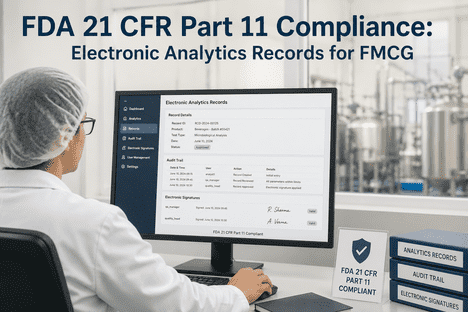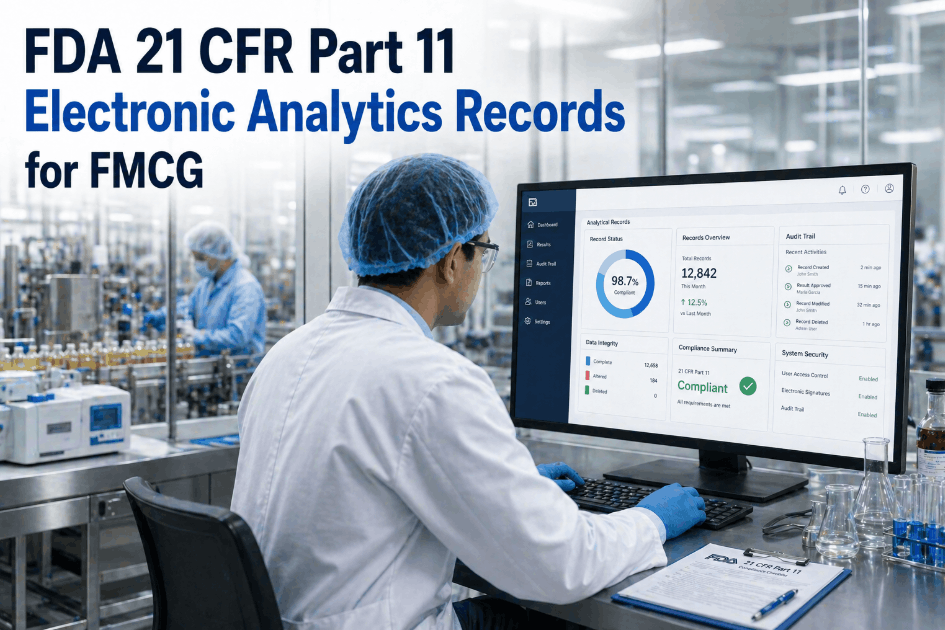
FDA 21 CFR Part 11 has evolved from a pharmaceutical-specific mandate into a foundational regulatory standard for FMCG enterprises managing electronic batch records, audit trail software, and digital signature compliance across distributed manufacturing operations. As fast-moving consumer goods manufacturers digitize their quality management system, document control software, and electronic records management workflows, alignment with FDA electronic records requirements is no longer optional—it has become the baseline expectation for any GxP-adjacent operation interacting with regulated supply chains, contract manufacturers, or export markets. A compliance analytics platform purpose-built for FMCG transforms 21 CFR Part 11 from an audit burden into a structured, defensible, automated discipline.
Automate FDA 21 CFR Part 11 Compliance Across Every FMCG Facility
iFactory's compliance analytics platform delivers electronic records management, audit trail software, digital signature workflows, and data integrity monitoring engineered for FMCG operations at enterprise scale.
Why 21 CFR Part 11 Compliance Software Is Now Critical for FMCG Manufacturers
For decades, FDA 21 CFR Part 11 was treated as a pharmaceutical concern. That perception is obsolete. FSMA modernization, FDA's renewed focus on data integrity in food safety, and the convergence of consumer goods supply chains with regulated pharma channels have pulled FMCG operations into the same compliance universe. Audit trail software, electronic batch records, and validation software are now standard expectations for any FMCG enterprise managing infant nutrition, dietary supplements, medical food, OTC adjacent SKUs, or co-manufacturing relationships with regulated brands. Quality leaders who Book a Demo with iFactory consistently discover their existing systems generate electronic records that would not survive a Part 11 inspection.
The risk profile is significant. A single Part 11 deficiency can trigger a Form 483 observation, a warning letter, or in escalated cases an import alert. For FMCG enterprises with global distribution, the downstream commercial impact of a regulatory finding far exceeds the cost of preventive compliance infrastructure. A modern compliance analytics platform converts 21 CFR Part 11 from a documentation exercise into a continuously verified, system-enforced discipline.
Electronic Records Validity
Every electronic record generated by manufacturing, quality, or laboratory systems must be attributable, legible, contemporaneous, original, accurate, and complete. Electronic records management infrastructure must enforce these properties automatically—not retrospectively.
Audit Trail Software Integrity
Audit trail software must capture every create, modify, and delete action with user identity, timestamp, and change context preserved in a tamper-evident format. Trails must remain queryable across the full retention horizon defined by FDA expectations.
Digital Signature Compliance
Digital signature compliance demands unique attribution, two-factor identity verification, and a permanent linkage between the signature and the underlying record. Signatures must remain valid even if the underlying system is migrated or upgraded.
System Validation Discipline
Validation software must demonstrate that every regulated system performs reliably, consistently, and as intended. The validation lifecycle—IQ, OQ, PQ—must be documented, version-controlled, and re-executed after every material configuration change.
Data Integrity Compliance: ALCOA+ Principles Applied to FMCG Electronic Records
FDA inspectors evaluate data integrity compliance through the ALCOA+ framework—a nine-attribute lens that defines what constitutes a defensible electronic record. Most FMCG enterprises have partial coverage of these attributes through fragmented systems, but Part 11 requires unified, system-enforced compliance across all nine. Quality leaders who Book a Demo typically receive an ALCOA+ gap analysis that maps their current state against each principle.
| ALCOA+ Principle | Regulatory Definition | FMCG System Requirement | Compliance Risk if Absent |
|---|---|---|---|
| Attributable | Every record traceable to its originating user | Unique login credentials enforced across all data entry points | Inspector cannot verify accountability for production decisions |
| Legible | Records readable for the full retention period | Format-stable storage, migration-tested across upgrades | Records become unreadable after system version changes |
| Contemporaneous | Captured at the moment of activity | Real-time data capture from MES, LIMS, sensors—no manual deferral | Backdated entries indicate non-contemporaneous practice |
| Original | The first capture, or a verified true copy | Source-of-truth designation for every record class enforced | Multiple uncontrolled copies create version conflicts |
| Accurate | Free from error, with controlled correction processes | Error correction routed through audit trail with reason codes | Silent corrections invalidate the entire record series |
| Complete | All data including reanalysis, deviations, retests | No record class excluded from electronic records management scope | Selective retention suggests intentional record manipulation |
| Consistent | Chronologically sequenced and internally aligned | Synchronized timestamps across all enterprise systems | Time discrepancies undermine entire batch defensibility |
| Enduring | Preserved for the regulatory retention horizon | Tamper-evident archive with verified backup integrity | Records lost or corrupted before retention period elapses |
| Available | Retrievable on demand for inspection | Indexed search across all electronic batch records and audit trails | Inspector wait time becomes an inspection finding itself |
21 CFR Part 11 Subpart Coverage Across the iFactory Compliance Analytics Platform
21 CFR Part 11 is structured into Subpart B (electronic records) and Subpart C (electronic signatures), with specific clauses governing closed systems, open systems, signature manifestation, and signature record linkage. The matrix below maps each regulatory clause to the platform capability that operationalizes it.
Core Capabilities of an FMCG-Grade FDA Compliance Software Stack
A defensible 21 CFR Part 11 deployment in FMCG operations requires more than digital forms with electronic signatures. It requires an integrated regulatory compliance software stack where electronic batch records, audit trail software, document control software, and validation software interoperate as a single source of compliance truth. Quality and IT leaders who Book a Demo see how these capabilities are exposed and governed in production environments.
Electronic Batch Records (EBR)
A digital master batch record drives every production run with embedded validation rules, parametric release logic, and exception management. Each batch generates a complete electronic record release file ready for QA review and regulatory archival.
Audit Trail Software
Comprehensive audit trail software captures every record creation, modification, view, and deletion with user identity, timestamp, system context, and reason code. Trails are immutable, indexed, and reviewable across the full GxP retention horizon.
Digital Signature Workflows
Digital signature compliance enforces two-factor authentication, captures signatory identity and intent, and binds each signature to the precise version of the record it approves. Signed records remain verifiable across system migrations.
Document Control Software
Document control software governs SOP, work instruction, and specification lifecycles with revision history, training acknowledgement, and effective-date enforcement. Outdated documents become inaccessible at the point of execution—not retrospectively.
Validation Software
Validation software automates IQ, OQ, and PQ execution with test scripts, evidence capture, and deviation routing. Re-validation triggers fire automatically after any qualifying configuration change—closing the validation drift loophole.
Data Integrity Monitoring
Continuous data integrity monitoring scans for ALCOA+ violations across all electronic records management activity. Anomalies—silent edits, time skew, unauthorized exports—are surfaced to compliance leadership in near real time.
Phased Deployment Roadmap for 21 CFR Part 11 Compliance in FMCG Operations
Rolling out FDA compliance software across an FMCG enterprise requires a structured pathway that builds from gap assessment through validated production use. Skipping the assessment phase produces compliance theater—systems that look compliant but fail under inspector scrutiny. Compliance leaders who Book a Demo receive a facility-specific Part 11 readiness assessment as the foundation for deployment scoping.
Part 11 Readiness Assessment & Gap Analysis
Audit every regulated system—MES, LIMS, ERP, document repositories, laboratory instruments—against the 21 CFR Part 11 clause matrix and ALCOA+ framework. Document each gap with risk rating, remediation scope, and validation impact. The output is a defensible deployment scope rather than a guess.
Platform Configuration & Validation Execution
Configure the compliance analytics platform against the gap register. Execute IQ, OQ, and PQ protocols with documented evidence. Establish role matrices, signature workflows, audit trail policies, and document control structures. Validation deliverables become permanent inspection artifacts.
Migration of Legacy Records & Cutover
Migrate active electronic records from legacy systems with chain-of-custody documentation. Decommission paper batch record processes in controlled cutover waves. Train every affected role with traceable training acknowledgement records before go-live.
Continuous Compliance Monitoring & Re-Validation
Activate continuous data integrity monitoring, periodic compliance review cadence, and automated re-validation triggers tied to configuration change events. Inspection readiness becomes a steady-state operating mode—not a quarterly fire drill.
The Financial Case for a Compliance Analytics Platform in FMCG
21 CFR Part 11 compliance investment is best evaluated against the realistic distribution of regulatory outcomes—not against a baseline of zero events. The cost of a Form 483 observation, warning letter, or import alert dwarfs the cost of preventive infrastructure many times over for any FMCG enterprise with national or international distribution.
Regulatory Event Avoidance
A warning letter typically triggers six to eighteen months of remediation costs, third-party consent agreement spending, and brand impairment exposure. Preventive Part 11 compliance software is the single highest-leverage risk reduction investment in FMCG quality operations.
Audit Preparation Efficiency
Inspector-ready electronic batch records, audit trails, and signed documents eliminate the manual scramble that historically consumes weeks of QA capacity per inspection. Centralized retrieval reduces audit prep effort by 60–75% across most FMCG deployments.
Quality Cycle Acceleration
Electronic batch records, parametric release, and automated deviation routing collapse batch release cycle time from days to hours. Working capital tied up in pending-release inventory drops materially across the FMCG portfolio.
FDA 21 CFR Part 11 Compliance for FMCG — Frequently Asked Questions
Does FDA 21 CFR Part 11 apply to FMCG operations or only to pharma?
21 CFR Part 11 governs electronic records and electronic signatures wherever those records are required by FDA regulation. FMCG operations producing dietary supplements, infant formula, medical food, OTC products, or co-manufacturing for regulated brands fall under Part 11 expectations whenever electronic systems generate FDA-required records.
What is the difference between electronic records management and document control software?
Electronic records management governs the entire lifecycle of regulated data captured by manufacturing, quality, and laboratory systems. Document control software is a subset focused specifically on controlled documents—SOPs, specifications, work instructions—including their revision history, training linkage, and effective-date enforcement.
How does audit trail software differ from regular system logging?
Standard system logging captures technical events for IT troubleshooting and may be configurable, deletable, or rotated out. Audit trail software is purpose-built for regulatory defensibility: it captures every regulated action with user identity, timestamp, and reason code in an immutable, queryable, retention-compliant format aligned with § 11.10(e).
What does digital signature compliance under 21 CFR Part 11 require?
Digital signature compliance requires unique attribution, two-component authentication for the first signature in a session, manifestation of the signer's printed name with date and meaning of the signature, and a permanent cryptographic binding between the signature and the record—sufficient that the signature cannot be excised from the record by ordinary means.
How long does a 21 CFR Part 11 compliance software deployment typically take?
A scoped FMCG deployment covering electronic batch records, audit trail software, digital signature workflows, document control software, and core validation typically requires 16–28 weeks from gap assessment through validated production go-live. Multi-facility rollouts extend this timeline while reusing the validation evidence package generated at the lead site.
Can a compliance analytics platform integrate with existing MES, LIMS, and ERP systems?
Yes. Modern regulatory compliance software is designed to interoperate with heterogeneous source systems through validated integration patterns. The platform ingests records from existing MES, LIMS, and ERP instances and applies a unified audit trail, signature, and retention policy layer—without forcing replacement of operational systems.
Operationalize FDA 21 CFR Part 11 Across Every FMCG Facility
iFactory's compliance analytics platform delivers electronic batch records, audit trail software, digital signature workflows, validation software, and continuous data integrity monitoring engineered for FMCG enterprises that cannot afford regulatory exposure.