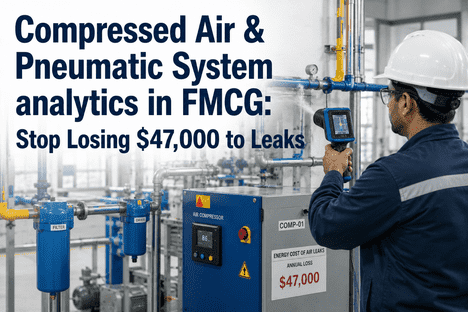
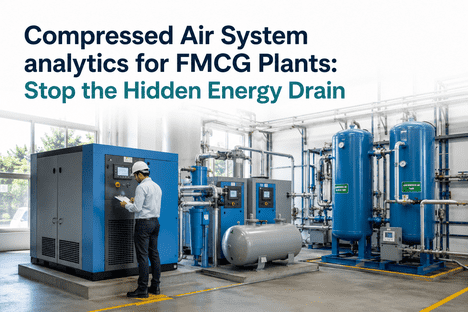
Compressed air is the most expensive utility in any FMCG production facility — yet it is also the most wasted. A single quarter-inch leak at 100 psi costs an FMCG plant $2,500 per year in wasted energy. With the average food and beverage facility hosting 15 to 30 active leaks at any given time, the annual leak cost alone reaches $37,500 to $47,000 before accounting for the productivity losses caused by pressure drops that slow pneumatic actuators, reduce robotic pick-and-place cycle times, and cause packaging machine misalignment. Despite these costs, most FMCG plants manage compressed air systems reactively — repairing leaks only when they become audible or when pressure drops trigger production complaints. Systematic compressed air and pneumatic system analytics changes this completely. iFactory's platform combines real-time pressure and flow monitoring with AI-driven leak detection, compressor health analytics, and automated work order generation to transform compressed air management from a neglected utility into a measurable savings center. Book a Demo to see how much your compressed air system is leaking.
Stop Losing $47,000+ Per Year to Compressed Air Leaks
iFactory's compressed air analytics platform connects pressure sensors, flow meters, and compressor controllers to a unified monitoring system that detects leaks, tracks energy waste, and automates repair workflows — delivering measurable energy savings from month one of deployment.
Why Compressed Air Is the Most Overlooked Energy Cost in FMCG Manufacturing
Compressed air systems consume 10 to 15 percent of total industrial electricity in FMCG manufacturing — more than lighting, HVAC, and material handling combined in many facilities. Yet the energy efficiency of a typical compressed air system rarely exceeds 15 to 20 percent, meaning 80 cents of every dollar spent on compressed air generation is lost to heat, leakage, inappropriate uses, and system inefficiencies. Leaks are the single largest controllable loss. A distribution system operating at 100 psi with a total leak rate of 30 percent — common in FMCG plants that have not conducted a systematic leak audit in the past 12 months — wastes enough energy to power the plant's entire lighting load. Beyond energy waste, leaks cause pressure fluctuations that degrade pneumatic actuator performance, slow robotic cycle times, and create packaging defects that drive rework and customer complaints. iFactory's analytics platform addresses every layer of this problem simultaneously.
01
Energy Waste from Leaks
FMCG plants lose $37,000 to $47,000 annually per facility to compressed air leaks alone. A distribution network with 30% leakage wastes 3.6 billion cubic feet of compressed air per year for a mid-size plant — enough to fill 40 Olympic swimming pools.
02
Pneumatic Actuator Performance Degradation
Pressure drops from leaks reduce pneumatic actuator force and speed, causing slower cycle times on fillers, conveyors, and packaging machines. A 10 psi drop can reduce actuator speed by 12 to 18 percent, directly reducing production throughput.
03
Robotic System Inefficiency
Robotic pick-and-place systems, palletizers, and case packers rely on consistent pneumatic pressure for gripper actuation and secondary motions. Pressure variability causes grip strength inconsistency, dropped product, and increased reject rates that drive waste and rework costs.
04
Compressor Reliability and Maintenance Cost
Leaks force compressors to run longer and cycle more frequently, accelerating wear on valves, bearings, and drive systems. Compressors in plants with uncontrolled leak rates require 30 to 50 percent more maintenance interventions than those in well-sealed systems.
→
Compressed air is the lowest-hanging fruit for energy cost reduction in any FMCG plant.
Book a Demo to see iFactory's Energy Monitoring module configured for your compressor room.
Conventional vs AI-Driven Compressed Air Management — The Performance Gap
The table below compares conventional compressed air management practices with AI-driven analytics across the key operational dimensions that determine system efficiency, energy cost, and reliability. Data reflects actual results from FMCG plants using iFactory's Energy Monitoring and PM Scheduling platform.
Pneumatic System Components Under Analytics — From Compressor to Actuator
iFactory's compressed air and pneumatic analytics platform covers every critical component in the compressed air supply chain — from air intake and compression through distribution, conditioning, and end-use actuation. Each component module delivers targeted insights that help maintenance and energy teams reduce waste, prevent failures, and optimize system performance. Book a Demo to see the full component coverage map for your facility.
Compressor Room
Air Compressor Analytics
Continuous monitoring of discharge pressure, temperature, oil condition, vibration, and power consumption for each compressor. AI models detect developing valve faults, bearing degradation, and cooling system inefficiency before they cause unplanned shutdowns or energy waste. Condition-based maintenance scheduling replaces fixed-interval PM.
Impact:12-18% compressor energy reduction
Distribution
Leak Detection and Localization
Flow meters at zone boundaries combined with AI pattern analysis detect leak events, estimate flow rate, and localize leaks to specific distribution zones. Nighttime baseline flow monitoring — when production is stopped — isolates leak flow from production demand and provides accurate leak quantification for repair prioritization.
Impact:$37,000-$47,000 annual leak cost recovered
Conditioning
Filter, Dryer, and Lubricator Monitoring
Differential pressure sensors across filters and dryers with trend analysis predict element replacement timing before pressure drop increases compressor load. Dew point monitoring on refrigerated and desiccant dryers prevents moisture contamination that causes pneumatic actuator corrosion and product quality issues.
Impact:40-60% filter energy loss reduction
End Use
Pneumatic Actuator and Robotic System Monitoring
Cycle time trend tracking for pneumatic actuators on fillers, conveyors, and packaging machines detects developing seal wear, piston drift, and valve degradation before they cause production stops or quality defects. Robotic gripper pressure monitoring ensures consistent pick-and-place performance.
Impact:60-80% fewer unplanned actuator failures
Deployment Roadmap — From Baseline Audit to Autonomous Air System Optimization
Deploying compressed air and pneumatic system analytics follows a structured five-phase timeline that delivers measurable energy savings at every stage. iFactory's platform and pre-built sensor integration templates accelerate deployment to 8-14 weeks for a typical FMCG plant, with phase 1 generating immediate leak quantification that typically pays for the entire deployment investment. Book a Demo to discuss your compressed air analytics deployment timeline.
01
Compressed Air System Audit and Sensor Installation (Weeks 1-3)
Install zone-level flow meters at each distribution branch, pressure transducers at key nodes, compressor power meters, and dew point sensors on dryers. Conduct baseline nighttime leak flow measurement to establish total system leak rate. Connect existing compressor controllers via Modbus or OPC-UA for runtime and status data. iFactory's pre-built sensor kits and commissioning templates accelerate this phase for a typical mid-size plant.
Deliverable: Real-time compressed air system data stream with baseline leak quantification
02
AI Model Training and Leak Detection Calibration (Weeks 3-6)
Train site-specific AI models using 2-3 weeks of baseline data to establish normal flow, pressure, and power consumption patterns for each production shift and product SKU. Calibrate leak detection algorithms using the nighttime baseline flow data, train anomaly detection models for compressor and actuator health, and validate against known leak events and maintenance records.
Deliverable: Validated AI models with documented leak detection accuracy
03
Dashboard Deployment and Alert Configuration (Weeks 6-9)
Deploy iFactory's compressed air analytics dashboard showing real-time system efficiency, leak flow by zone, compressor health scores, filter and dryer status, and pneumatic actuator cycle time trends. Configure tiered alerts for leak events, pressure excursions, compressor anomalies, and actuator degradation. Establish escalation workflows for critical alerts with automatic work order generation in iFactory CMMS.
Deliverable: Live operations dashboard with automated alerting and CMMS integration
04
Compressor Optimization and Pressure Band Tuning (Weeks 9-12)
Deploy AI-driven compressor sequencing optimization that automatically adjusts compressor load/unload setpoints based on real-time demand forecasting. Tune system pressure band to the narrowest range that satisfies all production demands — typically reducing pressure band from 25-30 psi to 10-15 psi. Configure predictive maintenance schedules for each compressor based on actual runtime and condition data.
Deliverable: AI-optimized compressor sequencing with validated energy savings
05
Continuous Improvement and Fleet Scaling (Week 12+)
Models continuously retrain on new operational data, improving leak detection sensitivity and compressor optimization accuracy with each production cycle. Monthly energy performance reviews track savings against baseline. The platform scales to additional production lines or facilities using standardized deployment templates. iFactory's multi-site interface provides unified visibility across all compressed air systems from a single dashboard.
Deliverable: Self-improving AI platform with validated energy savings compounding over time
Deploy Compressed Air Analytics at Your FMCG Plant
A deployment consultation maps the five-phase roadmap to your specific compressor room configuration, distribution network, and production requirements. Output: a documented deployment plan with timeline, sensor requirements, and projected energy savings.
Industry Expert Perspective on Compressed Air Analytics in FMCG
"I spent twenty-three years managing utility systems at four of the largest FMCG companies in the world — Kraft Heinz, Nestlé, PepsiCo, and Danone. In every plant, compressed air was the most ignored utility. Plant managers focused on steam efficiency and refrigeration because those systems had visible energy budgets. But no one owned the compressed air system. It was the orphan utility — everyone used it, no one managed it. At a frozen food plant in Iowa, we installed zone-level flow meters and discovered that 38 percent of the compressed air generated was escaping through leaks. The plant was spending $184,000 per year to generate compressed air, and $70,000 of that was literally blowing into the atmosphere. We fixed the leaks, installed pressure regulators at point of use, and implemented a continuous monitoring system — the same approach iFactory's platform uses — and reduced the plant's compressed air energy cost by 41 percent in the first year. The total investment was paid back in four months. The most common objection I hear from plant managers is that they do not have time for compressed air analytics because they are too busy fighting production fires. That is exactly backwards — compressed air analytics is the tool that prevents the fires. When your pneumatic actuators are running at full speed because pressure is stable, when your robots are gripping consistently because air quality is controlled, when your compressors are not cycling every 30 seconds because leaks have been fixed — the production fires stop happening.
Book a Demo to see how iFactory addresses these challenges."
— Director of Engineering Excellence at a Top-5 FMCG Company — 23 Years Experience — 18 Plants Across 6 Countries — Certified Energy Manager (CEM)
41%
Compressed air energy cost reduction achieved
4 months
Typical payback period for analytics investment
38%
Average leak rate found in unmonitored FMCG plants
Conclusion — Turn Your Compressed Air System from a Cost Center into a Savings Center
Compressed air is the most expensive utility in FMCG manufacturing, but it is also the one with the largest untapped savings potential. The average FMCG plant wastes 25 to 35 percent of the compressed air it generates to leaks that silently drain energy budgets, degrade pneumatic actuator performance, and increase compressor maintenance costs year after year. These losses are not inevitable — they are the direct result of the industry's collective failure to apply the same analytics rigor to compressed air that is routinely applied to steam, refrigeration, and electrical systems.
iFactory's compressed air and pneumatic system analytics platform changes this by delivering continuous visibility into every aspect of the compressed air supply chain — from compressor efficiency and distribution leak rates through filter health and end-use actuator performance. FMCG plants deploying the platform consistently reduce compressed air energy costs by 25 to 40 percent, cut unplanned pneumatic actuator failures by 60 to 80 percent, and achieve full payback on their analytics investment within 3 to 6 months. Book a Demo to start quantifying your compressed air savings potential with iFactory today.
Start Saving $47,000+ Per Year on Compressed Air Energy Costs
iFactory AI provides the integrated platform that transforms compressed air management from a neglected utility into a measurable savings center. Schedule a 30-minute demo to see the platform configured for your compressor room and distribution network.
Compressed Air & Pneumatic System Analytics — Frequently Asked Questions
How much money can an FMCG plant save by implementing compressed air analytics?
FMCG plants implementing iFactory's compressed air analytics platform typically reduce total compressed air energy costs by 25 to 40 percent within the first 12 months. For a mid-size plant spending $150,000 to $250,000 annually on compressed air generation, this translates to $37,500 to $100,000 in direct energy savings. Additional savings come from reduced compressor maintenance costs (30 to 50 percent reduction), fewer unplanned pneumatic actuator failures (60 to 80 percent reduction), and improved production throughput from stable system pressure.
How does AI detect compressed air leaks that human auditors miss?
What sensor infrastructure is needed to implement compressed air analytics?
The core sensor infrastructure includes zone-level flow meters at each major distribution branch, pressure transducers at compressor discharge and key network nodes, power meters on each compressor, and dew point sensors on dryers. Many FMCG plants already have some of these sensors installed for basic monitoring. iFactory's platform connects to existing sensors through Modbus, OPC-UA, and BACnet protocols and recommends cost-effective additions to close remaining coverage gaps. A typical mid-size plant with 3-5 distribution zones requires 5-8 additional flow meters and 8-12 pressure transducers for comprehensive coverage.
How does compressed air analytics improve pneumatic actuator and robotic system reliability?
Pneumatic actuators and robotic systems are directly affected by compressed air pressure and quality. Analytics improves reliability through three mechanisms. First, stable system pressure from reduced leaks ensures actuators operate at design speed and force. Second, air quality monitoring (dew point, particulate, oil carryover) prevents contamination that causes seal wear and valve sticking. Third, cycle time trend monitoring on individual actuators detects developing seal degradation, piston drift, and valve faults before they cause production stops — enabling planned replacement during scheduled changeovers rather than emergency repairs during production.
What is the typical payback period for compressed air analytics deployment?
FMCG plants deploying iFactory's compressed air analytics platform typically achieve full payback within 3 to 6 months. The primary payback drivers are energy savings from leak reduction and compressor optimization (typically $37,500 to $100,000 per year), avoided unplanned actuator and compressor failures (saving $15,000 to $40,000 per event), and reduced maintenance labor from condition-based scheduling replacing calendar-based PM. The nighttime baseline leak measurement conducted in week 1 of deployment typically identifies enough leak flow to justify the entire platform investment within the first month.
Can iFactory's platform integrate with my existing compressor controllers and building management system?
Yes — iFactory's platform includes pre-built connectors for major compressor controller brands and communication protocols including Modbus TCP, OPC-UA, BACnet/IP, and MQTT. The platform also integrates with building management systems, SCADA platforms, and existing CMMS systems for automatic work order generation. For plants with older compressors that lack digital controllers, iFactory provides retrofit sensor kits that add monitoring capability without requiring compressor replacement.