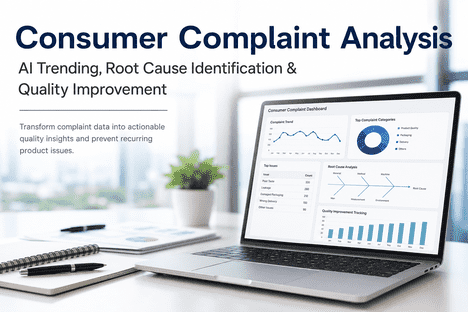
Consumer Complaint Analysis AI Trending, Root Cause Identification & Quality Improvement
By Seren on June 25, 2026
Most Quality Managers in FMCG manufacturing already sense the pattern long before the data confirms it: a spike in complaints about texture inconsistency in one production week, a recurring foreign material issue traced to a specific supplier lot, a packaging defect that surfaces across three different product lines simultaneously and then vanishes for months. The pattern is there. The signal is buried inside thousands of consumer feedback entries, call centre transcripts, regulatory reports, and retailer return records — scattered across systems that were never designed to share data. Consumer complaints are the richest source of quality intelligence that most FMCG manufacturers do not fully use. The gap between raw complaint data and actionable quality insight is not a lack of information. It is a lack of signal extraction. AI-powered complaint trending, root cause identification, and quality improvement tracking changes this entirely. For Quality Managers responsible for product safety, brand reputation, and continuous improvement, the question is no longer whether consumer complaints can be analysed at scale. It is how quickly you can turn that analysis into prevention.
Every Complaint Is a Quality Signal. AI Separates the Noise from the Pattern.
iFactory transforms raw consumer complaint data into trending dashboards, root cause analysis, and closed-loop quality improvement tracking — turning every complaint into a prevention opportunity.
Of FMCG companies lack a formal system for trending consumer complaints across product lines and production sites — most rely on manual spreadsheet consolidation
3-5x
Faster root cause identification when AI clustering and natural language processing replace manual complaint categorisation and trend analysis
60%+
Of quality-related recalls could be prevented if trending signals from consumer complaints had been acted on before regulatory thresholds were crossed
85%
Of Quality Managers surveyed say complaint data is collected but not systematically trended — the intelligence exists inside the organisation but never reaches the decision-maker
Why Most Consumer Complaint Data Never Generates Quality Improvement
Consumer complaints enter FMCG organisations through multiple channels — consumer affairs hotlines, email and web forms, social media platforms, retailer return data, regulatory authority reports, and third-party review sites. Each channel feeds a different system, uses a different categorisation scheme, and serves a different internal stakeholder. The consumer affairs team categorises complaints by customer service resolution. The regulatory team tracks them by compliance code. The quality team needs them classified by defect type, production line, shift, supplier lot, and process parameter — a classification axis that no single intake system was designed to capture. The result is that the same complaint event exists in three or four systems simultaneously but in none of them in a form that supports cross-functional root cause analysis.
01
Siloed Intake Channels
Consumer complaints arrive through call centres, email, social media, retailer reports, and regulatory filings — each with its own taxonomy and format. A foreign material complaint logged by the consumer affairs team as "quality issue" may be recorded by the retailer as "damaged goods" and by the regulatory contact as "physical contamination." The same event generates three different records that never cross-reference each other.
02
Manual Categorisation Limits
When complaint data is manually categorised, the taxonomy is typically limited to 15-20 predefined categories. Most actual product defects fall outside these categories or span multiple categories simultaneously. Manual coders default to the closest available category, which collapses distinct defect types into the same bucket and eliminates the granularity needed for root cause identification.
03
No Trending Across Time or Line
Without a unified complaint data platform, trending requires manual consolidation of spreadsheets from each intake channel and each production site. The effort is high enough that most quality teams trend complaints quarterly at best. A complaint pattern that develops over three weeks is invisible until the quarterly review — by which time tens of thousands of affected units may have reached consumers.
Before AI — The Manual Workflow
Complaints logged in 3-5 separate systems
↓
Manual export and spreadsheet consolidation (8-12 hrs per cycle)
↓
Categorisation by manual coders with 15-20 category limit
↓
Quarterly trending report — 60-90 day lag
↓
Trend identified after recall threshold crossed
After AI — The Automated Workflow
Complaints ingested from all channels via API
↓
NLP classification into 100+ defect, product, and process clusters
↓
Real-time trending across production lines, shifts, suppliers, and SKUs
↓
Root cause hypothesis generated from correlated production data
↓
Corrective action triggered before trend escalates to recall level
AI Trending · NLP Classification · Root Cause Correlation
Your Consumer Complaints Already Contain the Root Cause. What You Are Missing Is the AI That Finds It.
iFactory ingests complaint data from every channel, classifies it by defect type and production context, and surfaces trending signals before they become recall events. Quality improvement becomes continuous, not retrospective.
How AI Transforms Consumer Complaint Data Into Quality Improvement
AI-powered complaint analysis operates across three sequential capabilities — trending, root cause identification, and quality improvement tracking — each building on the output of the previous stage. Together, they create a closed-loop system where every consumer complaint drives measurable improvement in product quality.
01
AI Complaint Trending — See the Signal Before It Becomes a Crisis
Natural language processing models classify each complaint into a granular taxonomy of defect types, product categories, packaging formats, production lines, and complaint channels — extracting structured data from unstructured free-text descriptions. The system detects emerging trends in real time, flagging statistically significant increases in a specific defect category before the volume crosses the reporting threshold that would trigger manual attention. Trending is visualised on a dashboard that shows complaint volume by category over time, with automatic alerts when the rate of change exceeds the expected baseline for any product-SKU-production line combination.
02
Root Cause Identification — From Symptom to Source in Minutes
Once a trending signal is detected, the AI platform correlates complaint data with production records, supplier lots, quality control checkpoints, shift logs, and environmental conditions at the time of manufacture. The correlation engine identifies which production variables are statistically associated with the complaint cluster — a specific raw material lot, a temperature deviation during processing, a packaging seal parameter drift, a shift changeover period. Root cause hypotheses are ranked by statistical confidence and presented to the Quality Manager with supporting evidence from production data. This reduces root cause investigation time from days or weeks to hours.
03
Quality Improvement Tracking — Close the Loop on Every Complaint
Corrective and preventive actions are linked to the specific complaint cluster and root cause that triggered them. The platform tracks whether the action was implemented, whether it produced the expected reduction in complaint volume, and whether the same defect type reappears in a different product line or production site. This closed-loop tracking ensures that complaint-driven improvement does not stop at a single corrective action — it feeds back into the trending engine so that the effectiveness of every quality improvement is measured against the complaint data that initiated it.
We had been receiving consumer complaints about an off-flavour in one of our beverage lines for about six weeks. The volume was below what anyone would flag manually — maybe eight to twelve complaints per week across a national distribution footprint. The team assumed it was batch variation and did not escalate. When the AI platform ingested our complaint data and ran trending analysis, it identified that the off-flavour complaints were concentrated in product from a single production line, correlated with a specific fruit juice concentrate lot, and had started appearing three days after that lot went into production. The root cause was a supplier quality issue that had not been detected at incoming inspection because the parameter that shifted was not on our standard test panel. We recalled one lot instead of a full product line, and we updated our incoming inspection protocol within a week. Without AI trending, we would have kept accepting complaints as normal noise until the volume triggered a regulatory investigation.
— Quality Manager, National Beverage Manufacturer — 14 Production Lines, 200+ SKUs
The Four Complaint Categories That Drive Most FMCG Quality Improvement
Consumer complaints in FMCG manufacturing cluster into four dominant categories. Each category requires a distinct root cause investigation approach and quality improvement pathway. AI-powered complaint analysis handles all four simultaneously, but understanding the distinction helps Quality Managers configure the platform for their specific product portfolio.
01
Foreign Material & Physical Contamination
Safety Critical
Foreign material complaints are the highest-risk category in FMCG quality management. They account for a significant proportion of Class I and Class II recalls, carry the highest regulatory penalty exposure, and generate the most severe brand reputation damage. AI complaint classification identifies foreign material complaints by material type (metal, glass, plastic, insect, bone, wood), product category, production line, and packaging stage. Trending analysis across these dimensions reveals whether the material is originating from raw ingredients, processing equipment wear, packaging material failure, or environmental contamination. Correlation with maintenance records, supplier quality scores, and line changeover frequency enables root cause identification that prevents recurrence rather than reacting to individual incidents.
Material type classification
Equipment wear correlation
Supplier lot traceability
02
Sensory & Formulation Defects
Quality Critical
Sensory complaints — off-flavour, odour, texture inconsistency, appearance variation, colour deviation — are the most common complaint category in food and beverage manufacturing and the most difficult to trend manually because the language consumers use to describe sensory defects is highly variable. One consumer writes "tastes different than usual" while another reports "chemical aftertaste" and a third says "not the same as last batch." NLP models trained on sensory lexicon recognise these as descriptions of the same underlying defect type, clustering them even when no single keyword matches. Trending across production parameters, raw material lots, and process conditions identifies the formulation or processing variable responsible.
Sensory lexicon clustering
Ingredient lot correlation
Process parameter trending
03
Packaging & Labelling Defects
Compliance Critical
Packaging complaints include seal integrity failures, package damage during distribution, incorrect label application, missing or illegible date codes, and packaging material defects. These complaints are frequently the first indicator of a packaging line calibration drift, a material supplier quality change, or a distribution handling issue that will escalate to regulatory noncompliance if not corrected. AI complaint analysis correlates packaging complaints with packaging line sensor data, seal temperature and pressure logs, supplier material lot records, and distribution route data to identify whether the root cause is production-side, packaging material-side, or logistics-side.
Seal integrity parameter drift
Date code legibility tracking
Packaging material lot mapping
04
Allergen & Labelling Compliance Complaints
Regulatory Critical
Consumer reports of adverse reactions, allergen concerns, and labelling inaccuracies are the fastest-escalating complaint category from a regulatory perspective. A single consumer complaint about an undeclared allergen can trigger a regulatory investigation, even if no other complaints have been received. AI complaint trending for allergen and labelling issues prioritises speed of detection over statistical confirmation — the platform flags any complaint related to allergen concerns, ingredient declaration discrepancies, or labelling accuracy issues at the time of ingestion, regardless of volume. Root cause analysis correlates these complaints with formulation changeovers, label artwork revisions, supplier ingredient declarations, and packaging line configuration changes to identify whether the issue is systemic or isolated.
Real-time allergen alerting
Label artwork version tracking
Formulation changeover correlation
Conclusion — The Case for AI-Powered Complaint Analysis Is a Case for Preventive Quality Management
The gap between raw consumer complaint data and measurable quality improvement is not a data collection problem. It is a signal extraction problem. The complaints that predict the next recall, the next regulatory investigation, or the next brand reputation crisis are already in the system. They are simply not visible as a pattern until the volume crosses a threshold that manual trending cannot detect until it is too late for preventive action.
AI-powered complaint analysis closes that gap — not by replacing the Quality Manager's expertise, but by amplifying it. The platform does the trending, the clustering, the correlation, and the root cause identification that manual systems cannot sustain at scale. The Quality Manager does what only a quality professional can do: evaluate the root cause hypothesis, determine the corrective action, and ensure that the improvement is sustained across production lines and over time.
iFactory gives Quality Managers the AI infrastructure to ingest complaint data from every channel, classify it at granular detail, trend it in real time, and trace every complaint cluster to its root cause in production data. The platform makes complaint-driven quality improvement systematic rather than reactive. The Quality Manager's decision to act on the signal makes it preventive. Book a Demo to see how iFactory's AI complaint analysis maps to your current quality management workflow, or talk to an expert about configuring a pilot on your highest-complaint-volume product line.
Frequently Asked Questions
The platform ingests complaint data from consumer affairs hotline and email systems, web and mobile app feedback forms, social media platforms and brand monitoring tools, retailer return and customer service data feeds, regulatory authority complaint referrals, third-party review site data, and internal quality incident reports. Ingestion is handled through API connections, flat file upload, or direct database integration depending on the source system's capabilities. For brands using a consumer affairs CRM or complaint management platform, the ingestion is typically configured at the API level and runs continuously. For brands collecting complaints across multiple disconnected systems, iFactory provides a unified ingestion layer that normalises data from all sources into a single complaint record format before classification and trending. Talk to an expert to discuss the specific complaint channels applicable to your product portfolio and distribution footprint.
Consumer complaints are inherently noisy — consumers use different words, different levels of detail, and different reference frames to describe the same product issue. AI complaint classification uses transformer-based natural language processing models that are pre-trained on millions of consumer feedback texts and fine-tuned on FMCG sector complaint data. These models understand semantic similarity, meaning they can recognise that "tastes funny," "off-flavour," "weird aftertaste," and "not the usual taste" all refer to the same defect type even though they share no keywords in common. For complaints with very sparse descriptions, the model classifies based on available metadata — product SKU, production date code, purchase location, and complaint channel — inferring the most likely defect category from the context even when the free-text description is minimal. Every classification includes a confidence score, and complaints below the confidence threshold are routed to a human reviewer for manual classification, creating a continuous feedback loop that improves model accuracy over time. Book a demo to see the classification model perform on your actual complaint data.
Yes. Cross-site complaint correlation is one of the primary capabilities that distinguishes AI-powered complaint analysis from single-site quality management. The platform ingests production records from each manufacturing site — including batch records, production line sensor data, quality control checkpoint results, supplier lot tracking data, shift logs, and environmental monitoring data — and links them to consumer complaints through the product's production date code, lot number, or SKU. This enables the Quality Manager to see whether a complaint trend is isolated to a single production line at one site or is occurring across multiple sites using the same raw material supplier, the same packaging specification, or the same process parameter set. The cross-site correlation capability is particularly valuable for identifying supplier-driven quality issues that manifest differently at different sites and would otherwise be treated as unrelated local problems. Talk to an expert to discuss how cross-site correlation would apply to your multi-site manufacturing network.
Consumer complaint data is subject to regulatory record-keeping requirements under FDA 21 CFR Part 117 (current Good Manufacturing Practice and Hazard Analysis and Risk-Based Preventive Controls), FDA 21 CFR Part 110 (for low-acid canned foods), and similar regulatory frameworks in other jurisdictions. The platform maintains a complete audit trail for every complaint record — including the original complaint text, the AI classification result and confidence score, any human review or reclassification, the root cause analysis findings, and the corrective and preventive actions taken. Regulatory reports can be generated on demand, covering complaint volume by category, trending data over any time window, corrective action status, and trending analysis used to support preventive controls. The audit trail is immutable and timestamped, providing regulatory investigators with the documentation needed to demonstrate that complaint data was reviewed, trended, and acted upon in accordance with regulatory requirements. Talk to an expert to see the regulatory reporting module configured for your specific compliance framework.
Every Consumer Complaint Is a Quality Signal. Start Reading What Yours Are Saying.
iFactory gives Quality Managers the AI platform to trend consumer complaints, identify root causes, and track quality improvements across every product line and production site — turning complaint data into your most powerful preventive quality tool.

-in-fmcg-a-step-by-step-guide-to-eliminating-recurring-failures.png)