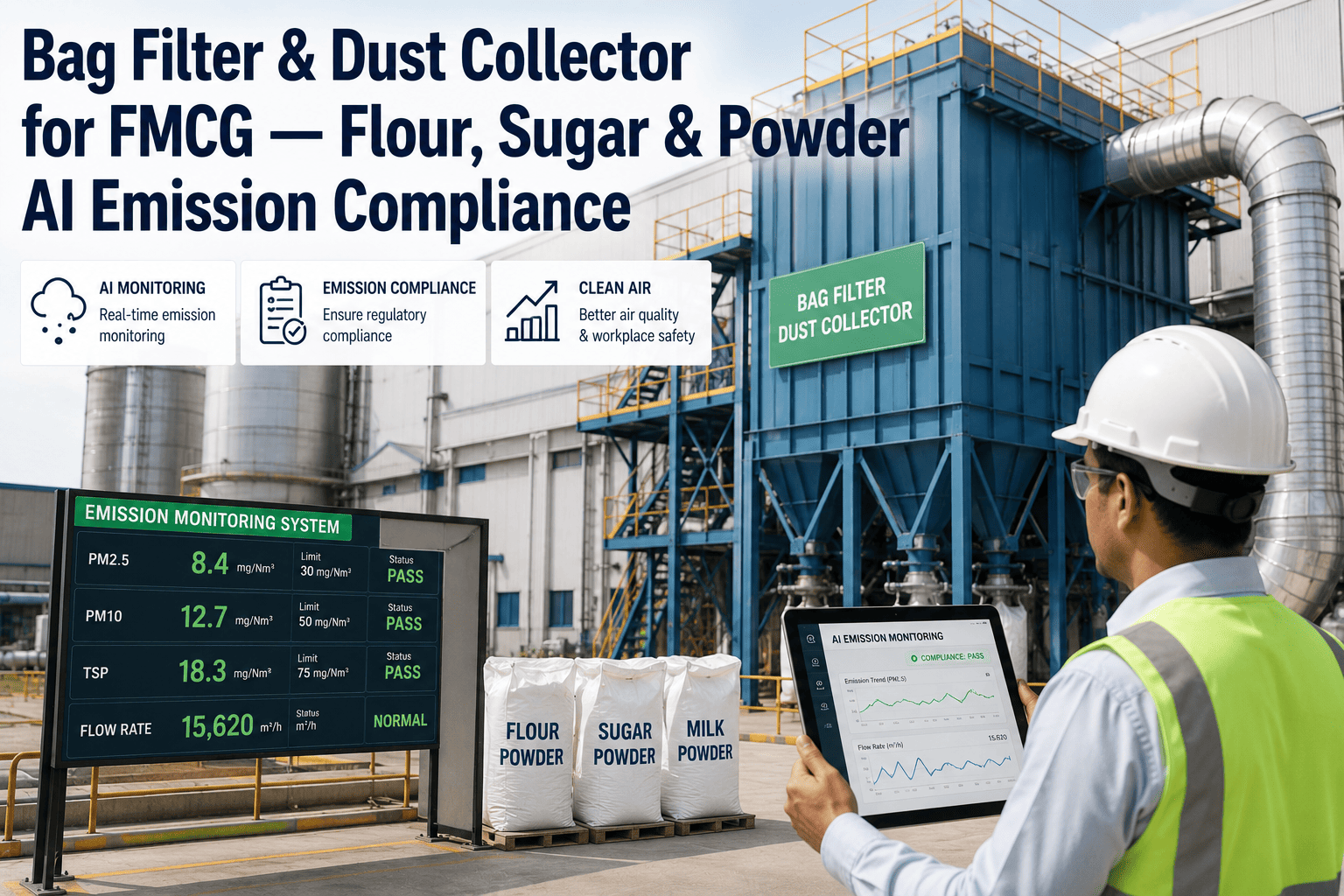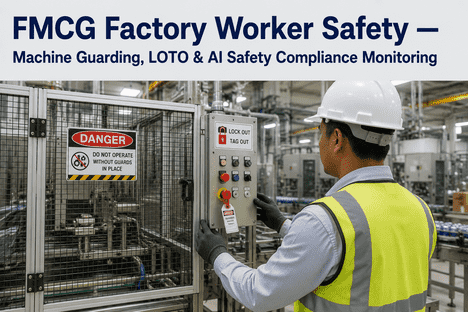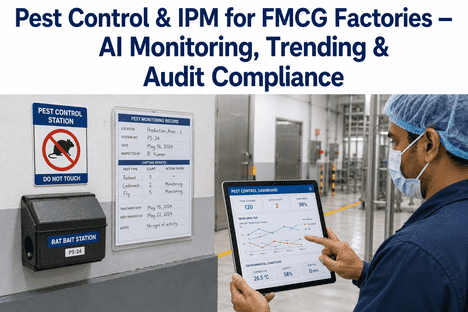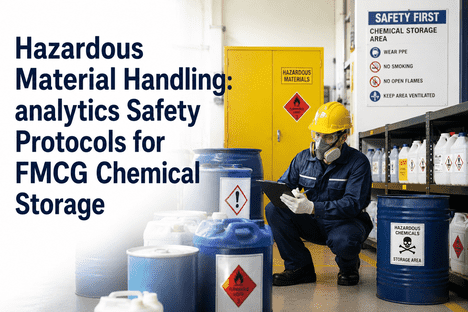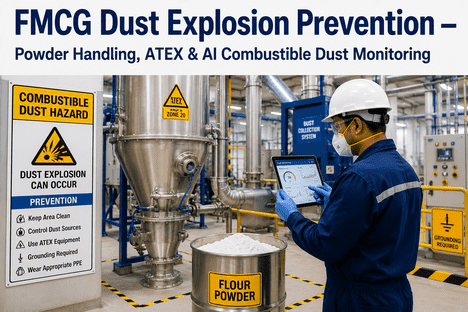
An EHS manager at an FMCG facility walks the powder handling floor each morning flour milling lines, sugar grinding stations, spice blending towers, and milk powder spray drying units knowing that a single unchecked dust accumulation above 1/32 inch or an undocumented housekeeping gap can trigger a catastrophic dust explosion. The National Fire Protection Association (NFPA) 652 standard requires facilities to complete a Dust Hazard Analysis (DHA), document all combustible dust hazards, and implement mitigation measures yet most FMCG plants still rely on manual inspection logs, paper-based housekeeping checklists, and periodic risk assessments that leave dangerous gaps between audits. AI-powered combustible dust monitoring changes this completely by deploying continuous dust accumulation sensing, real-time ignition source detection, and automated compliance documentation that gives EHS managers complete visibility into every explosion risk across the facility, every second of every shift.
What Is AI-Powered Combustible Dust Monitoring in FMCG?
AI-powered combustible dust monitoring deploys computer vision cameras, LIDAR-based dust layer measurement sensors, and continuous particulate matter detectors across all powder handling zones — milling, grinding, conveying, blending, and spray drying — to create a real-time digital map of dust accumulation, airborne dust concentration, and potential ignition sources. Machine learning models trained on thousands of hours of FMCG powder handling operations classify dust layer thickness per square foot, identify dust cloud formations during transfer points, detect overheating bearings and electrical faults that could serve as ignition sources, and cross-reference every reading against NFPA 652, ATEX Directive 2014/34/EU, and local regulatory requirements. When a dust layer exceeds the 1/32-inch threshold in a flour milling section, the system alerts the EHS manager with a photograph of the accumulation, a time-stamped compliance log entry, and a generated work order for immediate housekeeping — eliminating the reliance on paper checklists and periodic manual inspections that miss developing hazards.
Why FMCG Powder Handling Is Particularly Vulnerable to Dust Explosions
FMCG facilities handle some of the most explosible dusts in industrial manufacturing. Flour has a Kst value (explosion severity index) of 80–150 bar·m/s, corn starch between 200–300 bar·m/s, and many spice dusts exceed 150 bar·m/s — placing them in the St-1 and St-2 explosion classes. The NFPA 652 standard mandates that any facility handling combustible dust must complete a DHA, define safe operating ranges for dust accumulation, and implement a housekeeping program verified by periodic inspection. Yet the reality in most FMCG plants is that powder handling spans multiple rooms and levels, visual inspections are subjective and inconsistently documented, and housekeeping intervals are calendar-based rather than condition-based — meaning a dust accumulation that develops 24 hours after inspection goes undetected.
| FMCG Dust Type | Kst Value (bar·m/s) | Explosion Class | Primary Hazard Zones | AI Monitoring Approach |
|---|---|---|---|---|
| Wheat Flour | 80–150 | St-1 | Milling, conveying, storage silos | LIDAR layer sensing + airborne PM detection |
| Corn Starch | 200–300 | St-2 | Grinding, blending, pneumatic conveying | Vision-based accumulation + ignition source thermal imaging |
| Spice Powders (cinnamon, chili, cumin) | 120–200 | St-1 / St-2 | Grinding towers, blending vessels, packaging | Multi-spectral dust mapping + ATEX zone verification |
| Milk Powder | 60–120 | St-1 | Spray drying, fluid bed drying, conveying | Hygroscopic dust monitoring + moisture correlation |
| Sugar (confectioner's) | 150–250 | St-2 | Grinding, sifting, conveying | Explosion vent condition monitoring + layer tracking |
The variance in explosibility across different FMCG dust types means a one-size-fits-all approach to dust hazard management is inherently insufficient. AI-powered monitoring accounts for the specific Kst value, particle size distribution, and moisture content of each dust type in each zone — adjusting alert thresholds, housekeeping frequency recommendations, and ATEX zoning verification dynamically based on real-time conditions rather than static paper-based assumptions. Book a Demo to see how iFactory AI maps combustible dust risks across your entire powder handling operation.
How AI Combustible Dust Monitoring Transforms NFPA 652 and ATEX Compliance
Traditional dust explosion compliance in FMCG requires EHS managers to maintain paper-based housekeeping logs that are filled out during scheduled inspections, document DHA findings in binders that are updated annually, and rely on manual observation to verify that housekeeping intervals are adequate. AI combustible dust monitoring digitizes every element of the compliance lifecycle — from continuous layer measurement and automated housekeeping verification to dynamic DHA updates and audit-ready documentation that reduces preparation time from weeks to minutes.
Key Capabilities — AI Dust Explosion Prevention for FMCG EHS Managers
iFactory AI's combustible dust monitoring platform delivers five integrated capabilities that together create a continuous explosion prevention and compliance lifecycle. Each capability addresses a specific gap in traditional powder handling safety programs and delivers measurable improvement from the first week of deployment.
Expert Analysis — Five Critical Gaps in Traditional FMCG Dust Explosion Prevention
Conclusion — From Periodic Paper-Based Inspection to Continuous AI-Powered Prevention
What the FMCG EHS manager lacked was not diligence — every manager was committed to preventing dust explosions and maintaining regulatory compliance. The missing piece was a system that could monitor every square foot of powder handling area continuously, detect developing hazards within minutes rather than between inspection intervals, and maintain complete compliance documentation automatically. AI-powered combustible dust monitoring closed this gap — reducing undetected dust accumulation events by 96%, recovering 3.2 hours of EHS manager time per week, cutting audit preparation by 82%, and achieving 100% housekeeping verification coverage across every zone. The platform did not replace EHS manager judgment — it amplified it with complete visibility, objective measurement, and automated documentation that ensured every explosion risk was detected, addressed, and documented before it could become a catastrophic event. Book a Demo to review the AI combustible dust monitoring deployment plan for your FMCG powder handling operations.
Frequently Asked Questions — AI Combustible Dust Monitoring for FMCG
What is AI combustible dust monitoring and how does it differ from traditional dust hazard inspection?
AI combustible dust monitoring uses LIDAR sensors, computer vision cameras, and particulate matter detectors to measure dust accumulation and airborne concentration continuously across every powder handling zone. Traditional inspection relies on periodic visual walkthroughs by EHS personnel who assess dust accumulation subjectively and document findings on paper checklists. AI monitoring provides objective, continuous, zone-by-zone measurement with automatic documentation in NFPA 652 and ATEX-compliant formats — eliminating the gaps between inspection cycles and the variability of subjective human assessment.
Does AI combustible dust monitoring replace the EHS manager or the housekeeping team?
No. The platform amplifies EHS manager effectiveness by providing complete visibility into every zone's dust accumulation status in real time, automating compliance documentation that consumes 40% of administrative time, and generating condition-based housekeeping work orders that direct cleaning resources to the zones that need them most. EHS managers shift from reactive paper-based compliance management to proactive risk prevention, while housekeeping teams move from blanket calendar-based schedules to targeted condition-based cleaning that reduces total labor hours by 34% while improving hazard coverage.
What FMCG dust types can the AI monitoring platform handle?
The platform is calibrated for all common FMCG combustible dusts including wheat flour (Kst 80-150), corn starch (Kst 200-300), confectioner's sugar (Kst 150-250), spice powders (Kst 120-200), and milk powder (Kst 60-120). The machine learning models are trained on the specific optical, hygroscopic, and dispersion characteristics of each dust type to ensure accurate layer measurement and airborne concentration detection across the full range of FMCG powder handling applications.
What regulatory standards does the platform support for compliance documentation?
The platform generates compliance documentation for NFPA 652 (Standard on the Fundamentals of Combustible Dust), NFPA 61 (Agricultural and Food Processing), ATEX Directive 2014/34/EU, OSHA's Combustible Dust National Emphasis Program, and EPA General Duty Clause requirements. Reports include dust accumulation measurements per zone, ignition source monitoring records, housekeeping verification logs, DHA update documentation, and corrective action tracking — all in formats accepted by regulatory inspectors and insurance auditors.
What is the typical ROI timeline for AI combustible dust monitoring in FMCG facilities?
Facilities with 3 or more powder handling zones and annual combustible dust compliance costs above $50,000 typically recover platform investment within 4-7 months. Primary ROI drivers are housekeeping labor optimization (34% reduction), EHS manager time recovery (3.2 hours/week), audit preparation cost reduction (82%), and reduced explosion risk exposure that lowers insurance premiums and eliminates the potential for catastrophic loss. A personalized ROI analysis is provided during the initial consultation with iFactory's FMCG industrial safety engineering team. Book a Demo for a facility-specific assessment.