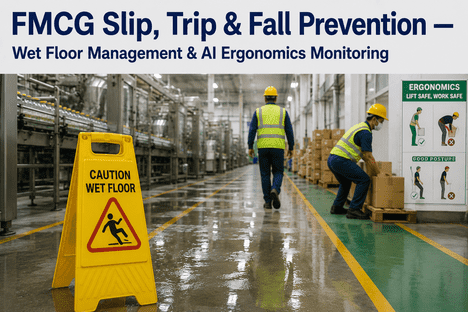
An EHS manager at a large FMCG production facility reviews the incident log for the previous quarter: twelve recordable injuries, nine of them from slips, trips, and falls. A sanitation worker slipped on a wet floor outside the dairy processing room at 4:30 AM when the overnight cleaning crew had finished but the floor drying procedure had not been completed. A packaging line operator tripped over a pallet jack left in the aisle between two filling stations, fracturing their wrist in the fall. A warehouse associate carrying a 25-kilogram bag of sugar stepped onto an uneven floor tile near the loading dock and twisted their knee so severely that they required surgery and missed twelve weeks of work. Each incident was investigated, root causes were documented, corrective actions were assigned — and a similar pattern of injuries continued the following quarter. The Bureau of Labor Statistics reports that slips, trips, and falls account for 27% of all nonfatal workplace injuries involving days away from work in manufacturing — and in FMCG facilities where wet processing, high-speed packaging lines, and manual material handling converge on the same floors, that percentage is consistently higher. AI-powered slip, trip, and fall prevention changes this by deploying computer vision wet floor detection, real-time ergonomic risk assessment, and automated PPE compliance monitoring that gives EHS managers continuous visibility into the floor-level hazards that cause the majority of workplace injuries. Book a Demo to see how iFactory AI monitors slip, trip, and fall hazards across your FMCG facility.
27%
Of all manufacturing workplace injuries involving days away from work are caused by slips, trips, and falls — the single largest cause category
68%
Reduction in slip, trip, and fall incidents within 14 weeks of deploying AI monitoring with real-time hazard alerts and automated corrective action
12.4
Average days away from work per slip, trip, and fall injury in FMCG manufacturing — higher than the manufacturing sector average
3.2
Hours of EHS manager time recovered per week from automated hazard monitoring and documentation that replaces manual safety walkthroughs
SLIP TRIP FALL PREVENTION · WET FLOOR AI · ERGONOMICS MONITORING · PPE COMPLIANCE · FMCG SAFETY
The Number One Cause of FMCG Workplace Injuries Is Also the Most Preventable — iFactory AI Monitors Floor-Level Hazards in Real Time.
AI-powered slip, trip, and fall prevention with computer vision wet floor detection, real-time ergonomic risk assessment, automated PPE compliance tracking, and incident documentation that reduces the leading cause of lost-time injuries across FMCG processing, packaging, and warehousing operations.
Why Slips, Trips, and Falls Dominate FMCG Injury Statistics — and Why Traditional Safety Programs Cannot Eliminate Them
FMCG facilities present a convergence of slip, trip, and fall hazards that is unmatched in most other manufacturing sectors. Wet processing in dairy, beverage, meat, and produce areas creates floor moisture that is continuously replenished throughout production shifts. High-speed packaging lines generate debris — plastic wrap fragments, spilled ingredients, broken pallet strapping — that accumulates in walkways faster than manual housekeeping can remove it. Manual material handling tasks — lifting, carrying, reaching, twisting — are performed hundreds of times per shift by workers on floors that may be uneven, sloping, or contaminated with grease and oil.
Traditional safety programs address these hazards through periodic safety walkthroughs, housekeeping checklists completed at the start of each shift, and incident investigations that occur after an injury has already happened. The fundamental limitation of this approach is that the hazard — a wet floor, a cluttered aisle, an improperly stored pallet jack — exists for minutes or hours between inspections, and the inspection frequency determines how long the hazard remains before it is detected and corrected. A wet floor that develops ten minutes after the safety walkthrough at a spill point in a dairy processing area can remain unmarked for the rest of the shift if no one reports it. A pallet jack left in an aisle by a forklift operator during the break changeover can cause three trips before the next scheduled housekeeping check. AI-powered monitoring closes this detection gap by deploying continuous computer vision surveillance that identifies floor-level hazards within seconds of their appearance, alerts the nearest responsible personnel, and documents the hazard lifecycle from detection to correction. Book a Demo to see how continuous hazard monitoring transforms the economics of FMCG workplace safety.
The Three Hazard Categories Driving FMCG Slip, Trip, and Fall Injuries — and How AI Monitoring Addresses Each
SLIP HAZARDS — Wet and Contaminated Floor Surfaces
Water, grease, oil, food debris, and cleaning agents create continuously changing floor friction conditions that traditional signage cannot keep pace with
Slip hazards in FMCG facilities arise from multiple sources that operate simultaneously: washdown stations in processing areas that generate standing water, overhead condensation in refrigerated zones that drips onto walking surfaces, grease and oil accumulation near fryers and cooking equipment, ingredient spills in blending and mixing areas, and cleaning operations that leave wet floors in high-traffic zones. Traditional control measures — wet floor signs, absorbent mats, and periodic drying — are reactive to known or visible hazards. A spill behind a mixing vessel that is not visible from the main aisle may go undetected for hours. AI computer vision cameras trained on floor surface conditions detect moisture sheen, standing water, and contaminant presence across the entire field of view, classifying each hazard by type, size, and severity within the detection zone. When a wet floor is detected in a pedestrian walkway, the system issues an immediate alert to the nearest supervisor with a photograph of the hazard and automatically generates a cleaning work order — reducing the time between hazard appearance and correction from hours to minutes.
TRIP HAZARDS — Aisle Obstructions, Floor Irregularities, and Housekeeping Gaps
The dynamic nature of FMCG production floors means clutter and obstructions accumulate between scheduled housekeeping cycles — creating trip hazards that persist until the next inspection
Trip hazards in FMCG environments are characterised by their dynamic generation rate: a packaging line changeover leaves strapping material on the floor, a forklift operator drops a pallet corner in the aisle, a sanitation worker leaves a hose stretched across a walkway, a broken pallet is staged in a pedestrian corridor. The frequency of hazard generation in a busy FMCG facility — particularly during shift changes, line changeovers, and sanitation breaks — means that the floor condition changes continuously, and a walkway that was clear ten minutes ago may now contain an obstruction that can cause a serious trip and fall injury. AI computer vision systems monitor designated walkways, aisles, and pedestrian zones continuously, detecting obstacles that intrude into the walking space — including pallets, carts, hoses, tools, debris, and protruding loads — and classifying each obstruction by size, location, and risk severity. The platform tracks obstruction duration and generates escalation alerts when a hazard remains uncorrected beyond the threshold time for the zone — ensuring that trip hazards are addressed within minutes rather than persisting between scheduled housekeeping rounds.
FALL HAZARDS — Ergonomic Risk Factors, Lifting Posture, and Repetitive Motion
Beyond floor-level hazards, the physical demands of FMCG work create ergonomic risk factors that contribute to fall events — particularly when workers are carrying loads, working at heights, or performing repetitive tasks
The Bureau of Labor Statistics data shows that falls in manufacturing are not limited to same-level slips on wet floors. Falls from height — ladders, platforms, mezzanines — and falls during manual material handling — carrying loads that shift the centre of gravity — account for a significant portion of FMCG fall injuries. Ergonomic risk factors including awkward posture, repetitive bending and twisting, and carrying loads in cluttered environments compound the physical vulnerability of workers. iFactory's AI ergonomics monitoring module analyses worker posture, lifting mechanics, and movement patterns from video data, applying the NIOSH lifting equation to classify each lift by risk level and flagging high-risk movements that increase fall probability. When a worker on a mezzanine platform assumes a posture that creates a fall risk — leaning over a railing, standing on an unstable surface, carrying a load that obstructs their forward view — the system generates a real-time alert to both the worker and the safety supervisor. This continuous ergonomic risk monitoring provides EHS managers with data that traditional periodic ergonomic assessments cannot capture: the actual distribution of lifting and movement risks across every shift, every workstation, and every operator.
Book a Demo to see how iFactory AI monitors ergonomic risk factors that contribute to fall injuries.
PPE COMPLIANCE GAPS — Footwear, Harnesses, and Personal Protective Equipment That Reduces Fall Severity
Proper PPE — slip-resistant footwear, fall arrest harnesses, knee pads — is the last line of defence against slip, trip, and fall injuries, but compliance is inconsistent across shifts and workers
OSHA's walking-working surfaces standard (29 CFR 1910 Subpart D) requires employers to assess slip, trip, and fall hazards and provide appropriate PPE, including slip-resistant footwear in wet processing areas and fall protection in elevated work zones. Yet PPE compliance in FMCG facilities varies significantly across shifts, temporary workers, and contract staff — and manual PPE checks at the start of each shift cannot detect compliance gaps that develop when workers remove PPE during the shift or when temporary workers arrive without the required equipment. iFactory's AI vision PPE compliance module detects footwear type, harness usage, and other PPE elements from video streams at facility entry points and throughout production areas, classifying each worker's PPE status against zone-specific requirements. When a worker enters a wet processing zone without slip-resistant footwear or accesses a mezzanine without a harness, the system generates an immediate alert at the zone entrance and notifies the safety supervisor. The PPE compliance module maintains per-worker, per-shift compliance records that satisfy OSHA documentation requirements and provide EHS managers with the data needed to target PPE training and enforcement resources at the specific workers and shifts where compliance gaps are concentrated.
"
We had implemented every traditional slip, trip, and fall prevention measure — slip-resistant footwear requirements, wet floor signage protocols, housekeeping checklists, ergonomic training programmes — and our incident rate was still the highest in our region. The problem was not that our safety programme was wrong. The problem was that the hazards were appearing and disappearing faster than our inspection cycle could capture them. A wet floor in the dairy processing area at 2:00 AM during the sanitation shift would be detected by the morning safety walkthrough four hours later — but by then, a worker had already slipped. iFactory's AI monitoring changed this by detecting hazards within seconds and generating immediate corrective actions. Our slip, trip, and fall incidents dropped by 68% in fourteen weeks, and our experience modification rate improved enough to reduce our workers compensation premium by 18% in the first year. The ROI on the platform was measured in months, not years.
— EHS Director, Multi-Site FMCG Manufacturer — 2,400 Employees Across Four Production Facilities
What iFactory's AI Slip, Trip, and Fall Prevention System Delivers
Most FMCG safety programmes rely on a combination of periodic walkthroughs, manual hazard reporting, and post-incident investigation to manage slip, trip, and fall risks. These tools produce a backward-looking picture of safety performance, but they cannot generate the continuous hazard detection, real-time alerting, and automated documentation that FMCG facilities require to prevent injuries rather than just record them. iFactory replaces this cycle with continuous floor-level safety intelligence across four integrated capabilities.
Capability 01
Computer Vision Wet Floor & Contamination Detection
Real-Time Hazard Detection
AI computer vision cameras trained on floor surface conditions detect moisture sheen, standing water, grease, oil, and food debris across all production and processing zones. The system classifies each contamination event by type, area, and severity — distinguishing between a small spill that can be quickly wiped and a large wet area that requires floor drying equipment and barrier placement. When a detection threshold is exceeded in a pedestrian walkway, the platform issues an immediate alert to the nearest supervisor with a photograph of the hazard and automatically generates a cleaning work order in the CMMS. The same detection feeds the hazard tracking dashboard that shows EHS managers the real-time distribution of slip hazards across the facility by zone, shift, and time of day — enabling targeted allocation of floor drying resources and identifying the specific process areas where wet floor hazards are most persistent.
Continuous moisture detection
Automated cleaning work orders
Per-zone hazard heatmaps
Capability 02
Aisle Obstruction & Walkway Intrusion Monitoring
Trip Hazard Prevention
Computer vision systems continuously monitor designated walkways, aisles, and pedestrian zones, detecting obstacles that intrude into walking spaces — including pallets, carts, hoses, tools, debris, and protruding loads from storage racks. The platform classifies each obstruction by size, location, and risk severity, and tracks the duration that the obstruction remains in the walkway. When a trip hazard exceeds the threshold time for the zone — typically two to five minutes in high-traffic pedestrian areas — the system escalates the alert to the zone supervisor and, if the obstruction is not cleared within the escalation time, to the EHS manager. The obstruction tracking data provides EHS managers with insights into the patterns that create trip hazards: specific shift times when aisle clutter is highest, specific workstations where debris generation is concentrated, and specific operators whose equipment staging practices create walkway obstructions. Book a Demo to see how iFactory AI monitors walkway obstructions and trip hazards across your facility.
Dynamic obstruction detection
Escalated alert workflows
Pattern-based hazard analysis
Capability 03
Ergonomic Risk & Lifting Posture Analysis
Ergonomic Risk Monitoring
AI ergonomic risk assessment analyses worker posture, lifting mechanics, and movement patterns from video data in real time, applying the NIOSH Revised Lifting Equation to classify each lift by risk level. The system detects high-risk movements — twisting while lifting, lifting from below knee height, carrying loads that obstruct forward vision — and the cumulative physical stress that increases fall probability during manual material handling. Ergonomic risk scores are calculated per workstation, per shift, and per operator, enabling EHS managers to target ergonomic interventions at the specific tasks and workers where risk is highest. When a worker on an elevated platform — mezzanine, ladder, maintenance platform — assumes a posture that creates a fall risk, the system generates a real-time alert to both the worker and the safety supervisor, with a photograph of the unsafe posture and a description of the corrective action required.
NIOSH lifting equation analysis
Per-worker risk scoring
Elevated work fall alerts
Capability 04
PPE Compliance Tracking & Automated Documentation
PPE Compliance Intelligence
AI vision PPE compliance monitoring detects footwear type, harness usage, and other PPE elements from video streams at facility entry points and production zones, classifying each worker's PPE status against zone-specific requirements per OSHA 29 CFR 1910 Subpart D. The system maintains per-worker, per-shift PPE compliance records that satisfy OSHA documentation requirements and provide EHS managers with the data needed to target PPE training and enforcement. When a compliance gap is detected — worker in a wet processing zone without slip-resistant footwear — the system generates an immediate alert with photograph and location, and logs the event in the compliance record. The PPE compliance dashboard shows compliance rates by zone, shift, worker type, and time period, enabling EHS managers to identify the specific areas and shifts where PPE enforcement needs to be strengthened and to demonstrate continuous improvement in PPE compliance during OSHA inspections. Book a Demo to see how iFactory AI tracks PPE compliance and automates OSHA documentation.
Zone-based PPE verification
Per-shift compliance records
OSHA-ready documentation
SLIP TRIP FALL PREVENTION · AI MONITORING · FMCG SAFETY
A Safety Walkthrough Catches What You Can See at That Moment. iFactory Catches Every Hazard Between Inspections.
Continuous computer vision wet floor and obstruction detection, AI ergonomic risk monitoring, automated PPE compliance tracking, and incident documentation that reduces the leading cause of lost-time injuries across FMCG operations.
Measurable Safety Improvement — Slip, Trip, and Fall Prevention in Practice
Within fourteen weeks of deploying AI-powered slip, trip, and fall prevention across a multi-line FMCG facility with wet processing, high-speed packaging, and warehouse operations, the EHS team documented measurable safety improvements validated through incident records, workers compensation data, and safety audit results.
Slip, Trip, and Fall Safety Metrics — Before and After AI Monitoring
Safety Metric
Before AI Platform
With AI Platform
STF Incident Rate
8.4 per 100 FTE
2.7 per 100 FTE
Hazard Detection Time
Hours to next inspection
Seconds — continuous monitoring
Hazard Correction Time
48 min average
4 min average
PPE Compliance Rate
72%
96%
EHS Documentation Time
8 hrs/week manual
Automated continuous
Workers Comp Premium
$1.00 baseline
18% reduction
Conclusion
The 27% of manufacturing workplace injuries caused by slips, trips, and falls is not a fixed statistic that FMCG EHS managers must accept as an unavoidable cost of production. It is a measure of the gap between the rate at which floor-level hazards appear in dynamic production environments and the rate at which traditional safety inspection programmes can detect and correct them. When every wet floor, every aisle obstruction, every unsafe lifting posture, and every PPE compliance gap is detected and corrected within minutes rather than hours — the injury rate that the industry has come to accept as normal becomes demonstrably preventable.
AI-powered slip, trip, and fall prevention changes the fundamental economics of FMCG workplace safety. When every hazard across the facility is monitored continuously, every correction is tracked automatically, and every incident is documented in OSHA-compliant format without manual effort — the EHS manager's role shifts from reacting to incident trends to managing a known hazard landscape with predictable prevention outcomes and measurable cost savings. The safety walkthrough that catches hazards visible at that moment is a starting point, not a prevention system. The continuous monitoring that catches every hazard between inspections is where the injury reduction and cost savings of FMCG workplace safety are determined.
iFactory's AI slip, trip, and fall prevention system gives FMCG EHS managers the continuous computer vision hazard detection, AI ergonomic risk monitoring, automated PPE compliance tracking, and OSHA-ready documentation that transform the leading cause of manufacturing workplace injuries from an accepted cost into a preventable outcome. Book a Demo to see how iFactory maps to your FMCG facility's floor-level hazards and generates your first continuous safety baseline.
Frequently Asked Questions
SLIP TRIP FALL PREVENTION · WET FLOOR AI · ERGONOMICS MONITORING · PPE COMPLIANCE
The 27% of Manufacturing Injuries Caused by Slips, Trips, and Falls Is Not Inevitable. iFactory AI Makes Every Floor-Level Hazard Visible and Correctable in Real Time.
Continuous computer vision wet floor and obstruction detection, AI ergonomic risk monitoring, automated PPE compliance tracking, and OSHA-ready incident documentation — purpose-built for FMCG EHS managers targeting the number one cause of workplace injuries in their facilities. Schedule a hazard assessment with iFactory's industrial safety engineering team.