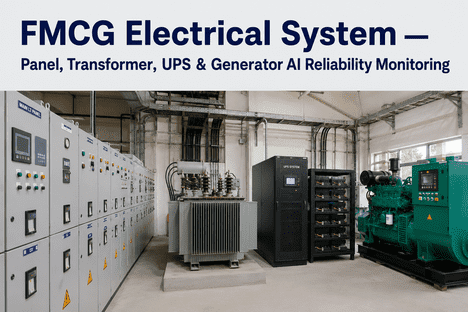
FMCG Electrical System Panel, Transformer, UPS & Generator AI Reliability Monitoring
By Seren on June 26, 2026
A loose connection in a 480-volt distribution panel heats up over three months — one degree per week, then three degrees per week, then ten degrees in a single shift. A transformer winding temperature drifts above its rated rise on a hot July afternoon, accelerating insulation degradation that will reduce its remaining useful life by an estimated 40%. A UPS battery string drops from 100% to 78% state of health over six weeks — a gradual capacity loss that no single weekly test detects, but that leaves the facility's critical control systems one battery failure away from riding through a power event on depleted reserves. A standby generator jacket water heater fails during a weekend when no one is on site, and the block temperature drops from 38 degrees Celsius to 4 degrees Celsius by Monday morning — just as a utility power interruption strikes the facility. Each of these failure modes is a distinct electrical system event, arising from different asset types, detectable by different parameters, and requiring different corrective actions. Yet they share one critical characteristic: they are all detectable weeks before they cause a production interruption — if the right monitoring infrastructure is in place. Electrical system failures account for 25% to 35% of all unplanned production stoppages in FMCG manufacturing according to IEEE Gold Book reliability data, making them the single largest category of avoidable downtime across the industry. A single electrical panel failure in a biscuit bakery in 2023 caused a four-hour production stoppage that resulted in USD 340,000 in lost output, emergency electrical contractor fees of USD 18,000, and a 48-hour product hold on affected batches due to the uncontrolled production stop. The US Department of Energy reports that 60% of electrical distribution equipment failures are preventable with condition-based monitoring — thermal anomalies detected weeks before flashover, transformer dissolved gas trends identified before winding failure, UPS battery degradation caught before capacity drops below critical threshold. Yet most FMCG facilities still rely on quarterly or annual thermographic surveys, manual battery load tests, and periodic generator exercises — point-in-time inspections that miss the progressive degradation patterns that occur between measurement intervals. For maintenance managers responsible for electrical system reliability in FMCG facilities, the mandate has never been clearer: the electrical distribution network that powers every production line, every refrigeration compressor, every HVAC air handler, and every control system is the most critical single point of failure in the facility. AI-powered electrical reliability monitoring changes the paradigm from periodic inspection to continuous condition assessment — thermal trend analysis, transformer health scoring, UPS battery degradation modelling, and generator readiness verification that together provide a complete, real-time picture of every electrical asset's condition and remaining useful life.
25-35% of All FMCG Production Stoppages Are Electrical. Every Breaker, Transformer, Battery, and Generator Is a Potential Downtime Event Waiting to Happen.
From panel thermal trend analysis to UPS battery degradation modelling and generator readiness verification — iFactory connects your electrical asset data to production reliability in real time. No more quarterly thermography blind spots.
Of unplanned production stoppages in FMCG manufacturing are caused by electrical system failures — the single largest category of avoidable downtime
60%
Of electrical distribution equipment failures are preventable with condition-based monitoring — thermal anomalies detected weeks before flashover or failure
USD 340K
Average cost of a single electrical panel failure in a mid-size FMCG facility — including lost production, emergency repairs, and product hold costs
85%
Of UPS battery replacements in FMCG facilities are performed reactively after capacity drops below critical threshold — not proactively based on degradation trends
The Electrical Reliability Blind Spot — Why Quarterly Thermography and Manual Load Tests Cannot Protect FMCG Production
Maintenance managers in FMCG facilities manage electrical distribution systems that span multiple voltage classes, asset categories, and criticality levels — medium-voltage switchgear feeding step-down transformers, low-voltage distribution panels serving production areas, UPS systems protecting control and automation equipment, and standby generators providing emergency backup. Each asset category degrades through distinct failure mechanisms that operate on different time scales. A loose connection in a panelboard bus bar can progress from nominal temperature to critical thermal excursion over weeks or months, depending on load current, ambient temperature, and vibration. A transformer winding insulation degradation occurs over years but accelerates sharply above rated temperature — a single over-temperature event can reduce remaining useful life by 10% to 40%. UPS battery capacity declines through a combination of electrochemical ageing, temperature stress, and charge-discharge cycling that is non-linear and difficult to predict without continuous impedance monitoring. The common thread across all electrical asset failure modes is that point-in-time inspection — quarterly thermography, annual battery load testing, monthly generator exercises — provides only a snapshot of condition on the day of measurement. The degradation that occurs between inspection intervals is invisible. And in electrical systems, the critical degradation typically accelerates: a connection that is 10 degrees above ambient in January may be 30 degrees above ambient by March as the resistance increases in a self-reinforcing thermal cycle. The quarterly inspection catches the 30-degree anomaly in March. By then, the failure is imminent and the intervention is an emergency shutdown rather than a planned repair.
01
Thermal Anomalies Develop Between Thermography Surveys
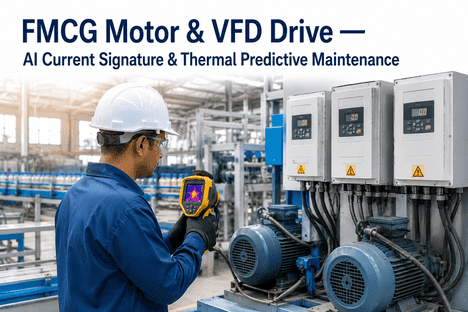
Quarterly or bi-annual infrared thermography is the industry standard for detecting loose connections, overloaded circuits, and failing components in electrical distribution equipment. But the interval between surveys — 90 to 180 days — is far longer than the time it takes for a developing thermal anomaly to progress from detectable to critical. IEEE Standard 1459 notes that 80% of electrical connection failures are preceded by a measurable temperature rise for at least two weeks before failure. Continuous temperature monitoring with wireless sensors on panelboard interiors, breaker connections, and bus bar joints detects these thermal trends as they develop, enabling intervention weeks before the anomaly reaches a critical level — rather than discovering it during the next scheduled thermographic survey.
02
Transformer Health Cannot Be Assessed by Oil Sampling Alone
Annual dissolved gas analysis (DGA) and oil quality testing provide critical insights into transformer winding and insulation condition. But a transformer can develop a developing fault — a partial discharge source, a localised hot spot, a cellulose decomposition event — that progresses significantly between annual oil sampling intervals. Continuous transformer monitoring with online DGA sensors, winding temperature probes, and load current tracking enables the detection of developing faults within days rather than months. AI analysis of combined DGA trends, thermal data, and load profiles provides a transformer health index that updates in real time, alerting maintenance managers to accelerating degradation patterns that warrant investigation between scheduled oil sampling cycles.
03
UPS Battery Degradation Is Invisible to Weekly Voltage Checks
The standard preventive maintenance check for UPS battery strings — measuring terminal voltage and performing an annual load test — cannot detect the progressive internal impedance increase that precedes battery failure. A valve-regulated lead-acid (VRLA) battery can show normal terminal voltage readings while its internal resistance has doubled, reducing its ability to deliver rated current during a power event. Continuous battery impedance monitoring with AI trend analysis detects capacity degradation 6 to 12 weeks before the battery string can no longer support the critical load during a utility power interruption. For lithium-ion UPS batteries now being deployed in FMCG facilities, continuous monitoring of state of health (SOH), state of charge (SOC), and cell voltage balance is essential for detecting the thermal runaway precursors that VRLA impedance monitoring cannot predict.
Before AI — The Periodic Inspection Workflow
Quarterly thermography survey of distribution panels and switchgear
↓
Annual transformer oil sampling and DGA analysis
↓
Monthly UPS battery voltage checks and annual load test
↓
Weekly generator exercise with manual log entry
↓
Failure discovered during inspection or after unplanned outage
After AI — The Continuous Monitoring Workflow
Wireless thermal sensors stream panel and connection temperatures continuously
↓
AI detects thermal trend acceleration and predicts time-to-critical
↓
Transformer health index updated with continuous DGA and thermal data
↓
UPS battery impedance trend analysis with remaining capacity prediction
↓
Planned intervention scheduled before failure — zero production impact
How AI Transforms FMCG Electrical System Reliability Monitoring
AI-powered electrical system reliability monitoring combines continuous sensor ingestion from panel-mounted thermal sensors, transformer monitoring probes, UPS battery impedance testers, and generator controllers with machine learning models that detect developing degradation patterns before they reach failure thresholds. The technology has moved from industrial power utility deployments to production-ready platforms for FMCG manufacturing facilities. Here is how it works in practice.
01
Connect Assets
Wireless thermal sensors on panel connections and breaker faces, online DGA and temperature probes on transformers, impedance testers on UPS battery strings, and generator controller data feeds connect via IoT gateway. No electrical system modification required.
02
AI Models Degradation
Machine learning models analyse thermal trends, transformer gas evolution rates, battery impedance trajectories, and generator start and load performance. Deviations are detected as developing failure patterns, not single-point threshold breaches.
03
Predict & Prioritise
AI calculates remaining useful life for each asset and generates a ranked list of recommended interventions based on criticality to production. Alerts include estimated time-to-failure and suggested corrective action by asset.
04
Schedule & Verify
Corrective work orders are generated with asset-specific instructions, spare parts recommendations, and safety isolation procedures. Post-repair thermal or impedance verification confirms the intervention restored normal operating condition.
Electrical Asset Condition Grades — What the Levels Mean for FMCG Production Reliability
Grade
Asset Condition
Indicators
Recommended Response
A
Good
Temperatures within 10°C of ambient. Transformer DGA within normal limits. UPS battery impedance within 110% of baseline. Generator starts within 10 seconds and accepts 100% load.
Continue continuous monitoring at standard interval. No intervention required. Reassess condition at next scheduled inspection.
B
Fair
Temperature 10-25°C above ambient on specific connections. DGA shows trace gas evolution. Battery impedance 110-130% of baseline. Generator start time 10-15 seconds.
Schedule investigation within 60 days. Increase monitoring frequency. Plan corrective action during next planned shutdown.
C
Poor
Temperature 25-40°C above ambient with accelerating trend. DGA shows significant gas generation. Battery impedance 130-160% of baseline. Generator fails to accept full load within 15 seconds.
Schedule intervention within 30 days. Prepare spare parts and contractor availability. High risk of failure if delayed beyond next operating cycle.
D
Critical
Temperature exceeding 40°C above ambient or accelerating rapidly. DGA indicates active fault. Battery impedance above 160% of baseline. Generator fails to start, starts but does not accept load, or exhibits abnormal vibration or coolant leak.
Immediate intervention required. Remove affected asset from service if production permits. Emergency repair or replacement. Production stoppage risk is high if action is delayed.
What AI Electrical Reliability Monitoring Delivers for FMCG Maintenance Managers
The measurable outcomes of deploying AI-powered electrical monitoring across an FMCG facility's distribution network, transformers, UPS systems, and generators extend beyond reduced downtime. They change the relationship between electrical asset condition data and production planning.
55%
Fewer Electrical Failures
Facilities using continuous electrical condition monitoring with AI trend analysis report a 55% reduction in unplanned electrical failures. The ability to detect thermal trends, battery impedance changes, and transformer gas evolution weeks before critical thresholds enables maintenance managers to schedule interventions during planned downtime rather than responding to emergency stoppages.
30%
Extended Transformer Life
Continuous monitoring of transformer winding temperature, load profile, and dissolved gas levels enables maintenance managers to identify and correct conditions that accelerate insulation ageing — overloading, inadequate cooling, partial discharge activity. Correcting these conditions before they cause cumulative damage extends transformer service life by an average of 30% compared to assets managed on time-based maintenance alone.
80%
UPS Battery Lead Time
Continuous battery impedance monitoring with AI trend analysis predicts end-of-life 6 to 12 weeks before the battery string can no longer support the critical load. This lead time allows maintenance managers to schedule battery replacement during planned outages rather than deploying emergency procurement and installation — typically at 2-3x the cost of a planned replacement.
Our facility has seven main distribution panels, four 2,500 kVA transformers, twelve UPS systems protecting critical PLC and SCADA networks, and three standby generators powering the entire chilled and frozen production wing. Before iFactory, we conducted quarterly thermography through a contractor, performed annual transformer oil sampling, and checked UPS battery voltages weekly. We thought we had a robust electrical maintenance programme. The quarterly thermography report from February showed everything within normal limits. In April, a main distribution panel feeder connection failed at 2:00 AM on a Sunday during a third shift production run. The thermal imaging from February had missed the developing hot spot because the connection was behind a deadfront cover. The connection temperature had risen from 25 degrees above ambient to 85 degrees above ambient in the intervening eight weeks. The repair cost was USD 22,000 for emergency electrical contractor call-out, lost production valued at USD 180,000, and a 36-hour product hold on affected frozen goods. After deploying continuous wireless thermal monitoring on every critical panel connection, we detected a developing hot spot on a transformer secondary connection within three days of its onset — 23 degrees above ambient and rising at two degrees per week. We scheduled the repair during a planned shutdown three weeks later. The repair cost was USD 3,800. The avoided production loss was every dollar of that quarter's revenue plan.
— Maintenance Manager, Multinational Frozen Food Manufacturer — 16 Years FMCG Electrical Systems Management
AI Electrical Monitoring · Thermal Trend Analysis · Transformer Health · UPS Battery · Generator Readiness
Your Electrical System Is the Most Critical Single Point of Failure in Your Facility. iFactory Monitors Every Panel, Transformer, UPS, and Generator Continuously.
iFactory enables FMCG maintenance managers to monitor thermal condition, transformer health, UPS battery degradation, and generator readiness with continuous AI-powered trend analysis and predictive alerts. No more quarterly thermography blind spots. No more emergency electrical failures.
Conclusion — The Case for AI Electrical Monitoring Is a Case for Production Continuity
The gap between the condition data electrical assets generate and the production reliability decisions maintenance managers need to make is not widening because sensing technology is insufficient. It is widening because point-in-time inspection intervals cannot capture the accelerated degradation patterns that characterise electrical failure progression. AI-powered continuous electrical monitoring closes that gap — not by replacing the expertise of electrical engineers and maintenance technicians, but by eliminating the blind spots between quarterly thermography surveys, annual transformer oil samples, and monthly battery checks that allow developing failures to progress from detectable to critical without intervention.
For maintenance managers in FMCG facilities, the decision to adopt AI electrical reliability monitoring is not a technology choice. It is a production continuity choice. Every thermal anomaly that progresses undetected between quarterly thermography surveys is a connection failure waiting to cause a production stoppage. Every transformer gas evolution trend that accelerates between annual oil samples is a winding failure reducing its remaining useful life. Every UPS battery impedance rise that goes unmonitored between monthly voltage checks is a critical control system left vulnerable to a power event.
iFactory gives FMCG maintenance managers the AI infrastructure to monitor electrical panel thermal condition, transformer health, UPS battery status, and generator readiness continuously — with trend-based predictive detection, remaining useful life modelling, and automated corrective action workflows that connect electrical asset data directly to production reliability decisions. The platform makes continuous electrical condition monitoring possible. The maintenance manager's decision to act on it makes the facility's production plan achievable. Book a Demo to see how iFactory's AI electrical monitoring maps to your facility's distribution network and critical power assets, or talk to an expert about configuring a pilot on your highest-criticality electrical infrastructure.
Frequently Asked Questions
iFactory's AI electrical monitoring platform supports medium-voltage switchgear, low-voltage distribution panels, motor control centres (MCCs), dry-type and oil-filled transformers, UPS systems (VRLA and lithium-ion), standby generators (diesel and natural gas), automatic transfer switches (ATS), power distribution units (PDUs), and branch circuit monitoring panels. Sensor types include wireless temperature sensors for panel connections and breaker faces, online dissolved gas analysis (DGA) sensors for transformers, battery impedance testers for UPS strings, generator controller data feeds (CAN bus, Modbus), current transformers (CTs) for load monitoring, and power quality analysers for harmonic and voltage sag detection. Integration with existing power monitoring systems and electrical SCADA platforms via Modbus, DNP3, BACnet, and REST API is supported without requiring panel or switchgear modification. Talk to an expert to discuss your facility's specific electrical asset inventory and monitoring requirements.
Quarterly infrared thermography provides a snapshot of thermal conditions on the day of the survey, but it cannot detect thermal anomalies that develop between survey intervals. Studies consistently show that 40-60% of electrical connection failures are preceded by a measurable temperature rise for at least two weeks before failure — well within a quarterly survey interval if continuous monitoring is in place, but invisible when the next survey is 90 days away. Continuous wireless thermal sensors mounted on panel connections, breaker lug terminations, and bus bar joints measure temperature at user-defined intervals (default: every 5 minutes) and transmit data to iFactory's AI analysis engine. The platform tracks temperature trends relative to ambient, load current, and historical baseline, detecting accelerating thermal trends that indicate developing connection degradation. When a trend exceeds a configurable threshold — temperature rising more than 5 degrees per week on a specific connection — the platform generates a predictive alert with the specific panel location, connection identification, and recommended intervention timeframe. Book a Demo to see continuous thermal monitoring applied to your facility's distribution panel data.
iFactory integrates directly with existing electrical power monitoring systems, SCADA platforms, and building management systems via Modbus RTU/TCP, DNP3, BACnet, MQTT, and REST API connections — no separate sensor deployment required for facilities with existing power monitoring infrastructure. For facilities where thermal monitoring sensors are not installed on panel connections — which is the case for the majority of FMCG facilities — iFactory supplies wireless temperature sensor kits that can be installed on panel interiors without requiring panel modification, electrical shutdown, or production interruption. The sensors mount with adhesive or magnetic backing on panel connections, breaker faces, and bus bar joints, and communicate via encrypted wireless mesh to the iFactory gateway. Typical installation for a facility with 25 to 50 distribution panels and MCCs takes two to three days with zero production impact. Talk to an expert to assess your current electrical monitoring infrastructure and identify sensor requirements.
ROI for AI electrical monitoring varies by facility size, electrical asset count, and baseline failure rate, but most FMCG customers achieve full platform payback within 4 to 10 months of deployment. The primary ROI driver is avoided production losses from unplanned electrical failures — a single prevented panel failure, transformer fault, or UPS battery outage typically saves USD 50,000 to USD 340,000 depending on the production line affected and the duration of the stoppage. Additional savings come from reduced emergency repair premiums (planned electrical interventions cost 60-70% less than emergency call-outs), extended transformer and UPS battery service life (reducing capital replacement frequency by 3-5 years per asset), and reduced contractor costs for quarterly thermography surveys (which can be reduced to an annual verification cycle once continuous monitoring is established). Book a Demo to receive a customised ROI projection based on your facility's electrical asset configuration, production criticality, and current failure history.
25-35% of Production Stoppages Are Electrical. Every Connection, Transformer, Battery, and Generator Is a Potential Failure. Start Monitoring What Matters.
iFactory gives FMCG maintenance managers the AI platform to monitor panel thermal condition, transformer health, UPS battery status, and generator readiness continuously — with trend-based predictive detection, remaining useful life modelling, and automated corrective action workflows that connect electrical asset data directly to production reliability decisions.