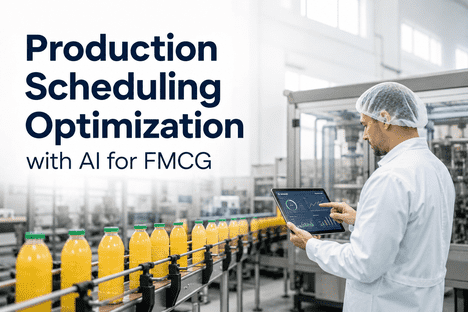
At 6 PM on a Friday, a scheduling supervisor at a beverage plant opens a spreadsheet with 47 SKUs, three production lines, 14 changeover matrices, and a demand file that arrived three hours late. By 8 PM, they have a schedule for Monday built on assumptions that will be invalid by Tuesday morning when a raw material delivery slips and a priority order is rushed in from the largest retailer. This is the reality of FMCG production scheduling in most plants: a human planner, a spreadsheet, and a wall of constraints that change faster than any static schedule can accommodate. AI-driven production scheduling changes the equation entirely.Instead of a once-a-week manual optimisation, the schedule becomes a continuously recomputed, constraint-aware plan that adapts in real time to demand shifts, material availability, line status, and changeover economics. This article explains exactly how AI transforms FMCG production scheduling from multi-SKU sequencing to changeover minimization to demand-driven dynamic re-planning.
Stop Spreadsheet Scheduling: Let AI Optimise Your FMCG Production Plan in Real Time
iFactory's AI-native scheduling engine continuously optimises multi-SKU sequencing, changeover minimization, and demand-driven planning across your FMCG lines reducing changeover time by up to 40% and improving OEE by 12–18% with no cloud dependency.
Why Spreadsheets and Gut Feel Are Costing Your FMCG Line Millions
Most FMCG plants still build production schedules the same way they did twenty years ago: a senior planner armed with Excel, tribal knowledge of changeover times, and a weekly demand file from sales. When a line goes down, a material shipment is delayed, or a rush order arrives, the entire schedule collapses — and the planner starts over. The hidden costs are staggering: excess changeover time, premium freight for expedited materials, overtime labour for weekend catch-up runs, and lost margin from sub-optimal product sequencing. Here is exactly where manual scheduling fails and what it costs.
Changeover Inefficiency 15–25% of Available Production Time Wasted
Poor product sequencing on multi-SKU FMCG lines adds 8–14 hours of unnecessary changeover per week. A beverage plant running 20 SKUs across 3 lines loses an average of $380,000 per year in changeover waste alone. AI sequencing groups products by similarity to minimise wash cycles, label changes, and format adjustments.
Demand-Plan Disconnect 30% of Schedules Are Obsolete Within 48 Hours
When demand shifts a retail promotion hits, a competitor is out of stock, or weather changes consumption patterns — the static schedule cannot react. Plants either rush product (premium freight, overtime) or miss the window entirely (lost revenue, retailer penalties). AI demand-driven scheduling re-optimises in minutes.
Raw Material Synchronisation Failure — Unplanned Line Stops Costing $12K–$18K/Hour
Schedules built without real-time material visibility trigger line stops when ingredients or packaging aren't available. A dairy plant loses 6–10 hours per month to material-related schedule breaks. AI scheduling integrates with inventory and procurement data to sequence production only when materials are confirmed available.
Co-Product and By-Product Misalignment — Waste and Reblending Costs
In FMCG processes with co-products (dairy, oils, milling), production of one SKU generates by-products that feed other SKUs. Manual schedules routinely misalign this cascade, creating surplus waste or forcing expensive reblending. AI models the full product cascade to synchronise interdependent production runs.
Weekend Catch-Up Runs — Overtime Labour and Higher Energy Costs
When the weekly schedule breaks, production spills into weekend catch-up runs. Weekend labour rates are 1.5x–2x weekday rates, and energy costs during off-peak hours may actually be lower — but the schedule is too broken to exploit it. AI optimises across the full week to minimise weekend work while maximising energy cost efficiency.
Your FMCG plant is losing $1.2M–$2.4M per year in scheduling inefficiency — changeover waste, premium freight, overtime labour, and missed revenue. Book a 30-min demo and we'll show you how iFactory's AI scheduling engine recaptures that margin in 6–10 weeks.
From Static Spreadsheet to Continuous Optimisation — In Four Steps
iFactory's production scheduling engine ingests your demand forecast, line constraints, material availability, and changeover matrices — then continuously computes the optimal production sequence across all lines and shifts. No cloud, no data leaving your plant, no manual intervention required for daily re-optimisation.
Ingest Constraints
iFactory connects to your ERP, demand planning system, and plant-floor PLCs to pull SKU demand, changeover matrices, line speeds, material inventories, and shift calendars — all on-premise via the NVIDIA appliance.
Build the Optimisation Model
Over 1–2 weeks, the AI learns your specific constraint hierarchy: changeover cost by sequence, material synchronisation rules, shelf-life windows, co-product relationships, and labour availability. The model becomes more precise with each scheduling cycle.
Generate and Publish the Schedule
The engine produces a fully constrained, sequenced schedule across all lines — typically in 3–8 minutes. Output includes line-by-line run sequences, start times, changeover windows, material pull signals, and labour assignments. Published directly to line-side displays and Shift Logbook.
Re-Optimise Continuously
When a constraint changes — demand spike, line breakdown, material delay — iFactory re-optimises the remaining schedule in 2–5 minutes. The planner reviews the proposed adjustment and approves with one click. No more rebuilding from scratch at 8 PM on Friday.
AI Scheduling That Understands the Real Constraints of FMCG Production
iFactory's scheduling engine is purpose-built for FMCG complexity — not a generic APS bolted onto a spreadsheet output. Every capability addresses a specific scheduling failure mode that FMCG plants experience daily.
Intelligent Multi-SKU Sequencing
Groups products by packaging format, flavour, colour, and allergen profile to minimise changeover time. The engine evaluates every possible sequence permutation and selects the optimal order. Typical result: 35–45% reduction in changeover hours per week.
Demand-Driven Dynamic Re-Scheduling
Connected to your demand planning system, iFactory detects demand shifts and re-optimises the schedule automatically. Promotional lifts, forecast error corrections, and retail order changes are incorporated within minutes of the data update.
Material-Constrained Scheduling
Integrates with inventory and procurement data to sequence production only when all required materials — ingredients, packaging, labels — are confirmed available or inbound within the required window. Eliminates material-driven line stops.
Shelf-Life and Freshness Optimisation
For perishable FMCG products, the engine sequences production to maximise retail shelf life at the point of delivery. Dairy, bakery, fresh juice, and prepared meal lines see 2–4 additional days of shelf life through optimised production timing.
Co-Product and Cascade Synchronisation
Models interdependent production processes where one SKU's output feeds another's input. Synchronises cheese, whey, and powder lines in dairy; crude, refined, and packaged oils in edible oil plants; fractions and blends in milling operations.
Integrated OEE and Schedule Adherence Tracking
iFactory correlates the scheduled plan with actual production data from line sensors. Schedule adherence is tracked in real time — deviations are flagged, and the engine automatically proposes a re-optimised schedule to recover lost production.
What FMCG Plants Achieve With AI-Driven Scheduling
These outcomes are drawn from iFactory deployments across beverage, dairy, snack food, and packaged goods lines. Results vary by plant complexity, but the improvement pattern is consistent across every deployment: measurable changeover reduction, OEE uplift, and planner productivity gain.
Turnkey AI Scheduling — On-Premise, No Cloud, Proven in FMCG
iFactory is a complete, on-premise scheduling platform that absorbs the workload of legacy APS, spreadsheet-based planning, and manual schedule management. You provide data-source access; we deliver a working pilot in 6–10 weeks. Here is exactly what is included.
On-Premise NVIDIA Appliance
Zero cloud dependency. All scheduling data stays on your plant network. No data egress costs, no IT security reviews, no latency. The AI engine runs entirely behind your firewall.
6–10 Week Pilot to ROI
We connect to your ERP, demand system, and line PLCs in weeks. The AI begins generating optimised schedules immediately. You see measurable ROI — fewer changeovers, higher OEE, less planner overtime — within one quarter.
ERP and APS Integration
iFactory integrates with SAP, Oracle, Microsoft Dynamics, and legacy APS systems. We absorb the scheduling workload without rip-and-replace. Data flows bidirectionally — optimised schedules publish back to your ERP for material planning and order execution.
Shift Logbook Integration
Schedules publish directly to iFactory's Shift Logbook — line operators see the daily plan, sequence, and changeover schedule on line-side tablets. Completed runs and actual changeover times are logged back to the scheduling engine for continuous model improvement.
24x7 Managed Service & Support
iFactory's operations team monitors your scheduling engine around the clock. If a constraint shift causes schedule degradation, we are alerted before you are. Includes unlimited support, model updates, and quarterly scheduling performance reviews.
Real-Time Line-Side Displays
Every line station receives the current schedule, upcoming changeover, and real-time adherence status on in-plant displays. Operators know exactly what to run next and when the next changeover begins — no more walking to the planner's office for updates.
Frequently Asked Questions About AI Production Scheduling
Your FMCG Plant Is Losing Margin Every Day You Rely on Spreadsheet Scheduling
Stop manual scheduling. Start continuous AI-driven optimisation that adapts to demand, materials, and line status in real time. Book a 30-minute demo and we'll show you how iFactory delivers a working pilot in 6–10 weeks — on-premise, zero cloud, proven ROI.