Sixty-five percent is the number that keeps coming up whenever FMCG operations leaders compare notes on AI: roughly two out of three pilots never make it past the trial line into a production line. The pattern is rarely a bad model. It is almost always the same handful of decisions made in the first thirty days — before a single prediction ever reached a plant floor. Those decisions are visible in hindsight, and they are fixable in advance, which is exactly what the rest of this breakdown is built to show, alongside how the iFactory team approaches each one differently from day one.
FMCG OPERATIONS — AI DEPLOYMENT
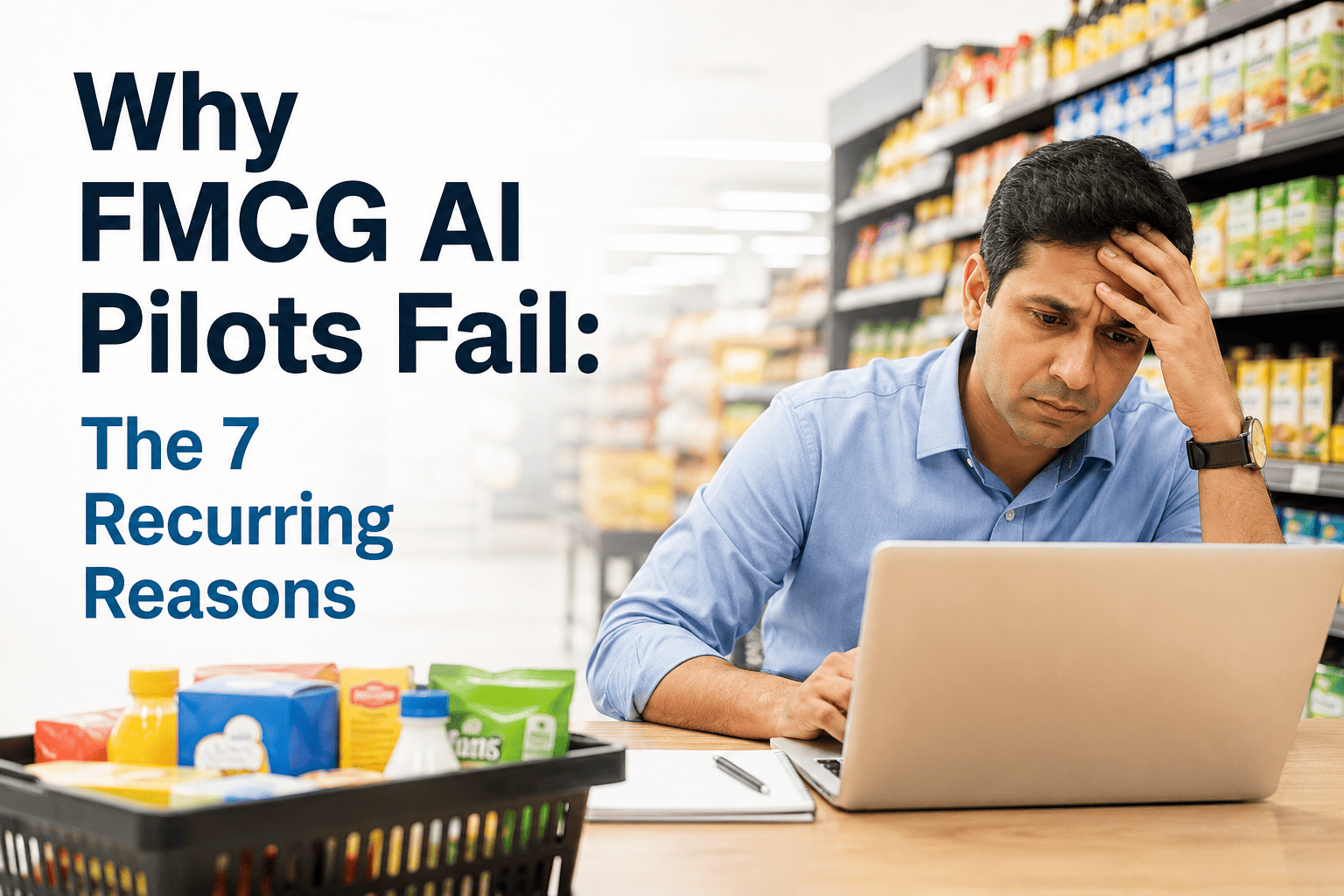
Why FMCG AI Pilots Fail: The 7 Recurring Reasons
Across dozens of FMCG plant and supply chain deployments, the same seven failure points appear again and again — long before the model itself is ever the problem. Here is what actually stalls AI pilots, and the framework that fixes each one before it happens.
65%
of enterprise AI pilots stall before reaching production scale
4-6
months is the average window before pilot fatigue sets in
7
recurring root causes account for nearly all stalled FMCG pilots
The Pattern Behind Every Stalled Pilot
Talk to enough plant directors and data science leads across FMCG manufacturers and a pattern surfaces fast: the pilots that die were almost never killed by inaccurate models. They were killed by decisions made before the model was ever trained — an unclear owner, a use case chosen because it was interesting rather than valuable, or a baseline nobody bothered to capture. By the time the technical work is finished, the business case has already quietly evaporated. Understanding these seven points is the difference between a pilot that becomes a reference case and one that becomes a line item nobody wants to revisit at budget season.
78%
Reach First Model Output
52%
Reach a Business Review
35%
Reach Production Scale
The 7 Reasons FMCG AI Pilots Actually Fail
None of the seven reasons below are exotic. Each one is a familiar organizational habit that happens to be lethal to an AI initiative specifically, because AI projects fail quietly — there is rarely a single dramatic collapse, just a slow drift toward "we'll revisit next quarter" that never arrives. Recognizing which of these is active in your own organization is the fastest diagnostic available before committing budget to a new pilot.
01
Data Foundations Were Never Actually Ready
Plant sensor feeds, MES logs, and quality records that looked complete in a demo turn out to have gaps, inconsistent labeling, and conflicting timestamps once a model needs to run against them daily. Teams discover this three weeks into the pilot instead of during scoping, and the "AI project" quietly becomes a data engineering project with no budget line for it.
02
The Use Case Was Chosen for Novelty, Not Value
Computer vision on a packaging line photographs well for a leadership deck, but if the underlying defect rate was already low, the financial upside is small no matter how accurate the model becomes. Pilots chosen for visibility rather than measurable value struggle to justify continued investment once the initial excitement fades.
03
No Baseline Existed to Prove Impact
Without a documented pre-AI number for waste, downtime, or throughput, there is no way to demonstrate improvement later, regardless of how well the system actually performs. Finance teams cannot approve scale-up budget against a claim that cannot be measured against a starting point.
04
Change Management Was an Afterthought
A model that flags a quality issue is worthless if the line operator does not trust the alert, was never trained on what to do with it, or has no time built into their shift to act on it. Technical success and operational adoption are two entirely separate projects, and most pilots only staff for the first one.
05
Integration Effort Was Badly Underestimated
Connecting a pilot to ERP, MES, or warehouse systems is usually quoted as a footnote and turns out to be the majority of the engineering timeline. Plants with legacy or heavily customized systems in particular find the integration layer takes longer than the AI model itself.
06
Executive Sponsorship Faded After Kickoff
The leader who championed the pilot at launch moves to another priority, gets promoted, or simply stops attending the monthly review, and the project loses the authority needed to push through cross-functional blockers that inevitably appear during scale-up.
07
Success Was Never Defined in Business Terms
"Model accuracy of 92%" is a data science metric, not a business case. Without a target tied to waste reduction, labor hours saved, or margin protected, there is nothing for a P&L owner to sign off on when the pilot period ends and a scale-up decision has to be made.
Symptom vs Root Cause — What Teams See vs What Is Actually Happening
The visible symptom of a stalling pilot rarely matches the underlying cause, which is exactly why so many pilots get the wrong fix applied. A team that sees "leadership lost interest" usually treats it as a communication problem, when the real issue was that success criteria were never defined clearly enough to communicate progress against in the first place. The table below maps the symptom teams typically report against the root cause behind it.
| What Teams Report Seeing | Root Cause Underneath It | Reason Number |
|---|
| "The model results looked fine but nobody acted on them" | No operational workflow or training built around the alert | Reason 04 |
| "We couldn't get budget for phase two" | No baseline number existed to prove the pilot's financial impact | Reason 03 |
| "IT took three extra months to connect the systems" | Integration scope was never assessed during planning | Reason 05 |
| "Leadership just lost interest" | Success was never defined in terms finance could evaluate | Reason 07 |
| "The data science team kept asking for more data" | Data foundations were incomplete before the pilot even started | Reason 01 |
| "The pilot worked but nobody wanted to scale it" | The use case never carried enough financial upside to justify scaling | Reason 02 |
Find Out Which of the 7 Reasons Is Active in Your Pipeline
iFactory runs a structured pilot-readiness review before any deployment begins, scoring your data foundations, use case selection, and organizational readiness against the same framework used across dozens of FMCG plants.
Stalled Pilot vs Scaled Deployment — Side by Side
The gap between a pilot that quietly dies and one that becomes a reference deployment is rarely about the sophistication of the technology. It is about a small number of decisions made differently at the outset. The comparison below lays out what each path typically looks like in practice, from the first thirty days through the twelve-month mark.
Pilots That Stall
Use case chosen because it demos well
Data readiness assessed after kickoff
No documented baseline before go-live
Success measured only in model accuracy
Single executive sponsor, no cross-functional owner
Integration scoped as an afterthought
Pilots That Scale
Use case scored against measurable financial upside
Data audit completed before scope is finalized
Baseline captured over 2-4 weeks before go-live
Success tied to waste, downtime, or labor hours saved
Operations, IT, and finance all own part of the outcome
Integration mapped and quoted during planning phase
A Plant Operations Director on What Changed the Second Time Around
"
Our first AI pilot was a computer vision project on a filling line, and honestly it worked from a technical standpoint — the model caught what it was supposed to catch. What killed it was that we never wrote down what "success" meant in a way finance could sign off on, so when the pilot period ended, we had a working model and no business case. Nobody wanted to be the one to kill it, so it just sat there running with nobody actively championing it, and it eventually got quietly deprioritized. When we ran our second pilot, we spent the first three weeks doing almost nothing visible — capturing a real baseline, mapping every system the model would need to talk to, and writing down a specific dollar target tied to downtime reduction. It felt slow at the time. But when that pilot period ended, we had a number to show, a workflow the line operators already trusted because they had been part of building it, and a scale-up decision that took one meeting instead of six months of hallway conversations. The technology was almost identical both times. The preparation was not.
— Plant Operations Director, National FMCG Manufacturer · Led Two AI Deployments Across 6 Facilities
The Pre-Pilot Checklist That Prevents All Seven Failure Modes
Every one of the seven reasons above is preventable with the same underlying discipline: doing the unglamorous groundwork before a single line of model code is written. The checklist below reflects the readiness review iFactory runs with FMCG operations teams before any pilot begins, mapped directly against the reasons pilots fail.
✓
Data audit completed across every source system the pilot will depend on, with gaps documented before scoping is finalized.
✓
Use case scored against financial upside, data readiness, and organizational appetite — not against how well it will present in a leadership review.
✓
Baseline metrics captured over a documented 2-4 week window before the pilot goes live, using the same measurement method that will be used afterward.
✓
Line-level training built into the rollout plan, with a defined workflow for what happens the moment an alert or prediction fires.
✓
Integration scope mapped against every ERP, MES, or warehouse system the pilot will need to read from or write to, with timeline built accordingly.
✓
Cross-functional ownership assigned across operations, IT, and finance so the project does not depend on one individual's continued attention.
✓
Business success metric defined in dollars, hours, or waste percentage — written down before go-live, not reconstructed afterward to justify continuation.
Frequently Asked Questions
Is a 65% pilot failure rate really typical, or is our organization doing something unusually wrong?
A stall rate in that range is common across enterprise AI generally, not just FMCG, and it says far more about how pilots are typically structured than about any one organization's capability. The pattern holds across industries specifically because the seven reasons above are organizational habits — unclear success metrics, underestimated integration effort, fading sponsorship — rather than technology limitations. Most FMCG manufacturers we work with have already run at least one pilot that stalled for exactly these reasons before bringing in a more structured process the second time. It is a solvable pattern, not a reflection of internal capability.
How long should a data readiness audit take before starting a pilot?
For most single-use-case pilots, a thorough data audit across the relevant source systems takes two to three weeks, covering data completeness, labeling consistency, timestamp alignment, and access permissions across every system the model will depend on. Skipping this step to move faster is the single most common false economy in FMCG AI pilots, because the gaps discovered mid-pilot end up costing far more time than the audit would have. Organizations with cleaner MES and ERP environments can often complete this in under two weeks, while those running heavily customized legacy systems may need closer to a month.
What should a baseline measurement period actually capture before AI goes live?
A useful baseline captures the exact metric the pilot is meant to improve — waste percentage, unplanned downtime hours, defect rate, or labor hours on a specific task — measured using the same method and timeframe that will be used to evaluate the pilot afterward. It typically runs two to four weeks to smooth out day-to-day variability and capture a representative range rather than a single unusually good or bad week. Without this step, any improvement claimed after the pilot is essentially unverifiable, which is precisely why so many pilots that technically worked still fail to secure scale-up budget.
Who should own an AI pilot inside an FMCG manufacturing organization?
The strongest pattern across successful deployments is shared ownership rather than a single champion: an operations leader who owns the business outcome, an IT or data leader who owns the technical integration, and a finance stakeholder who owns validating the baseline and the eventual ROI case. Single-sponsor pilots are especially vulnerable to Reason 06 above, because the entire project's authority disappears the moment that one person's attention shifts elsewhere. You can
talk to our team about how we structure cross-functional ownership during pilot planning.
How does iFactory help avoid these seven failure points specifically?
Every iFactory engagement begins with a structured readiness review that scores the proposed use case against financial upside, data readiness, and organizational appetite before any pilot work begins, followed by a documented baseline capture period and a business-metric definition signed off by both operations and finance stakeholders. Integration scope is mapped against your actual ERP, MES, and plant systems during planning rather than discovered mid-pilot. The goal is to make sure that by the time a model is actually running, every one of the seven common failure points has already been addressed. To walk through the readiness framework against your own use case,
book a demo with our team.
Give Your Next AI Pilot a Real Chance at Scale
Most FMCG AI pilots do not fail because the model was wrong — they fail because of decisions made before the model was ever trained. iFactory's readiness framework addresses all seven recurring failure points before your pilot goes live, so the deployment that works in week four still works in month twelve.





-in-fmcg-a-step-by-step-guide-to-eliminating-recurring-failures.png)