Every protein portion that leaves a trim line is priced before anyone has actually weighed it — a worker's eye and a target sheet decide the cut, and the scale downstream only confirms whether that guess was safe. Plants almost always guess high, because a portion under the label is a compliance problem and a portion over the label is just absorbed as cost. That absorbed cost is giveaway, and across a beef, pork or poultry line it quietly eats more margin than most line items on the floor. The plants closing that gap in 2026 are predicting weight from the shape of the piece before it reaches the scale, and comparing that approach against what your line runs today is the fastest way to see where your own number sits.
Predict the Weight Before the Blade Finishes the Cut
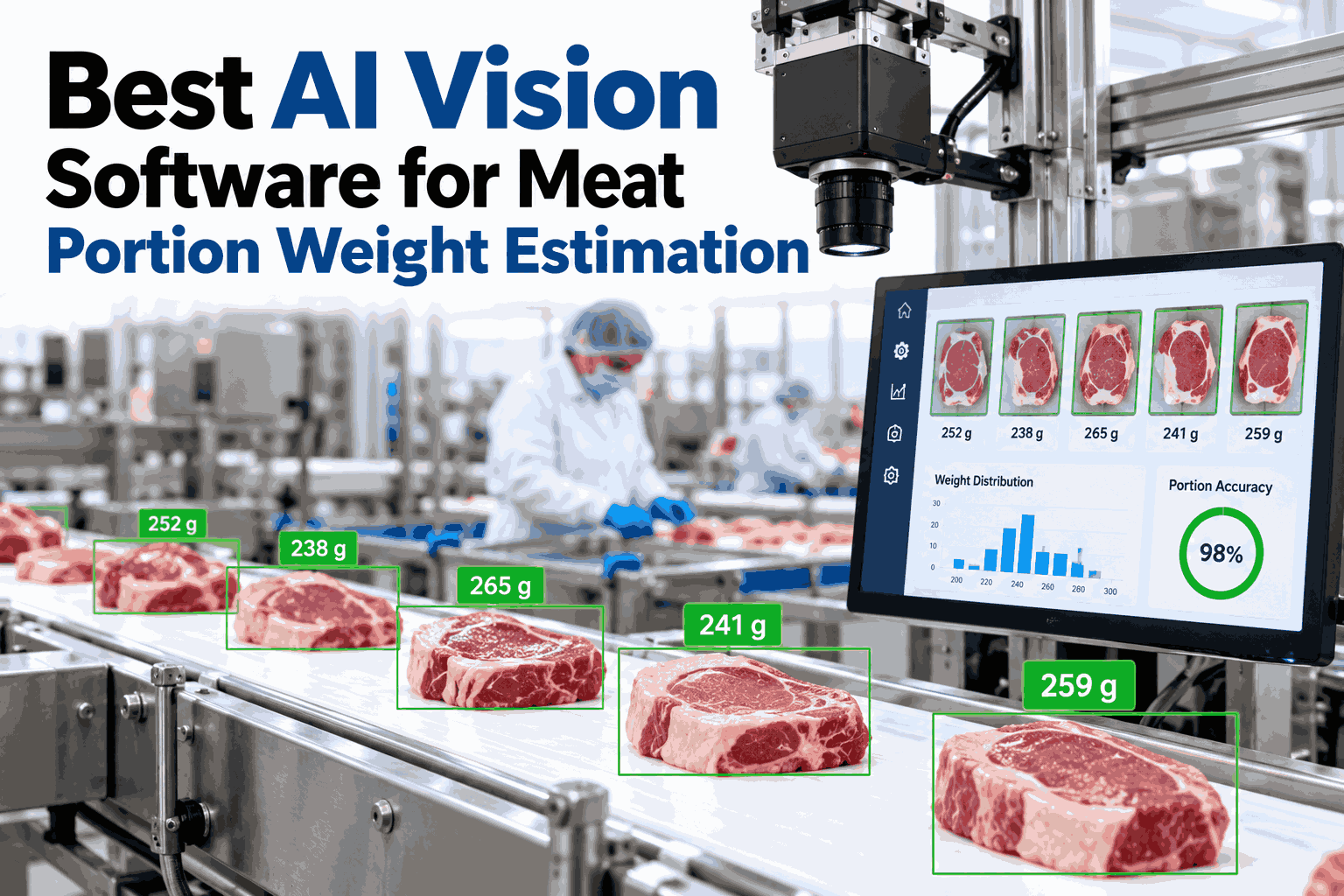
iFactory AI reads the 3D geometry of every portion in motion and predicts its weight against target before it ever reaches a scale, so the line corrects in real time instead of discovering the miss downstream.
Why the Scale Is Always the Last to Know
A checkweigher is a referee, not a coach. It tells you, after the fact, whether a portion met the label — but by the time that number appears, the piece has already been cut, trimmed and packed. There is nothing left to correct on that unit, only a decision to rework it, downgrade it, or let the overage through and absorb the cost.
Minimum-weight pricing makes this worse, not better. Packers are paid on the number printed on the label, not the actual product inside, so every operator on the line learns the same lesson: when in doubt, run it heavy. That habit compounds across a shift, a week, a quarter, and it never shows up as one dramatic loss — it shows up as a margin that is quietly, permanently a few points lower than it should be.
The irony is that most plants already own the data that would prove this. Checkweigher logs and yield reports sit in the historian untouched, because nobody has connected the dots between "average pack weight a few grams over label" and "a few points of margin gone every quarter." The gap is visible in hindsight; the problem is that hindsight never gets to act on the next cut.
Every stage before the scale is where the weight was actually decided. A detection system that only runs at the scale can report the miss; it can never prevent the next one.
Where Giveaway Actually Costs You
The job card only shows the labor and the material on a single portion, but a persistent giveaway habit touches several budgets at once, which is why the true number is almost always larger than whatever a spot audit turns up.
Raw material burn
Every gram given away on a portion is a gram of paid-for livestock that never turns into billable finished product, multiplied across thousands of packs a shift.
Lost case count
Heavy portions mean fewer packs out of the same carcass or batch, so a plant can run a full shift and still ship less saleable product than its yield should allow.
Rework and downgrade labor
A portion far enough from target still has to be re-trimmed, re-packed or downgraded to a lower-value cut, adding labor hours that were never budgeted.
Retailer and customer penalties
Large retail and foodservice accounts routinely audit case weights against contract terms, and a pattern of over-pack can trigger chargebacks or renegotiated pricing.
Competitive price exposure
A competitor running tighter giveaway can price more aggressively on the same raw material cost, eroding share on commodity cuts where price is the main lever.
Inventory and planning drag
When actual case counts routinely run below forecast because of giveaway, planning has to pad orders upstream, tying up working capital that didn't need to move.
How 3D Vision Predicts Weight Before the Scale
Weight is a function of volume and density, and a calibrated 3D camera can measure volume directly from the shape of the piece as it moves. Once the system has learned the density profile of a given cut — fat content, bone structure, moisture — predicting the weight from the scan becomes a geometry problem the camera can solve in the time it takes the portion to pass beneath it.
This is a meaningfully harder problem than weighing a box or a bottle, because no two portions of meat share the same shape, and density itself varies within a single piece. A rib section carries bone at a different density than the surrounding muscle, and a fillet's fat cap shifts the overall weight-to-volume ratio compared to a leaner cut from the same bird. The model has to account for that internal variation, not just the outer silhouette, which is why density profiles are trained per cut rather than applied generically.
Scan the shape
A structured-light or stereo camera captures a full 3D surface map of the portion in motion, without slowing the line or touching the product.
Build the volume
The surface map is converted into a volume estimate, accounting for the irregular contours that make meat and poultry harder to measure than a uniform product.
Apply the density model
A density profile trained on that specific cut and species converts volume into a predicted weight, correcting for fat marbling and bone where it matters.
Act before the cut lands
The predicted weight is compared against target in milliseconds, so the portioner, grader or operator can adjust while the piece is still in motion.
See the Prediction Run on Your Own Cuts
Bring footage or sample pieces from your own line to a 30-minute session and watch the geometry-to-weight model score your actual product, not a demo reel.
Five Signs Your Portioning Line Has a Hidden Giveaway Problem
Giveaway rarely gets flagged on its own — it hides inside numbers that look fine individually. If a few of these sound familiar, the gap is already costing more than anyone on the floor has added up. None of these signs require an audit to notice; they are usually sitting in conversations the floor has every week without anyone connecting them to a dollar figure.
Average pack weight sits comfortably above the label on every shift, and nobody has ever asked why it isn't sitting closer to it.
Operators openly admit they "cut a little heavy to be safe" whenever a reject or a customer complaint is fresh in memory.
Average weight drifts upward toward the end of a shift, as fatigue pushes operators toward the safer, heavier cut.
Yield reports show raw material consumption rising faster than finished-pack volume, with no obvious cause on the kill or receiving side.
Checkweigher rejects cluster near the target line itself, meaning the line is tuned to avoid unders at the direct cost of running overs.
None of this needs new hardware to confirm. The pattern is already sitting in a month of checkweigher and yield data — what's missing is a prediction layer upstream that can act on it before the cut is final.
Checkweigher Confirmation vs Predictive Vision
A checkweigher and a predictive vision system are not competitors — one confirms, the other prevents. The difference is where in the process each one gets to act, and that single difference is what determines whether a plant can run a tight target band with confidence or has to keep a wide buffer just to stay safe.
| Capability | Checkweigher alone | iFactory 3D vision prediction |
|---|---|---|
| When weight is known | After the portion is cut, trimmed and packed | Before the cut is finalized, from the live scan |
| Correction point | None — the piece is already final | Portioner, grader or operator, in real time |
| Feedback loop | Reject or accept, logged after the fact | Live target comparison during the cut |
| Data captured | Final weight only | Shape, volume, density and predicted weight |
| Typical outcome | Giveaway buffer stays built in to avoid rejects | Target weight tightened as prediction confidence grows |
Most plants that add prediction keep the checkweigher in place as the final safeguard. The gain comes from no longer needing a wide safety buffer to pass it.
What to Look For in the Best Meat Vision Software in 2026
"Best" depends on the cuts you run, but a handful of capabilities separate software that holds up on a real trim line from a system that only performs well in a vendor's demo video. Ask any vendor to run these six checks against samples from your own product before signing anything.
Handles irregular geometry
Meat and poultry are never uniform shapes. The model needs density profiles built for your actual cuts, not a generic solid-object volume estimate.
Runs at line speed
Prediction has to complete before the portion passes the camera. A system that lags the line is a reporting tool, not a correction tool.
Learns from your own scale data
Accuracy should keep improving as predicted weights are checked against real scale confirmations from your floor, not stay fixed at install.
Feeds the portioner, not just a dashboard
A prediction that only shows up in a report after the shift never saves a gram. It needs a path back to the equipment doing the cutting.
Tracks giveaway as a trending number
A single day's reading tells you little. Useful software shows the average pack-to-target gap trending down week over week as the model tightens.
Works across species and cuts
A plant rarely runs one product. The platform should extend to new cuts and species without a rebuild of the vision model from scratch.
A Composite Scenario: The Fillet Line That Found Two Points of Margin
A poultry processor running fixed-weight breast fillet packs was averaging comfortably above its printed label on every shift, and nobody treated it as a problem because rejects at the checkweigher were rare. A 3D vision scan was added just ahead of the final trim station, predicting each fillet's weight against a tight target band before trim was finalized. Operators began seeing a live predicted-weight readout instead of cutting on instinct, and the trim adjustment for a piece running heavy happened in the same motion as the cut, not as a separate correction later.
The first two weeks were deliberately left as a shadow run — predictions were logged and compared against scale confirmations, but nothing changed on the floor yet, so the team could trust the number before acting on it. Once predicted weight was consistently tracking the scale within a tight margin, the portioner feedback was switched on and the target band was tightened in two small steps rather than one large jump, giving operators time to adjust without a spike in rejects.
Which Stations Benefit Most From Weight Prediction
Giveaway is created at several different points on a line, and each one responds to prediction a little differently. Most plants start at whichever station carries the tightest margin pressure and expand from there.
Primary trim stations
Where the biggest swings happen, since a trimmer's judgment on fat and bone removal has the widest natural variation. Prediction here catches the largest misses earliest.
Portioning and cutting lines
Fixed-weight packs for retail or foodservice live or die on this station. A tight target band here has the most direct line to margin recovered per case.
Grading stations
Where pieces are sorted into weight or quality bands before batching. Prediction improves which band a borderline piece is assigned to, reducing batch-level overfill.
Case-ready and multi-pack lines
Where several pieces are combined to hit a total case weight. Predicting each piece in advance lets the combination logic pick a tighter-fitting set instead of padding with an extra piece.
Where iFactory AI Fits
iFactory AI is a smart-manufacturing vision platform, and weight prediction for meat and poultry portioning is one of the jobs it is purpose-built to do ahead of the checkweigher, not instead of it. It is built to sit alongside the equipment and systems a plant already runs, not to force a rebuild of the line around a new vendor's hardware.
Cut-specific density models
Volume-to-weight profiles are trained on your own cuts and species, so a fatty rib portion and a lean fillet are never scored by the same curve.
Live portioner feedback
Predicted weight is pushed back to the portioning or grading equipment in real time, so the correction happens on the piece in motion, not the next one.
Continuous accuracy tuning
Every scale confirmation feeds back into the model, so predicted weight keeps converging closer to the actual read as the line keeps running.
Giveaway tracked as a trend line
The gap between average pack weight and label target is logged shift over shift, turning a one-time audit number into a metric the plant actually manages.
iFactory AI arrives pre-configured on an NVIDIA AI server that ships racked and ready, software pre-loaded. Rack it, connect power and Ethernet, and the prediction model is live. Rollout covers camera placement, line integration, operator training and 24×7 remote monitoring, so the giveaway number reflects your real production, not a sample run. The density models are trained on your own scale-confirmed samples rather than a generic library, which is the main reason accuracy on real product tends to be higher than a plant expects going in.
Frequently Asked Questions
Does 3D vision replace our checkweigher?
No, and it isn't meant to. The checkweigher stays in place as the final confirmation step and still catches anything the prediction missed. Vision prediction works earlier in the process, giving operators and the portioner a chance to correct the piece before it becomes a final, packed portion that only the scale can judge, which is what shrinks the buffer plants have historically needed to stay safe.
How accurate is a weight prediction from geometry alone?
Accuracy depends on how well the density model has been trained on your specific cuts, and it typically improves over the first weeks of live operation as scale-confirmed data feeds back into the model. Plants usually see predictions converge to within a small margin of the confirmed scale weight once enough samples have been run, which is why the shadow-run period before activating portioner feedback matters so much.
Does this work across different species and cut types?
Yes — beef, pork and poultry all have different density and geometry profiles, so each cut is modeled separately rather than scored against one generic curve. Adding a new product typically means training a new profile on sample pieces rather than redesigning the camera setup itself.
Will tightening the target band increase our reject rate?
The goal is the opposite. Because the correction happens before the cut is final, plants can tighten the target band while rejects stay flat or fall, since fewer portions are left too far from target by the time they reach the checkweigher. You can see this tested against your own cuts in a live 30-minute walkthrough.
What does the plant need to have in place before installing this?
A trim or portioning station with room for a camera, access to existing scale data for model training, and a line controller or portioner that can receive a live signal. Most of the setup work happens during the pilot phase, and walking through your current line layout is the quickest way to confirm fit before committing to a rollout.
Stop Finding Out the Weight After It's Too Late to Fix
iFactory AI predicts portion weight from geometry before the cut is final, feeds the correction back to your line, and keeps tightening accuracy on your own scale data. See it scored on your own cuts.