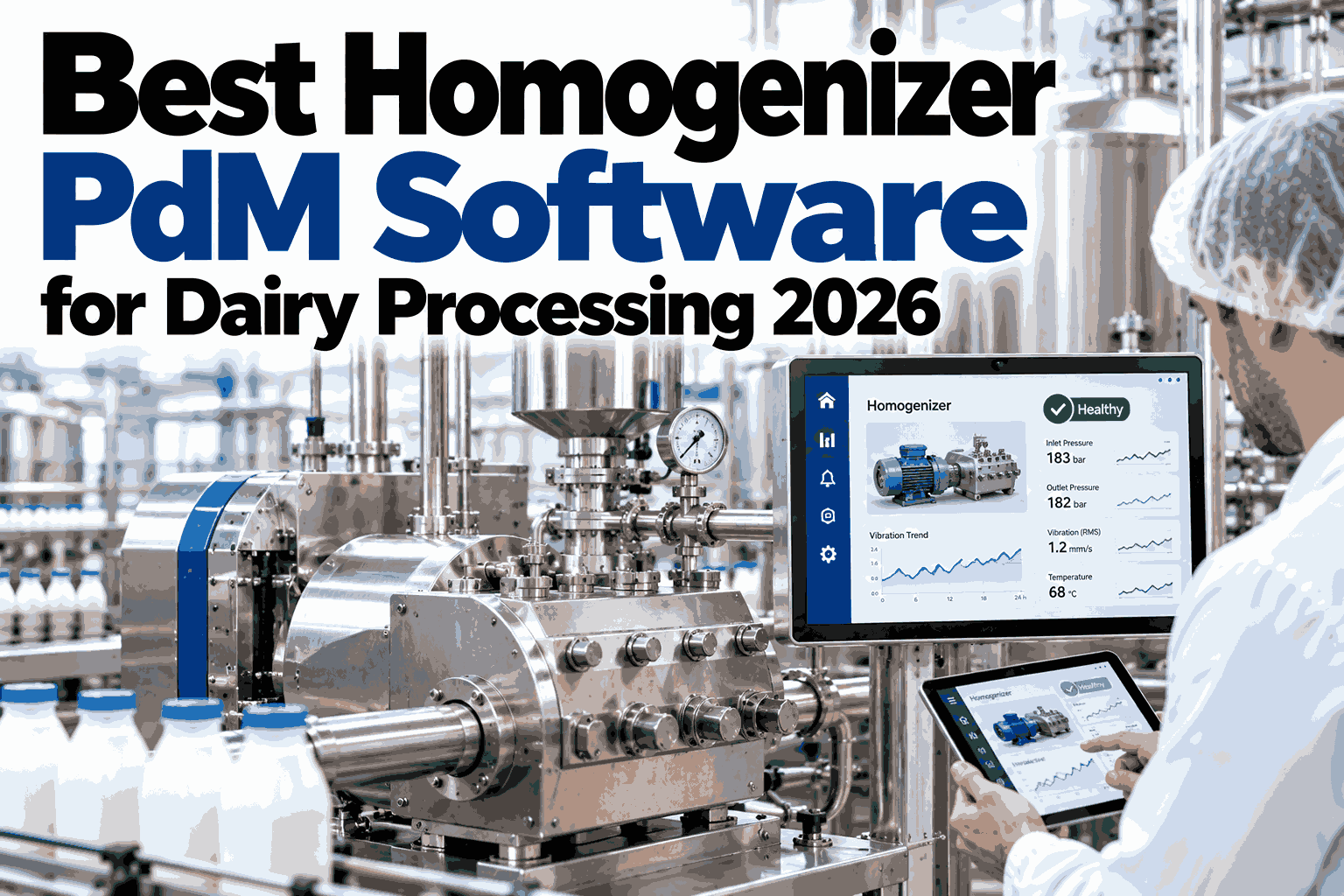
A homogenizer does its hardest work in silence. Milk is forced through a tiny valve gap at high pressure, and when a piston valve wears or a plunger seal starts to drift, the first symptom is not an alarm but a slight change in fat globule size that nobody sees until quality checks fail. By then the batch is already compromised and the machine is already damaged. Predictive maintenance software watches pressure stability, seal behavior, and hydraulic health continuously, so wear is caught while there is still time to plan the repair. This article explains what to look for in 2026, and you can preview the monitoring on a homogenizer like yours before making a choice.
ARTICLE · HOMOGENIZER PDM · DAIRY PROCESSING
Best Homogenizer PdM Software for Dairy Processing in 2026
Predict piston valve wear, plunger seal drift, and hydraulic pressure loss weeks before a batch is lost.
THE COST CASCADE
How One Worn Valve Becomes a Lost Batch
Each step is small. Together they empty a tank.
Valve seat wears slightly
Pressure holds less steadily
Particle size drifts
Quality check fails
Batch rejected
INSIDE THE MACHINE
Four Points Worth Watching on a Two Stage Homogenizer
Plunger pump
Seal drift and packing wear
First stage valve
Piston and seat erosion
Second stage valve
Breaks up remaining clusters
Hydraulic circuit
Pressure loss and oil condition
WEAR ANATOMY
What Fails First and How It Announces Itself
Piston valve wear
Pressure needs more adjustment to hold the same setpoint.
Warning: several weeks
Plunger seal drift
Leak rate creeps up and pulsation changes on each stroke.
Warning: several weeks
Hydraulic pressure loss
Actuation pressure falls slowly between maintenance visits.
Warning: weeks to days
Crankshaft bearing wear
Vibration rises at stroke related frequencies and heat builds.
Warning: weeks
HEALTH METER
Reading Pressure Stability at a Glance
Steady pressure, normal pulsation. Nothing to do.
Wider swings or slow decline. Plan the repair.
Sustained loss or spikes. Schedule the stop.
MONITORING APPROACHES
Gauge Rounds vs Continuous AI Monitoring
| Question | Gauge Rounds | Periodic Vibration | Continuous AI |
|---|
| Catches slow valve wear | Rarely | Sometimes | Yes, from pressure trend |
| Sees seal drift | After a visible leak | Not directly | From stroke pulsation |
| Coverage between visits | None | None | Every shift |
| Ties fault to quality risk | No | No | Yes |
WHAT SETS THE BEST APART
Five Traits of Strong Homogenizer Software
01
Learns baselines per product, because cream and skim run differently.
02
Reads both stages, not only the first stage pressure.
03
Links a fault to the batch it may affect.
04
Names the part and the repair window in each alert.
05
Adds sensors only where they change a decision.
ROLLOUT PATH
From First Sensor to Confident Alerts
Week 1
Confirm pressure, stroke, and hydraulic data sources.
Weeks 2-3
Add targeted sensors and capture normal runs per product.
Weeks 4-5
Tune drift limits and connect work orders.
Ongoing
Compare alerts with valve and seal inspections.
FREQUENTLY ASKED QUESTIONS
What Dairy Teams Ask About Homogenizer PdM
How early can it warn about piston valve wear?
Valve wear is gradual, so the pressure trend usually shows it several weeks before quality is affected. The platform compares today's pressure effort with the same product's own history, which makes small changes visible. Warnings arrive with a confidence level so planners can decide timing.
Watch a valve wear example unfold.
Can it work with the pressure sensors we already have?
Yes, most homogenizers already report pressure and often stroke or motor data. The platform starts with those signals and adds sensors only where a gap limits certainty. This keeps the first phase quick and avoids reworking a machine that runs well.
Check your sensor coverage with our team.
Does it understand different products and pressure settings?
It does. Each product and pressure setting gets its own normal profile, so a recipe change is not mistaken for wear. Alerts appear only when behavior departs from what is normal for that product. This keeps false alarms low during busy changeovers.
Ask support about recipe changeovers.
How does it connect a fault to quality risk?
Alerts carry the time window in which the machine was drifting. Quality teams can then see which batches ran in that window and prioritize extra checks. This shortens investigations and reduces the chance of a bad batch shipping.
See batch to fault tracing in a demo.
What return should a dairy plant expect?
Returns come from fewer lost batches, fewer emergency stops, and planned spares purchases. You can estimate them from past rejected batches and unplanned homogenizer downtime. The platform then tracks avoided failures over time.
Estimate your homogenizer savings with us.
CATCH WEAR BEFORE IT CATCHES YOUR BATCH
Give Every Homogenizer an Early Warning System
See how iFactory tracks valve, seal, and hydraulic health so your team repairs on schedule instead of after a rejected batch.