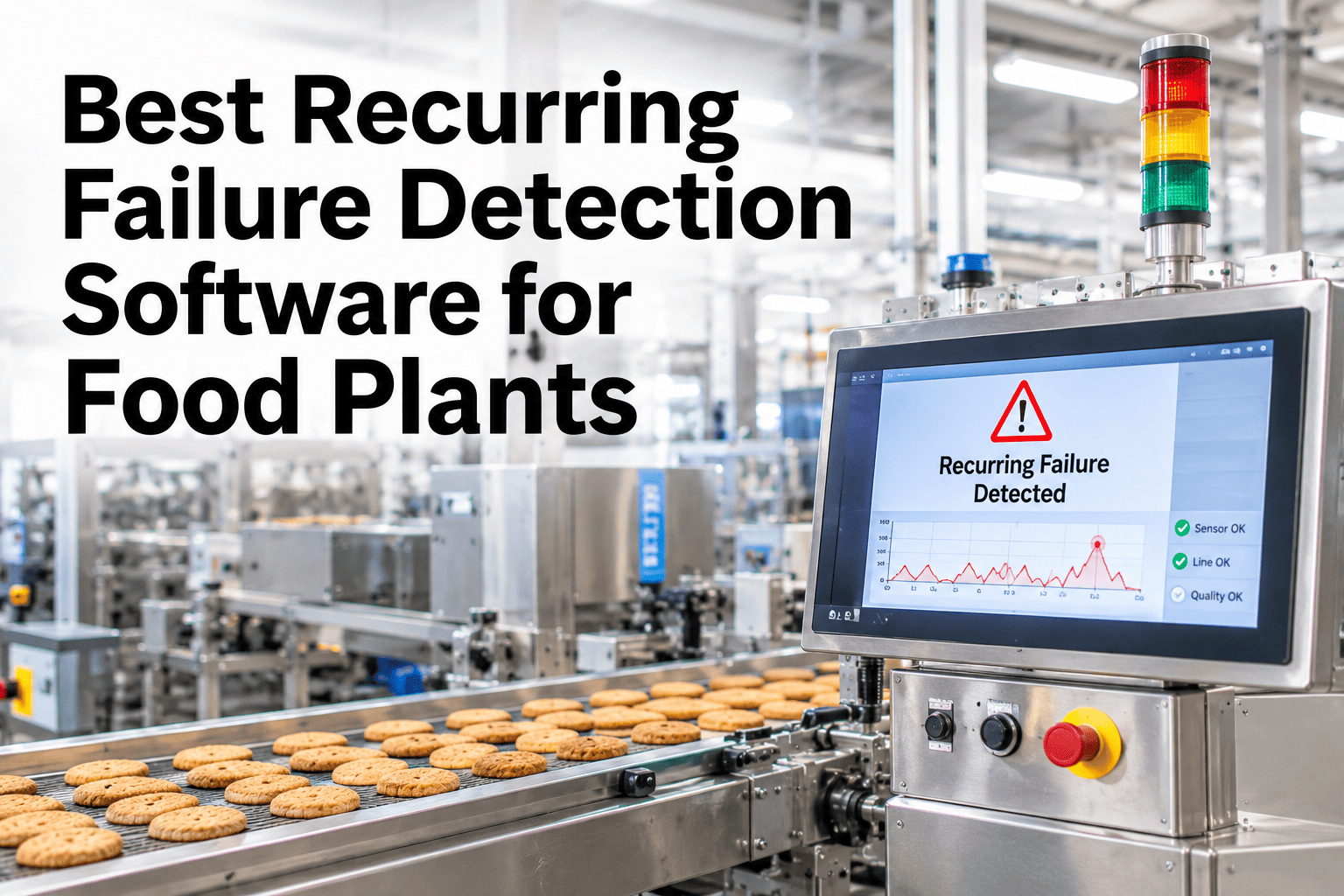
The same conveyor motor failing every six weeks, the same reason code appearing on every third shift, the same part number showing up across unrelated work orders — these patterns are invisible to a team reviewing failures one ticket at a time, because no single ticket looks unusual on its own. Recurring failure detection auto-clusters faults by asset, reason code, shift and part to expose the "bad actor" hiding inside a pile of individually unremarkable events. You can run this clustering against your own failure history with our team.
Food Plant Reliability, 2027
No Single Ticket Looks Unusual. The Pattern Does.
iFactory, an on-premise AI platform for CMMS and predictive maintenance, auto-clusters every fault by asset, reason code, shift and part, turning a pile of individually ordinary tickets into a ranked list of bad actors demanding attention.
By Asset
By Reason Code
By Shift
By Part
What it is
What Does Recurring Failure Detection Actually Find?
Recurring failure detection groups work orders and fault events across multiple dimensions at once — the same asset, the same reason code, the same shift pattern, or the same part number — to surface clusters a reliability team would otherwise only notice by accident, months after the pattern started.
A "bad actor" is an asset, part or condition responsible for a disproportionate share of failures. It is rarely obvious from any single work order, because each individual ticket describes one event, not the pattern across dozens of them.
Four clustering dimensions
Four Ways a Pattern Can Hide in Plain Sight
By asset
The same piece of equipment failing repeatedly, even with different symptoms each time.
By reason code
The same failure mode appearing across different assets or lines.
By shift
A failure pattern concentrated on one shift, pointing to a process or training gap.
By part
A specific component or supplier batch linked to repeated early failures.
How it works
Four Steps From Raw Tickets to a Ranked Bad-Actor List
1
Pull historical work orders and fault logs with asset, reason code, shift and part data attached.
2
Auto-cluster events across all four dimensions simultaneously, not just one at a time.
3
Rank clusters by frequency and cost, so the worst offenders surface at the top automatically.
4
Route the top cluster to RCA before it generates another avoidable repeat failure.
Comparison
Reviewing Tickets One by One vs Auto-Clustered Detection
| Dimension | Ticket-by-Ticket Review | Auto-Clustered Detection |
|---|
| Pattern visibility | Only noticed by accident, if at all | Surfaced automatically across all tickets |
| Time to spot a bad actor | Months, often after repeated failures | As soon as enough history accumulates |
| Dimensions considered | Usually one at a time, manually | Asset, reason code, shift and part together |
| Prioritization | Subjective, based on recent memory | Ranked by frequency and cost |
Expert review
What a Reliability Engineer Would Check First
Holds up
Bad-actor analysis through multi-dimensional clustering is an established reliability-engineering technique; automating it mainly removes the manual effort and the months-long detection lag.
Watch for
Clustering that only looks at asset alone and misses a reason-code or shift pattern spanning multiple assets — the cross-dimensional view is where the real value is.
Do next
Run this against your maintenance team's current "usual suspects" list first — the results that confirm what they already suspect build trust fast, and the surprises are usually the most valuable finding.
FAQ
What Food Plants Ask About Recurring Failure Detection
How much work order history is needed before clustering is reliable?
Several months of consistent reason-coded work orders generally give enough signal for the first meaningful clusters to emerge; detection improves further as more history accumulates.
Check what your current history already shows with our team.
What if our reason codes are inconsistent across shifts?
Inconsistent reason coding weakens the by-reason-code clustering specifically, though asset and part-based clusters can still surface even with messy codes. Standardizing reason codes going forward improves accuracy over time.
Ask about reason code standardization.
Can this detect a bad part batch from a specific supplier?
Yes, if part lot or supplier data is captured on work orders, clustering by part can reveal a batch of components failing at an unusually high rate, which a single work order review would never connect on its own.
Does this replace a root cause investigation?
No — it identifies which pattern deserves an investigation first. The clustering surfaces the bad actor; a structured RCA still needs to determine why it is failing repeatedly.
Connect this to your RCA process with our team.
How often should the clustering be re-run?
Monthly is a reasonable default for most food plants, since that balances having enough new data to detect emerging patterns without waiting so long that a new bad actor goes unaddressed.
Discuss a review cadence for your plant.